
Formal and Substantive Equality: Difference & Creamy Layer Impact

From Current Affairs Notes for UPSC » Editorials & In-depths » This topic
The discourse on social justice in India is witnessing a renewed intensity, fueled by recent political declarations and judicial inquiries. The leader of the opposition in Bihar, Tejashwi Yadav, has promised to increase reservations to 85% if his alliance comes to power, challenging the long-standing 50% cap. Simultaneously, the Supreme Court is examining the possibility of introducing a ‘creamy layer’ system for Scheduled Castes (SC) and Scheduled Tribes (ST) to ensure equitable distribution of benefits. These developments bring the core principles of formal and substantive equality into sharp focus, forcing a re-evaluation of the mechanisms designed to create a just and equitable society. This article delves into these two concepts of equality, exploring their meaning, application, and the ongoing debates surrounding them in the Indian context.
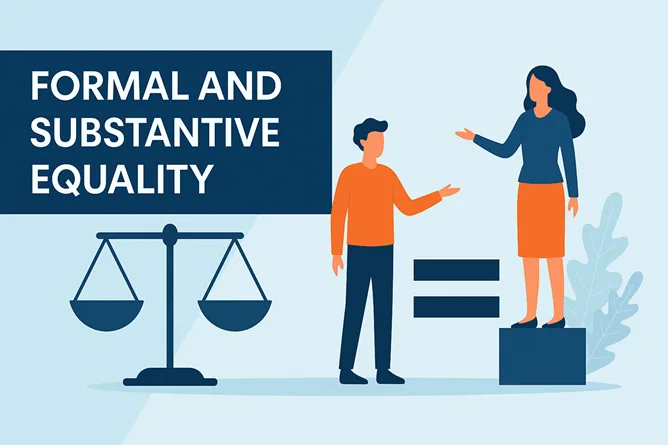
What are Formal and Substantive Equality?
Understanding the distinction between these two forms of equality is crucial to grasping the nuances of affirmative action policies and the foundational principles of justice in a diverse society. They represent two different philosophies for achieving fairness.
- Formal Equality
- Also known as equality of opportunity, this principle advocates for treating every individual in exactly the same manner, regardless of their background or personal characteristics. It is often summarized by the phrase, “likes should be treated alike.”
- Key Features:
- Sameness of Treatment: It insists that laws, rules, and policies must be applied uniformly to everyone, without any special provisions or exceptions for any particular group. The process is the same for all.
- Non-Discrimination: The primary focus is on eliminating direct and explicit discrimination. It champions a ‘colour-blind’ or ‘caste-blind’ approach where personal identity markers are ignored in official procedures.
- Procedural Fairness: This model emphasizes that as long as the rules of a competition (like an exam or a job application) are the same for all participants, the outcome is considered fair.
- Meritocracy: It operates on the assumption that in a system where everyone is treated identically, success will be determined purely by individual merit, talent, and hard work.
- Example: A job advertisement that is open to all applicants, where selection is based solely on the scores of a standardized competitive exam, is a perfect example of formal equality in practice.
- Substantive Equality
- Also referred to as equality of outcomes, this principle recognizes that treating unequal individuals in an identical manner can paradoxically perpetuate and even worsen existing inequalities. It acknowledges that not everyone starts from the same point.
- Key Features:
- Addressing Disadvantage: It acknowledges that certain groups begin from a significantly disadvantaged position due to historical, social, and structural factors like centuries of caste-based oppression, patriarchy, or geographic isolation.
- Differential Treatment: To correct these imbalances, it justifies treating different groups differently to create a genuine level playing field. This involves taking positive, proactive measures to assist disadvantaged groups.
- Focus on Results: The ultimate goal is not just to provide equal opportunities but to ensure that people from all sections of society can actually achieve equitable outcomes. It aims to reduce the glaring gap between the most and least advantaged groups.
- Corrective Justice: It functions as a form of corrective or remedial justice, aiming to undo the lingering effects of past discrimination.
- Example: The policy of reservation in educational institutions and government jobs for SC, ST, and Other Backward Classes (OBC) communities is a prime example of substantive equality in action, designed to ensure their representation and upliftment.
Why is Substantive Equality Necessary in Society?
The need for substantive equality arises directly from the inherent limitations of formal equality, especially in a society marked by deep-rooted social hierarchies and historical injustices like India.
- To Counter Historical Injustice and its Effects:
- Communities such as Scheduled Castes and Scheduled Tribes have faced systemic discrimination, violence, and socio-economic exclusion for millennia. This has deprived them of access to land, education, resources, and social capital.
- Formal equality, by ignoring these historical wrongs and their continuing impact, fails to provide a genuine remedy. It is like starting a race where some runners are miles behind the starting line. Substantive equality, through measures like reservations, seeks to provide a form of reparative justice and a much-needed head start.
- To Create a True Level Playing Field:
- An individual from a privileged urban background with access to elite schooling, private coaching, and strong social networks does not compete on the same footing as an individual from a remote, marginalized community who might be a first-generation learner.
- Substantive equality aims to correct these unequal starting points. It recognizes that true equality of opportunity is not just about open access but also about having the capacity and resources to avail that access.
- To Promote Social Inclusion, Diversity, and Better Governance:
- By ensuring the representation of marginalized communities in public institutions, education, and employment, substantive equality helps to build a more inclusive and diverse society.
- This representation is not merely about fulfilling a numerical quota; it is about bringing diverse perspectives, experiences, and concerns into decision-making processes. This enriches governance, makes policies more responsive, and strengthens the fabric of democracy.
Where are these Concepts Reflected in the Indian Constitution?
The Indian Constitution is a visionary document that masterfully embodies both the principles of formal and substantive equality, providing a robust framework for social transformation.
- Article 14:
- This article guarantees to every person “equality before the law” and “equal protection of the laws.” These two phrases are the bedrock of equality jurisprudence in India.
- “Equality before the law” is a concept borrowed from English common law and represents formal equality. It implies that no person is above the law and that everyone is subject to the ordinary laws of the land.
- “Equal protection of the laws,” a concept from the American Constitution, is the basis for substantive equality. It allows for reasonable classification. The state can treat different groups differently if the classification is based on an intelligible differentia (a clear criterion) and has a rational nexus (a logical connection) with the objective sought to be achieved.
- This article guarantees to every person “equality before the law” and “equal protection of the laws.” These two phrases are the bedrock of equality jurisprudence in India.
- Article 15:
- Article 15(1) is a classic statement of formal equality, prohibiting the state from discriminating against any citizen on grounds only of religion, race, caste, sex, or place of birth.
- However, Articles 15(3), 15(4), and 15(5) are crucial enabling provisions for substantive equality. They empower the state to make special affirmative action provisions for women and children (15(3)) and for the advancement of any socially and educationally backward classes of citizens, including SCs and STs (15(4) and 15(5)).
- Article 16:
- Article 16(1) guarantees equality of opportunity for all citizens in matters relating to public employment, which aligns with formal equality.
- Article 16(4) is the specific constitutional anchor for job reservations. It empowers the state to make provisions for the reservation of appointments or posts in favour of any backward class of citizens that, in the opinion of the state, is not adequately represented in public services. This is a direct application of substantive equality.
How is Substantive Equality Actually Implemented in India?
The primary and most widely debated tool for achieving substantive equality in India has been the policy of reservation, also known as affirmative action.
- The Core Mechanism of Reservation:
- This policy involves setting aside a certain percentage of seats in government jobs, public sector undertakings, higher educational institutions, and even legislative bodies for members of designated communities.
- At the central level, the reservation quota is currently 15% for Scheduled Castes (SCs), 7.5% for Scheduled Tribes (STs), and 27% for Other Backward Classes (OBCs), totaling 49.5%. An additional 10% is reserved for Economically Weaker Sections (EWS).
- The Judicially Imposed 50% Cap on Reservations:
- In the landmark case of Indra Sawhney & Others vs. Union of India (1992), popularly known as the Mandal Commission case, a nine-judge bench of the Supreme Court delivered a historic verdict.
- The court upheld the 27% reservation for OBCs but stipulated that total reservations should not exceed 50%.
- The court’s reasoning was that this cap was essential to strike a delicate balance between the goal of social justice for backward classes and the need to maintain administrative efficiency and the principle of equality of opportunity for the unreserved category. It stated this was a “rule of caution.”
- The Concept of the ‘Creamy Layer’:
- The very same Indra Sawhney judgment introduced and institutionalized the concept of the creamy layer, but only for OBCs.
- It mandated that the socially and economically advanced members within the OBC communities should be identified and excluded from the benefits of reservation. The rationale was that the benefits of this affirmative action policy should flow to the most deserving and not be monopolized by the well-off sections within the backward classes who no longer need such support.
What are the Most Recent Debates and Developments?
The landscape of reservation policy remains highly dynamic and politically charged, with several critical issues currently being debated in public and legal forums.
- The Political Push to Exceed the 50% Cap:
- The recent proposal by Tejashwi Yadav to increase reservations in Bihar to 85% exemplifies the growing political demand to breach the 50% ceiling set by the judiciary.
- The core argument is that the 50% cap is an arbitrary judicial creation and does not reflect the actual population of backward classes, which, according to various surveys and demands for a caste census, is estimated to be much higher. Proponents advocate for representation in proportion to the population (“jitni abadi, utna haq“).
- Several states, such as Tamil Nadu (which has a 69% reservation quota), have already exceeded the cap and have placed their reservation laws in the Ninth Schedule of the Constitution to protect them from immediate judicial review. However, the Supreme Court, in the I.R. Coelho case (2007), has ruled that even laws placed in the Ninth Schedule after April 24, 1973, can be judicially reviewed if they violate the basic structure of the Constitution.
- Introducing the ‘Creamy Layer’ Concept for SCs and STs:
- The Supreme Court has recently issued a notice to the Union government on a petition seeking the introduction of a system similar to the creamy layer for SC and ST communities.
- Arguments in Favour:
- Proponents argue that over decades, the benefits of reservation within SC/ST communities have been disproportionately cornered by a few influential and affluent families, while the most marginalized individuals within these groups continue to languish in poverty and deprivation.
- They suggest that an income-based prioritization mechanism or an exclusion principle would ensure that the benefits reach the neediest individuals, thus fulfilling the true purpose of substantive equality.
- Arguments Against:
- Opponents strongly argue that the very basis of reservation for SCs and STs is not just economic backwardness but the severe social stigma of untouchability and historical injustice, which continues to affect all members of these communities regardless of their economic status.
- There is also a significant fear that introducing a creamy layer could lead to a large number of reserved seats remaining unfilled due to a lack of “eligible” candidates, which might then be de-reserved and opened to the general category, defeating the purpose of representation.
Comparison Chart: Formal Equality vs. Substantive Equality
| Feature | Formal Equality | Substantive Equality |
|---|---|---|
| Core Idea | Treat everyone the same. | Treat people differently based on their needs to achieve fairness. |
| Focus | Equal opportunity and a fair process. | Equal outcomes and equitable results. |
| Approach | Is ‘blind’ to differences like caste, gender, etc. | Is ‘conscious’ of differences and historical disadvantages. |
| Method | Uniform and identical application of laws for all. | Use of special measures, affirmative action, and reservations. |
| Goal | To prevent direct and explicit discrimination. | To remedy past and ongoing systemic discrimination and its effects. |
| Constitutional Basis | Article 14 (Equality before Law), Article 15(1), Article 16(1). | Article 14 (Equal Protection of Laws), Article 15(4), Article 16(4). |
What are the Significance and Challenges of this Approach?
The implementation of substantive equality through reservations has had a profound but mixed impact on Indian society.
- Significance:
- Social Mobility: It has undeniably provided a pathway for many individuals from marginalized communities to access higher education and formal employment, leading to unprecedented upward social mobility for some.
- Political Empowerment: It has given a sense of empowerment and a significant political voice to historically oppressed groups, making the political landscape more representative.
- Building an Inclusive Nation: By promoting a more inclusive and representative administration and society, it contributes to the larger constitutional goal of national integration and fraternity.
- Limitations and Challenges:
- Uneven Distribution of Benefits: As highlighted by the creamy layer debate, there is a strong perception and growing evidence that the benefits of reservation are not percolating down to the most marginalized sections within the reserved categories themselves.
- Politicization for Electoral Gain: Reservation has often been used as a tool for vote-bank politics, leading to a competitive clamour for inclusion from various communities, sometimes without sufficient data to prove their backwardness.
- Perception of Compromising Merit: There is a persistent narrative that reservations compromise meritocracy and lead to a decline in the efficiency of public services. While there is no conclusive data to support this claim, it creates social friction.
- Stigmatization of Beneficiaries: In some social and professional settings, individuals who benefit from reservation may face stigma or be perceived as less meritorious, which can affect their self-esteem, confidence, and social integration.
What is the Most Prudent Way Forward?
The future of reservation policy requires a nuanced, data-centric, and balanced approach that moves beyond the binary of support and opposition.
- Embrace Data-Driven Policymaking:
- There is an urgent and critical need for reliable, comprehensive, and up-to-date data on the socio-economic status of various castes and communities. A nationwide caste census could provide the essential empirical basis for reviewing, rationalizing, and fine-tuning the entire reservation policy.
- Explore Sub-Categorization within Reserved Categories:
- To address the pressing issue of unequal distribution of benefits, the idea of sub-categorization within the large SC, ST, and OBC categories needs to be seriously considered. This would involve identifying the most backward groups within the larger categories and creating separate, targeted quotas for them to ensure benefits reach the ‘last man in the line’.
- Institute a Mechanism for Periodic Review:
- Reservation policies should not be seen as permanent. The Constitution itself intended them as temporary measures. A mechanism for a periodic, objective review (e.g., every 10-15 years) should be established to assess their effectiveness and make necessary adjustments based on socio-economic data.
- Shift Focus to Quality of Education and Skill Development:
- Reservation is a means to an end, not an end in itself. The ultimate constitutional goal is to create a society where such affirmative action is no longer needed. This requires a massive, parallel investment in improving the quality of public schooling and skill development programs for all, especially for the marginalized.
- Move Beyond Reservation to Holistic Affirmative Action:
- The discourse on social justice must broaden to include other forms of affirmative action, such as providing targeted scholarships, residential coaching, entrepreneurial support, and financial aid for individuals from disadvantaged communities to thrive in the private sector as well.
Conclusion
The debate between formal and substantive equality is at the very heart of India’s ongoing journey towards fulfilling its constitutional promise of social justice. While formal equality provides the essential and non-negotiable foundation of a non-discriminatory state, it is the principle of substantive equality that breathes life into the dream of creating a truly equal and fraternal society. The ongoing discussions around increasing the reservation cap and introducing a creamy layer for SCs and STs reflect the immense complexities and challenges of implementing this vision. Moving forward, the primary challenge for policymakers is to navigate these contentious issues with wisdom, courage, and a commitment to evidence, relying on empirical data rather than political expediency. The goal must be to refine the tools of substantive equality to ensure they are effective, just, and ultimately contribute to building an India where every single citizen has the genuine opportunity to realize their fullest potential.
Q. Critically analyze how the interpretation of equality in the Indian Constitution has evolved from a formal to a substantive one, with special reference to the judiciary’s role in shaping reservation policy. (250 words)

Related Posts
If you like this post, please share your feedback in the comments section below so that we will upload more posts like this.

Responses