[Newsbits] 5-6.03.2024: Chakshu, Right to Abortion, Gevra Mine & more

newsbits mindmap notes
/ Corruption
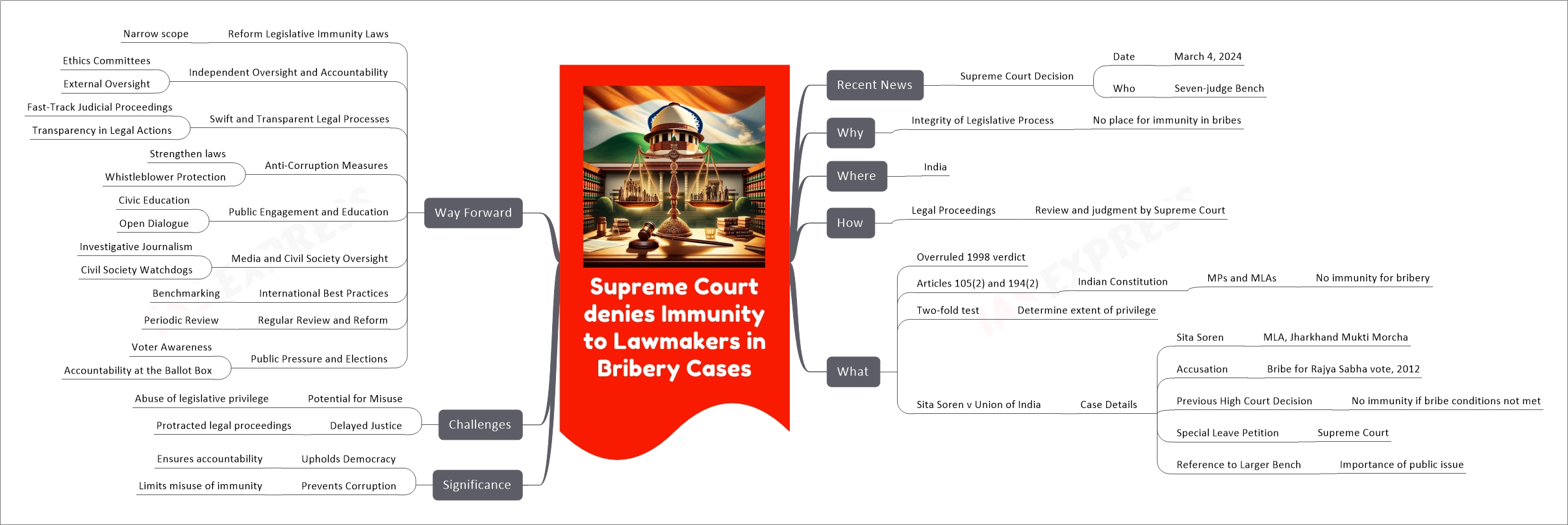
Supreme Court denies Immunity to Lawmakers in Bribery Cases mind map
  Recent News
    Supreme Court Decision
      Date
        March 4, 2024
      Who
        Seven-judge Bench
  Why
    Integrity of Legislative Process
      No place for immunity in bribes
  Where
    India
  How
    Legal Proceedings
      Review and judgment by Supreme Court
  What
    Overruled 1998 verdict
    Articles 105(2) and 194(2)
      Indian Constitution
        MPs and MLAs
          No immunity for bribery
    Two-fold test
      Determine extent of privilege
    Sita Soren v Union of India
      Case Details
        Sita Soren
          MLA, Jharkhand Mukti Morcha
        Accusation
          Bribe for Rajya Sabha vote, 2012
        Previous High Court Decision
          No immunity if bribe conditions not met
        Special Leave Petition
          Supreme Court
        Reference to Larger Bench
          Importance of public issue
  Significance
    Upholds Democracy
      Ensures accountability
    Prevents Corruption
      Limits misuse of immunity
  Challenges
    Potential for Misuse
      Abuse of legislative privilege
    Delayed Justice
      Protracted legal proceedings
  Way Forward
    Reform Legislative Immunity Laws
      Narrow scope
    Independent Oversight and Accountability
      Ethics Committees
      External Oversight
    Swift and Transparent Legal Processes
      Fast-Track Judicial Proceedings
      Transparency in Legal Actions
    Anti-Corruption Measures
      Strengthen laws
      Whistleblower Protection
    Public Engagement and Education
      Civic Education
      Open Dialogue
    Media and Civil Society Oversight
      Investigative Journalism
      Civil Society Watchdogs
    International Best Practices
      Benchmarking
    Regular Review and Reform
      Periodic Review
    Public Pressure and Elections
      Voter Awareness
      Accountability at the Ballot Box

The Supreme Court of India has recently made a landmark ruling that Members of Parliament (MPs) and Members of Legislative Assemblies (MLAs) do not possess immunity from prosecution for bribery related to their speech or vote in the legislature. This decision, which came from a unanimous verdict by a seven-judge constitution bench, overturns a previous 1998 verdict that had granted such immunity. The case in question involved Sita Soren, an MLA accused of accepting a bribe for her vote in the Rajya Sabha elections of 2012. The court’s ruling emphasizes the importance of integrity in the legislative process and the accountability of lawmakers, marking a significant shift in how legal immunity under Articles 105(2) and 194(2) of the Indian Constitution is interpreted in relation to acts of bribery​​​​.

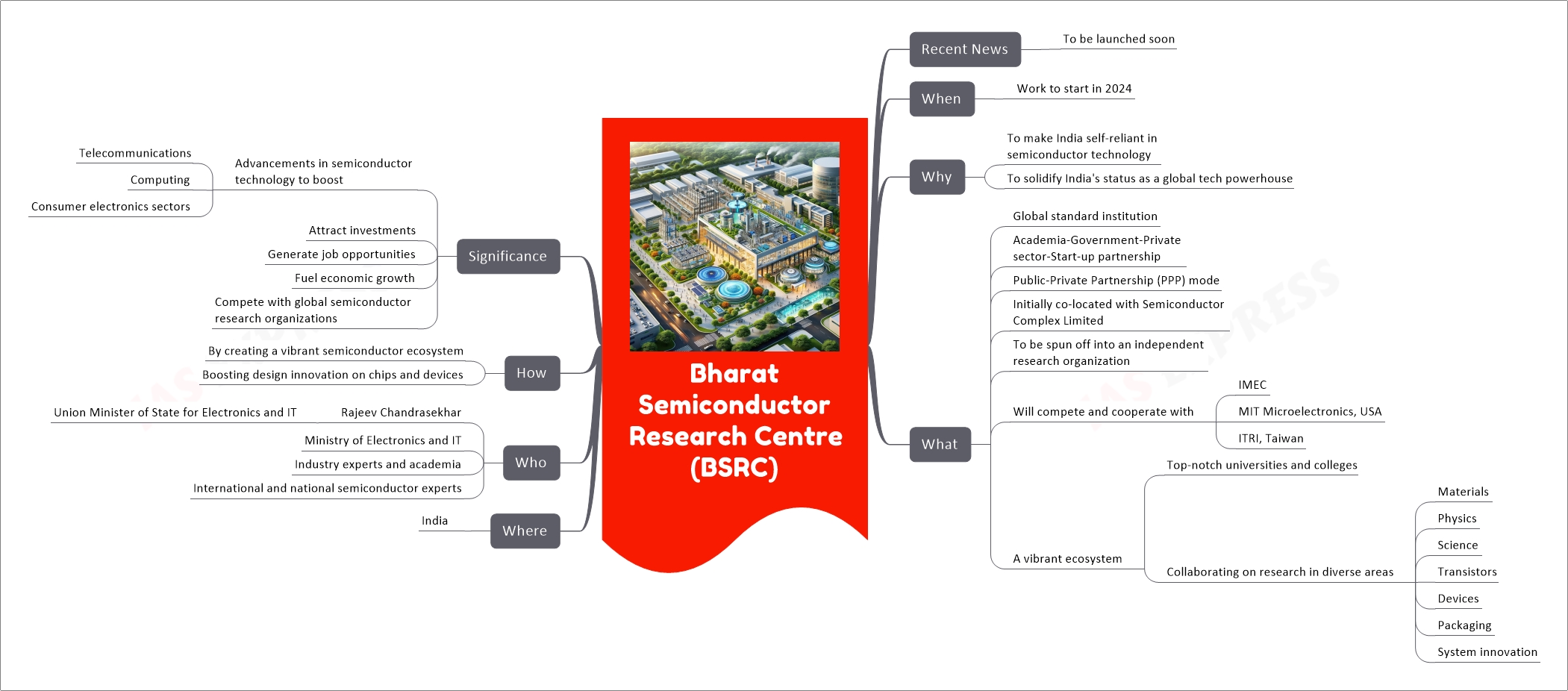
Bharat Semiconductor Research Centre (BSRC) mind map
  Recent News
    To be launched soon
  When
    Work to start in 2024
  Why
    To make India self-reliant in semiconductor technology
    To solidify India's status as a global tech powerhouse
  What
    Global standard institution
    Academia-Government-Private sector-Start-up partnership
    Public-Private Partnership (PPP) mode
    Initially co-located with Semiconductor Complex Limited
    To be spun off into an independent research organization
    Will compete and cooperate with
      IMEC
      MIT Microelectronics, USA
      ITRI, Taiwan
    A vibrant ecosystem
      Top-notch universities and colleges
      Collaborating on research in diverse areas
        Materials
        Physics
        Science
        Transistors
        Devices
        Packaging
        System innovation
  Where
    India
  Who
    Rajeev Chandrasekhar
      Union Minister of State for Electronics and IT
    Ministry of Electronics and IT
    Industry experts and academia
    International and national semiconductor experts
  How
    By creating a vibrant semiconductor ecosystem
    Boosting design innovation on chips and devices
  Significance
    Advancements in semiconductor technology to boost
      Telecommunications
      Computing
      Consumer electronics sectors
    Attract investments
    Generate job opportunities
    Fuel economic growth
    Compete with global semiconductor research organizations

The Bharat Semiconductor Research Centre (BSRC) is an upcoming initiative by the Indian government, aimed at establishing India as a leader in semiconductor research and making the nation self-reliant in semiconductor technology. This center is to be a global standard institution formed through a partnership between academia, the government, private sectors, and startups, designed to foster innovation and development in semiconductor technology. Set to begin work in 2024, the BSRC is expected to significantly impact India’s tech industry, advancing sectors like telecommunications, computing, and consumer electronics, while also attracting investments and creating job opportunities​​​​.

/ Banking
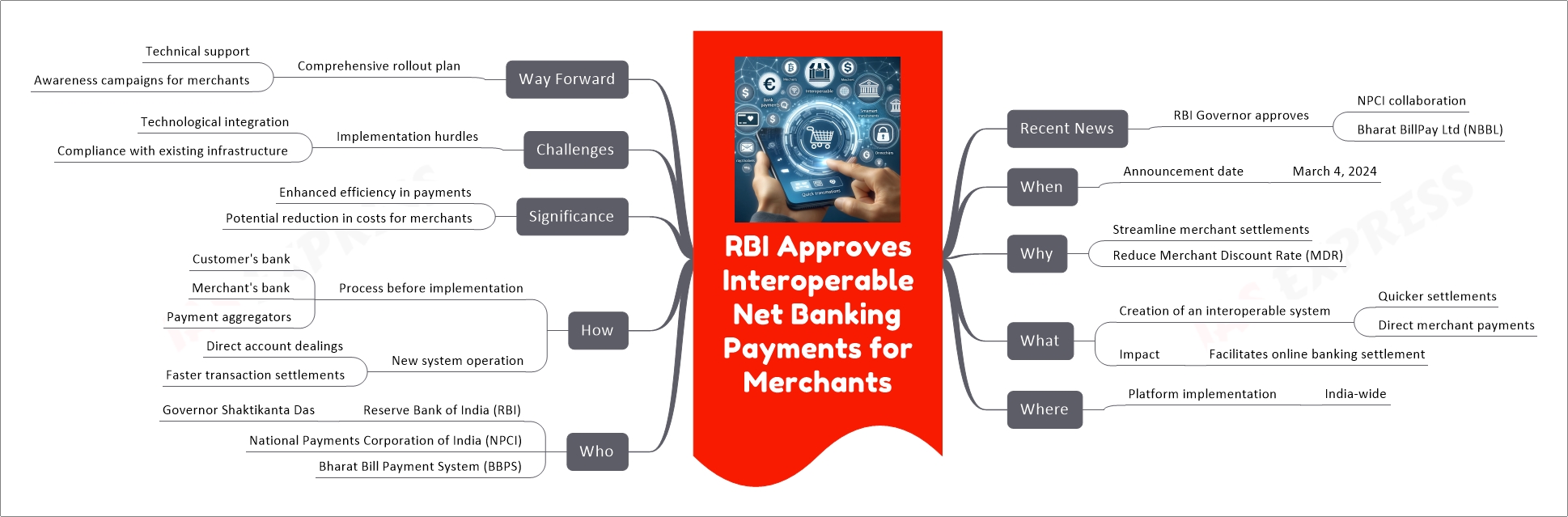
RBI Approves Interoperable Net Banking Payments for Merchants mind map
  Recent News
    RBI Governor approves
      NPCI collaboration
      Bharat BillPay Ltd (NBBL)
  When
    Announcement date
      March 4, 2024
  Why
    Streamline merchant settlements
    Reduce Merchant Discount Rate (MDR)
  What
    Creation of an interoperable system
      Quicker settlements
      Direct merchant payments
    Impact
      Facilitates online banking settlement
  Where
    Platform implementation
      India-wide
  Who
    Reserve Bank of India (RBI)
      Governor Shaktikanta Das
    National Payments Corporation of India (NPCI)
    Bharat Bill Payment System (BBPS)
  How
    Process before implementation
      Customer's bank
      Merchant's bank
      Payment aggregators
    New system operation
      Direct account dealings
      Faster transaction settlements
  Significance
    Enhanced efficiency in payments
    Potential reduction in costs for merchants
  Challenges
    Implementation hurdles
      Technological integration
      Compliance with existing infrastructure
  Way Forward
    Comprehensive rollout plan
      Technical support
      Awareness campaigns for merchants

The RBI has sanctioned the development of an interoperable net banking payment system by the NPCI in collaboration with Bharat BillPay Ltd (NBBL). This system aims to facilitate quicker settlements and direct payments for merchants, potentially reducing the Merchant Discount Rate (MDR). By allowing for direct dealings between accounts through a new platform, it seeks to streamline the payment process, thereby enhancing efficiency and reducing costs for merchants.
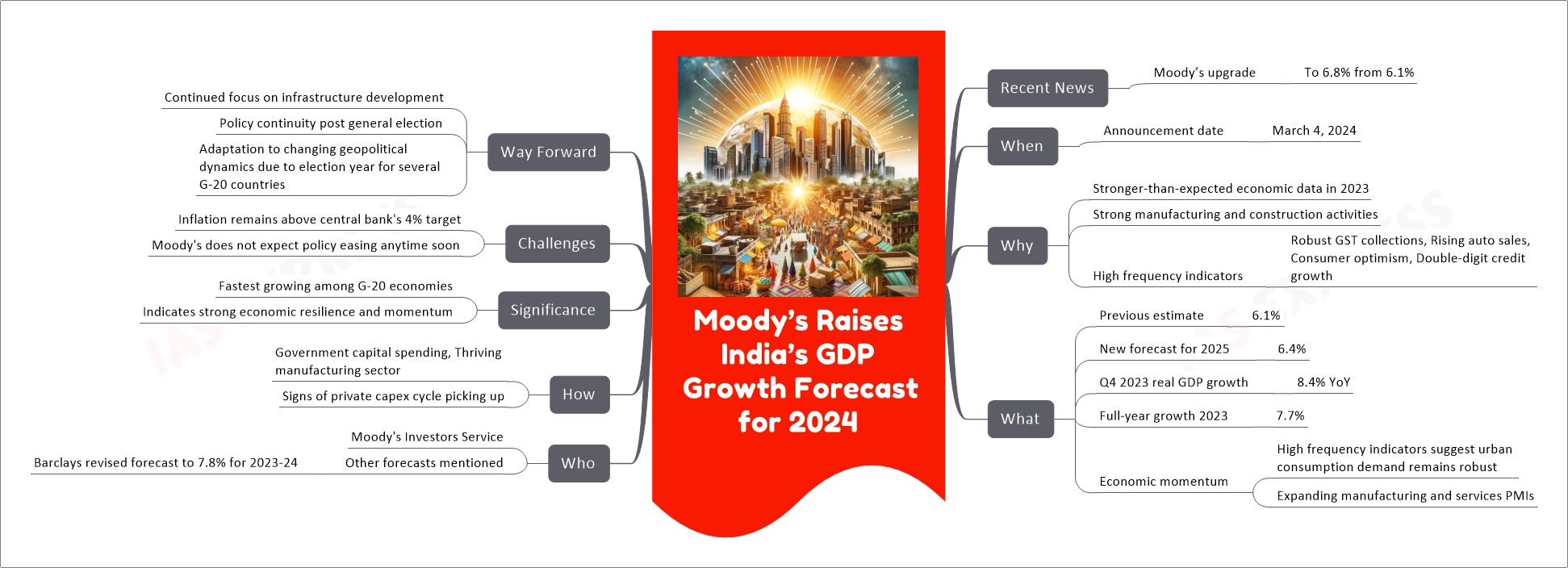
Moody’s Raises India’s GDP Growth Forecast for 2024 mind map
  Recent News
    Moody’s upgrade
      To 6.8% from 6.1%
  When
    Announcement date
      March 4, 2024
  Why
    Stronger-than-expected economic data in 2023
    Strong manufacturing and construction activities
    High frequency indicators
      Robust GST collections, Rising auto sales, Consumer optimism, Double-digit credit growth
  What
    Previous estimate
      6.1%
    New forecast for 2025
      6.4%
    Q4 2023 real GDP growth
      8.4% YoY
    Full-year growth 2023
      7.7%
    Economic momentum
      High frequency indicators suggest urban consumption demand remains robust
      Expanding manufacturing and services PMIs
  Who
    Moody's Investors Service
    Other forecasts mentioned
      Barclays revised forecast to 7.8% for 2023-24
  How
    Government capital spending, Thriving manufacturing sector
    Signs of private capex cycle picking up
  Significance
    Fastest growing among G-20 economies
    Indicates strong economic resilience and momentum
  Challenges
    Inflation remains above central bank's 4% target
    Moody's does not expect policy easing anytime soon
  Way Forward
    Continued focus on infrastructure development
    Policy continuity post general election
    Adaptation to changing geopolitical dynamics due to election year for several G-20 countries

Moody’s Investors Service recently raised India’s GDP growth forecast for the year 2024 to 6.8% from an earlier estimate of 6.1%. This revision is attributed to stronger-than-expected economic performance in 2023, including significant growth in manufacturing and construction activities. India’s economy had shown an impressive growth rate of 8.4% year-over-year in the fourth quarter of 2023, leading to a full-year growth of 7.7%. Factors such as robust Goods and Services Tax collections, rising automobile sales, consumer optimism, and double-digit credit growth have contributed to this positive outlook. Despite the strong growth dynamics, Moody’s highlighted concerns over inflation, which remains above the Reserve Bank of India’s 4% target, suggesting that policy easing may not occur in the near future. Additionally, Moody’s projects that G20 economies will collectively grow by 2.4% in 2024, indicating that India’s growth rate is significantly higher than the average for G20 nations​​​​​​.

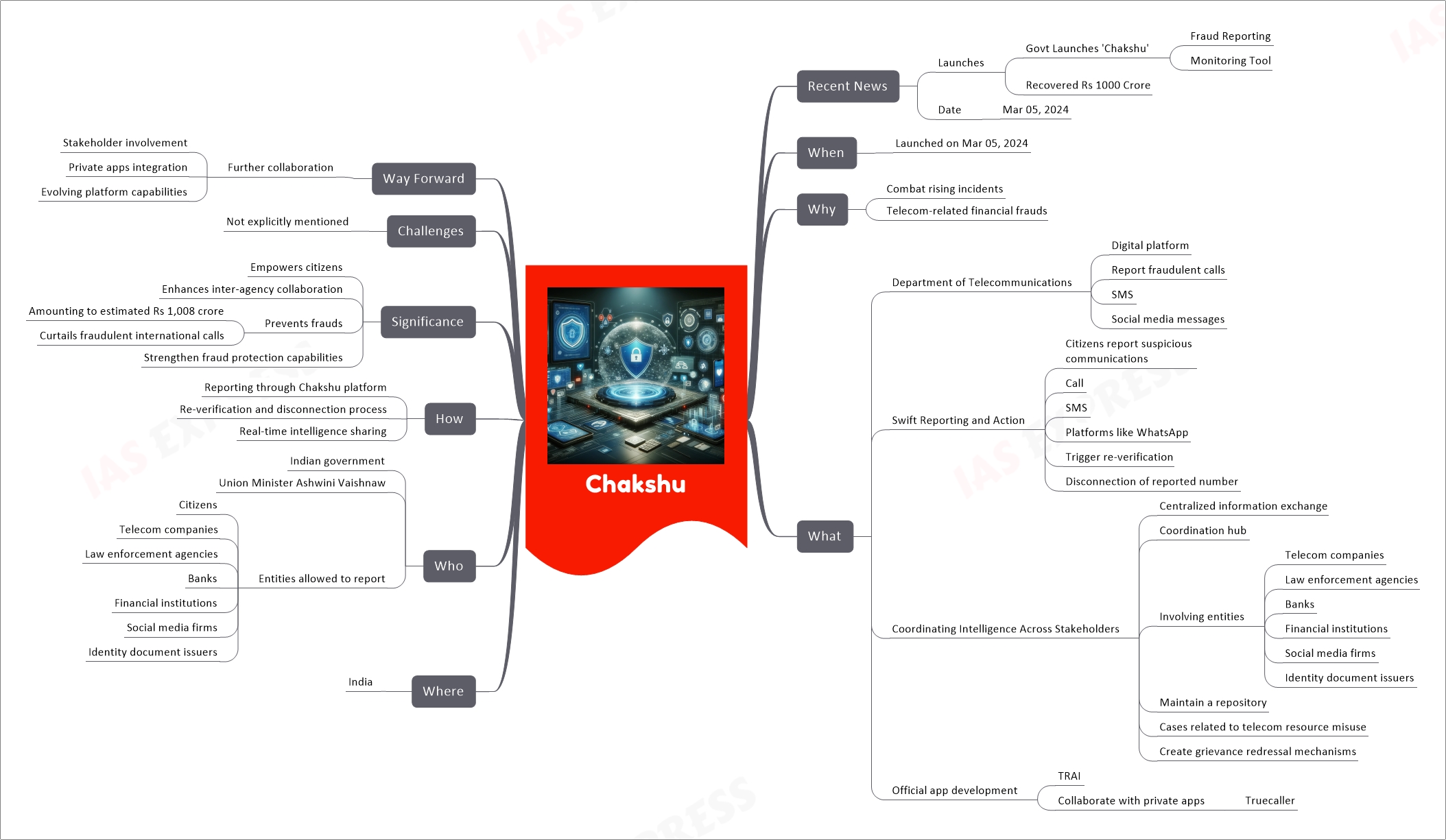
Chakshu mind map
  Recent News
    Launches
      Govt Launches 'Chakshu'
        Fraud Reporting
        Monitoring Tool
      Recovered Rs 1000 Crore
    Date
      Mar 05, 2024
  When
    Launched on Mar 05, 2024
  Why
    Combat rising incidents
    Telecom-related financial frauds
  What
    Department of Telecommunications
      Digital platform
      Report fraudulent calls
      SMS
      Social media messages
    Swift Reporting and Action
      Citizens report suspicious communications
      Call
      SMS
      Platforms like WhatsApp
      Trigger re-verification
      Disconnection of reported number
    Coordinating Intelligence Across Stakeholders
      Centralized information exchange
      Coordination hub
      Involving entities
        Telecom companies
        Law enforcement agencies
        Banks
        Financial institutions
        Social media firms
        Identity document issuers
      Maintain a repository
      Cases related to telecom resource misuse
      Create grievance redressal mechanisms
    Official app development
      TRAI
      Collaborate with private apps
        Truecaller
  Where
    India
  Who
    Indian government
    Union Minister Ashwini Vaishnaw
    Entities allowed to report
      Citizens
      Telecom companies
      Law enforcement agencies
      Banks
      Financial institutions
      Social media firms
      Identity document issuers
  How
    Reporting through Chakshu platform
    Re-verification and disconnection process
    Real-time intelligence sharing
  Significance
    Empowers citizens
    Enhances inter-agency collaboration
    Prevents frauds
      Amounting to estimated Rs 1,008 crore
      Curtails fraudulent international calls
    Strengthen fraud protection capabilities
  Challenges
    Not explicitly mentioned
  Way Forward
    Further collaboration
      Stakeholder involvement
      Private apps integration
      Evolving platform capabilities

The Chakshu platform, launched by the Indian government, represents a significant step in combating telecom-related financial frauds, including fraudulent calls, SMS, and social media messages. It enables citizens and various stakeholders, such as telecom companies, law enforcement agencies, banks, financial institutions, and social media firms, to report suspicious communications. The platform, part of the Department of Telecommunications, offers a swift reporting and action mechanism, triggering re-verification and, if necessary, disconnection of the reported number. It aims to coordinate intelligence across different stakeholders, maintaining a repository of cases related to telecom resource misuse and creating grievance redressal mechanisms for inadvertent disruptions or monetary losses. Launched on March 5, 2024, Chakshu has already shown promise by preventing frauds amounting to an estimated Rs 1,008 crore and significantly reducing fraudulent international calls​​​​.

France Enshrines the Right to Abortion in Its Constitution mind map
  Recent News
    France becomes the first country to enshrine abortion rights in its constitution
  When
    March 4, 2024
  Why
    Response to US Supreme Court's 2022 decision to reverse Roe v. Wade
    Fear that abortion rights could be eroded in France as well
  What
    Amendment added to Article 34 of the French constitution
    "The law determines the conditions in which a woman has the guaranteed freedom to have recourse to an abortion"
  Where
    Versailles, France
  Who
    French Parliament
      MPs and senators voted 780 against 72
    Supported by
      Women's rights groups
      Prime Minister Gabriel Attal
      President Emmanuel Macron
    Opposed by
      Far-right leader Marine Le Pen
      Association of Catholic Families
  How
    Pushed by activists after Roe v. Wade reversal
    Final vote in a special joint session
  Significance
    Protects women's right to seek an abortion under the constitution
    Sends a message of bodily autonomy to women
    Makes France a leader in reproductive rights
  Challenges
    Criticized as political maneuvering by some
    Claimed as unnecessary by opponents
  Way Forward
    Seen as a step to safeguard against potential future restrictions on abortion
    Sparks conversation on reproductive rights globally

France has made history by becoming the first country in the world to constitutionally enshrine the right to abortion, following a decisive vote in Parliament. This landmark decision was influenced by the recent rollback of abortion rights in the United States and aims to safeguard women’s reproductive rights against future challenges. The amendment, added to Article 34 of the French Constitution, ensures women’s freedom to seek an abortion, a move broadly supported across the French political spectrum and by the public. While the decision has been celebrated by women’s rights groups and government officials as a monumental step towards protecting bodily autonomy and reproductive freedom, it has also faced criticism from conservative and anti-abortion groups. Nonetheless, this act solidifies France’s commitment to women’s rights, amidst a global landscape where such freedoms are increasingly under threat.
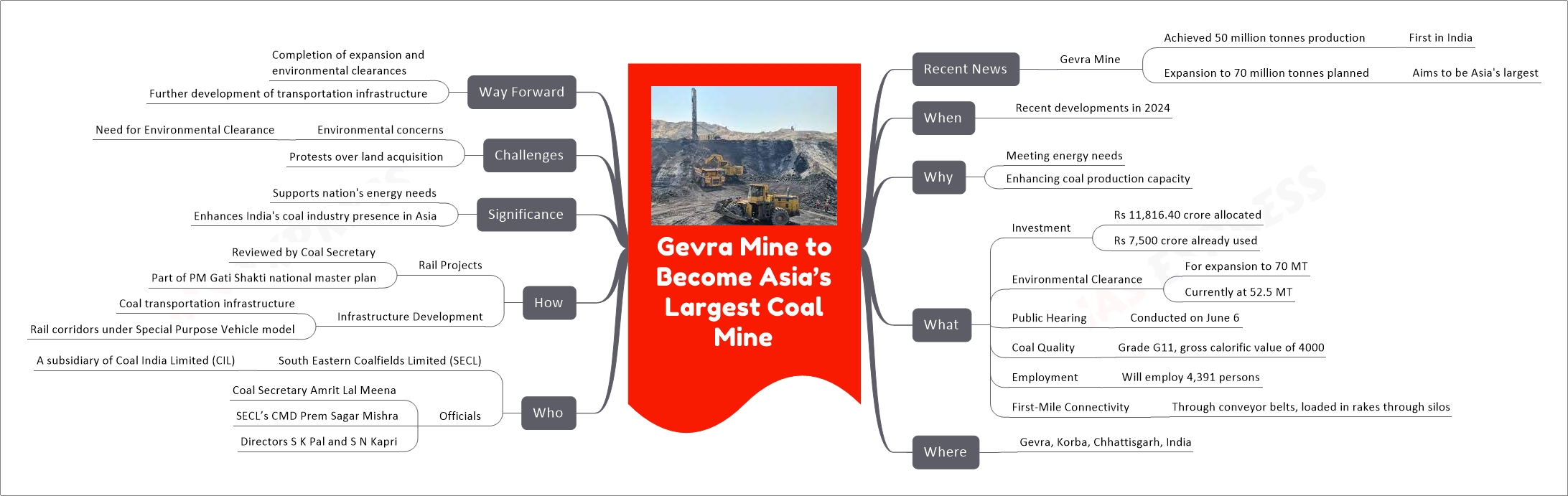
/ Mining
Gevra Mine to Become Asia’s Largest Coal Mine mind map
  Recent News
    Gevra Mine
      Achieved 50 million tonnes production
        First in India
      Expansion to 70 million tonnes planned
        Aims to be Asia's largest
  When
    Recent developments in 2024
  Why
    Meeting energy needs
    Enhancing coal production capacity
  What
    Investment
      Rs 11,816.40 crore allocated
      Rs 7,500 crore already used
    Environmental Clearance
      For expansion to 70 MT
      Currently at 52.5 MT
    Public Hearing
      Conducted on June 6
    Coal Quality
      Grade G11, gross calorific value of 4000
    Employment
      Will employ 4,391 persons
    First-Mile Connectivity
      Through conveyor belts, loaded in rakes through silos
  Where
    Gevra, Korba, Chhattisgarh, India
  Who
    South Eastern Coalfields Limited (SECL)
      A subsidiary of Coal India Limited (CIL)
    Officials
      Coal Secretary Amrit Lal Meena
      SECL’s CMD Prem Sagar Mishra
      Directors S K Pal and S N Kapri
  How
    Rail Projects
      Reviewed by Coal Secretary
      Part of PM Gati Shakti national master plan
    Infrastructure Development
      Coal transportation infrastructure
      Rail corridors under Special Purpose Vehicle model
  Significance
    Supports nation's energy needs
    Enhances India's coal industry presence in Asia
  Challenges
    Environmental concerns
      Need for Environmental Clearance
    Protests over land acquisition
  Way Forward
    Completion of expansion and environmental clearances
    Further development of transportation infrastructure

The Gevra Mine, operated by South Eastern Coalfields Limited (SECL), a subsidiary of Coal India Limited (CIL), is on its way to becoming Asia’s largest coal mine. Recent efforts to ramp up its annual production from 50 million tonnes to 70 million tonnes aim to meet the growing energy needs and enhance India’s coal production capacity. This significant expansion involves a hefty investment, addressing environmental clearance, and developing first-mile connectivity to streamline coal transportation. With a focus on infrastructure development, including rail projects as part of the PM Gati Shakti national master plan, the project also faces challenges such as environmental concerns and protests over land acquisition. Nonetheless, the expansion of the Gevra Mine is significant for India’s coal industry, promising to bolster the country’s position in the Asian coal market while ensuring employment opportunities and meeting energy demands​​​​​​​​​​​​​​.

/ Awards & Honors
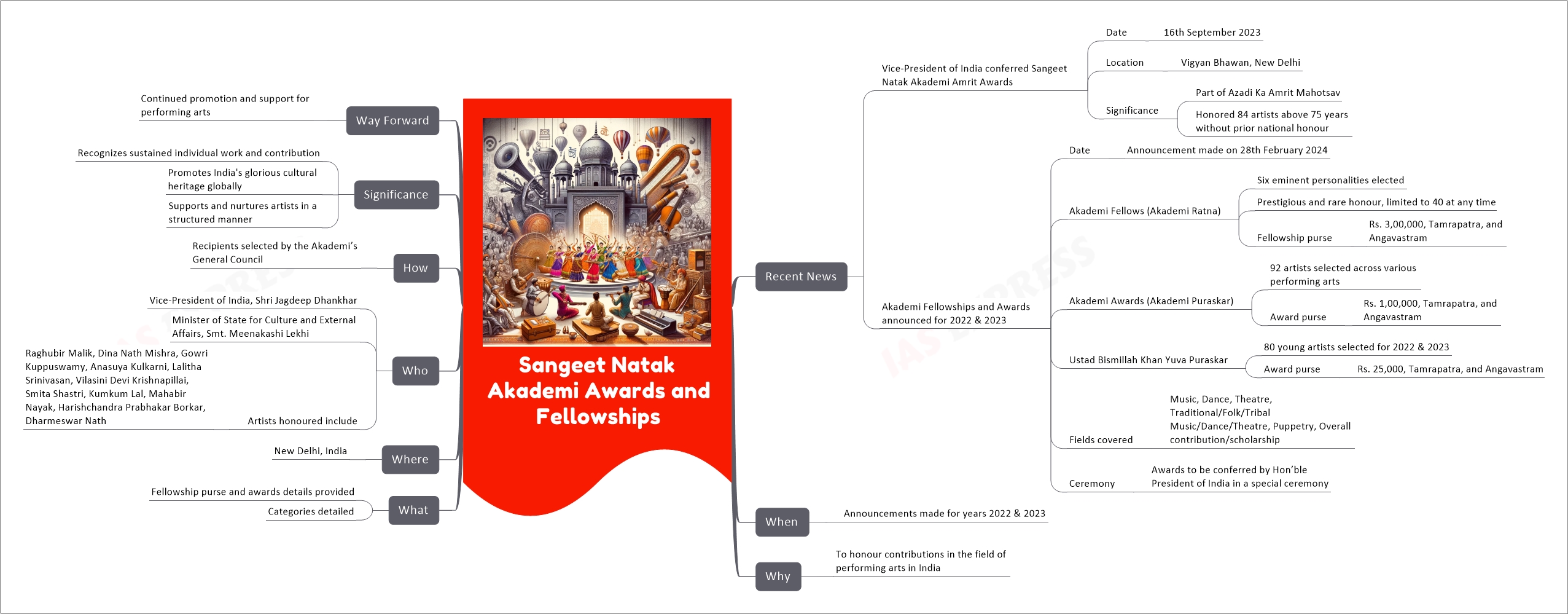
Sangeet Natak Akademi Awards and Fellowships mind map
  Recent News
    Vice-President of India conferred Sangeet Natak Akademi Amrit Awards
      Date
        16th September 2023
      Location
        Vigyan Bhawan, New Delhi
      Significance
        Part of Azadi Ka Amrit Mahotsav
        Honored 84 artists above 75 years without prior national honour
    Akademi Fellowships and Awards announced for 2022 & 2023
      Date
        Announcement made on 28th February 2024
      Akademi Fellows (Akademi Ratna)
        Six eminent personalities elected
        Prestigious and rare honour, limited to 40 at any time
        Fellowship purse
          Rs. 3,00,000, Tamrapatra, and Angavastram
      Akademi Awards (Akademi Puraskar)
        92 artists selected across various performing arts
        Award purse
          Rs. 1,00,000, Tamrapatra, and Angavastram
      Ustad Bismillah Khan Yuva Puraskar
        80 young artists selected for 2022 & 2023
        Award purse
          Rs. 25,000, Tamrapatra, and Angavastram
      Fields covered
        Music, Dance, Theatre, Traditional/Folk/Tribal Music/Dance/Theatre, Puppetry, Overall contribution/scholarship
      Ceremony
        Awards to be conferred by Hon’ble President of India in a special ceremony
  When
    Announcements made for years 2022 & 2023
  Why
    To honour contributions in the field of performing arts in India
  What
    Fellowship purse and awards details provided
    Categories detailed
  Where
    New Delhi, India
  Who
    Vice-President of India, Shri Jagdeep Dhankhar
    Minister of State for Culture and External Affairs, Smt. Meenakashi Lekhi
    Artists honoured include
      Raghubir Malik, Dina Nath Mishra, Gowri Kuppuswamy, Anasuya Kulkarni, Lalitha Srinivasan, Vilasini Devi Krishnapillai, Smita Shastri, Kumkum Lal, Mahabir Nayak, Harishchandra Prabhakar Borkar, Dharmeswar Nath
  How
    Recipients selected by the Akademi’s General Council
  Significance
    Recognizes sustained individual work and contribution
    Promotes India's glorious cultural heritage globally
    Supports and nurtures artists in a structured manner
  Way Forward
    Continued promotion and support for performing arts

The Sangeet Natak Akademi Awards and Fellowships represent the highest form of recognition in the field of performing arts in India, including music, dance, and theatre. These accolades are awarded by the Sangeet Natak Akademi, India’s National Academy of Music, Dance, and Drama, which was set up in 1953. The awards aim to honor the exceptional contributions of artists to the cultural heritage of India. The Fellowships (Akademi Ratna) are conferred upon distinguished individuals for their lifetime achievements and are limited to 40 living recipients at any given time, while the Akademi Awards (Akademi Puraskar) recognize excellence in the performing arts. Additionally, the Ustad Bismillah Khan Yuva Puraskar is awarded to young artists to encourage their talent in the field of performing arts. These awards and fellowships not only celebrate the artists’ individual contributions but also aim to inspire future generations to preserve and promote India’s diverse cultural traditions​​​​.

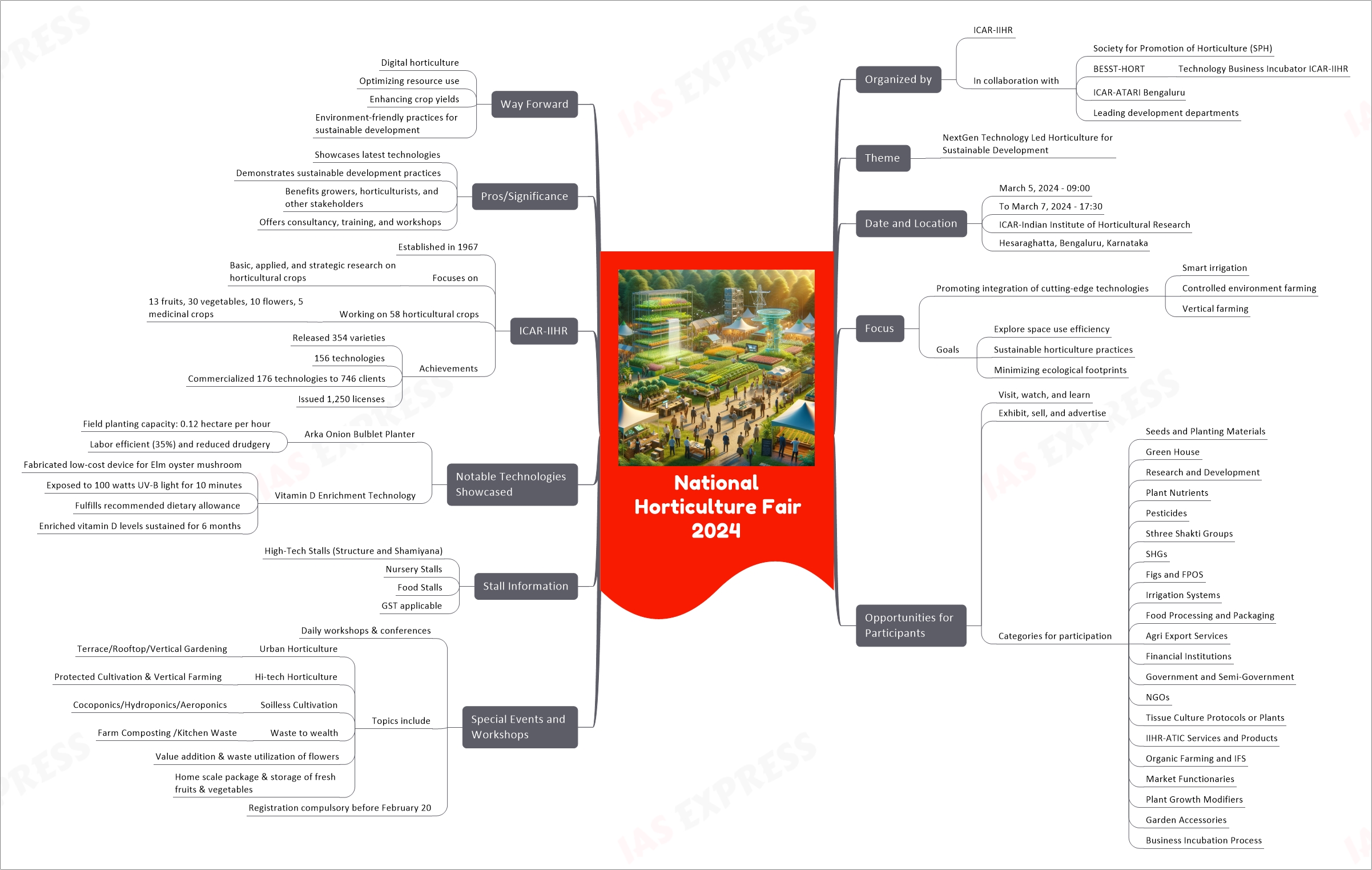
National Horticulture Fair 2024 mind map
  Organized by
    ICAR-IIHR
    In collaboration with
      Society for Promotion of Horticulture (SPH)
      BESST-HORT
        Technology Business Incubator ICAR-IIHR
      ICAR-ATARI Bengaluru
      Leading development departments
  Theme
    NextGen Technology Led Horticulture for Sustainable Development
  Date and Location
    March 5, 2024 - 09:00
    To March 7, 2024 - 17:30
    ICAR-Indian Institute of Horticultural Research
    Hesaraghatta, Bengaluru, Karnataka
  Focus
    Promoting integration of cutting-edge technologies
      Smart irrigation
      Controlled environment farming
      Vertical farming
    Goals
      Explore space use efficiency
      Sustainable horticulture practices
      Minimizing ecological footprints
  Opportunities for Participants
    Visit, watch, and learn
    Exhibit, sell, and advertise
    Categories for participation
      Seeds and Planting Materials
      Green House
      Research and Development
      Plant Nutrients
      Pesticides
      Sthree Shakti Groups
      SHGs
      Figs and FPOS
      Irrigation Systems
      Food Processing and Packaging
      Agri Export Services
      Financial Institutions
      Government and Semi-Government
      NGOs
      Tissue Culture Protocols or Plants
      IIHR-ATIC Services and Products
      Organic Farming and IFS
      Market Functionaries
      Plant Growth Modifiers
      Garden Accessories
      Business Incubation Process
  Special Events and Workshops
    Daily workshops & conferences
    Topics include
      Urban Horticulture
        Terrace/Rooftop/Vertical Gardening
      Hi-tech Horticulture
        Protected Cultivation & Vertical Farming
      Soilless Cultivation
        Cocoponics/Hydroponics/Aeroponics
      Waste to wealth
        Farm Composting /Kitchen Waste
      Value addition & waste utilization of flowers
      Home scale package & storage of fresh fruits & vegetables
    Registration compulsory before February 20
  Stall Information
    High-Tech Stalls (Structure and Shamiyana)
    Nursery Stalls
    Food Stalls
    GST applicable
  Notable Technologies Showcased
    Arka Onion Bulblet Planter
      Field planting capacity: 0.12 hectare per hour
      Labor efficient (35%) and reduced drudgery
    Vitamin D Enrichment Technology
      Fabricated low-cost device for Elm oyster mushroom
      Exposed to 100 watts UV-B light for 10 minutes
      Fulfills recommended dietary allowance
      Enriched vitamin D levels sustained for 6 months
  ICAR-IIHR
    Established in 1967
    Focuses on
      Basic, applied, and strategic research on horticultural crops
    Working on 58 horticultural crops
      13 fruits, 30 vegetables, 10 flowers, 5 medicinal crops
    Achievements
      Released 354 varieties
      156 technologies
      Commercialized 176 technologies to 746 clients
      Issued 1,250 licenses
  Pros/Significance
    Showcases latest technologies
    Demonstrates sustainable development practices
    Benefits growers, horticulturists, and other stakeholders
    Offers consultancy, training, and workshops
  Way Forward
    Digital horticulture
    Optimizing resource use
    Enhancing crop yields
    Environment-friendly practices for sustainable development

The National Horticulture Fair 2024, scheduled for March 5-7 in Bengaluru, Karnataka, is a significant event organized by the ICAR-IIHR. It focuses on showcasing next-generation technologies in horticulture aimed at sustainable development. The fair emphasizes the importance of integrating advanced technologies such as smart irrigation, controlled environment farming, and vertical farming into horticultural practices. It offers participants a unique opportunity to learn, exhibit, and engage with experts in various fields, including research and development, organic farming, and food processing. With a rich program that includes special workshops and the presentation of innovative technologies like the Arka Onion Bulblet Planter and Vitamin D Enrichment Technology, the fair aims to educate and inspire farmers, agripreneurs, students, and other stakeholders towards more efficient and sustainable agricultural practices​​​​​​.

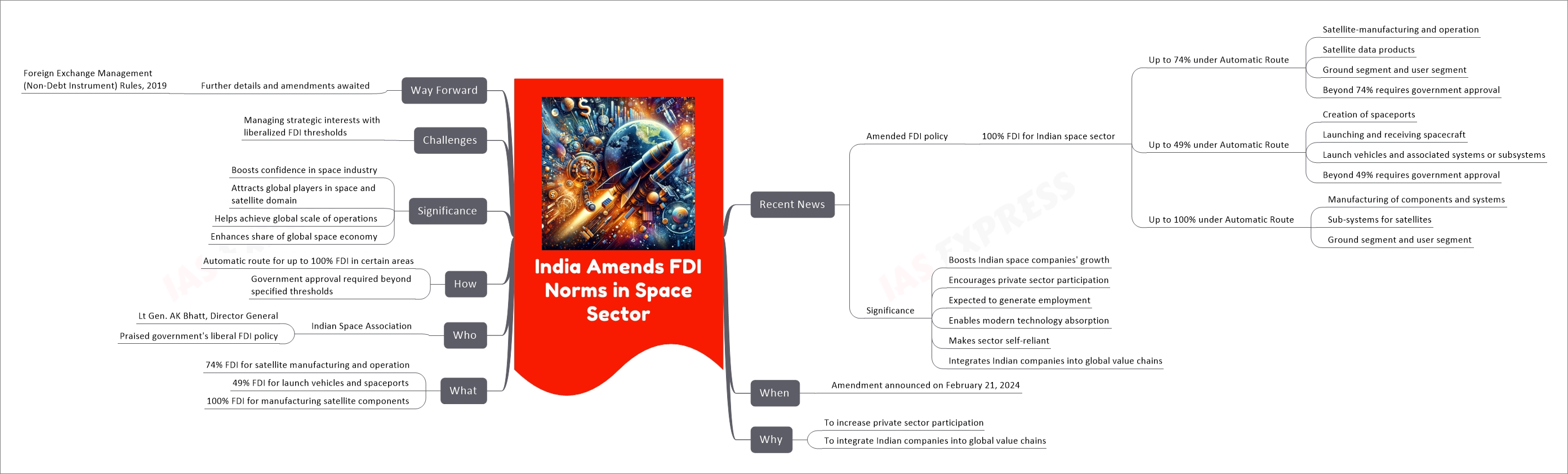
India Amends FDI Norms in Space Sector mind map
  Recent News
    Amended FDI policy
      100% FDI for Indian space sector
        Up to 74% under Automatic Route
          Satellite-manufacturing and operation
          Satellite data products
          Ground segment and user segment
          Beyond 74% requires government approval
        Up to 49% under Automatic Route
          Creation of spaceports
          Launching and receiving spacecraft
          Launch vehicles and associated systems or subsystems
          Beyond 49% requires government approval
        Up to 100% under Automatic Route
          Manufacturing of components and systems
          Sub-systems for satellites
          Ground segment and user segment
    Significance
      Boosts Indian space companies' growth
      Encourages private sector participation
      Expected to generate employment
      Enables modern technology absorption
      Makes sector self-reliant
      Integrates Indian companies into global value chains
  When
    Amendment announced on February 21, 2024
  Why
    To increase private sector participation
    To integrate Indian companies into global value chains
  What
    74% FDI for satellite manufacturing and operation
    49% FDI for launch vehicles and spaceports
    100% FDI for manufacturing satellite components
  Who
    Indian Space Association
      Lt Gen. AK Bhatt, Director General
      Praised government's liberal FDI policy
  How
    Automatic route for up to 100% FDI in certain areas
    Government approval required beyond specified thresholds
  Significance
    Boosts confidence in space industry
    Attracts global players in space and satellite domain
    Helps achieve global scale of operations
    Enhances share of global space economy
  Challenges
    Managing strategic interests with liberalized FDI thresholds
  Way Forward
    Further details and amendments awaited
      Foreign Exchange Management (Non-Debt Instrument) Rules, 2019

The recent amendment of FDI norms in India’s space sector marks a significant liberalization aimed at boosting growth and innovation. The new policy allows up to 100% FDI under the automatic route in various categories, promoting private sector participation and integrating Indian companies into global value chains. This move is expected to generate employment, enable technology absorption, and make the sector self-reliant. With the Indian Space Association welcoming these changes, the future looks promising for India’s space industry, potentially enhancing its share in the global space economy.

If you like this post, please share your feedback in the comments section below so that we will upload more posts like this.

Responses

🖍️ Highlight
HomeCoursesPlansAccount