[Newsbits] 18.12.2023 – Ketamine, Akash Missile, Gene Drive, & more

newsbits mindmap notes

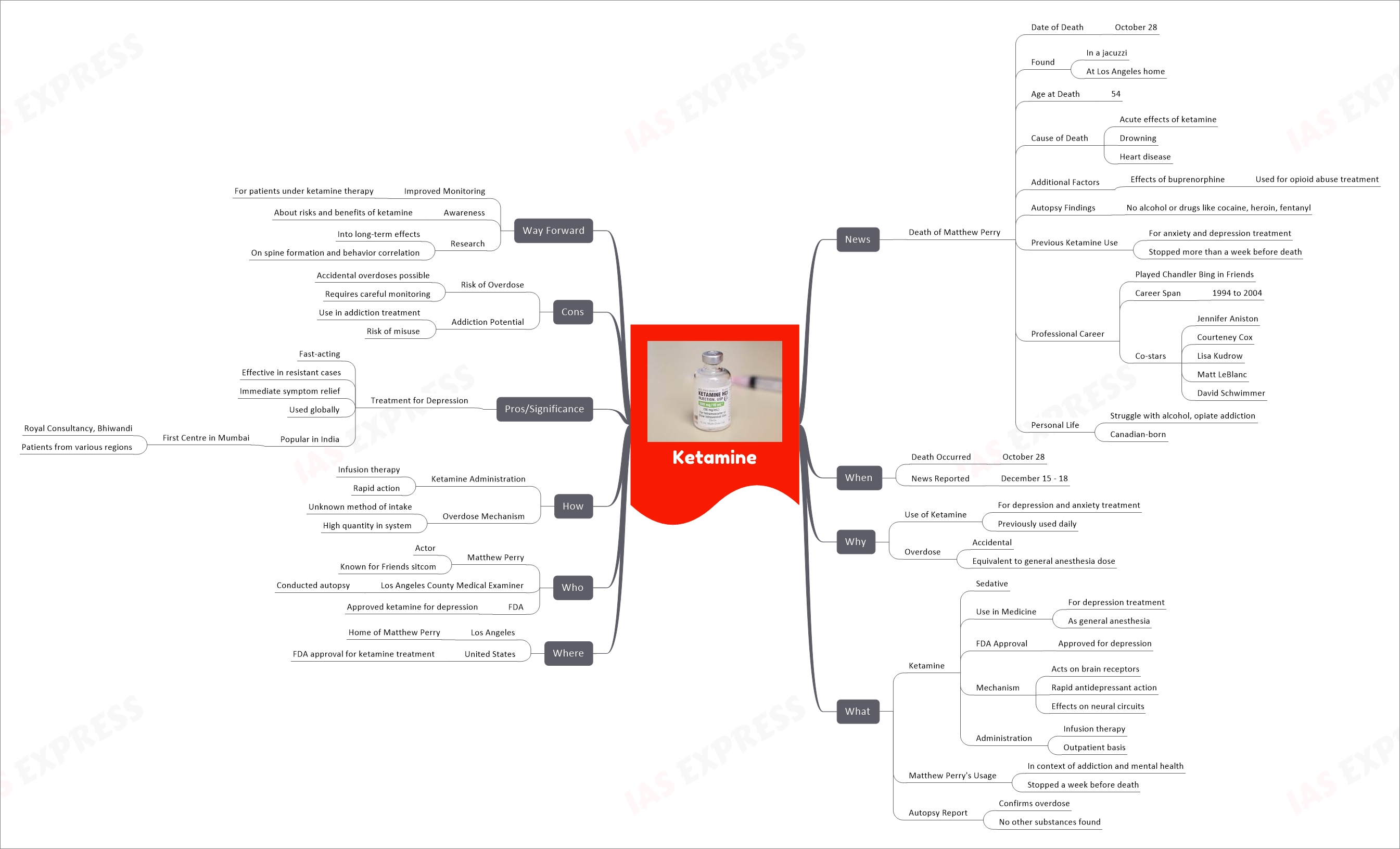
Ketamine mind map
  News
    Death of Matthew Perry
      Date of Death
        October 28
      Found
        In a jacuzzi
        At Los Angeles home
      Age at Death
        54
      Cause of Death
        Acute effects of ketamine
        Drowning
        Heart disease
      Additional Factors
        Effects of buprenorphine
          Used for opioid abuse treatment
      Autopsy Findings
        No alcohol or drugs like cocaine, heroin, fentanyl
      Previous Ketamine Use
        For anxiety and depression treatment
        Stopped more than a week before death
      Professional Career
        Played Chandler Bing in Friends
        Career Span
          1994 to 2004
        Co-stars
          Jennifer Aniston
          Courteney Cox
          Lisa Kudrow
          Matt LeBlanc
          David Schwimmer
      Personal Life
        Struggle with alcohol, opiate addiction
        Canadian-born
  When
    Death Occurred
      October 28
    News Reported
      December 15 - 18
  Why
    Use of Ketamine
      For depression and anxiety treatment
      Previously used daily
    Overdose
      Accidental
      Equivalent to general anesthesia dose
  What
    Ketamine
      Sedative
      Use in Medicine
        For depression treatment
        As general anesthesia
      FDA Approval
        Approved for depression
      Mechanism
        Acts on brain receptors
        Rapid antidepressant action
        Effects on neural circuits
      Administration
        Infusion therapy
        Outpatient basis
    Matthew Perry's Usage
      In context of addiction and mental health
      Stopped a week before death
    Autopsy Report
      Confirms overdose
      No other substances found
  Where
    Los Angeles
      Home of Matthew Perry
    United States
      FDA approval for ketamine treatment
  Who
    Matthew Perry
      Actor
      Known for Friends sitcom
    Los Angeles County Medical Examiner
      Conducted autopsy
    FDA
      Approved ketamine for depression
  How
    Ketamine Administration
      Infusion therapy
      Rapid action
    Overdose Mechanism
      Unknown method of intake
      High quantity in system
  Pros/Significance
    Treatment for Depression
      Fast-acting
      Effective in resistant cases
      Immediate symptom relief
      Used globally
      Popular in India
        First Centre in Mumbai
          Royal Consultancy, Bhiwandi
          Patients from various regions
  Cons
    Risk of Overdose
      Accidental overdoses possible
      Requires careful monitoring
    Addiction Potential
      Use in addiction treatment
      Risk of misuse
  Way Forward
    Improved Monitoring
      For patients under ketamine therapy
    Awareness
      About risks and benefits of ketamine
    Research
      Into long-term effects
      On spine formation and behavior correlation

Summary:- Matthew Perry, famed for his role in the sitcom “Friends,” tragically passed away on October 28, 2023, due to the acute effects of a ketamine overdose, which was compounded by drowning and heart disease. Ketamine, a sedative approved by the FDA for treating depression, acts rapidly on brain receptors and is effective in resistant cases. Perry had struggled with addiction and mental health issues, using ketamine to manage anxiety and depression. His death has brought attention to the potential risks and benefits of ketamine, emphasizing the need for careful monitoring and awareness regarding its use. Ketamine therapy is gaining popularity globally, including in India, where it offers immediate relief for depressive symptoms, especially in drug-resistant cases.

UNSC Veto Power & Gaza Ceasefire mind map
  December 2023 News
    UNSC Resolution on Gaza
      Proposal
        By United Arab Emirates
        Co-sponsorship
          From 97 Member States
          Within 24 hours
        Focus
          Immediate humanitarian ceasefire
          Release of all hostages
          Ensuring humanitarian access
        Support
          13 Council members
          Including China, France, Russia
      Veto
        By United States
        Date
          9 December 2023
        Reasons for Veto
          Unbalanced resolution
          Ignored US recommendations
          Failed to condemn Hamas' terrorist attacks
          Overlooked Israel's right to self-defence
      Reaction
        Global disappointment
        Criticism of US decision
        Highlighting need for ceasefire
    General Assembly Action
      Resolution Adoption
        Title
          "Protection of civilians and upholding legal and humanitarian obligations"
        Vote Outcome
          153 in favour
          10 against
          23 abstentions
        Failed Amendments
          Austria's amendment
          US's amendment
        Key Points
          Immediate ceasefire
          Compliance with international law
          Release of hostages
          Humanitarian access
      International Response
        Support from Arab Group
        Criticism from Israel
        Advocacy by Pakistan, Syria, Tunisia
  UNSC Veto Power
    Origin
      In Article 27 of the United Nations Charter
    Scope
      Applies to substantive resolutions
      Does not prevent adoption if abstained or absent
    Controversy
      Seen as undemocratic
      Hinders action on war crimes
    Reforms Proposed
      Limiting veto to vital issues
      Requiring multiple states' agreement
      Possible abolition
  Context of Gaza Ceasefire
    Conflict Duration
      Over 63 days
    Casualties
      More than 18,000 people
    International Law
      Obligations under humanitarian law
      Protection of civilians
    Diplomatic Efforts
      By various countries
      Aimed at ending hostilities
    Humanitarian Situation
      Catastrophic conditions in Gaza
      Need for immediate relief
  Way Forward
    Enhanced Diplomacy
      Need for effective negotiating process
      Engaging all Member States
    Humanitarian Focus
      Prioritizing civilian protection
      Ensuring consistent humanitarian aid
    Accountability
      Addressing violations of international law
      Holding aggressors accountable

Summary:- The recent news about the veto power in the UNSC related to the Gaza ceasefire highlights the complexities of international diplomacy and decision-making within the United Nations. A resolution proposed by the United Arab Emirates, co-sponsored by 97 Member States, called for an immediate humanitarian ceasefire in Gaza. However, it was vetoed by the United States in the UNSC, citing reasons such as the resolution’s failure to condemn Hamas’ terrorist attacks and to recognize Israel’s right to self-defense. This veto led to significant global disappointment and criticism. In response, the UN General Assembly adopted a resolution demanding an immediate ceasefire and compliance with international law. The situation underscores ongoing debates about the UNSC’s veto power, its implications for global peace and security, and the need for more inclusive and effective diplomatic processes.

/ etc), Missiles, Submarines
Akash Missile System mind map
  December 2023 News
    Astrashakti military exercise
    India first to engage four targets
    Range of 25 kilometers
  When
    Development began in 1983
    First trial firings in 1990
    Inducted in Indian Air Force in 2014
    Inducted in Indian Army in 2015
  Why
    Protect vulnerable areas
    Defense against air attacks
  What
    Medium-range mobile SAM
      Surface to Air Missile
    Range up to 30 kilometers
    Targets aircraft, UAVs, missiles
  Where
    India
    Export interests globally
  Who
    Developed by DRDO
      Defence Research and Development Organisation
    Produced by BDL
      Bharat Dynamics Limited
    BEL, Tata Power SED, L&T involved
      Bharat Electronics Limited
      Strategic Engineering Division
      Larsen & Toubro
  How
    Command guidance system
    Mobile launch platforms
    ECCM features
      Electronic Counter-Countermeasures
    Multiple target engagement
  Pros/Significance
    Indigenous technology
    Cost-effective adaptation
    Export potential
    Multi-target capability
  Challenges
    Radar, control units, sensor issues
    43% failure rate in tests
    Quality concerns
    Trust issues during war
  Way Forward
    Address technical challenges
    Enhance reliability
    Expand export success

Summary:- The Akash missile system is a medium-range mobile surface-to-air missile developed by India’s Defence Research and Development Organisation (DRDO) and produced by Bharat Dynamics Limited (BDL). It is designed to protect vulnerable areas from air attacks by targeting aircraft, UAVs, and missiles up to 30 km away. The system has been inducted into the Indian Air Force and the Indian Army and has shown export potential. Recently, during the Astrashakti military exercise, India demonstrated the capability of the Akash system to engage four aerial targets simultaneously at a range of 25 kilometers, marking a global first. However, the system has faced challenges, including issues with radar, electronic control units, and sensors, and a significant failure rate during tests. The way forward includes addressing these technical challenges to enhance reliability and expand its success in exports.

/ Biotechnology
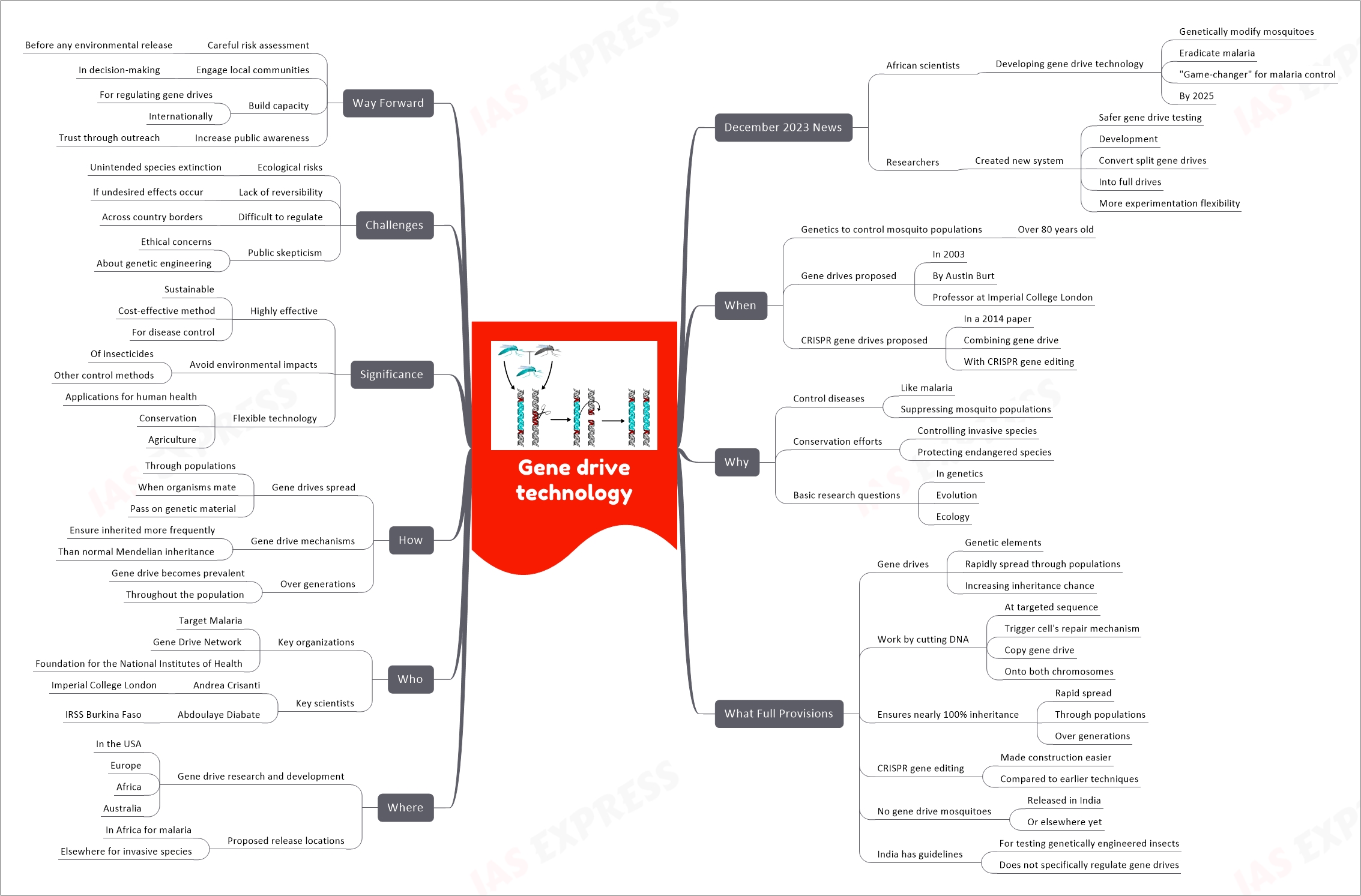
Gene drive technology mind map
  December 2023 News
    African scientists
      Developing gene drive technology
        Genetically modify mosquitoes
        Eradicate malaria
        "Game-changer" for malaria control
        By 2025
    Researchers
      Created new system
        Safer gene drive testing
        Development
        Convert split gene drives
        Into full drives
        More experimentation flexibility
  When
    Genetics to control mosquito populations
      Over 80 years old
    Gene drives proposed
      In 2003
      By Austin Burt
      Professor at Imperial College London
    CRISPR gene drives proposed
      In a 2014 paper
      Combining gene drive
      With CRISPR gene editing
  Why
    Control diseases
      Like malaria
      Suppressing mosquito populations
    Conservation efforts
      Controlling invasive species
      Protecting endangered species
    Basic research questions
      In genetics
      Evolution
      Ecology
  What Full Provisions
    Gene drives
      Genetic elements
      Rapidly spread through populations
      Increasing inheritance chance
    Work by cutting DNA
      At targeted sequence
      Trigger cell's repair mechanism
      Copy gene drive
      Onto both chromosomes
    Ensures nearly 100% inheritance
      Rapid spread
      Through populations
      Over generations
    CRISPR gene editing
      Made construction easier
      Compared to earlier techniques
    No gene drive mosquitoes
      Released in India
      Or elsewhere yet
    India has guidelines
      For testing genetically engineered insects
      Does not specifically regulate gene drives
  Where
    Gene drive research and development
      In the USA
      Europe
      Africa
      Australia
    Proposed release locations
      In Africa for malaria
      Elsewhere for invasive species
  Who
    Key organizations
      Target Malaria
      Gene Drive Network
      Foundation for the National Institutes of Health
    Key scientists
      Andrea Crisanti
        Imperial College London
      Abdoulaye Diabate
        IRSS Burkina Faso
  How
    Gene drives spread
      Through populations
      When organisms mate
      Pass on genetic material
    Gene drive mechanisms
      Ensure inherited more frequently
      Than normal Mendelian inheritance
    Over generations
      Gene drive becomes prevalent
      Throughout the population
  Significance
    Highly effective
      Sustainable
      Cost-effective method
      For disease control
    Avoid environmental impacts
      Of insecticides
      Other control methods
    Flexible technology
      Applications for human health
      Conservation
      Agriculture
  Challenges
    Ecological risks
      Unintended species extinction
    Lack of reversibility
      If undesired effects occur
    Difficult to regulate
      Across country borders
    Public skepticism
      Ethical concerns
      About genetic engineering
  Way Forward
    Careful risk assessment
      Before any environmental release
    Engage local communities
      In decision-making
    Build capacity
      For regulating gene drives
      Internationally
    Increase public awareness
      Trust through outreach

Summary: Gene drive technology is a method of genetic engineering that allows specific genes to spread rapidly through a population. This technology, which can override natural selection, is made possible by the gene editing tool CRISPR-Cas9. Gene drives can be used to control disease-carrying insects like mosquitoes, potentially eradicating diseases like malaria. However, the technology also poses significant ecological risks, including the possibility of unintended species extinction. Therefore, it’s crucial to conduct thorough testing and risk assessment before deploying gene drives. Additionally, public engagement and clear regulation are necessary to address ethical concerns and skepticism about genetic engineering. As of December 2023, gene drive research and development are ongoing in various parts of the world, including the USA, Europe, Africa, and Australia
If you like this post, please share your feedback in the comments section below so that we will upload more posts like this.

Responses

🖍️ Highlight
HomeCoursesPlansAccount