
Polavaram Irrigation Project: Features, Timeline, Benefits, Challenges, and Current Status


From Current Affairs Notes for UPSC » Editorials & In-depths » This topic
[ytep url="https://youtu.be/KbR_5MFWAWg" duration="610″]
Introduction
The Polavaram Irrigation Project is a massive multi-purpose terminal reservoir on the Godavari River in Andhra Pradesh, recently gaining attention due to a significant legal development. On January 12, 2026, the Supreme Court of India, led by CJI Surya Kant and Justice Joymalya Bagchi, disposed of a writ petition filed by Telangana against the project's expansion, specifically the Polavaram-Banakacherla Link Project. The court observed that the dispute concerning water resources and alleged violations of the Godavari Water Disputes Tribunal (GWDT) Award falls under the ambit of the Inter-State Water Disputes Act, 1956 or Article 131, rather than Article 32, calling the petition "prima facie not maintainable" while granting liberty to pursue appropriate civil remedies.
What is the Recent Supreme Court Ruling?
Legal Context and Court Observations
- Supreme Court Verdict Details
- The Supreme Court bench delivered its order on January 12, 2026, addressing the writ petition filed by the State of Telangana against the Union Government and the State of Andhra Pradesh.
- The bench was presided over by Chief Justice of India (CJI) Surya Kant and Justice Joymalya Bagchi.
- The court termed the petition "prima facie not maintainable" under Article 32, which is typically used for the enforcement of fundamental rights.
- Reasoning for Disposal
- The court observed that the core of the dispute was an inter-state water dispute regarding the sharing of river waters.
- The bench noted that such disputes should ideally be addressed under the Inter-State Water Disputes Act, 1956 or through a Civil Suit under Article 131 of the Constitution, which deals with disputes between the Centre and States or between two States.
- The court pointed out a procedural flaw: Telangana had failed to join Karnataka and Maharashtra as respondents in the writ petition, despite them being necessary parties to the original GWDT Award of 1980.
- Outcome for Telangana
- Senior Advocate A.M. Singhvi, representing Telangana, requested the court not to "dismiss" the petition to avoid negative precedence.
- The court agreed to "dispose of" the petition as withdrawn, granting Telangana the liberty to file a fresh civil suit (Original Suit) raising the same issues.
- Telangana Irrigation Minister N. Uttam Kumar Reddy stated that the state would now file a comprehensive suit to challenge the project more effectively with broader arguments.
- The Supreme Court bench delivered its order on January 12, 2026, addressing the writ petition filed by the State of Telangana against the Union Government and the State of Andhra Pradesh.
The Core of the Dispute
- The Polavaram-Banakacherla Link Project (PBLP)
- The conflict centers on Andhra Pradesh's proposal to construct the Polavaram-Banakacherla Link Project, which was later renamed the Polavaram-Nallamala Sagar Link Project (PNLP).
- Telangana alleges that this project intends to divert 200 TMC (Thousand Million Cubic feet) of Godavari floodwaters to the Krishna and Penna basins.
- This diversion quantity of 200 TMC is contested as a violation of the GWDT Award, which originally capped the diversion at 80 TMC.
- Allegations of Violations
- Telangana claims the project lacks necessary clearances from the Central Water Commission (CWC) and the Apex Council established under the Andhra Pradesh Reorganisation Act, 2014.
- The state argues that the unauthorized expansion alters the reservoir's operation schedule, keeping water levels at the Full Reservoir Level (FRL) for longer periods.
- This change poses a threat of backwater submergence to critical areas in Telangana, including the Bhadrachalam Temple town and the Manuguru Heavy Water Plant.
What are the Key Features of the Project?
Technical Specifications
- Dam and Reservoir
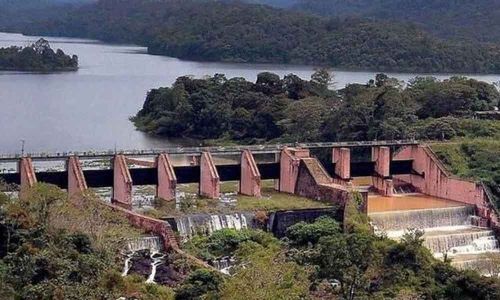
- The project features a massive Earth-cum-Rock Fill (ECRF) dam that is 2,454 meters long.
- It includes a concrete spillway spanning 1,128 meters to manage flood flows.
- The Gross Storage Capacity of the reservoir is 194 TMC at an FRL of 150 feet (45.72 meters).
- The Live Storage Capacity is 75.2 TMC above the canal's full supply level.
- The Spillway is designed for a massive discharge capacity of 50 lakh cusecs (cubic feet per second), making it one of the largest in the world to handle Godavari floods.
- Diaphragm Wall
- A critical component is the plastic concrete diaphragm wall, built 40 to 120 meters deep into the riverbed.
- This wall acts as a barrier to prevent water seepage beneath the earth dam and is the first of its kind in India for such a depth.
- Canal Network
- Right Main Canal: This canal stretches 174 kilometers and is designed to transfer Godavari water to the Krishna River.
- Left Main Canal: This canal runs for 181.5 kilometers to supply water to Visakhapatnam and East Godavari districts.
- Power House: The project includes a hydroelectric power plant on the left flank with an installed capacity of 960 MW (12 turbines of 80 MW each).
Project Classification
- National Project Status
- The project was declared a National Project under the Andhra Pradesh Reorganisation Act, 2014.
- This status implies that the Central Government is responsible for funding the irrigation component and expediting its execution.
- The Polavaram Project Authority (PPA) was constituted by the Centre to supervise the project implementation.
Why is the Project Considered Crucial for the Region?
Irrigation and Agriculture
- Command Area Development
- The project aims to create a new irrigation potential of 7.2 lakh acres (approx. 2.91 lakh hectares).
- The beneficiary districts include West Godavari, East Godavari, Krishna, and Visakhapatnam.
- It also intends to stabilize the irrigation for an existing 23.5 lakh acres in the Godavari and Krishna deltas, ensuring crop security against monsoon failures.
- Drought Mitigation
- The project is designed to transfer surplus water to the drought-prone Rayalaseema region via the Krishna river.
- By diverting water to the Krishna basin, it relieves stress on the Srisailam and Nagarjuna Sagar projects, allowing them to serve upland areas better.
Water Supply and Industry
- Drinking Water
- It allocates 23.44 TMC of water specifically for domestic and industrial use.
- The city of Visakhapatnam, a major industrial hub, relies on this project for its long-term water security.
- It aims to provide drinking water to 540 villages en route the canals.
- River Linking Strategy
- The project is the key to the Godavari-Krishna link, transferring 80 TMC of water to the Krishna river at Vijayawada.
- This diversion allows Maharashtra and Karnataka to utilize an additional 35 TMC of Krishna water upstream, as per the GWDT Award.
Where is the Project Located and Who is Affected?
Geographical Setting
- Location Coordinates
- The dam is located near Ramayyapeta village in Polavaram Mandal, Eluru District (formerly West Godavari) of Andhra Pradesh.
- It is situated about 40 kilometers upstream of the Sir Arthur Cotton Barrage at Rajamahendravaram.
- Basin Impact
- The project harnesses the lower Godavari basin, which has massive flood flows.
- The reservoir backwater extends about 150 kilometers along the main river and 115 kilometers along the Sabari River tributary.
Affected States and Areas
- Submergence Zones
- Andhra Pradesh: The project will submerge roughly 276 villages (official estimate) to over 300 villages (unofficial estimate).
- Odisha: Approximately 4 villages and 648 hectares of land in Malkangiri district face submergence.
- Chhattisgarh: About 8 villages and 795 hectares of land in Dantewada district are in the submergence zone.
- Telangana: The state claims that backwater will affect Bhadrachalam, Manuguru, and several tribal hamlets in Khammam district.
- Tribal Impact
- The affected areas are predominantly Scheduled Areas inhabited by tribal communities like the Koya and Kondareddis.
- Environmentalists argue that the project threatens the Papikonda National Park and sensitive ecological zones.
When was the Project Conceived and Developed?
Historical Timeline
- Early Conceptualization (1941 – 1980)
- 1941: The project was first proposed by Diwan Bahadur L. Venkatakrishna Iyer, Chief Engineer of the Madras Presidency.
- 1946-47: Initial estimates pegged the cost at Rs 129 crore.
- 1980: The foundation stone was laid by the then Chief Minister T. Anjaiah.
- 1980: The Godavari Water Disputes Tribunal (GWDT) gave its final award, setting the legal framework for the project and inter-state sharing.
- Revival and Bifurcation (2004 – 2014)
- 2004: Chief Minister Y.S. Rajasekhara Reddy revived the project with a "Bhoomi Pooja" and accelerated canal works.
- 2005: The Detailed Project Report (DPR) was submitted to the CWC.
- 2009: The project received environmental clearance and CWC approval.
- 2014: The Andhra Pradesh Reorganisation Act declared it a National Project; seven mandals from Telangana were merged into Andhra Pradesh to facilitate construction.
- Modern Era (2014 – Present)
- 2014-2019: Construction of the diaphragm wall and spillway advanced under the TDP government.
- 2020: The project faced setbacks due to floods and damage to the diaphragm wall.
- 2025: The Union Government approved a revised cost of Rs 30,436 crore in the Union Budget.
- 2026: The Supreme Court disposed of Telangana's petition, directing the state to file a civil suit. The Andhra Pradesh government set a target to complete the diaphragm wall by February 2026.
Who are the Key Stakeholders and Parties Involved?
Government Agencies
- Central Government
- Ministry of Jal Shakti: The nodal ministry providing funds and oversight.
- Polavaram Project Authority (PPA): The dedicated agency based in Hyderabad ensuring project implementation.
- Central Water Commission (CWC): The technical body responsible for design approvals and backwater studies.
- State Governments
- Andhra Pradesh: The executing authority, responsible for land acquisition and Rehabilitation and Resettlement (R&R).
- Telangana: An upper riparian state contesting the project's expansion and backwater impacts.
- Odisha & Chhattisgarh: Upper riparian states concerned about land submergence and protective embankments.
- Karnataka & Maharashtra: Beneficiaries of the Krishna water exchange clause in the GWDT Award.
Contractors and Builders
- Execution Agencies
- Major infrastructure firms like Megha Engineering & Infrastructures Ltd (MEIL) have been involved in critical works like the spillway and diaphragm wall.
- Bauergmbh (a German company) was involved in the initial diaphragm wall construction.
How Does the Project Function and Impact the Ecosystem?
Working Mechanism
- Gravity and Lift Systems
- The main project relies on gravity to flow water through the Right and Left Main Canals.
- The controversial Polavaram-Banakacherla Link proposes lifting water from the Polavaram reservoir (at 37m MSL) to the Banakacherla Regulator (at 267m MSL).
- This involves a massive lift irrigation scheme and a 19.5 km tunnel through the Nallamala hills.
- Flood Management
- The spillway operates 48 gates to discharge up to 50 lakh cusecs of water downstream.
- This regulation aims to moderate floods in the Godavari delta, protecting the Rajahmundry and Konaseema areas.
Environmental and Social Impacts
- Displacement Crisis
- The project has displaced 96,660 families (Project Displaced Families – PDFs).
- A significant portion belongs to Scheduled Tribes (STs) who lose their ancestral forest lands.
- Rehabilitation efforts have been slow; reports indicate that many R&R colonies lack legal status under the PESA Act.
- Ecological Concerns
- The submergence affects rich biodiversity in the Eastern Ghats, including the Papikonda National Park.
- Telangana argues that the stagnant backwater will cause environmental degradation and siltation upstream.
What is the Significance of this National Project?
Strategic Importance
- River Interlinking Model
- It is the first major component of India's National River Linking Project (NRLP) to be implemented.
- The Godavari-Krishna link serves as a blueprint for future inter-basin transfers to address regional imbalances.
- Food Security
- By stabilizing the Krishna and Godavari deltas, often called the "Rice Bowl of India", the project ensures food security for the nation.
- It brings green revolution benefits to the upland areas of Visakhapatnam and East Godavari.
Economic Benefits
- Power Generation
- The 960 MW power plant contributes to the state's energy grid, providing cheap renewable energy.
- Industrial Corridor
- Assured water supply facilitates the growth of the Visakhapatnam-Chennai Industrial Corridor, boosting GDP and employment.
What are the Major Limitations and Challenges Faced?
Technical and Engineering Hurdles
- Diaphragm Wall Failure
- The diaphragm wall was damaged during the floods of 2019-20 because the Upper Coffer Dam was built without completing the spillway, causing high-velocity flows to scour the riverbed.
- Repairing this wall is technically complex and costly, estimated at Rs 990 crore.
- Foundation Issues
- The dam is built on a deep permeable sandy bed, requiring sophisticated vibro-compaction and plastic concrete technologies.
Legal and Interstate Disputes
- GWDT Award Violations
- Telangana asserts that diverting 200 TMC violates the 80 TMC limit set by the GWDT Award.
- The lack of consensus on backwater levels remains a major sticking point with Odisha and Chhattisgarh refusing to accept CWC studies.
- Clearance Issues
- The Expert Appraisal Committee (EAC) of the MoEFCC recently rejected the Terms of Reference (TOR) for the Banakacherla Link, citing the need for GWDT compliance.
Financial Constraints
- Cost Escalation
- The project cost has escalated significantly from Rs 129 crore in 1946 to over Rs 55,000 crore (state estimates) and Rs 30,436 crore (approved by Centre for balance works).
- Delays in reimbursement from the Centre have historically slowed down execution.
What is the Way Forward for Resolution?
Legal and Institutional Paths
- Civil Suits (Article 131)
- Following the Supreme Court's Jan 2026 advice, Telangana is expected to file a civil suit under Article 131 to adjudicate the Banakacherla dispute.
- This will likely lead to a detailed judicial examination of the GWDT Award clauses regarding "surplus water" and "diversion limits".
- Tribunal Adjudication
- The disputes may eventually be referred back to the Godavari Water Disputes Tribunal or a new tribunal for a binding clarification on the 80 TMC vs 200 TMC issue.
Technical Solutions
- Joint Surveys
- A high-level technical committee comprising experts from AP, Telangana, and the CWC has been proposed to conduct joint surveys of the backwater areas.
- Conducting a neutral study by the CWPRS (Pune) could settle the factual disagreements regarding submergence levels at Bhadrachalam.
- Protective Embankments
- Andhra Pradesh must construct adequate protective embankments in Odisha and Chhattisgarh as per the GWDT agreement to prevent submergence.
- The design of these embankments should be finalized in consultation with the affected states.
Political Dialogue
- Cooperative Federalism
- The Apex Council, chaired by the Union Jal Shakti Minister, serves as the forum for political dialogue between the Chief Ministers of Telangana and AP.
- Regular meetings and data sharing can reduce the "trust deficit" and facilitate smoother project implementation.
Comparison Chart of Major Irrigation Projects
| Feature | Polavaram Project (Godavari) | Kaleshwaram Project (Godavari) | Sardar Sarovar (Narmada) | Nagarjuna Sagar (Krishna) |
| River | Godavari | Godavari (Pranahita) | Narmada | Krishna |
| Primary Type | Gravity & Storage (Major Dam) | Lift Irrigation (Multi-stage) | Gravity (Concrete Gravity) | Gravity (Masonry Dam) |
| Gross Storage | 194 TMC | 148 TMC (cumulative) | 338 TMC (9.58 BCM) | 312 TMC |
| Spillway Capacity | 50 Lakh Cusecs (Highest) | – | 30 Lakh Cusecs | 13 Lakh Cusecs |
| Irrigation Potential | 7.2 Lakh Acres (New) | 18-37 Lakh Acres (Target) | 18 Lakh Hectares | 24 Lakh Acres |
| Installed Power | 960 MW | – (Net Consumer) | 1,450 MW | 815.6 MW |
| Beneficiary States | AP, Krishna Basin States | Telangana | Gujarat, MP, Raj, Maha | AP, Telangana |
| Key Controversy | Interstate Backwater/Displacement | High Cost/Pump Efficiency | Rehabilitation/Height | Water Sharing (AP vs TS) |
Conclusion
The Polavaram Irrigation Project stands as a testament to India's engineering ambition and the complexities of federal water governance. While it promises to transform the agricultural and industrial landscape of Andhra Pradesh through drought mitigation and river linking, it remains entangled in significant legal and humanitarian challenges. The Supreme Court's recent decision on January 12, 2026, to redirect the legal battle to Article 131 proceedings underscores the need for a constitutional resolution to inter-state water disputes. Moving forward, the project's success will depend not only on technical feats like repairing the diaphragm wall but also on transparent adherence to the GWDT Award, equitable rehabilitation of displaced tribal communities, and cooperative dialogue with riparian states like Telangana, Odisha, and Chhattisgarh to address backwater concerns.
Q. Inter-state river water disputes in India often persist despite the existence of Tribunals. Analyze the limitations of the existing legal framework in resolving conflicts like the Polavaram project." (250 words)

Related Posts



If you like this post, please share your feedback in the comments section below so that we will upload more posts like this.

Responses