
Kaleshwaram Lift Irrigation Project – Ambitious Lifeline Amid Controversies

From Current Affairs Notes for UPSC » Editorials & In-depths » This topic
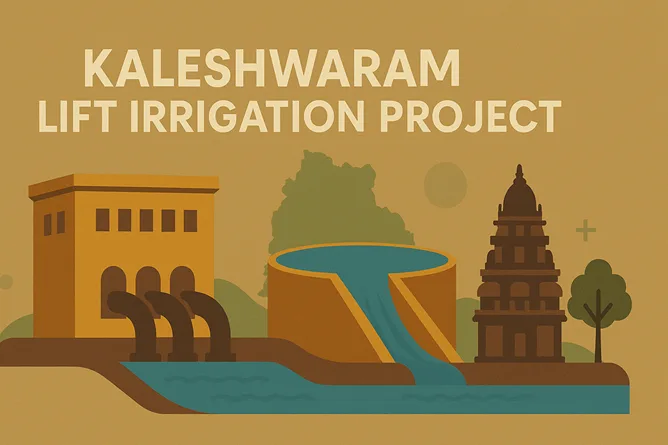
The Kaleshwaram Lift Irrigation Project (KLIP), touted as the lifeline of Telangana, has become mired in controversy due to questions over its conception and execution. Launched by the previous state government, this mega-project promised to transform Telangana’s water landscape. However, within just a few years of its inauguration, a major barrage of the project suffered structural damage and two others developed alarming cracks. These failures have fueled criticism that KLIP, once seen as a game-changer, may instead be a colossal misadventure – a massive public investment that risks burdening the state’s finances for years to come.
What is the Kaleshwaram Lift Irrigation Project?
- Kaleshwaram Lift Irrigation Project (KLIP) is a multi-purpose lift irrigation scheme on the Godavari River in Telangana, designed to pump water to higher-altitude, drought-prone regions.
- It is among the world’s largest multi-stage irrigation systems, spanning ~500 km with 3 barrages, dozens of pump stations, and around 1,800 km of canals. The project plans to utilize about 240 TMC of Godavari water annually (roughly 70% for irrigation, and the rest for cities and industries).
Why was the Kaleshwaram project undertaken?
- Mitigating water scarcity: Telangana often faced droughts while much of its Godavari water flowed unused to the sea. KLIP was conceived to capture this water and channel it to water-scarce regions, ensuring the state’s share is utilized instead of going to waste.
- Boosting agriculture and rural livelihoods: By irrigating nearly 18 lakh acres of farmland, the project aims to enable double-cropping and improve crop yields. This is expected to raise farmers’ incomes, generate rural employment, and reduce the distress migration that occurs from drought-prone villages.
- Urban and industrial water supply: A portion of KLIP’s water is reserved for cities as well as industries. This is expected to secure drinking water for millions of urban residents (for example, reducing Hyderabad’s water shortages in summer) and to provide reliable water for industrial use (ensuring factories and power plants have the water they need). By meeting both household and industrial demand, KLIP supports broader economic development in the state.
Where does the Kaleshwaram project operate?
- Geographical spread: The project is located in the northern Godavari basin of Telangana. It starts at the Godavari’s confluence with the Pranahita (near Kaleshwaram on the Telangana–Maharashtra border) and distributes water across 13 districts of Telangana.
- Water is collected and lifted at three barrages on the Godavari – Medigadda, Annaram, and Sundilla. From there, a network of canals, pipelines, and newly built reservoirs conveys water into the state’s uplands, reaching areas that previously lacked reliable surface water for irrigation or drinking.
When was the Kaleshwaram project conceptualized and implemented?
The project evolved from an earlier plan (Pranahita-Chevella) and was redesigned after Telangana’s formation in 2014. Construction began in 2016 and the first phase was inaugurated in June 2019, with major components completed in about three years. Water deliveries started in 2019 and have been ramped up in stages since then as remaining canals and reservoirs are completed.
Who are the stakeholders and beneficiaries of the Kaleshwaram project?
KLIP was conceived and executed by the Telangana government (under Chief Minister K. Chandrashekar Rao) as its flagship program, implemented by the state irrigation department. It was funded by state resources and loans. The beneficiaries span both rural and urban sectors – farmers in the project’s command area get irrigation for their fields, while city residents (such as those in Hyderabad) receive augmented drinking water supply, and industries gain a dependable water source for their operations.
How does the Kaleshwaram lift irrigation system work?
Multi-stage pumping mechanism: Instead of relying on gravity, KLIP lifts water upward through a chain of pumping stages. Water is first collected at a low barrage on the Godavari, then pumped up through a series of intermediate lifting stations into high-elevation storage reservoirs inland. In total, the project lifts water by roughly 500 meters of elevation. Once at the top reservoirs, water can flow out by gravity through canals to fields and settlements. Operating this massive system is energy-intensive – at full capacity it may require nearly 7,000 MW of electricity to run all the pumps.
How does the Kaleshwaram project compare with the earlier Pranahita-Chevella plan?
| Aspect | Pranahita-Chevella Project (Earlier Plan) | Kaleshwaram Project (Current Plan) |
|---|---|---|
| Irrigation scope | ~16.4 lakh acres in 7 districts; included ~30 TMC drinking water for Hyderabad. | ~18.3 lakh acres in 13 districts; also 30–40 TMC for cities and 16 TMC for industry. |
| Estimated cost | ~₹40,000 crore (initial estimate). | ~₹80,000 crore initially; later ~₹1,00,000+ crore. |
| Lift & energy | Smaller lift (higher intake level) – more gravity flow, low energy needs. | ~500 m total lift (multi-stage) – huge pumping, very high power use. |
What is the significance of the Kaleshwaram project?
- Agricultural and rural benefits: By bringing reliable water to previously rain-fed farms, KLIP enables higher crop production (multiple crops a year instead of one) and improves farm incomes. The surge in agricultural output and activity is expected to boost the rural economy, generating rural employment and raising the standard of living in villages. In the long run, this can reduce rural poverty and curb distress migration of farmers to cities.
- Urban and industrial water supply: A portion of KLIP’s water is reserved for cities as well as industries. This secures drinking water for millions of urban residents (easing chronic shortages in cities like Hyderabad) and provides a reliable water source for industrial use. Factories, power plants, and industrial hubs can count on KLIP water for their operations, which can attract investments and generate jobs in the region.
What are the limitations of the Kaleshwaram project?
- Massive financial burden: The project’s enormous cost (over ₹1 lakh crore) puts pressure on the state budget and raises questions about the high cost-per-acre of irrigation achieved. Telangana faces heavy annual loan repayments (around ₹15,000 crore per year) for KLIP, which could crowd out other development spending.
- High energy consumption: Pumping water nearly half a kilometer up requires tremendous electricity. Running KLIP at capacity demands thousands of megawatts, resulting in steep operating costs. The project depends on continuous power – any interruption or spike in energy cost can disrupt water delivery and undermine its viability.
- Environmental and social impact: Building large reservoirs (like Mallanna Sagar) required land acquisition and uprooted villages, exacting social costs. Inundating forests and fields also altered local ecosystems. Moreover, diverting substantial river water can affect downstream ecology (for instance, by reducing flows in the lower Godavari).
- Maintenance challenges: The complex infrastructure requires diligent upkeep. The Godavari’s silt-heavy waters can lead to sedimentation in the barrage reservoirs, reducing their capacity unless regularly dredged. Maintaining hundreds of mechanical components (pumps, motors, gates) is demanding, and lapses in upkeep could quickly impair the system’s performance.
- Reliability concerns: KLIP’s efficacy is tied to external factors. In a drought year, the Godavari’s flow might be insufficient to meet the project’s designed water draw, leaving the expensive infrastructure underutilized. Similarly, unlike gravity canals, a lift system has no natural flow if pumps stop – if pumps fail, water supply halts immediately. These dependencies make the system less resilient to shocks compared to traditional gravity-fed projects.
What challenges has the Kaleshwaram project faced?
- Engineering and design challenges: The haste to build KLIP meant some design and quality checks may have been compromised. For example, geological surveys were arguably insufficient and flood levels might have been underestimated in design. Technically, executing such a vast project was challenging – constructing huge pump houses deep underground and large barrages in a short span pushed engineering limits. Additionally, the project faced administrative hurdles such as legal scrutiny over rushed clearances and the need to train staff and develop proper maintenance protocols to run this vast system. Heavy floods in initial years further tested the new structures, showing how hard it is to ensure stability under extreme conditions.
- Land acquisition and rehabilitation: Securing thousands of acres for canals and reservoirs was a social challenge. In some areas, locals resisted, seeking better compensation, forcing the government to deal with court cases and protests. Ensuring fair rehabilitation of displaced families has been crucial for equity. Balancing development needs with people’s rights required careful negotiation and added time and cost to the project.
Why is the Kaleshwaram project mired in recent controversy?
- Structural setbacks: In late 2023, a serious structural failure occurred: a portion of the Medigadda barrage sank and cracked, and around the same time, worrying cracks and seepage were noticed in the other two barrages upstream. These failures, so soon after inauguration, raised serious questions about construction quality. A probe by the National Dam Safety Authority (NDSA) found that poor foundation surveys, design flaws, and construction lapses caused the damage in all three barrages.
- Political blame game: The new state government lambasted KLIP as a “colossal failure”, accusing the former regime of negligence in execution and of saddling the state with debt for a flawed project. They cited the barrage collapse as proof and demanded accountability. Meanwhile, the previous government’s leaders defended KLIP, blaming freak floods for the damage and accusing the new regime of politicizing a technical problem. This war of words quickly dominated state headlines.
- Public accountability and action: Observers have questioned whether proper procedures were followed during KLIP’s construction. The government has promised to carry out necessary repairs (strengthening foundations, etc.) as per expert recommendations, and to punish any wrongdoing by contractors or officials. These problems have undeniably tarnished the project’s image.
What is the way forward for the Kaleshwaram project?
- Structural fixes and safety upgrades: The immediate step is to repair and reinforce the damaged barrages and other weak links. This involves possibly rebuilding the failed portion of the Medigadda barrage and strengthening all three barrages (improving foundations, adding seepage controls, etc.). Installing advanced monitoring systems to detect any structural stress early is also crucial. Diligent execution of these fixes is key to restoring the project’s full functionality and safety.
- Accountability and oversight: A thorough review of what went wrong should guide corrective steps, and any officials or contractors responsible for lapses must be held accountable. Going forward, strict adherence to technical standards and greater transparency (peer reviews, independent audits) are essential so that issues are caught and fixed early.
- Financial and operational adjustments: Options include restructuring the project’s debt to reduce interest outgo and adopting cost-saving measures. For instance, dedicating some solar power to run the pumps, which could significantly cut electricity costs. Such steps would improve the project’s financial sustainability.
- Maximizing benefits efficiently: The state should complete all last-mile channels so that the intended farmlands actually receive water. Promoting efficient irrigation techniques (like drip irrigation on KLIP-served farms) will ensure more crop per drop and prevent waste. In short, focusing on efficiency will help Telangana extract the maximum benefit from every drop of water that Kaleshwaram lifts.
In conclusion, the Kaleshwaram Lift Irrigation Project represents a bold effort to secure water for Telangana’s people and farms. It demonstrates what bold engineering can achieve, but also exposes the risks of rushing mega-projects. The setbacks are a cautionary tale that even ambitious, well-intentioned schemes need rigorous planning and quality control. If the current flaws are fixed and lessons learned, KLIP can still deliver much of its promise – turning dry lands fertile and bringing water security to those who need it most.
Q. Critically examine the significance of the Kaleshwaram Lift Irrigation Project for Telangana and the challenges encountered in its implementation. (250 words)

Related Posts


If you like this post, please share your feedback in the comments section below so that we will upload more posts like this.

Responses