Japan’s Sominsai Festival

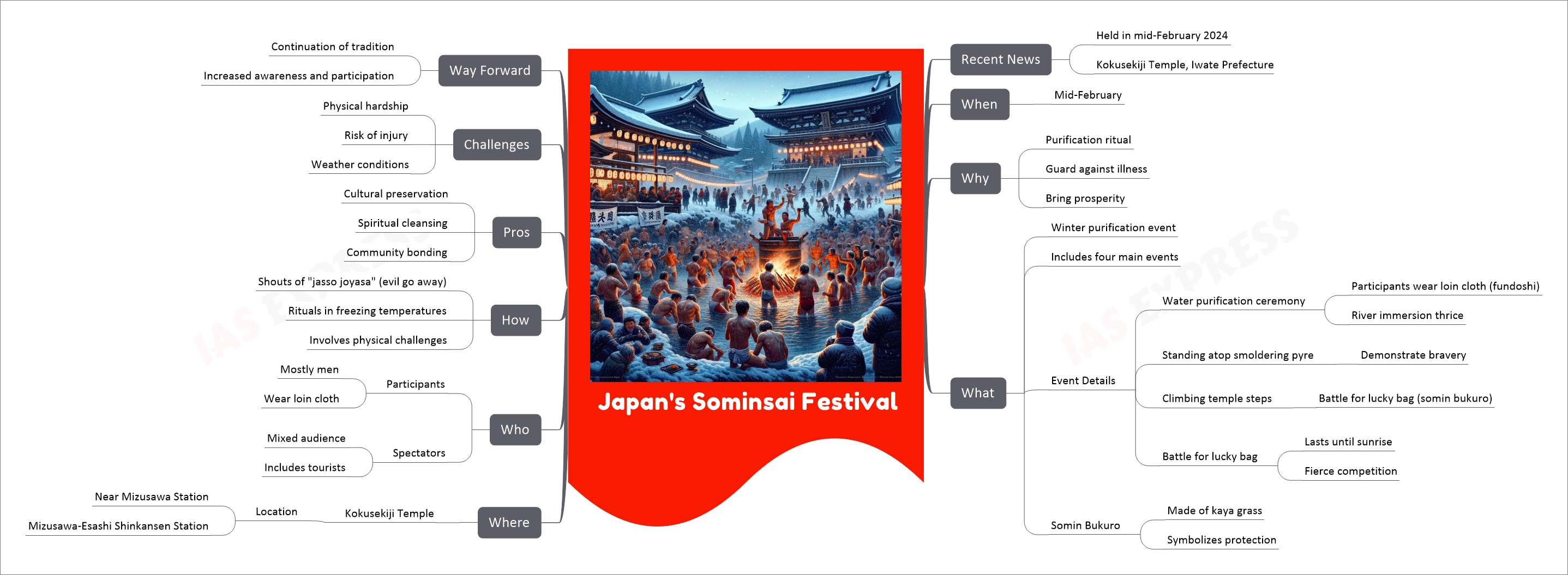
Japan's Sominsai Festival mind map
  Recent News
    Held in mid-February 2024
    Kokusekiji Temple, Iwate Prefecture
  When
    Mid-February
  Why
    Purification ritual
    Guard against illness
    Bring prosperity
  What
    Winter purification event
    Includes four main events
    Event Details
      Water purification ceremony
        Participants wear loin cloth (fundoshi)
        River immersion thrice
      Standing atop smoldering pyre
        Demonstrate bravery
      Climbing temple steps
        Battle for lucky bag (somin bukuro)
      Battle for lucky bag
        Lasts until sunrise
        Fierce competition
    Somin Bukuro
      Made of kaya grass
      Symbolizes protection
  Where
    Kokusekiji Temple
      Location
        Near Mizusawa Station
        Mizusawa-Esashi Shinkansen Station
  Who
    Participants
      Mostly men
      Wear loin cloth
    Spectators
      Mixed audience
      Includes tourists
  How
    Shouts of "jasso joyasa" (evil go away)
    Rituals in freezing temperatures
    Involves physical challenges
  Pros
    Cultural preservation
    Spiritual cleansing
    Community bonding
  Challenges
    Physical hardship
    Risk of injury
    Weather conditions
  Way Forward
    Continuation of tradition
    Increased awareness and participation

Japan’s Sominsai Festival, typically held in mid-February at Kokusekiji Temple in Iwate Prefecture, is a profound winter purification event. It serves as a ritual to guard against illness and to bring prosperity. The festival, which spans the entire night, consists of four main events, including a water purification ceremony where participants immerse themselves in a river, stand atop a smoldering pyre, and partake in a symbolic battle for a lucky bag known as ‘somin bukuro.’ The participants, mostly men wearing traditional loin cloths, endure these rituals in freezing temperatures. The event is characterized by shouts of “jasso joyasa,” meaning “evil go away,” reflecting its purpose as a spiritual cleansing and protective ritual. Despite the physical challenges and risk of injury, the festival is a significant cultural event that fosters community bonding and the preservation of traditional practices.

Related Posts
If you like this post, please share your feedback in the comments section below so that we will upload more posts like this.

Responses

🖍️ Highlight
HomeCoursesPlansAccount