[Newsbits] 21-23.02.2024: BharatGPT, Raisina Dialogue & More

newsbits mindmap notes
Terahertz Tags to Spot Product Tampering mind map
  Recent News
    MIT Researchers' Innovation
      Next-Gen Cryptographic ID Tags
      Utilize Terahertz Waves
  When
    Research and Development Date
      Not specified
  Why
    Combat Product Tampering
      Secure Authenticity
      Prevent Counterfeit Transfer
  What
    Terahertz Tags
      Tiny Size
        Approximately 4 Square Millimeters
      Unique Pattern Creation
        Metallic Particles in Adhesive
        Unreplicable Fingerprint
      Improved Security
        Over Traditional RFIDs
    Machine Learning Model
      Detects Pattern Fingerprints
      Accuracy Over 99%
  Where
    Application Areas
      Items Too Small for RFIDs
        Certain Medical Devices
  Who
    Developers and Contributors
      MIT's Terahertz Integrated Electronics Group
      Energy-Efficient Circuits and Systems Group
    Researchers
      Associate Professor Ruonan Han
      Graduate Student Eunseok Lee
  How
    Operational Mechanism
      Terahertz Waves Detect Unique Pattern
      Initial Reading Stored in Cloud
    Limitations
      High Transmission Loss
      Limited Range
        Close Proximity Requirement
  Significance
    Enhanced Security Features
      Difficult to Duplicate
      Almost Impossible to Transfer
    Potential Applications
      ID, Security, and Authentication
  Challenges
    Range Limitation
      Proximity Requirement for Reading
    Transmission Loss of Terahertz Waves
  Way Forward
    Extension of Terahertz Waves' Reach
      Address Current Limitations
      Broaden Application Scope

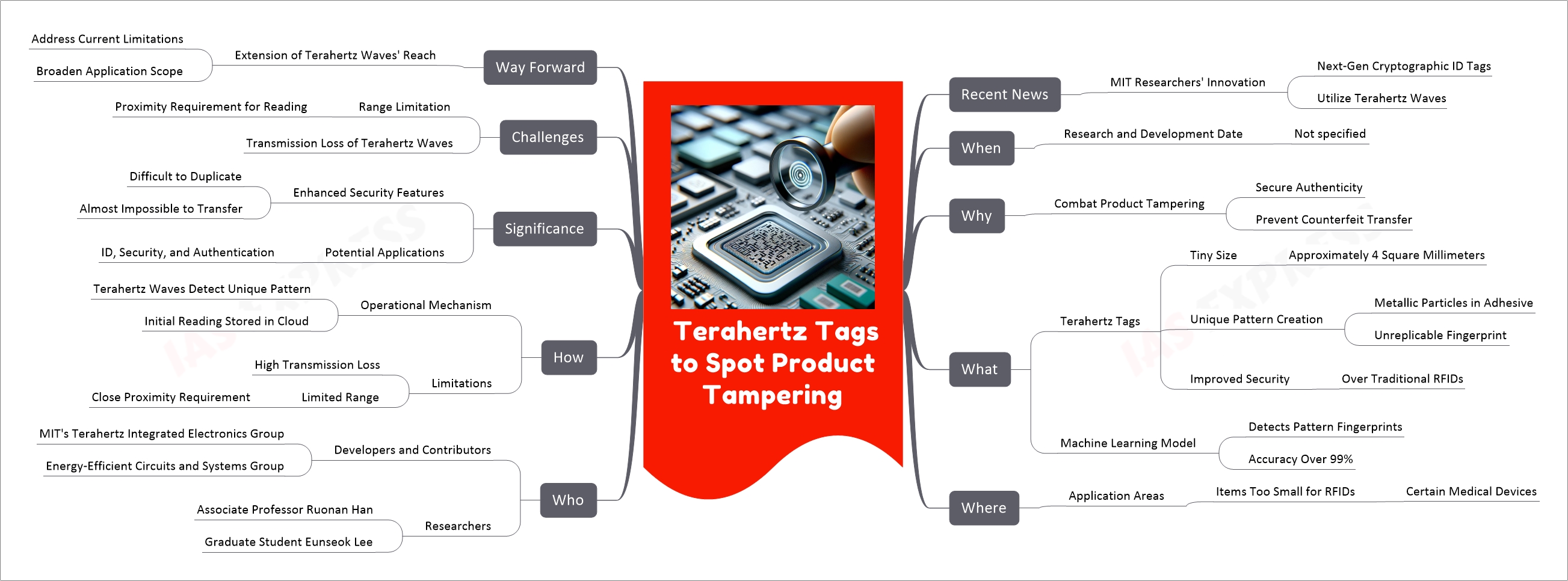
Terahertz tags, developed by MIT researchers, represent a groundbreaking advancement in combating product tampering and counterfeit transfer. These tiny tags, only about 4 square millimeters in size, create a unique, unreplicable pattern using metallic particles in their adhesive, acting like a fingerprint for authentication. They offer enhanced security compared to traditional RFIDs and are especially useful for small items like certain medical devices. The tags are read using terahertz waves, and their authenticity is verified with a machine-learning model boasting over 99% accuracy. However, they do have limitations, such as a short range of effectiveness and high transmission loss. The researchers are working on extending the reach of terahertz waves to overcome these challenges and widen their application in security and authentication.
India Approves 100% FDI in Space Sector mind map
  Recent News
    Union Cabinet approval
      Date
        21 Feb 2024
      Prime Minister
        Shri Narendra Modi
      Source
        Press Information Bureau (PIB) Delhi
  When
    Policy Announcement
      Date
        21 Feb 2024
  Why
    Vision
      Atmanirbhar Bharat
    Economic Growth
      Investment Increase
      Income Boost
      Employment Generation
  What
    Satellite Sub-Sector
      Division
        Three Activities
    FDI Limit
      Satellites-Manufacturing & Operation
        Up to 74% (Automatic route)
      Launch Vehicles, Spaceports
        Up to 49% (Automatic route)
      Components Manufacturing
        100% (Automatic route)
  Where
    Application
      Indian Space Sector
  Who
    Union Cabinet
    Prime Minister
      Shri Narendra Modi
    Regulatory Body
      IN-SPACe
        Indian National Space Promotion and Authorization Centre
  How
    Policy Reform
      Enhancing Business Ease
      FDI Inflow Contribution
    Private Sector Role
      From Vendor to Collaborator
    Government Initiatives
      Level Playing Field Creation
  Significance
    Economic Benefits
      Employment Creation
      Technology Absorption
    Global Integration
      Indian Companies
      Global Value Chains
    Initiatives Support
      Make In India
      Atmanirbhar Bharat
  Challenges
    Market Dominance Risk
      Foreign Companies
      Local Competitors Squeeze Out
    Economic Vulnerability
      Excessive Foreign Dependence
    National Security
      Regulatory Framework Importance
  Way Forward
    Balanced Regulation
      Investment Attraction
      National Interest Protection

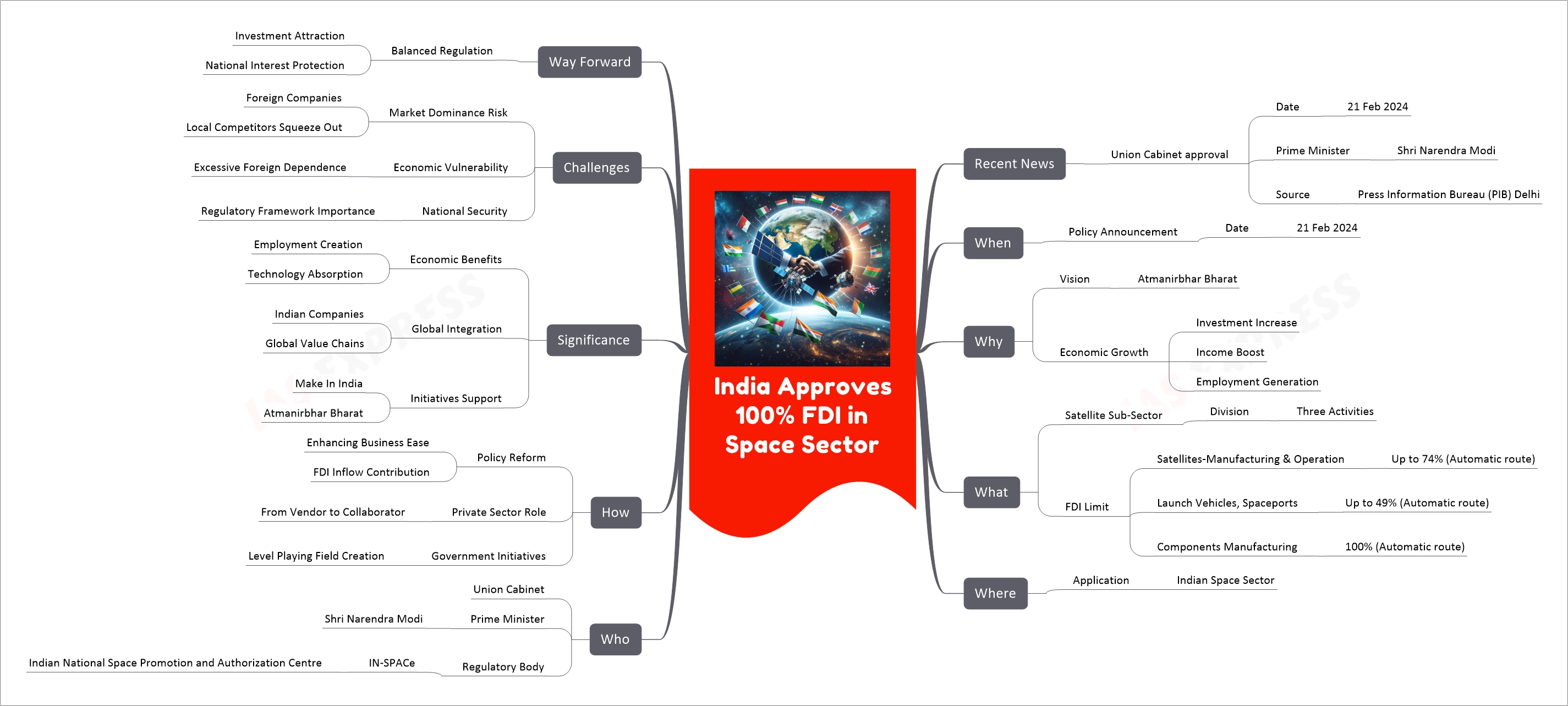
The Indian government’s recent policy to approve 100% Foreign Direct Investment (FDI) in the space sector marks a significant shift towards liberalizing the sector. Announced on February 21, 2024, the policy aims to bolster the Atmanirbhar Bharat vision by increasing investment, income, and employment. It categorizes investment opportunities in the space sector into three segments, allowing different levels of FDI under automatic and government routes. The policy, overseen by the Indian National Space Promotion and Authorization Centre (IN-SPACe), aims to transform the role of private players from mere vendors to collaborators in space activities. While the move promises economic benefits and global integration, it also raises concerns about potential market dominance by foreign companies and the need for balanced regulations to protect national interests.
Raisina Dialogue Conference 2024 mind map
  When
    February 21-23, 2024
  Where
    New Delhi, India
  Who
    Organisers
      Observer Research Foundation
      Ministry of External Affairs, India
    Participants
      Prime Minister Narendra Modi
      Greek Prime Minister Kyriakos Mitsotakis
      Former Heads of State
      Serving Ministers
      Military Commanders
      Industry Leaders
      Technology Innovators
      Academics
      Journalists
      Strategic Affairs Scholars
      Representatives from 100+ countries
  Why
    Addressing global challenges
    Fostering international cooperation
  What
    Thematic Pillars
      Tech Frontiers
        Regulations & Realities
      Peace with the Planet
        Invest & Innovate
      War & Peace
        Armouries & Asymmetries
      Decolonising Multilateralism
        Institutions & Inclusion
      Post-2030 Agenda
        People & Progress
      Defending Democracy
        Society & Sovereignty
  How
    Multi-stakeholder, cross-sectoral discussions
    Digital and in-person participation
    Over 2500 in-person participants
    Millions engaging via digital platforms
  Significance
    Promotes global dialogue
    Encourages cross-sectoral cooperation
    Platform for varied international perspectives
  Challenges
    Managing diverse viewpoints
    Implementing outcomes globally
  Way Forward
    Continued international dialogue
    Collaboration on shared global issues

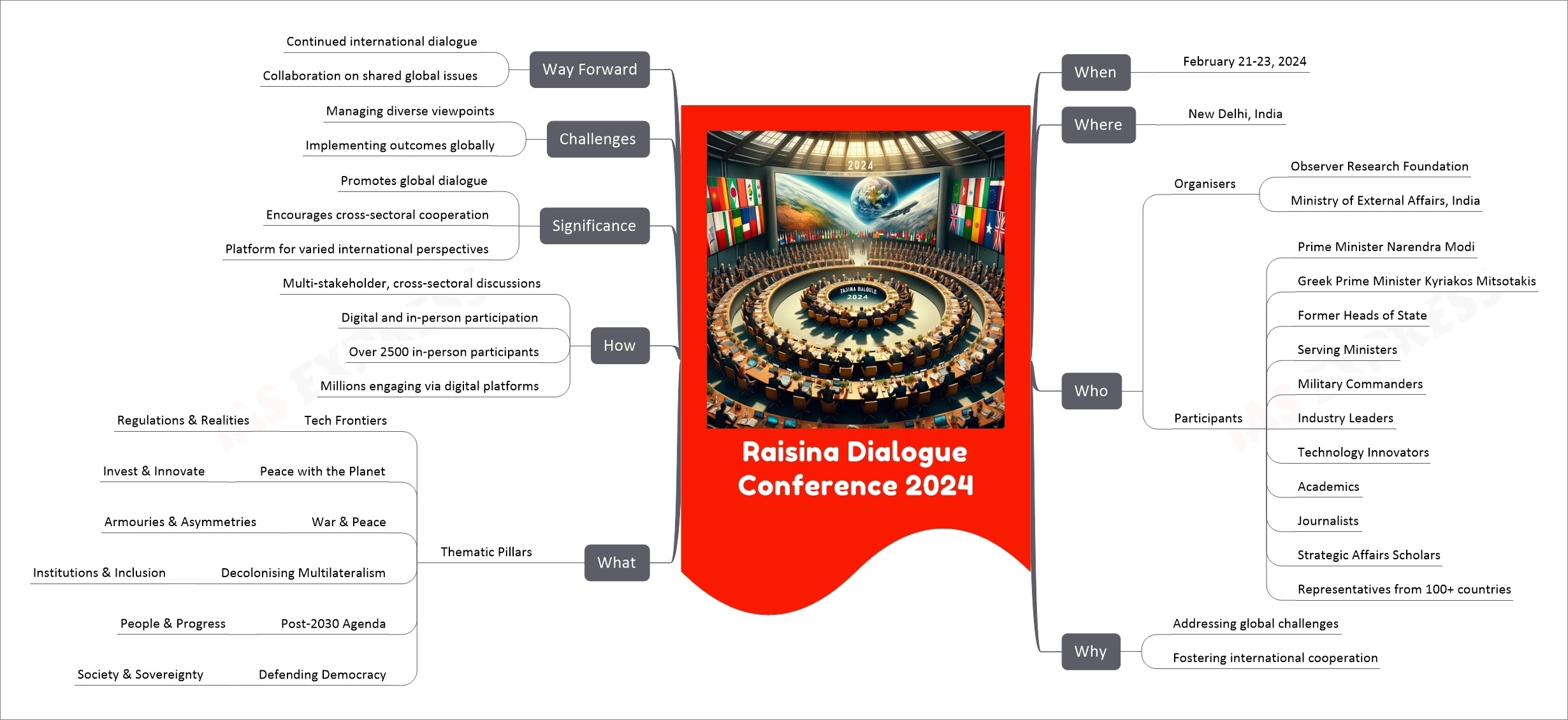
The Raisina Dialogue Conference 2024, held from February 21-23 in New Delhi, is a prominent international forum on geopolitics and geo-economics. Organized by the Observer Research Foundation and India’s Ministry of External Affairs, it brings together global leaders, including India’s Prime Minister Narendra Modi and Greek Prime Minister Kyriakos Mitsotakis. The conference focuses on pressing global issues through six thematic pillars: technological advancements, environmental sustainability, contemporary warfare, redefining multilateralism, future development agendas, and the resilience of democracy. It facilitates multi-stakeholder discussions with over 2500 participants and millions engaging digitally, highlighting its importance as a platform for international cooperation and dialogue on critical world matters.
BharatGPT mind map
  Recent News
    Launched by CoRover.ai
    Collaboration with Reliance Jio, IIT Bombay
  When
    Launched in 2024
  Why
    To create India-centric AI
    Address linguistic diversity in India
  What
    Generative AI
      Text, Voice, Video capabilities
    Multilingual Support
      Over 12 Indian languages
      Empowering diverse communication
    Omni-Channel Platform
      Integration with web, WhatsApp, Facebook Messenger
    Data Localisation
      Data kept within India
    Fine-Tuned for Indian Users
      Tailored to Indian market and user behavior
  Where
    Developed and Hosted in India
  Who
    Collaborators
      IIT Bombay
      Other IITs and IIITs
      IIM Indore
      Seetha Mahalaxmi Healthcare (SML)
    Key Personalities
      Prof. Narendra Ahuja, University of Illinois
      Prof. Bhiksha Raj, Carnegie Mellon University
      Akash Ambani, Reliance Jio
      Saurabh Kumar Chaubey, IIITD Foundation
  How
    Utilizes CoRover's Conversational AI platform
    Multi-layered NLP approach
    Focus on data security and efficiency
  Significance
    Addresses India's language diversity
    Data security with localisation
    Boost to Indian AI ecosystem
    Tailored for Indian context and users
  Challenges
    Computational resource demands
    Data quality and biases
    Domain-specific adaptation
  Way Forward
    Expansion into various business sectors
      Primarily telecom and retail
    Integration with Reliance Jio services
      Including media, commerce, communication
    Development of Indian AI operating systems
      E.g., for television

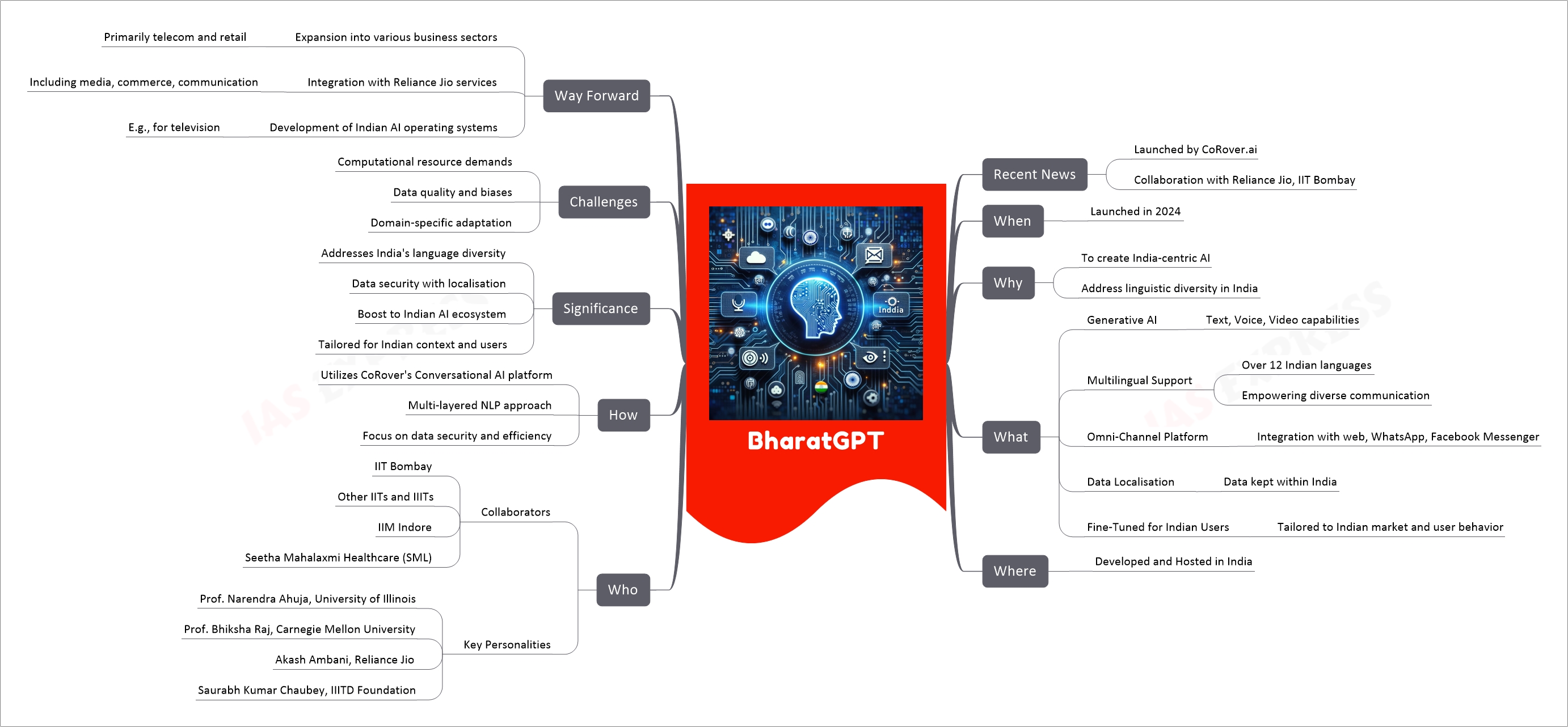
BharatGPT, developed by CoRover.ai in collaboration with Reliance Jio and several Indian institutes of technology like IIT Bombay, represents a significant step in India’s journey towards creating a tailored AI ecosystem. This generative AI platform is unique in its multilingual capabilities, supporting over 12 Indian languages, and is fine-tuned specifically for the Indian user base. It stands out for its data localization commitment, ensuring that all data remains within India’s borders, thereby aligning with the country’s data security and privacy norms. BharatGPT is versatile in its application, supporting text, voice, and video, and is designed to cater to diverse sectors, with a particular focus on telecom and retail, fields where Reliance is a key player.
/ Governance
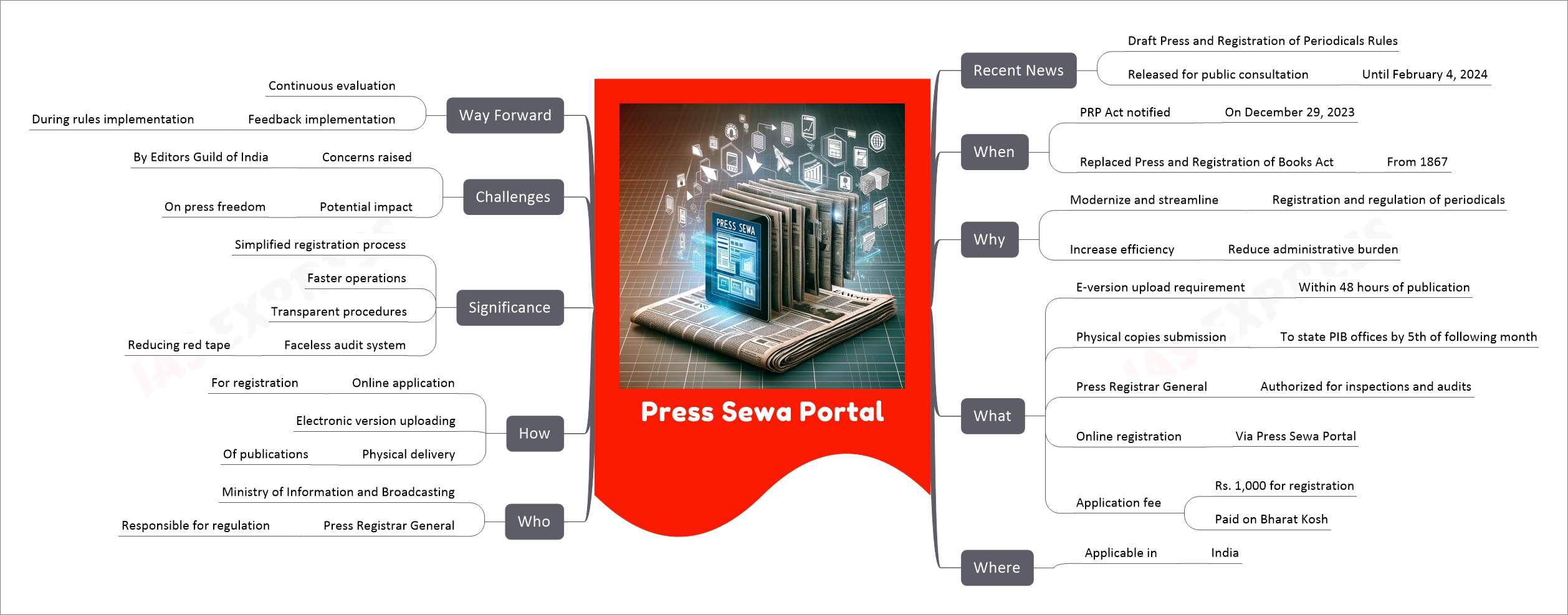
Press Sewa Portal mind map
  Recent News
    Draft Press and Registration of Periodicals Rules
    Released for public consultation
      Until February 4, 2024
  When
    PRP Act notified
      On December 29, 2023
    Replaced Press and Registration of Books Act
      From 1867
  Why
    Modernize and streamline
      Registration and regulation of periodicals
    Increase efficiency
      Reduce administrative burden
  What
    E-version upload requirement
      Within 48 hours of publication
    Physical copies submission
      To state PIB offices by 5th of following month
    Press Registrar General
      Authorized for inspections and audits
    Online registration
      Via Press Sewa Portal
    Application fee
      Rs. 1,000 for registration
      Paid on Bharat Kosh
  Where
    Applicable in
      India
  Who
    Ministry of Information and Broadcasting
    Press Registrar General
      Responsible for regulation
  How
    Online application
      For registration
    Electronic version uploading
    Physical delivery
      Of publications
  Significance
    Simplified registration process
    Faster operations
    Transparent procedures
    Faceless audit system
      Reducing red tape
  Challenges
    Concerns raised
      By Editors Guild of India
    Potential impact
      On press freedom
  Way Forward
    Continuous evaluation
    Feedback implementation
      During rules implementation

The Press Sewa Portal, introduced under the Press and Registration of Periodicals Act, 2023 by the Indian Ministry of Information and Broadcasting, is a digital platform designed to streamline the registration and regulation of periodicals in India. It mandates publishers to upload e-versions of their publications within 48 hours and submit physical copies monthly to the Press Information Bureau. Aimed at modernizing the process and making it more efficient, the portal also allows for faceless audits and inspections by the Press Registrar General. While it promises operational efficiency and transparency, concerns have been raised about its potential impact on press freedom.
/ Diseases
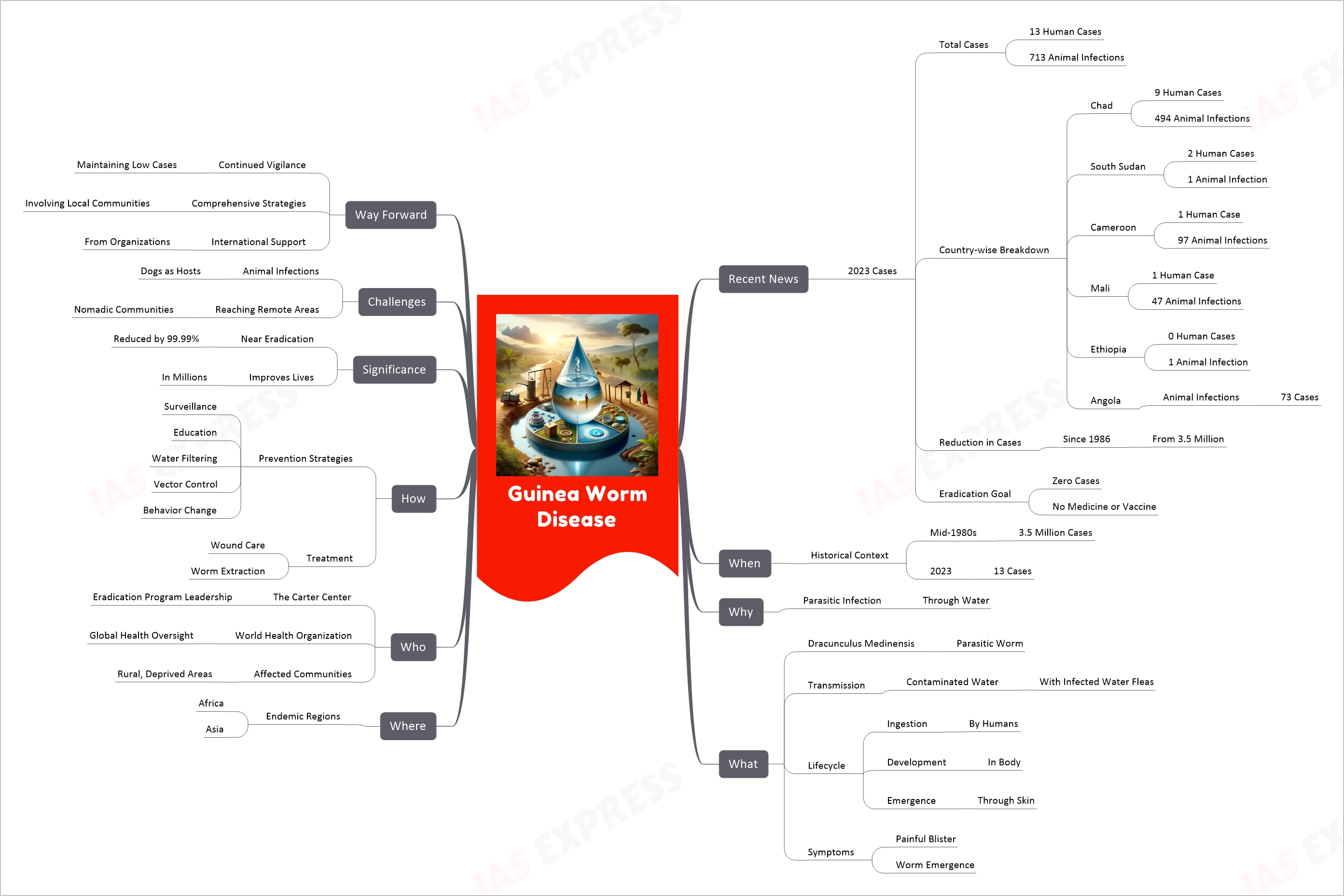
Guinea Worm Disease mind map
  Recent News
    2023 Cases
      Total Cases
        13 Human Cases
        713 Animal Infections
      Country-wise Breakdown
        Chad
          9 Human Cases
          494 Animal Infections
        South Sudan
          2 Human Cases
          1 Animal Infection
        Cameroon
          1 Human Case
          97 Animal Infections
        Mali
          1 Human Case
          47 Animal Infections
        Ethiopia
          0 Human Cases
          1 Animal Infection
        Angola
          Animal Infections
            73 Cases
      Reduction in Cases
        Since 1986
          From 3.5 Million
      Eradication Goal
        Zero Cases
        No Medicine or Vaccine
  When
    Historical Context
      Mid-1980s
        3.5 Million Cases
      2023
        13 Cases
  Why
    Parasitic Infection
      Through Water
  What
    Dracunculus Medinensis
      Parasitic Worm
    Transmission
      Contaminated Water
        With Infected Water Fleas
    Lifecycle
      Ingestion
        By Humans
      Development
        In Body
      Emergence
        Through Skin
    Symptoms
      Painful Blister
      Worm Emergence
  Where
    Endemic Regions
      Africa
      Asia
  Who
    The Carter Center
      Eradication Program Leadership
    World Health Organization
      Global Health Oversight
    Affected Communities
      Rural, Deprived Areas
  How
    Prevention Strategies
      Surveillance
      Education
      Water Filtering
      Vector Control
      Behavior Change
    Treatment
      Wound Care
      Worm Extraction
  Significance
    Near Eradication
      Reduced by 99.99%
    Improves Lives
      In Millions
  Challenges
    Animal Infections
      Dogs as Hosts
    Reaching Remote Areas
      Nomadic Communities
  Way Forward
    Continued Vigilance
      Maintaining Low Cases
    Comprehensive Strategies
      Involving Local Communities
    International Support
      From Organizations

Guinea worm disease, caused by the parasitic worm Dracunculus medinensis, is a crippling ailment transmitted through drinking water contaminated with infected water fleas. Once prevalent with 3.5 million cases in the mid-1980s across Africa and Asia, the disease has seen a dramatic reduction, with only 13 human cases reported worldwide in 2023. The Carter Center, leading the eradication efforts since 1986, has brought the disease to the brink of eradication without the use of medicine or vaccines, relying instead on community-based interventions like surveillance, education, water filtering, and vector control. Although the disease is rarely fatal, it leads to severe disability and affects the most deprived and isolated communities. The final push towards complete eradication faces challenges such as animal infections, especially in dogs, and reaching remote or nomadic communities.

If you like this post, please share your feedback in the comments section below so that we will upload more posts like this.

Responses

🖍️ Highlight
HomeCoursesPlansAccount