
The Saudi-Pakistan Defence Pact: A New Regional Order

From Current Affairs Notes for UPSC » Editorials & In-depths » This topic
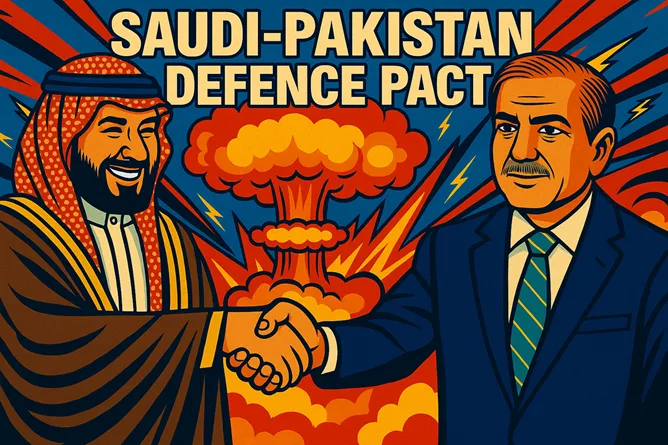
The recent signing of a mutual defence pact between Saudi Arabia and Pakistan marks a pivotal moment in West Asian geopolitics, formalising decades of informal military cooperation into a binding strategic alliance. Its timing is critical, coming just days after Israel’s unprecedented bombing of Doha and amidst growing doubts over America’s security guarantees to the Gulf monarchies. With the ongoing war in Gaza, Iran-backed Houthis demonstrating their military power, and a perceived American retrenchment from the region, Saudi Arabia is actively hedging its bets. For Pakistan, a nation with a formidable military but grappling with severe economic challenges, this pact is a timely opportunity to assert itself as a principal security provider and secure vital economic support, heralding a significant shift in the regional security architecture.
What are the key features of this defence agreement?
- Core Principle of Mutual Defence
- The cornerstone of the pact is a collective security clause, which unequivocally states that any aggression against either country shall be considered an aggression against both.
- This transforms a historically strong but informal relationship into a formal, binding strategic alliance, elevating the commitment from goodwill to a treaty obligation.
- Comprehensive Military Cooperation
- According to senior officials, the agreement is a “comprehensive defensive agreement that encompasses all military means,” a deliberately broad phrasing.
- This language has fueled widespread interpretation that the pact provides Saudi Arabia with a de-facto nuclear umbrella from Pakistan, the sole nuclear-armed state in the Muslim world.
- It also paves the way for deeper collaboration in the defence industry, including joint military production, technology transfer, and shared research and development initiatives.
- Formalisation of Long-Standing Existing Ties
- This pact institutionalises a security partnership that traces its origins back to the 1960s.
- Pakistan has consistently maintained a military presence in the Kingdom, with an estimated 1,500 to 2,000 troops currently deployed in various training and advisory capacities.
- Both nations have a history of conducting regular joint military exercises, such as the “Naseem Al-Bahr” naval drills and the “Al-Samsam” land force exercises, which are now set to expand in scope and complexity.
Why was this strategic pact signed at this particular time?
- For Saudi Arabia: Diversifying Security and Countering Regional Threats
- Waning Confidence in the United States: There is a growing perception among Gulf monarchies that the United States is no longer a fully reliable security guarantor, a sentiment that has been building since the US response to previous attacks on Saudi oil infrastructure.
- Heightened Regional Insecurity: The timing was profoundly influenced by recent geopolitical shocks. The Israeli airstrike on Doha, Qatar, on September 9, 2025, was a watershed moment, demonstrating that even a wealthy Gulf capital was vulnerable and accelerating the finalisation of the pact.
- Deterrence Against Iran: The agreement serves as a powerful strategic counterweight to Iran and its advancing nuclear program. The alliance sends a clear message that if Iran crosses the nuclear threshold, Saudi Arabia has a credible and powerful partner to rely on.
- Countering the Houthi Threat: Years of persistent drone and missile attacks from Houthi rebels in Yemen have exposed vulnerabilities in Saudi Arabia’s expensive air defence systems, compelling Riyadh to seek more robust and layered security partnerships.
- For Pakistan: Securing Economic Gain and Reinforcing Strategic Relevance
- Overriding Economic Imperatives: Pakistan is facing a severe economic crisis. The pact is widely seen as a gateway to unlocking substantial Saudi investment, crucial financial aid packages, and favourable deferred oil payment facilities, providing a vital economic lifeline.
- Projecting Power as a Security Provider: The agreement allows Pakistan, with its large, disciplined, and combat-experienced military, to formally position itself as a key security provider for the broader Muslim world, particularly for the Gulf states.
- Strategic Balancing Act: The alliance enhances Pakistan’s strategic weight in a region where its primary rival, India, has been making significant diplomatic and economic inroads, particularly with the Gulf monarchies.
- Opportunities for Military Modernisation: Closer military integration provides the Pakistani military with invaluable exposure to sophisticated Western military hardware in the Saudi arsenal. This offers unique training opportunities, for instance, against platforms like the Rafale fighter jet, which is also operated by the Indian Air Force.
How will this defence pact likely be operationalised?
- Expansion of Joint Military Activities and Exercises
- The pact is expected to immediately increase the frequency, scale, and complexity of joint military exercises covering all three services—land, air, and sea.
- This will involve building upon existing drills, such as the “Al-Battar” exercises for special forces and the “Zilzal” series for air forces, and introducing more integrated, multi-domain war games.
- Increased Troop Deployment and Integrated Training
- The number of Pakistani military personnel deployed in Saudi Arabia for training, advisory, and internal security roles is likely to see a significant increase.
- This builds on a long history of cooperation; Pakistan has already trained over 8,000 Saudi military personnel since the 1960s, and this program is set to be expanded and deepened under the new agreement.
- Deepening Defence Industrial and Technological Cooperation
- A key goal of the agreement is to transition the relationship from a simple arms buyer-seller dynamic to one of joint production and development of military hardware.
- This could see Pakistan contributing its established expertise in areas like missile technology and small arms manufacturing, while Saudi Arabia provides the vast capital required for research, development, and large-scale manufacturing.
What are the immediate implications for India’s strategic interests?
- Complicating Strategic and Military Calculations
- The pact’s mutual defence clause directly impacts India’s strategic calculus regarding Pakistan. Any future military confrontation with Pakistan could theoretically invoke the clause, potentially drawing a response from Saudi Arabia, whether diplomatic, economic, or military.
- This development significantly raises the stakes for any potential conflict and complicates India’s established deterrence posture and military planning scenarios, particularly concerning a two-front threat.
- A Test for India’s Diplomatic Relationships
- India has meticulously cultivated a robust strategic partnership with Saudi Arabia in recent years, which is now one of its top trading partners with bilateral trade reaching approximately USD 42.98 billion in the 2023-24 fiscal year.
- This pact puts that relationship to the test. While Saudi Arabia has been quick to reassure India that its partnership with New Delhi remains strong, the Indian government will be watching vigilantly to see how Riyadh balances its new treaty obligations to Pakistan with its deep-rooted economic and strategic ties with India. The official Indian response has been cautious, stating it “will study the implications of this development for our national security.”
- Potential for New Diplomatic Leverage and Mediation
- On the other hand, some analysts argue that Saudi Arabia’s immense economic interdependence with India makes it highly improbable that it would take a military side with Pakistan in a conflict.
- Riyadh could leverage its unique position of being a close partner to both South Asian rivals to act as a mediator, playing a crucial role in de-escalating future crises rather than fueling them.
How does this formal alliance compare to the previous informal one?
| Dimension | Pre-Pact Relationship (Informal Alliance) | Post-Pact Relationship (Formal Alliance) |
|---|---|---|
| Defence Commitment | Informal security cooperation, based on unwritten understandings and mutual goodwill. Pakistani troops were present in advisory and training roles. | Formal and binding mutual defence clause. An attack on one is explicitly defined as an attack on both, demanding a collective response. |
| Nuclear Dimension | Highly speculative and unconfirmed reports of a secret “nuclear-for-oil” understanding. | Stronger implication of a de-facto nuclear umbrella, though not explicitly stated in the public domain. The pact’s reference to “all military means” is seen as a coded reference. |
| Regional Role | Pakistan acted as a background security partner and a source of manpower; Saudi Arabia was primarily an economic benefactor and a source of financial aid. | Pakistan’s role is elevated to that of a formal security guarantor. Saudi Arabia gains a powerful, non-Western military ally to project power. |
| Economic Ties | Primarily a transactional, donor-recipient relationship. Saudi Arabia provided financial bailouts and oil on deferred payments to Pakistan during economic crises. | A more strategic economic partnership is envisioned, with a focus on long-term Saudi investment in key sectors of Pakistan’s economy like energy, agriculture, and infrastructure. |
| Geopolitical Alignment | Both countries were traditionally aligned with the US, but with increasing divergences and questions about American commitment. | Signals a clear and deliberate step towards security diversification away from a sole reliance on the US, contributing to the formation of a new regional security bloc. |
What are the potential limitations and challenges ahead for this pact?
- The Inherent Risk of Regional Entanglement
- The pact creates a significant risk of mutual entanglement in regional conflicts. Pakistan, which has historically tried to avoid taking sides in the Saudi-Iran rivalry, could now be drawn into Saudi Arabia’s conflicts with Iran or its regional proxies.
- Conversely, Saudi Arabia is now formally tied to the volatile India-Pakistan dynamic, a situation it has managed from a diplomatic distance in the past. This complicates its balancing act in South Asia.
- Ambiguity in the Clause of Implementation
- The practical application of the mutual defence clause remains untested and ambiguous. History is replete with examples of defence pacts that did not guarantee automatic military intervention in a crisis.
- Ultimately, national interests at the time of a crisis will dictate each country’s response. The interpretation of what constitutes “aggression” will be a critical, and potentially contentious, point.
- Adverse Reactions from Other Regional and Global Powers
- The pact will undoubtedly be viewed with deep concern in Tehran and Tel Aviv, potentially escalating regional arms races and proxy warfare.
- It also sends a powerful message to Washington about the declining perception of its reliability as a security partner, which could have long-term repercussions for US influence and force projection in the Middle East.
What is the most probable way forward for this alliance?
- Strengthening Military and Institutional Integration
- In the short term, both nations will focus on institutionalising their cooperation. This will involve establishing a permanent joint military committee to hold regular high-level meetings and oversee the pact’s implementation.
- A primary focus will be on enhancing interoperability between their armed forces through more complex, integrated, and frequent joint exercises.
- A Sharp Focus on Tangible Economic Deliverables
- For the alliance to be sustainable, particularly from Pakistan’s perspective, it must be cemented with tangible economic benefits.
- The successful and timely rollout of the promised multi-billion-dollar Saudi investments into Pakistan’s economy will be a key barometer of the pact’s long-term health and viability.
- Navigating a Complex and Tense Diplomatic Landscape
- Both Saudi Arabia and Pakistan will need to engage in a very careful and sophisticated diplomatic balancing act.
- This will involve managing the anxieties and concerns of other major powers who have a stake in the region, most notably India, Iran, and the United States, to prevent the alliance from becoming a source of instability.
Conclusion
The Saudi-Pakistan defence pact is far more than a simple formalisation of a long-standing friendship; it is a shrewd and calculated geopolitical manoeuvre in response to a rapidly evolving and increasingly uncertain global order. For Saudi Arabia, it represents a cornerstone in its strategy to build a more autonomous security framework, less dependent on the United States and anchored by a formidable regional military power. For Pakistan, it offers a crucial economic lifeline and an opportunity to reassert its strategic importance on the world stage. However, this powerful new alliance is also laden with significant challenges and risks. It introduces new layers of complexity into the volatile politics of both West and South Asia, creating fresh lines of potential conflict even as it aims to establish a stronger deterrent. For India and other key regional actors, the pact is a clear signal that the strategic sands are shifting, necessitating a careful and dynamic recalibration of foreign and security policies for the new realities ahead.
Q. Analyze the impact of the Saudi-Pakistan defense pact on West Asia’s strategic balance and India’s foreign policy choices. (250 words)

Related Posts


If you like this post, please share your feedback in the comments section below so that we will upload more posts like this.

Responses