Revised Community Radio Station Guidelines

Revised Community Radio Station Guidelines mind map

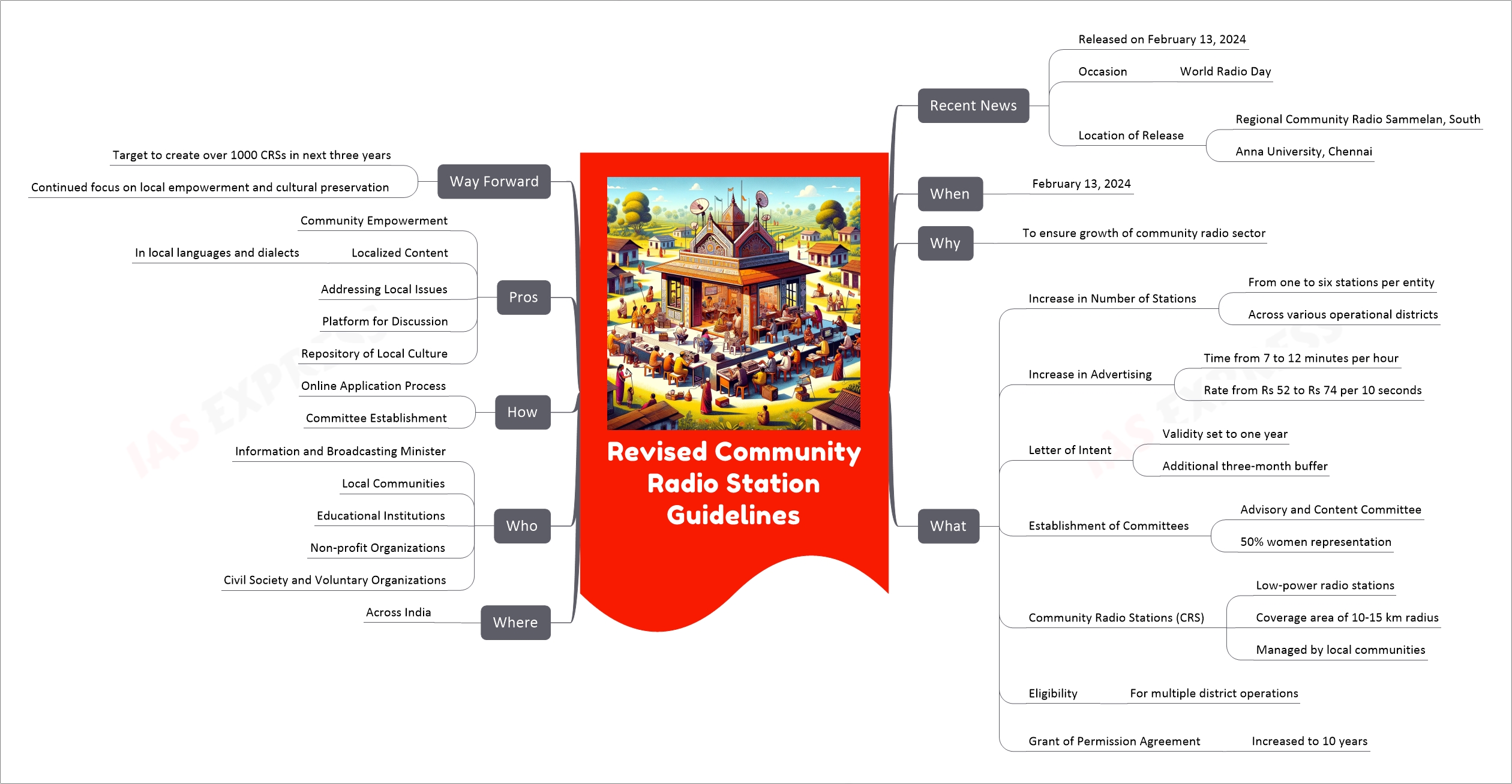
  Recent News
    Released on February 13, 2024
    Occasion
      World Radio Day
    Location of Release
      Regional Community Radio Sammelan, South
      Anna University, Chennai
  When
    February 13, 2024
  Why
    To ensure growth of community radio sector
  What
    Increase in Number of Stations
      From one to six stations per entity
      Across various operational districts
    Increase in Advertising
      Time from 7 to 12 minutes per hour
      Rate from Rs 52 to Rs 74 per 10 seconds
    Letter of Intent
      Validity set to one year
      Additional three-month buffer
    Establishment of Committees
      Advisory and Content Committee
      50% women representation
    Community Radio Stations (CRS)
      Low-power radio stations
      Coverage area of 10-15 km radius
      Managed by local communities
    Eligibility
      For multiple district operations
    Grant of Permission Agreement
      Increased to 10 years
  Where
    Across India
  Who
    Information and Broadcasting Minister
    Local Communities
    Educational Institutions
    Non-profit Organizations
    Civil Society and Voluntary Organizations
  How
    Online Application Process
    Committee Establishment
  Pros
    Community Empowerment
    Localized Content
      In local languages and dialects
    Addressing Local Issues
    Platform for Discussion
    Repository of Local Culture
  Way Forward
    Target to create over 1000 CRSs in next three years
    Continued focus on local empowerment and cultural preservation

The Revised Community Radio Station Guidelines, released in February 2024, mark a significant step towards the expansion and empowerment of community radio in India. These guidelines increase the number of stations an entity can operate, raise advertising time and rates, and mandate the formation of committees with local community representation, including a 50% quota for women. They aim to strengthen local voices and address community-specific issues through radio broadcasting in local languages and dialects, thus fostering community engagement and cultural preservation.

Related Posts

If you like this post, please share your feedback in the comments section below so that we will upload more posts like this.

Responses

🖍️ Highlight
HomeCoursesPlansAccount