
India-US Corn Trade: A Deep Dive into Tariffs, Technology, and Tensions

From Current Affairs Notes for UPSC » Editorials & In-depths » This topic
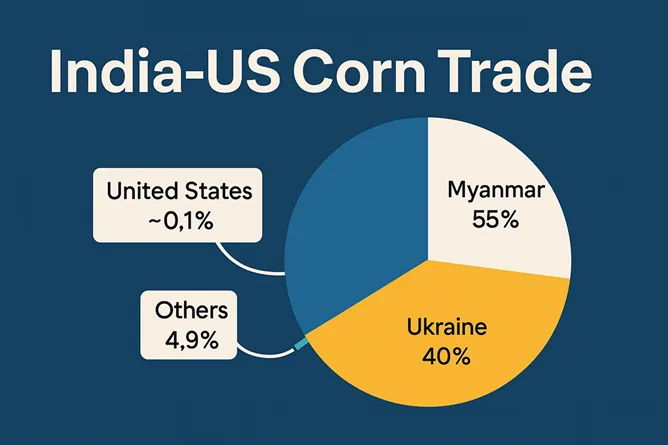
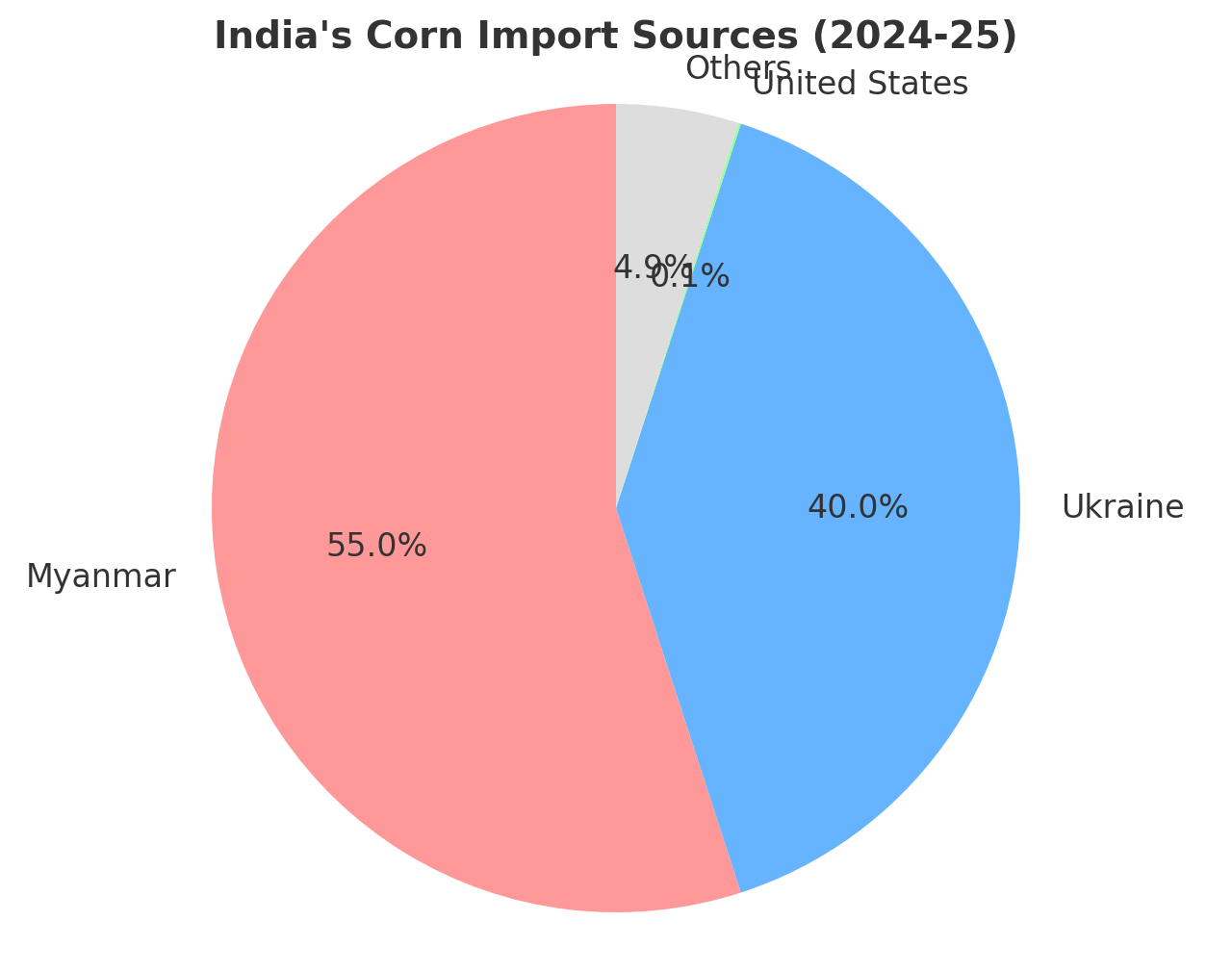
The intricate relationship between India and the United States has recently found a new point of friction: corn. A seemingly simple agricultural commodity has become a symbol of a larger trade imbalance and conflicting national priorities. The issue was sharply highlighted by recent remarks from US Commerce Secretary Howard Lutnick, who questioned why India, a nation of 1.4 billion people, imports a minuscule amount of American corn. In the 2024-25 period, India’s corn imports were dominated by Myanmar and Ukraine, with the US contributing a mere 1,100 tonnes out of nearly a million tonnes. This report unpacks the multifaceted reasons behind this trade dynamic, exploring the policies, economic drivers, and political sensitivities that define this complex agricultural standoff.
What is the Current Corn Trade Scenario?
- India’s Shift in Market Position
- Historically, India was a corn exporter, but it has recently turned into a net importer.
- This shift is primarily driven by a surge in domestic demand, especially from two key sectors:
- The poultry industry, which requires corn for animal feed.
- The burgeoning ethanol production sector, as the government aggressively pursues its ethanol blending program (EBP) to reduce dependency on fossil fuels.
- India’s Import Sources
- Despite being a global agricultural powerhouse, the US is not a significant source of corn for India.
- In the 2024-25 fiscal year, India’s total corn imports stood at 0.97 million tonnes.
- The breakdown of these imports clearly shows a preference for other nations:
- Myanmar was the largest supplier, providing 0.53 million tonnes.
- Ukraine followed, with 0.39 million tonnes.
- The United States supplied an insignificant 1,100 tonnes.
- India’s Domestic Production Landscape
- India is one of the world’s top corn producers, with annual production figures hovering between 37 and 42 million metric tons.
- The majority of corn cultivation in India is undertaken by small and marginal farmers, making the sector politically and economically sensitive.
- The government provides a Minimum Support Price (MSP) for corn, which for the 2025-26 crop is around Rs 24 per kg, often higher than prevailing international prices for US corn (which can be as low as Rs 15 per kg).
Why Does India Restrict US Corn Imports?
- The Genetically Modified (GM) Red Line
- The single most significant barrier is India’s firm policy against genetically modified organisms (GMOs) in its food chain.
- India prohibits the import of GM food crops, including corn, as a matter of principle to protect its biodiversity, food safety, and seed sovereignty.
- This policy directly clashes with the American agricultural model:
- An estimated 94% of all corn grown in the United States is genetically modified. This makes the vast majority of the US corn supply ineligible for import into India under current rules.
- Even proposals to allow GM corn strictly for animal feed or industrial use have been rejected due to fears of contamination and backdoor entry into the food supply chain.
- A Structure of High Tariffs
- India employs a Tariff Rate Quota (TRQ) system for corn imports, which acts as a major economic deterrent.
- The policy has two tiers:
- A relatively low tariff of 15% is applied to the first 0.5 million tonnes of imported corn annually.
- Any import quantity beyond this quota is hit with a very steep 50% duty.
- This high tariff makes large-scale imports from distant and already cost-effective producers like the US commercially unviable for Indian buyers.
- Protection of Domestic Farmers
- A core objective of India’s agricultural policy is to shield its millions of smallholder farmers from global price shocks and competition from heavily subsidized foreign agriculture.
- Allowing unrestricted access to cheap, subsidized American corn could lead to a price crash in the domestic market, severely impacting the livelihoods of Indian farmers.
What is the Recent Lutnick Controversy?
- The Sharp Public Rebuke
- In September 2025, the trade friction escalated significantly following pointed remarks from US Commerce Secretary Howard Lutnick.
- He publicly questioned India’s trade practices with a pointed rhetorical question: “India brags that they have 1.4 billion people. Why won’t 1.4 billion people buy one bushel of US corn?”
- He accused India of maintaining a “one-way” trade relationship, where it sells everything to the US but blocks American farm products with high tariffs.
- The Underlying US Desperation
- Lutnick’s comments are not occurring in a vacuum. They reflect a growing sense of urgency within the US to find new export markets.
- This desperation is a direct consequence of the US-China trade war.
- China, once a top buyer of US agricultural goods, has drastically cut its imports. US corn exports to China plummeted from $5.2 billion in 2022 to just $331 million in 2024.
- With the massive Chinese market now largely inaccessible, the US is aggressively scouting for alternative large-scale buyers, with India being a prime target.
- Warning of Trade Consequences
- The statements were coupled with a warning that India could face a “tough time” in its trade relationship with Washington if it fails to reduce tariffs and provide market access.
- This represents a clear strategy of using public and diplomatic pressure to force a policy change in New Delhi.
Who Are the Key Stakeholders Involved?
- Government Bodies
- Government of India: The Ministry of Commerce and Industry and the Ministry of Agriculture & Farmers’ Welfare are the key bodies formulating and defending India’s trade policies and agricultural interests.
- US Government: The Department of Commerce, led by Secretary Lutnick, and the United States Department of Agriculture (USDA) are at the forefront of advocating for American farmers and exporters.
- Agricultural Producers
- Indian Farmers: A vast and politically influential group of mostly small-scale farmers who rely on government protectionist policies like MSP and high import tariffs.
- American Farmers: Represent a powerful lobby in the US, operating large, highly mechanized, and efficient corporate farms that produce a massive surplus and are heavily reliant on export markets.
- Industry and Consumer Groups
- Indian Poultry & Ethanol Industries: These sectors are major consumers of corn and would benefit from cheaper imports. However, they must balance this with reliance on domestic supply and government regulations.
- US Grains Council: An influential trade association that actively lobbies foreign governments to remove trade barriers and open markets for US agricultural exports.
What is the Wider Significance for India?
- A Test for Agricultural Sovereignty
- This dispute is more than just about a single commodity; for India, it is a matter of food security and agricultural sovereignty.
- The decision to allow or disallow GM crops has profound, long-term implications for India’s entire food ecosystem, its biodiversity, and the autonomy of its farmers.
- Implications for Broader Trade Relations
- The corn issue is a microcosm of the larger frictions within the India-US trade relationship.
- How this specific dispute is resolved could set the tone for a potential, more comprehensive Free Trade Agreement (FTA) in the future.
- Setting a Precedent for Developing Nations
- The outcome of this standoff could serve as a precedent for how other developing countries with large, vulnerable agricultural populations negotiate with major agricultural exporters.
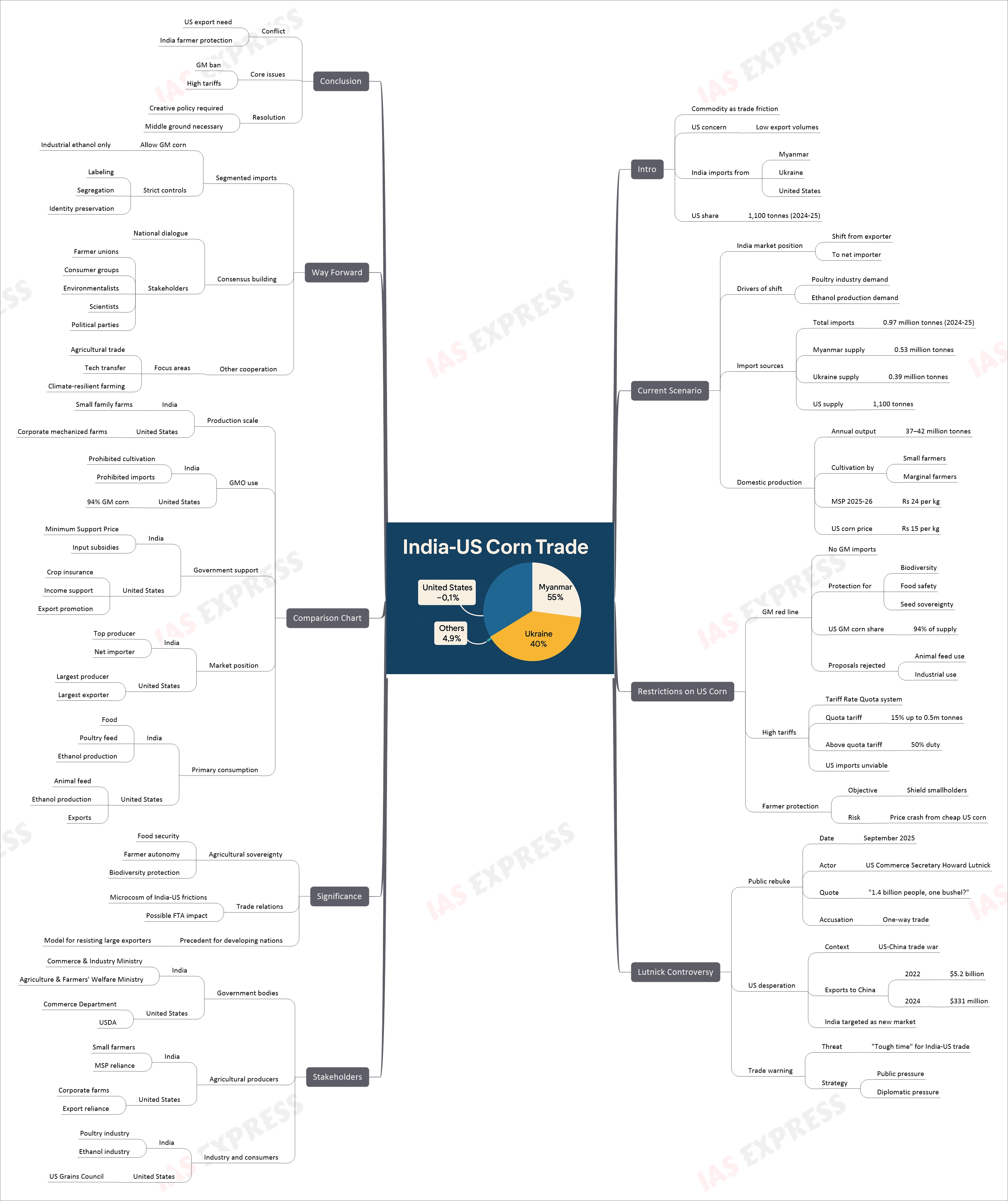
Comparison Chart:
| Feature | India | United States |
|---|---|---|
| Primary Production Scale | Dominated by small and marginal family-owned farms. | Characterized by large, corporate, and highly mechanized farms. |
| Use of GMOs | Prohibited for commercial cultivation and food imports. | Widespread, with approximately 94% of all corn being GM. |
| Government Support | Minimum Support Price (MSP) to ensure baseline income for farmers, input subsidies. | Extensive system of crop insurance, direct income support, and export promotion programs. |
| Current Market Position | A top global producer, but recently turned net importer due to rising domestic demand. | The world’s largest producer and exporter, consistently generating a massive surplus. |
| Primary Consumption | Food, poultry feed, and a rapidly growing share for ethanol production. | Animal feed, ethanol production (a very large share), and exports. |
What Could Be a Potential Way Forward?
- Exploring a Segmented Approach
- A potential compromise could involve India considering the import of US corn for specific, non-food end-uses with strict controls.
- This could mean allowing GM corn imports exclusively for industrial ethanol production, under a framework of rigorous labeling, segregation, and identity preservation to prevent any leakage into the food and feed chains.
- Building Domestic Consensus
- Any significant shift in India’s long-standing GM policy would require a comprehensive and transparent national dialogue.
- This would involve building a scientific and political consensus among all stakeholders, including farmer unions, consumer groups, environmentalists, scientists, and political parties.
- Focusing on Other Areas of Cooperation
- While the corn issue remains contentious, both nations can work to strengthen cooperation in less controversial areas of agricultural trade, technology transfer, and climate-resilient agriculture to build goodwill.
Conclusion
The India-US corn trade dispute is a classic case of conflicting national interests, pitting America’s need for export markets against India’s imperative to protect its farmers and maintain its food policies. The pointed statements from the US administration have intensified the pressure, but the core issues—India’s non-GM stance and protectionist tariffs—are deeply entrenched in its domestic political and economic reality. A resolution will not be simple or swift. It will demand more than just diplomatic pressure; it will require creative policymaking and a willingness to find a middle ground that respects India’s sovereign right to define its agricultural future while acknowledging the dynamics of global trade.
Q. Critically analyze how the India-US corn dispute reflects the conflict between national food security imperatives and the obligations of global trade liberalization. (250 words)
Related Posts

If you like this post, please share your feedback in the comments section below so that we will upload more posts like this.

Responses