European Free Trade Association (EFTA)

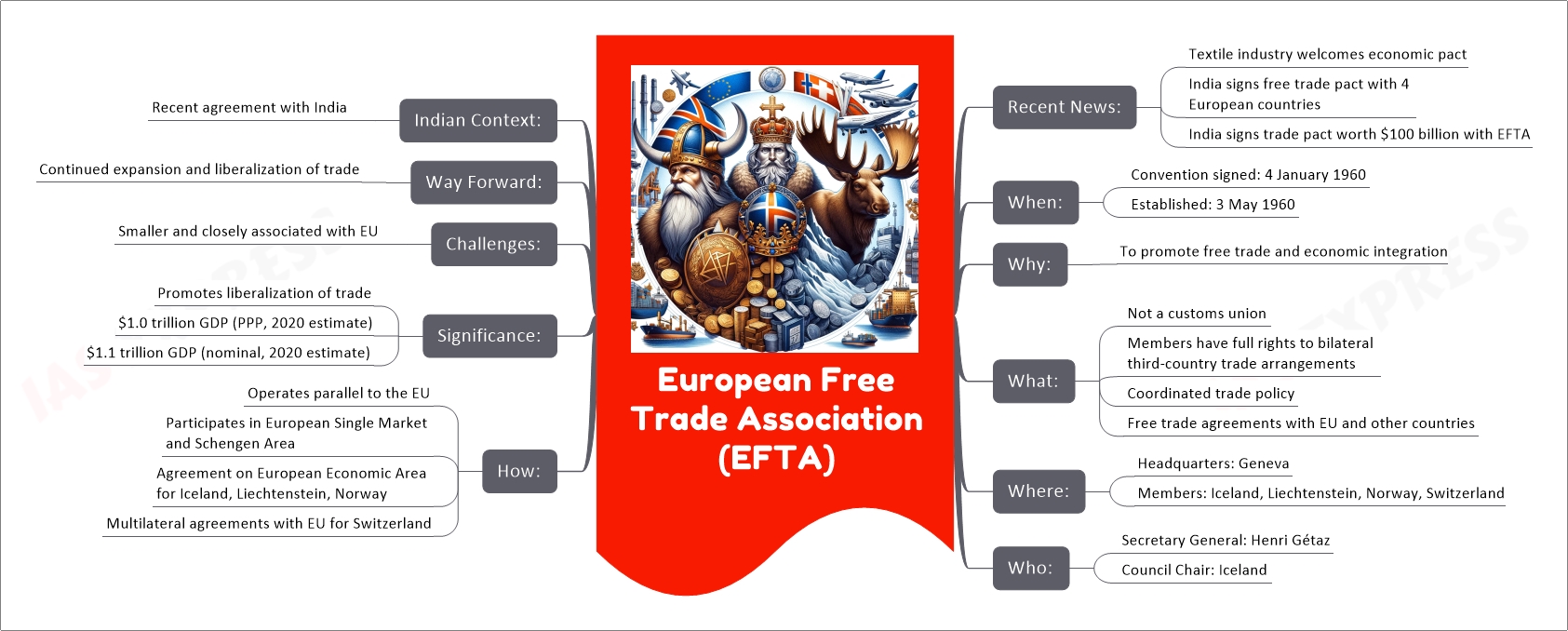
European Free Trade Association (EFTA) mind map

  Recent News:
    Textile industry welcomes economic pact
    India signs free trade pact with 4 European countries
    India signs trade pact worth $100 billion with EFTA
  When:
    Convention signed: 4 January 1960
    Established: 3 May 1960
  Why:
    To promote free trade and economic integration
  What:
    Not a customs union
    Members have full rights to bilateral third-country trade arrangements
    Coordinated trade policy
    Free trade agreements with EU and other countries
  Where:
    Headquarters: Geneva
    Members: Iceland, Liechtenstein, Norway, Switzerland
  Who:
    Secretary General: Henri Gétaz
    Council Chair: Iceland
  How:
    Operates parallel to the EU
    Participates in European Single Market and Schengen Area
    Agreement on European Economic Area for Iceland, Liechtenstein, Norway
    Multilateral agreements with EU for Switzerland
  Significance:
    Promotes liberalization of trade
    $1.0 trillion GDP (PPP, 2020 estimate)
    $1.1 trillion GDP (nominal, 2020 estimate)
  Challenges:
    Smaller and closely associated with EU
  Way Forward:
    Continued expansion and liberalization of trade
  Indian Context:
    Recent agreement with India

The European Free Trade Association (EFTA) is an intergovernmental organization composed of Iceland, Liechtenstein, Norway, and Switzerland. It was established in 1960 to promote free trade and economic cooperation among its members, within Europe and globally. EFTA is not a customs union, which means its member states retain full autonomy over their trade policies and can negotiate bilateral trade agreements with third countries. However, EFTA countries coordinate their trade policies and have concluded joint free trade agreements with the EU and other nations. While EFTA operates in parallel with the European Union, participating in the European Single Market and part of the Schengen Area, its members are not part of the EU Customs Union. The Association is significant for promoting the liberalization of trade, with its members having a combined GDP of around $1.0 trillion (PPP) or $1.1 trillion (nominal) as of 2020. EFTA has recently been in the news for signing a significant trade pact with India, showcasing its ongoing relevance and efforts to expand trade relations globally​​​​​​​​​​​​.
Related Posts

If you like this post, please share your feedback in the comments section below so that we will upload more posts like this.

Responses

🖍️ Highlight
HomeCoursesPlansAccount