
Assent to Bills: Timeline for the President and Governors in India


From Current Affairs Notes for UPSC » Editorials & In-depths » This topic
The process of a Bill becoming a law is a cornerstone of our democracy, but it is not complete when it is passed by the legislature. The final, crucial step is the assent of the head of state—the President at the Union level and the Governor at the State level. This stage ensures that proposed laws are constitutionally sound and aligns with national policies. However, the timeline for this assent has recently become a subject of intense debate and judicial scrutiny. The Supreme Court last week finished hearing arguments and reserved its opinion in the crucial reference made by President Droupadi Murmu on the powers of the President and Governors in giving assent to Bills. This follows a ruling where the Court held that Tamil Nadu Governor R N Ravi’s prolonged delay in granting assent to 10 Bills was unconstitutional, exercising its inherent powers under Article 142 to grant assent and highlighting a critical grey area in our constitutional framework.
What is the Bill Assent Process?
- When a Bill is passed by the Parliament or a State Legislature, it requires the formal approval, or assent, of the head of state to become an Act (a law).
- This is not merely a ceremonial signature but a substantive step in the legislative process, serving as a final check on the legislative actions of the elected bodies.
- Key Constitutional Provisions:
- Article 111: This article of the Constitution deals with the President’s assent to Bills passed by the Parliament.
- The President has three options:
- Give assent to the Bill, making it an Act.
- Withhold assent to the Bill, which is a form of veto.
- Return the Bill (if it is not a Money Bill) for reconsideration by Parliament.
- The President has three options:
- Article 200: This article deals with the Governor’s assent to Bills passed by the State Legislature.
- The Governor has four distinct options:
- Give assent to the Bill.
- Withhold assent from the Bill.
- Return the Bill (if it is not a Money Bill) for reconsideration by the state legislature.
- Reserve the Bill for the consideration of the President. This is a unique power not available to the President.
- The Governor has four distinct options:
- Article 201: This article outlines the procedure when a Governor reserves a Bill for the President’s consideration.
- The President can then either give assent or withhold it.
- The President can also direct the Governor to return the Bill to the State Legislature for reconsideration (if it is not a Money Bill). The state must reconsider it within six months.
- Article 111: This article of the Constitution deals with the President’s assent to Bills passed by the Parliament.
Why Is Assent Power Necessary?
- Constitutional Check and Balance:
- It serves as a crucial safeguard to ensure that the laws passed by the legislature are within the limits of the Constitution.
- The President or Governor can examine a Bill for potential violations of fundamental rights, the basic structure of the constitution, or other key constitutional provisions.
- Harmonization of National and State Laws:
- This power helps in preventing a State law from clashing with a Union law, especially on subjects in the Concurrent List.
- A Governor may reserve a Bill for the President’s consideration if it contradicts a law made by Parliament, thereby maintaining legislative consistency across the country.
- Improving Quality of Legislation:
- The power to return a Bill for reconsideration allows the head of state to highlight potential flaws or suggest amendments.
- This encourages the legislature to have a second, more deliberative look at the Bill. For instance, a bill might have unforeseen financial implications impacting the state budget by over 15%, and the Governor’s query can prompt a necessary fiscal review.
Where Does This Process Occur?
- At the Union Level:
- The process culminates after a Bill is successfully passed by both Houses of Parliament (the Lok Sabha and the Rajya Sabha).
- The passed Bill is then formally presented to the President of India for their assent at the Rashtrapati Bhavan in New Delhi.
- At the State Level:
- This occurs after a Bill is passed by the State Legislative Assembly (and the Legislative Council, in the approximately 6 states that have a bicameral legislature).
- The Bill is then presented to the Governor of the respective state at the Raj Bhavan.
- If the Governor decides to reserve the Bill, the legislative document is then forwarded to the President’s Secretariat for a final decision by the President.
When Should Assent Be Given?
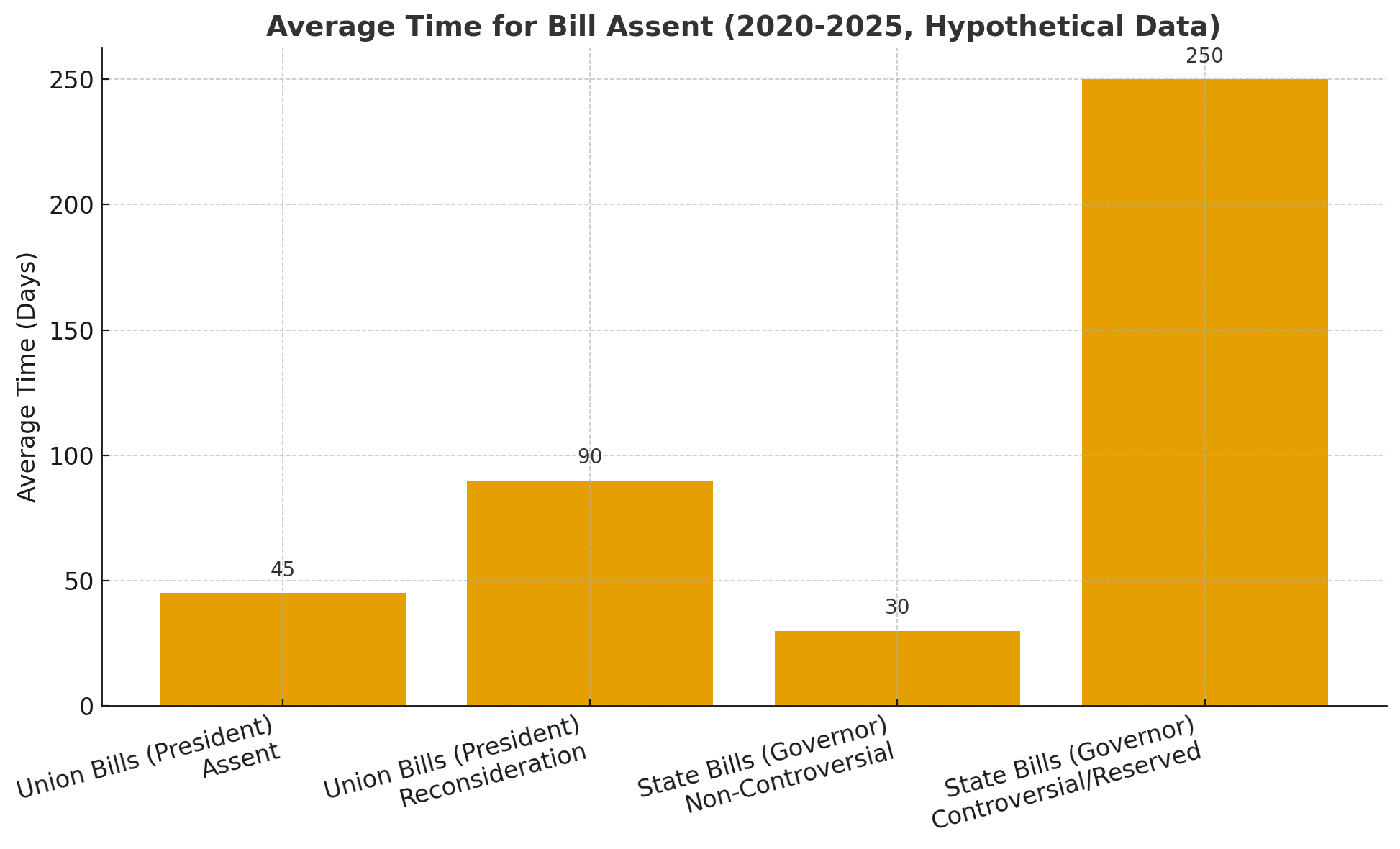
- The Constitution is notably vague on this point, using the phrase “as soon as possible” for the return of a Bill by the President (Article 111) or the Governor (Article 200).
- Crucially, it does not prescribe a specific timeline or a fixed deadline within which the President or Governor must give or withhold assent.
- The Problem of Indefinite Delay:
- This constitutional ambiguity has led to situations where Bills have remained pending with a Governor or the President for many months, sometimes even years.
- This tactic of indefinite delay is often referred to as a “pocket veto,” where the head of state effectively blocks a Bill by simply not acting on it, thereby preventing it from becoming law.
- In some states, crucial legislation has been stalled for over 20-24 months, effectively paralyzing the state’s legislative agenda.
- The Supreme Court’s Interpretation:
- The judiciary has started to weigh in on this issue. The Supreme Court has observed that the phrase “as soon as possible” has constitutional significance and that Governors cannot sit on Bills indefinitely.
- The Court has clarified that a Governor must communicate a decision without undue delay, as inaction can subvert the democratic process.
Who Are the Key Actors Involved?
- The Legislature:
- This includes the Parliament at the central level and the State Legislatures at the state level. They are the primary bodies responsible for debating, amending, and passing the Bill.
- The Executive Head:
- The President of India, who is the constitutional head of the Union executive.
- The Governor of a State, who is the head of the State executive and also functions as a vital link between the Centre and the State.
- The Council of Ministers:
- The President and Governor are constitutionally expected to act on the aid and advice of the Council of Ministers, which is headed by the Prime Minister or Chief Minister, respectively.
- However, in certain specific situations, such as reserving a Bill for the President or returning it for reconsideration, the Governor may exercise their discretion.
- The Judiciary:
- The Supreme Court and High Courts play the role of the ultimate interpreter of the Constitution. They can adjudicate on the legality of actions taken by the President or Governor and rule on disputes arising from the assent process.
How is the Assent Process Carried Out?
- Step 1: Bill Passed by the Legislature: A Bill is introduced, debated, and passed by the required majority in the houses of the legislature.
- Step 2: Presentation for Formal Assent: The passed Bill is formally transmitted to the President or the Governor for their final approval.
- Step 3: Action by the Head of State:
- Option A: Assent is Given: The President or Governor signs the Bill. It is then published in the official gazette and officially becomes an Act.
- Option B: Assent is Withheld: The Bill is rejected and does not become law. This is an absolute veto and is used very rarely in modern practice.
- Option C: The Bill is Returned for Reconsideration: The President or Governor sends the Bill back to the legislature with a message requesting a review of certain clauses.
- If the legislature passes the Bill again, either with or without accepting the suggested amendments, and sends it back, the President or Governor must give their assent. This obligation makes the veto only suspensive.
- Option D: The Bill is Reserved for the President (Governor only): The Governor decides that the Bill requires the President’s consideration and forwards it.
- The President then exercises their power under Article 201. The State Legislature has no further role unless the President decides to return it for their reconsideration.
What is the Significance of Assent Power?
- Upholding the Federal Structure:
- The Governor’s power to reserve Bills for the President is a critical tool that allows the Central government to review state legislation. This is meant to ensure national unity and policy coherence.
- For example, if a state law could potentially obstruct interstate trade and commerce, a key Union subject, the President can withhold assent to maintain economic integration.
- Protecting Constitutional and Judicial Integrity:
- This power acts as a crucial check against legislative overreach by a majority government that might try to pass unconstitutional laws.
- A Governor is constitutionally bound to reserve any Bill that, in their opinion, would so derogate from the powers of the State High Court as to endanger its constitutional position.
- Enhancing Legislative Deliberation:
- The power to return a Bill forces the legislature to pause and reconsider its provisions, which can lead to more robust, effective, and well-thought-out laws. This enhances the overall quality of the democratic process.
What is the Impact of Recent News?
- The Supreme Court has recently taken a proactive and significant stance on the long-standing issue of delays in granting assent to Bills.
- The Landmark Tamil Nadu Case:
- In a major ruling, the Court declared that the Tamil Nadu Governor’s prolonged inaction and delay in granting assent to 10 different Bills was unconstitutional.
- To resolve the legislative impasse, the Court exercised its extraordinary and inherent powers under Article 142 of the Constitution, which allows it to pass any order necessary for doing “complete justice,” and itself granted “deemed assent” to the pending Bills.
- The Presidential Reference to the Court:
- Following this assertive ruling, President Droupadi Murmu invoked the Supreme Court’s advisory jurisdiction under Article 143.
- This reference formally asks the Court for its expert opinion on the powers of the President and Governors concerning assent, particularly on the possibility of setting timelines for their decisions.
- The Supreme Court has heard arguments from the Attorney General, states, and legal experts and has reserved its opinion, which is now eagerly awaited across the country.
- The Core Constitutional Question: The central issue being examined is whether a Governor’s option to “withhold” assent under Article 200 implies they can indefinitely shelve or “kill” a Bill, or if they are constitutionally bound to take one of the three other actions (assent, return, or reserve) in a timely fashion.
What Are the Limitations and Challenges?
- Absence of Clear Timelines:
- The most significant challenge is the lack of a fixed timeframe in the Constitution, which creates a loophole for indefinite delays that can be politically motivated.
- This ambiguity can be exploited by a Governor, who is appointed by the central government, to deliberately obstruct the legislative agenda of a state government run by a different political party.
- Controversial Discretionary Power:
- The Governor’s power to reserve a Bill for the President is largely discretionary and has often been a source of friction between the Centre and States.
- It raises fundamental questions about the federal balance of power, as it can be perceived as an undue interference by the Centre in the exclusive legislative domain of the states.
- Potential for Constitutional Deadlock:
- Prolonged inaction by a Governor can lead to a serious legislative and administrative deadlock, stalling important public policies and reforms.
- A constitutional crisis can emerge if a Governor withholds assent, the legislature re-passes the bill, and the Governor then reserves it for the President, creating a procedural loop that subverts the legislative process. The recent Supreme Court hearing examined this very sequence of events.
Comparison Chart: President vs. Governor’s Assent Powers
| Feature | President (Article 111 – Union Bills) | Governor (Article 200 & 201 – State Bills) |
|---|---|---|
| Assent | Can give assent. | Can give assent. |
| Withholding Assent | Can withhold assent (absolute veto). | Can withhold assent (absolute veto). |
| Return of Bill | Can return a non-Money Bill for reconsideration. | Can return a non-Money Bill for reconsideration. |
| Obligation on Return | Must give assent if the Bill is passed again by Parliament. | Must give assent if the Bill is passed again by the State Legislature. |
| Reservation of Bill | Not applicable. | Can reserve a Bill for the consideration of the President. This is a key differential power. |
| Money Bills | Cannot return a Money Bill. Can only give or withhold assent. | Cannot return a Money Bill. Can give assent, withhold assent, or reserve it for the President. |
What is the Way Forward?
- Constitutional Amendment for Timelines:
- To bring definitive clarity and prevent future misuse, a constitutional amendment could be introduced to prescribe a reasonable and fixed timeline for the President and Governors to act on Bills.
- For example, a clear period of 30 to 60 days could be constitutionally mandated for a decision to be made, preventing indefinite delays.
- Strengthening Constitutional Conventions:
- Beyond legal changes, healthy democratic conventions should be established and followed, where the unelected head of state acts promptly on the advice of the democratically elected government.
- Discretionary powers should be used sparingly and only in rare and exceptional circumstances, as originally intended, not as a political tool to create roadblocks.
- A Clear Judicial Pronouncement:
- The upcoming opinion of the Supreme Court on the Presidential reference is of paramount importance.
- A clear and binding judgment that defines the boundaries, responsibilities, and timelines for the assent process will provide a definitive legal framework. This would significantly reduce the scope for future conflicts and strengthen the rule of law.
Conclusion
The power of assent is a delicate and vital component of India’s constitutional machinery, intended to serve as a thoughtful check and balance, not as a political tool for obstruction. The absence of a defined timeline has created a significant constitutional grey area, leading to friction between the executive and the legislature, and more broadly, between the Centre and the States. The recent and decisive interventions by the Supreme Court have brought this critical issue to the forefront, underscoring the urgent need for clarity and accountability. The forthcoming opinion of the apex court on the Presidential reference holds the promise of finally settling this long-standing constitutional dilemma. A clear directive will ensure that the legislative will of the people, expressed through their elected representatives, is respected in a timely and transparent manner, thereby reinforcing the very foundations of our federal democracy.
Q. Critically examine the discretionary powers of the Governor in the legislative process, especially in the context of withholding assent and reserving bills for the President’s consideration. (250 words)

Related Posts

If you like this post, please share your feedback in the comments section below so that we will upload more posts like this.

Responses