
Sabka Bima, Sabki Raksha: Insurance Laws (Amendment) Bill, 2025 and the Shift to 100% FDI

From Current Affairs Notes for UPSC » Editorials & In-depths » This topic
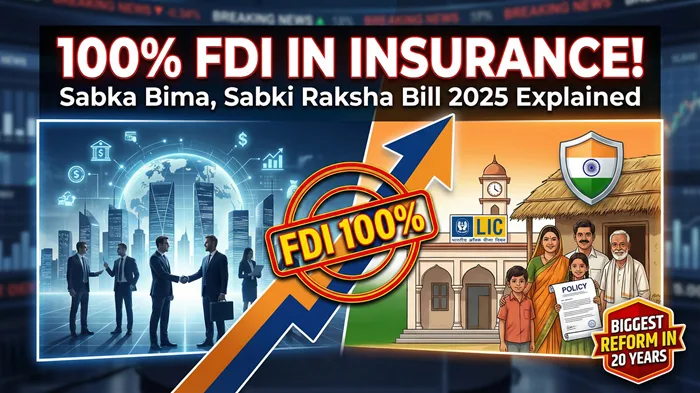
The Indian financial sector has witnessed a historic transformation with the approval of the ‘Sabka Bima, Sabki Raksha’ (Amendment of Insurance Laws) Bill, 2025 by the Union Cabinet and its subsequent passage in the Lok Sabha and Rajya Sabha in December 2025. This decisive legislation amends key laws like the Insurance Act, 1938, and the LIC Act, 1956, to increase the Foreign Direct Investment (FDI) limit from 74% to 100% under the automatic route. By removing the mandate for Indian ownership and control, the government aims to attract massive patient capital, enhance insurance penetration, and foster global integration. This move is a strategic step towards the national vision of “Insurance for All by 2047,” ensuring that every citizen has access to affordable financial protection.
What Is The Recent News About The Bill?
- Legislative Approval
- The Union Cabinet cleared the Bill on December 12, 2025.
- The Lok Sabha passed the Bill on December 16, 2025.
- The Rajya Sabha approved it on December 17, 2025, completing the parliamentary process.
- Core Objective
- The Bill is titled ‘Sabka Bima, Sabki Raksha’, which translates to “Insurance for Everyone, Protection for Everyone.”
- It aligns with the government’s goal of Viksit Bharat (Developed India) by utilizing insurance funds for long-term nation-building.
- Key Shift
- It marks the end of the “Indian owned and controlled” era for insurance companies.
- Global insurers can now own 100% equity in Indian subsidiaries without needing a local partner.
What Are The Key Features Of The Legislation?
- 100% Foreign Direct Investment (FDI)
- The FDI limit is raised from 74% to 100%.
- investments are allowed under the automatic route, meaning no prior government approval is needed.
- This applies to both Life and General insurance companies.
- Governance Safeguards
- Residency Requirement: To ensure accountability, the Bill mandates that at least one key person must be a resident Indian citizen.
- This applies to the Chairperson, Managing Director (MD), or Chief Executive Officer (CEO).
- Board Composition: The previous rule requiring 50% Independent Directors for companies with over 49% foreign investment has been removed.
- Residency Requirement: To ensure accountability, the Bill mandates that at least one key person must be a resident Indian citizen.
- Reinsurance Reforms
- Net Owned Fund (NOF): The minimum capital required for foreign reinsurers to set up in India has been reduced.
- Old limit: ₹5,000 crore.
- New limit: ₹1,000 crore.
- This aims to make India a global reinsurance hub and keep premiums within the country.
- Net Owned Fund (NOF): The minimum capital required for foreign reinsurers to set up in India has been reduced.
- Ease of Doing Business for Intermediaries
- One-Time Registration: Insurance agents and brokers no longer need to renew their licenses every three years.
- They will now have perpetual registration subject to fee payments.
- Penalties: The regulator can now suspend licenses for violations instead of cancelling them directly, ensuring business continuity.
- One-Time Registration: Insurance agents and brokers no longer need to renew their licenses every three years.
- Policyholder Protection
- Protection Fund: A statutory Policyholders’ Education and Protection Fund will be created.
- It will be funded by penalties collected from violators and unclaimed amounts.
- Disgorgement: The regulator (IRDAI) can force companies to return wrongful gains made through mis-selling.
- Protection Fund: A statutory Policyholders’ Education and Protection Fund will be created.
- LIC Autonomy
- The Life Insurance Corporation (LIC) board gets more power.
- They can open zonal or overseas offices without seeking government permission every time.
Why Was This Major Change Required Now?
- Capital Constraints
- Insurance is a capital-intensive business requiring huge funds for solvency margins (ability to pay claims).
- Indian partners in Joint Ventures often struggled to infuse capital, slowing down growth.
- 100% FDI allows global parents to inject money freely without diluting Indian partners.
- Low Penetration and Density
- Penetration: India’s insurance premiums are only about 4.0% of GDP, much lower than the global average of 7%.
- Density: The per capita premium in India is around $\text{95, while the global average is significantly higher.
- Huge investment is needed to reach the uninsured population in rural areas.
- Need for Patient Capital
- Insurance funds are long-term (20-30 years), making them ideal for funding infrastructure projects like roads and ports.
- Technology Transfer
- Global giants were hesitant to share proprietary technology with companies they didn’t fully control.
- Full ownership incentivizes them to bring AI-based underwriting and digital claims processing to India.
Where And When Did The Liberalization Journey Start?
- Ancient Roots
- Concepts of insurance were mentioned in ancient texts like Manusmriti and Arthashastra (pooling resources for calamities).
- Pre-Independence (1912-1938)
- 1912: First statutory measure to regulate life insurance.
- 1938: Insurance Act, 1938 was passed to govern the sector.
- Nationalization Era (1956-1972)
- 1956: Life insurance was nationalized; LIC was formed.
- 1972: General insurance was nationalized; GIC was formed.
- Liberalization Phase (1990s-Present)
- 1994: Malhotra Committee recommended private entry and foreign investment.
- 2000: Sector opened to private players with 26\% FDI.
- 2015: FDI limit raised to 49\% (Indian ownership mandatory).
- 2021: FDI limit raised to 74\% (Indian management control mandatory).
- 2025: FDI limit raised to 100\% (Full foreign ownership allowed).
Who Are The Stakeholders Impacted By This?
- Global Insurers
- Companies like Zurich, Allianz, Generali, and AXA.
- They can now buy out Indian partners or set up wholly-owned subsidiaries.
- Domestic Promoters
- Indian banks and conglomerates in insurance Joint Ventures.
- They can now exit non-core businesses and monetize their stakes at a premium.
- The Regulator (IRDAI)
- Gains more power to regulate via notifications.
- Empowered to impose penalties and protect consumers more effectively.
- Policyholders (Common Man)
- Likely to see lower premiums due to competition.
- Access to new products like cyber insurance and parametric insurance.
- Employees and Unions
- Groups like AIIEA oppose the move.
- They fear job losses or a shift from social security to profit-making.
How Will The New System Work Effectively?
- Regulation-Led Framework
- The Act moves from rigid laws to flexible regulations.
- IRDAI can set capital and solvency norms dynamically based on market needs.
- Automatic Investment Route
- Foreign investors transfer funds through banking channels without FIPB or Cabinet approval.
- This reduces bureaucratic delays and improves Ease of Doing Business.
- Disgorgement Mechanism
- If an insurer makes money by cheating customers (mis-selling), IRDAI calculates the amount.
- The money is seized and put into the Protection Fund for consumer welfare.
What Is The Significance Of This Move?
- Macroeconomic Stability
- Attracts stable Foreign Exchange (Forex) inflows.
- Strengthens the Rupee and funds the fiscal deficit.
- Financial Inclusion
- Global micro-insurance players can enter the Indian market.
- Helps cover the “Missing Middle” (people not poor enough for govt schemes but not rich enough for standard policies).
- Innovation and Specialization
- Introduction of Sector-Specific Licenses.
- Niche players can focus solely on marine, crop, or pet insurance.
What Are The Limitations And Challenges Involved?
- Rural Neglect (Cream Skimming)
- Foreign companies might focus only on profitable urban markets.
- Rural and social sector obligations might be ignored without strict enforcement.
- Data Privacy Risks
- Sensitive health and financial data of Indians will be handled by foreign entities.
- Ensuring data remains in India (Data Localization) is a major challenge.
- Omission of Composite License
- The Bill did not allow a single company to sell both Life and Non-Life insurance.
- Customers still cannot buy a single “all-in-one” policy for health, life, and car.
- Trust Deficit
- Insurance is sold on trust.
- Foreign brands without a local face may struggle to win over conservative Indian savers.
Comparison Chart: Before vs. After 2025 Bill
| Feature | Pre-2025 Regime (2021 Amendment) | Sabka Bima, Sabki Raksha Act, 2025 |
| FDI Limit | 74\% | 100\% (Automatic Route) |
| Ownership | Indian ownership & control required | 100\% Foreign ownership allowed |
| Residency | Majority of Directors & KMPs must be Indian | One KMP (MD/CEO/Chair) must be Indian |
| Ind. Directors | 50\% must be Independent if FDI > 49\% | Requirement Removed |
| Reinsurance | Min Capital: ₹5,000 Crore | Min Capital: ₹1,000 Crore |
| Licenses | Renewal every 3 years | One-time (Perpetual) |
| LIC Powers | Govt approval for new offices | Board approval sufficient |
What Is The Way Forward For India?
- Strict Monitoring
- IRDAI must enforce Risk-Based Solvency norms to prevent failures.
- Ensure foreign parents support Indian subsidiaries during crises.
- Promoting GIFT City
- Use the lower capital norms to attract reinsurers to IFSC GIFT City.
- Develop an ecosystem for global reinsurance trade.
- Digital Integration
- Integrate new players with Bima Sugam (digital insurance marketplace).
- Democratize access to products for the last-mile user.
- Focus on Awareness
- Use the new Protection Fund to educate people about insurance rights.
- Combat mis-selling through strict audits.
Conclusion
The Sabka Bima, Sabki Raksha Bill, 2025 represents a bold leap from protectionism to globalization, aiming to secure the financial future of every Indian. By allowing 100\% FDI, the government has prioritized the urgent need for capital and technology over traditional ownership concerns. While challenges regarding data security and rural outreach remain, the empowered role of IRDAI and the retention of key residency safeguards provide a balanced framework. If implemented effectively, this reform will not only drive the sector towards the }$10 trillion economy goal but also ensure that the safety net of insurance truly reaches the grassroots of India by 2047.
Q. Analyze the strategic rationale behind 100% FDI in insurance and evaluate if regulatory safeguards sufficiently protect domestic interests while ensuring rural penetration. (250 words)


Related Posts




If you like this post, please share your feedback in the comments section below so that we will upload more posts like this.

Responses