
Promotion and Regulation of Online Gaming Act, 2025


From Current Affairs Notes for UPSC » Editorials & In-depths » This topic
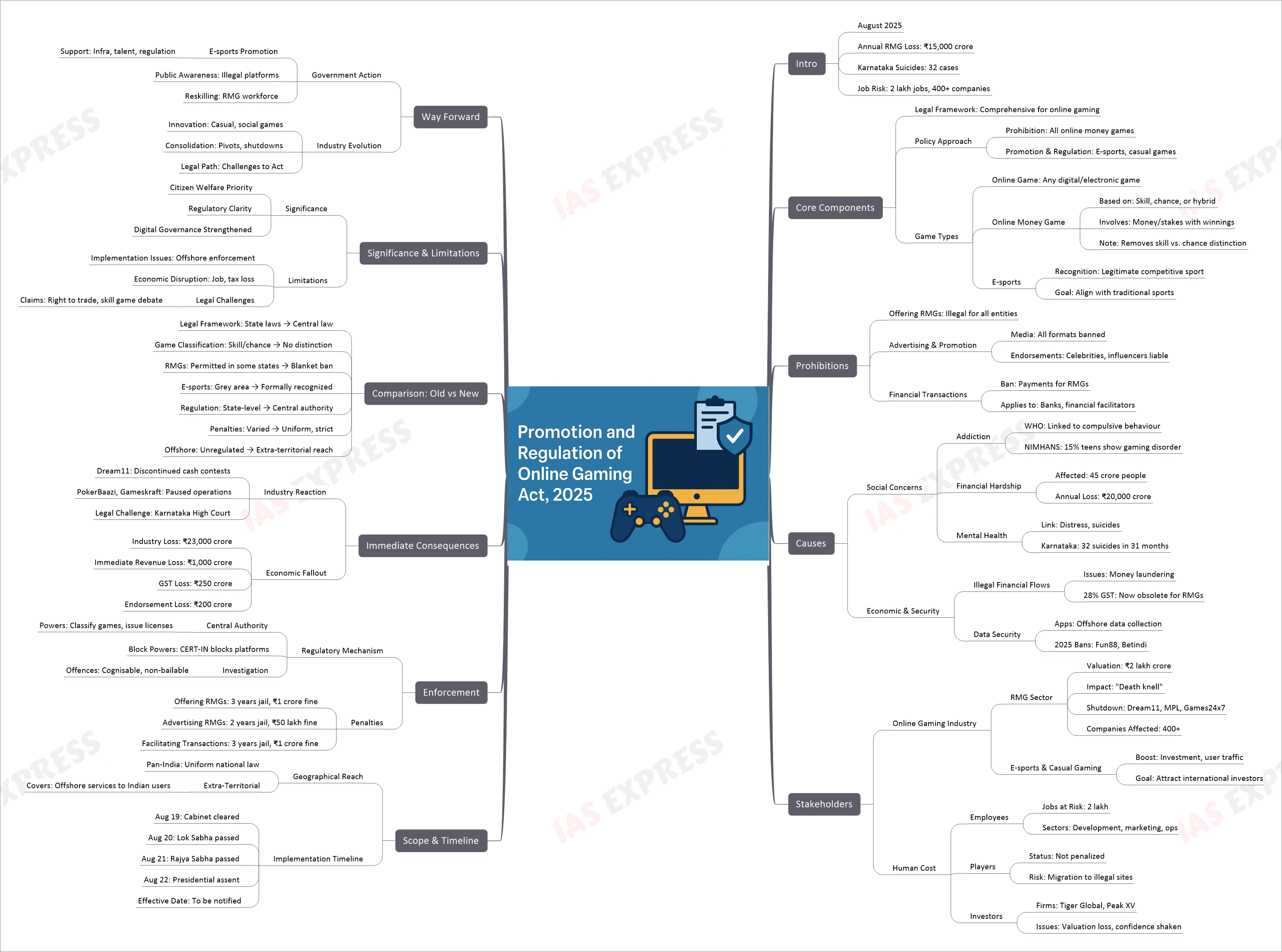
In a landmark and swift legislative move, the Indian Parliament has reshaped the nation’s digital landscape by passing the Promotion and Regulation of Online Gaming Bill, 2025. This decisive action comes amidst growing concerns over the societal costs of online gaming. Government data starkly suggests that Indians are losing approximately ₹15,000 crore every year to what it terms “Real Money Games” (RMGs). The World Health Organization (WHO) has highlighted the link between these games and severe issues like compulsive behaviour and financial hardship. These dangers are tragically reflected in Karnataka, where 32 suicides in the last 31 months have been attributed to online gaming addiction. In contrast, the RMG industry has voiced alarm, stating this ban could threaten over two lakh jobs across more than 400 companies, wiping out a significant sector of the digital economy overnight.
What Exactly Does This New Gaming Law Entail?
What are the core components of the Act?
- The Act provides a comprehensive legal framework for the online gaming sector in India.
- Its primary feature is a bifurcated, or two-pronged, policy approach.
- It imposes a complete and unequivocal prohibition on all forms of “online money games“.
- Simultaneously, it seeks to promote and regulate other forms of online gaming, such as e-sports and social/casual games that do not involve financial stakes.
How does the Act define different types of games?
- Online Game: The definition is broad, covering any game played on digital/electronic devices.
- Online Money Game (RMG): This is the key category targeted by the ban.
- It is defined as any online game, whether based on skill, chance, or a hybrid of both, that involves depositing money or stakes with the promise of winnings.
- This definition is a significant departure from previous legal precedent, which often distinguished between games of skill (generally permissible) and games of chance (gambling). The new Act eliminates this distinction for money-based online games.
- E-sports: The Act formally recognizes e-sports as a legitimate competitive sport, aiming to create a supportive ecosystem for its growth, potentially aligning it with traditional sports in terms of official support and recognition.
What are the main prohibitions under this legislation?
- Offering RMGs: It is now illegal for any person or company to offer online money gaming services to users in India.
- Advertising and Promotion: The Act criminalizes the advertisement and promotion of online money games.
- This ban extends across all media formats, including digital platforms, print, and television.
- It specifically includes endorsements by celebrities and social media influencers, making them liable.
- Financial Transactions: A crucial provision, designed to cripple the RMG industry, prohibits the facilitation of financial transactions for these games.
- It directs that banks, financial institutions, and payment facilitators shall not permit payments for any online money gaming service, effectively cutting off the industry’s financial lifelines.
Why Was the Online Gaming Act Deemed Necessary?
What were the primary social concerns driving the law?
- Widespread Addiction: The government has highlighted the growing menace of gaming addiction.
- The World Health Organization (WHO) has linked RMGs to compulsive behaviour, psychological distress, and disruption of family life.
- Studies have shown alarming trends, with one NIMHANS study indicating that around 15% of Indian teenagers exhibit signs of gaming disorder.
- Severe Financial Hardship: The promise of quick wealth has led to devastating financial losses for citizens.
- Government data indicates that 45 crore people have been negatively affected, losing an estimated ₹20,000 crore annually through these platforms.
- These losses have pushed many individuals and families into debt and ruin.
- Mental Health and Suicides: The most tragic consequence has been the loss of life.
- The psychological distress and financial ruin stemming from gaming addiction have been directly linked to suicides.
- A stark example is from Karnataka, which reported 32 cases of suicide attributed to online gaming addiction over a 31-month period.
What were the major economic and security reasons?
- Illegal Financial Activities: The unregulated nature of the online gaming world made it a conduit for illicit financial flows.
- The government has linked these platforms to money laundering and other unlawful financial activities.
- The 28% GST on deposits, implemented in 2023, was a prior attempt to formalize the sector, but the new ban renders these tax structures obsolete for RMGs.
- Data Security and Sovereignty: The Act addresses concerns about user data and national security.
- Many offshore gaming apps were found to be collecting user data unlawfully.
- In 2025 alone, several betting apps like Fun88 and Betindi were banned for unlicensed operations and promoting illegal betting, highlighting the risks posed by such platforms.
Who Are the Stakeholders Impacted by This Act?
How does this law affect the online gaming industry?
- RMG Sector: The impact on the real-money gaming sector is catastrophic.
- The industry, valued at over ₹2 lakh crore, has been described as receiving a “death knell”.
- Major platforms like Dream11, Mobile Premier League (MPL), and Games24x7 have been forced to suspend their real-money operations, with many shifting to a free-to-play model.
- The ban threatens the existence of over 400 companies in this space.
- E-sports and Casual Gaming Sector: The Act is expected to provide a significant boost to these legitimate gaming sectors.
- With the ban on RMGs, investment and user traffic are expected to pivot towards e-sports, game development, and casual gaming.
- Regulatory clarity is intended to attract international investors who were previously wary of the Indian market’s association with gambling.
What is the human cost of this legislative change?
- Employees: The ban poses a direct threat to a large workforce.
- The RMG industry claims that more than two lakh direct and indirect jobs are at risk.
- This includes roles across game development, marketing, customer support, and operations. Many employees were left jobless overnight as companies collapsed within hours of the announcement.
- Players and Users: The government’s stance is that the player is a victim, not an offender.
- The Act does not penalize individuals for playing the games.
- However, millions of users who played these games for entertainment are now left with limited options, which could push them towards illegal offshore betting sites.
- Investors: The sudden ban has put significant investments at risk.
- Global and domestic investors like Tiger Global and Peak XV Partners had backed firms that are now facing an existential crisis.
- The valuation of unicorns in this sector has been severely eroded, shaking investor confidence.
Where and When Does This Law Apply?
What is the geographical reach of the Act?
- Pan-India Applicability: The “Promotion and Regulation of Online Gaming Act, 2025” extends to the whole of India.
- This creates a uniform national law, replacing the earlier fragmented system where states regulated gaming and betting within their own jurisdictions.
- Extra-Territorial Jurisdiction: A key feature is its application to offshore activities.
- The Act is applicable to any online money gaming service that is offered to users in India, even if the service provider is hosted or operated from outside India.
- This provision is designed to prevent foreign operators from targeting Indian citizens and bypassing domestic laws.
What is the timeline of the Act’s implementation?
- Rapid Enactment: The legislative process was unusually swift.
- August 19, 2025: The Union Cabinet cleared the Bill.
- August 20, 2025: The Bill was introduced and passed in the Lok Sabha.
- August 21, 2025: The Bill was passed in the Rajya Sabha.
- August 22, 2025: The Bill received Presidential Assent, officially becoming an Act of Parliament.
- Effective Date: The Act comes into effect on a date to be notified by the Central Government. Following the President’s assent, major gaming firms did not wait for the final notification and immediately began winding down their real-money operations.
How Will the New Gaming Law Be Enforced?
What is the regulatory and enforcement mechanism?
- Central Regulatory Authority: The Act empowers the Central Government to establish a regulatory authority to oversee its implementation and regulate the legitimate gaming sector.
- This Authority will have the power to classify games, issue licenses for permissible games, and monitor the ecosystem.
- Blocking Powers: The government can take direct action against non-compliant platforms.
- The Indian Computer Emergency Response Team (CERT-IN) is empowered to issue orders to block access to illegal gaming platforms.
- Investigation and Seizure: The Act grants significant powers to law enforcement.
- Offences under the act are cognisable and non-bailable, meaning police can arrest individuals without a warrant, placing gaming violations on par with serious crimes.
What are the penalties for non-compliance?
- For Offering RMGs:
- Punishable with imprisonment of up to three years, a fine of up to ₹1 crore, or both.
- For Advertising RMGs:
- Punishable with imprisonment of up to two years, a fine of up to ₹50 lakh, or both.
- For Facilitating Financial Transactions:
- Punishable with imprisonment of up to three years, a fine of up to ₹1 crore, or both.
Recent News and Immediate Consequences
How did the industry react in the immediate aftermath?
- The passage of the Act sent shockwaves through the RMG industry.
- Leading companies acted preemptively, shutting down paid contests even before the Act was formally notified.
- Dream11 announced the discontinuation of cash contests and pivoted to a free-to-play platform. It also informed the BCCI that it could not continue as Team India’s title sponsor due to revenue losses.
- PokerBaazi and Gameskraft also paused all real-money gaming activities, assuring users that their funds were safe and available for withdrawal.
- Many companies, including Junglee Games, Zupee, and Ace23, are preparing to challenge the Act in the Karnataka High Court, arguing it is unconstitutional.
What was the immediate economic fallout?
- The ban wiped out a ₹23,000 crore industry virtually overnight.
- The industry reported an immediate loss of ₹1,000 crore in revenue, with the government missing out on an estimated ₹250 crore in GST revenue in the short term.
- The advertising ecosystem also took a hit, with Indian cricket’s top stars losing an estimated ₹200 crore in endorsement deals linked to RMG platforms.
Comparison Chart: Old Regime vs. New Act
| Feature | Previous Regulatory Environment | Promotion and Regulation of Online Gaming Act, 2025 |
|---|---|---|
| Legal Framework | Fragmented; primarily under State ‘Public Gambling’ Acts. | Uniform central law applicable across India. |
| Game Classification | Distinction between ‘Game of Skill’ and ‘Game of Chance’. | No distinction for games involving money; all are banned. |
| Real Money Games | Permitted in many states if classified as a ‘Game of Skill’. | Complete blanket ban on all online games with money stakes. |
| E-Sports | No formal recognition; existed in a legal grey area. | Formally recognized and promoted as a legitimate sport. |
| Regulatory Body | No central authority; regulated at the state level, if at all. | Provision for a Central Regulatory Authority to oversee the sector. |
| Penalties | Varied widely by state; often not stringent for online violations. | Severe and uniform penalties, including up to 3 years jail and ₹1 crore fine. |
| Offshore Platforms | Difficult to regulate; operated outside Indian legal jurisdiction. | Extra-territorial application; can block and penalize offshore platforms. |
What are the Act’s Significance and Limitations?
What is the broader significance of this law?
- Prioritizing Citizen Welfare: The Act represents a clear policy choice by the government to prioritize social welfare and citizen protection over the commercial interests of an industry it deems harmful.
- Regulatory Clarity: By creating a clear-cut ban on one segment and promoting another, the law ends years of ambiguity and legal grey areas that clouded the entire gaming industry.
- Strengthening Digital Governance: It marks a significant step in India’s journey of digital governance, showing a resolve to tackle emerging digital-era challenges with firm legislation.
What are the potential limitations and challenges ahead?
- Implementation Challenges: Enforcing a ban on offshore and illegal platforms will be a continuous technological and legal battle. Users may migrate to these platforms, which are often more dangerous and completely unregulated.
- Economic Disruption: The sudden closure of a major industry will have undeniable economic consequences, including significant job losses and loss of tax revenue, which the government will need to manage.
- Legal Scrutiny: The Act is expected to face strong legal challenges.
- Gaming companies are likely to argue in court that the blanket ban is unconstitutional and infringes upon the right to trade and commerce, particularly for games of skill.
- The debate over what constitutes a ‘game of skill’ versus a ‘game of chance’, which the Supreme Court has weighed in on previously, will be central to these legal battles.
What is the Way Forward for Online Gaming in India?
How can the government manage the transition?
- Focus on E-sports Growth: The government must follow through on its promise to promote e-sports. This includes creating infrastructure, supporting talent, and fostering a clear regulatory environment for this emerging sector.
- Public Awareness Campaigns: There is a need for large-scale public awareness campaigns to educate citizens about the dangers of illegal offshore betting and gaming platforms.
- Reskilling and Support: Measures may be needed to support the thousands of employees displaced from the RMG industry by providing reskilling opportunities to help them transition into other sectors of the digital economy.
How might the industry evolve?
- Innovation in Non-RMG Gaming: The ban will compel the industry to innovate in areas like social gaming, casual gaming, and game development for global audiences.
- Consolidation and Pivots: We can expect to see consolidation in the market, with some firms shutting down while others pivot their business models towards permissible forms of entertainment, such as WinZO’s entry into the US market.
- A Long Legal Road: The future of online gaming in India will be significantly shaped by the outcomes of the legal challenges against the 2025 Act. The judiciary’s interpretation of the law will be crucial in determining the final contours of the industry.
Conclusion
The Promotion and Regulation of Online Gaming Act, 2025, is a watershed moment for India’s digital economy. It is a bold, albeit controversial, legislative intervention that seeks to protect citizens from the well-documented harms of online money gaming, such as addiction and crippling financial loss. The government’s decisive action, prioritizing social security over a lucrative industry, has been praised by many as a necessary step to safeguard families and the nation’s youth. However, this hard-line stance has come at a significant economic cost, dismantling an entire industry, displacing a large workforce, and raising questions about regulatory stability. While the Act carves out a promising path for the promotion of e-sports and legitimate gaming, its future will be defined by its ability to navigate inevitable legal challenges and the government’s success in preventing the migration of users to the dark corners of the internet’s illegal betting world.
Q. Critically analyze the legislative choice of a complete ban on real-money gaming over a regulatory framework. (250 words)
Related Posts



If you like this post, please share your feedback in the comments section below so that we will upload more posts like this.

Responses