[Newsbits] 3+4.01.2024: Chameleon Trojan, SMART 2.0, Free Movement Regime & more

newsbits mindmap notes

Desert Cyclone Exercise mind map

The “Desert Cyclone” is a joint military exercise between India and the UAE, aimed at strengthening defense ties and enhancing interoperability, especially in urban warfare. Conducted in Rajasthan from January 2-15, 2024, it involves 45 personnel from both nations’ armies. This exercise marks a significant step in the defense relationship between the two countries, reflecting their commitment to regional security and stability. The collaboration also extends to other areas such as defense equipment production and sharing strategic information, showcasing the deep-rooted historical friendship between India and the UAE.

/ Space
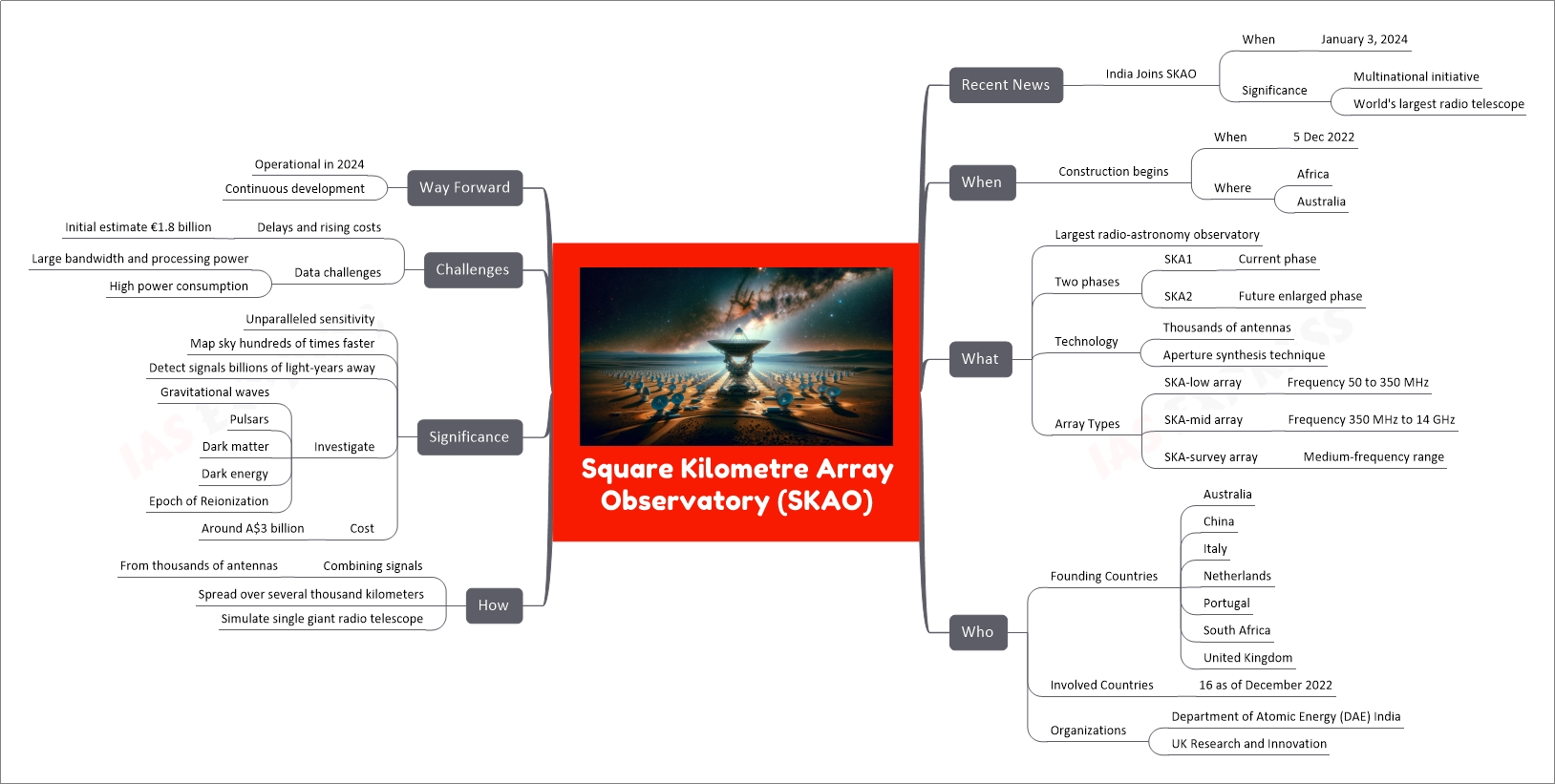
Square Kilometre Array Observatory (SKAO) mind map
  Recent News
    India Joins SKAO
      When
        January 3, 2024
      Significance
        Multinational initiative
        World's largest radio telescope
  When
    Construction begins
      When
        5 Dec 2022
      Where
        Africa
        Australia
  What
    Largest radio-astronomy observatory
    Two phases
      SKA1
        Current phase
      SKA2
        Future enlarged phase
    Technology
      Thousands of antennas
      Aperture synthesis technique
    Array Types
      SKA-low array
        Frequency 50 to 350 MHz
      SKA-mid array
        Frequency 350 MHz to 14 GHz
      SKA-survey array
        Medium-frequency range
  Who
    Founding Countries
      Australia
      China
      Italy
      Netherlands
      Portugal
      South Africa
      United Kingdom
    Involved Countries
      16 as of December 2022
    Organizations
      Department of Atomic Energy (DAE) India
      UK Research and Innovation
  How
    Combining signals
      From thousands of antennas
    Spread over several thousand kilometers
    Simulate single giant radio telescope
  Significance
    Unparalleled sensitivity
    Map sky hundreds of times faster
    Detect signals billions of light-years away
    Investigate
      Gravitational waves
      Pulsars
      Dark matter
      Dark energy
      Epoch of Reionization
    Cost
      Around A$3 billion
  Challenges
    Delays and rising costs
      Initial estimate €1.8 billion
    Data challenges
      Large bandwidth and processing power
      High power consumption
  Way Forward
    Operational in 2024
    Continuous development

The Square Kilometre Array Observatory (SKAO) represents an ambitious multinational project aimed at constructing the world’s largest radio telescope. With construction commencing in December 2022 across sites in Africa and Australia, this groundbreaking facility will utilize thousands of antennas to simulate a singular, massive radio telescope. SKAO will provide unprecedented sensitivity and the ability to rapidly map the sky, significantly advancing our understanding of the universe. Key focus areas include studying gravitational waves, pulsars, dark matter, and dark energy, and investigating the Epoch of Reionization. Despite challenges like delays and rising costs, the SKAO, once operational in 2024, promises to revolutionize our perception of the cosmos.

/ Black Money
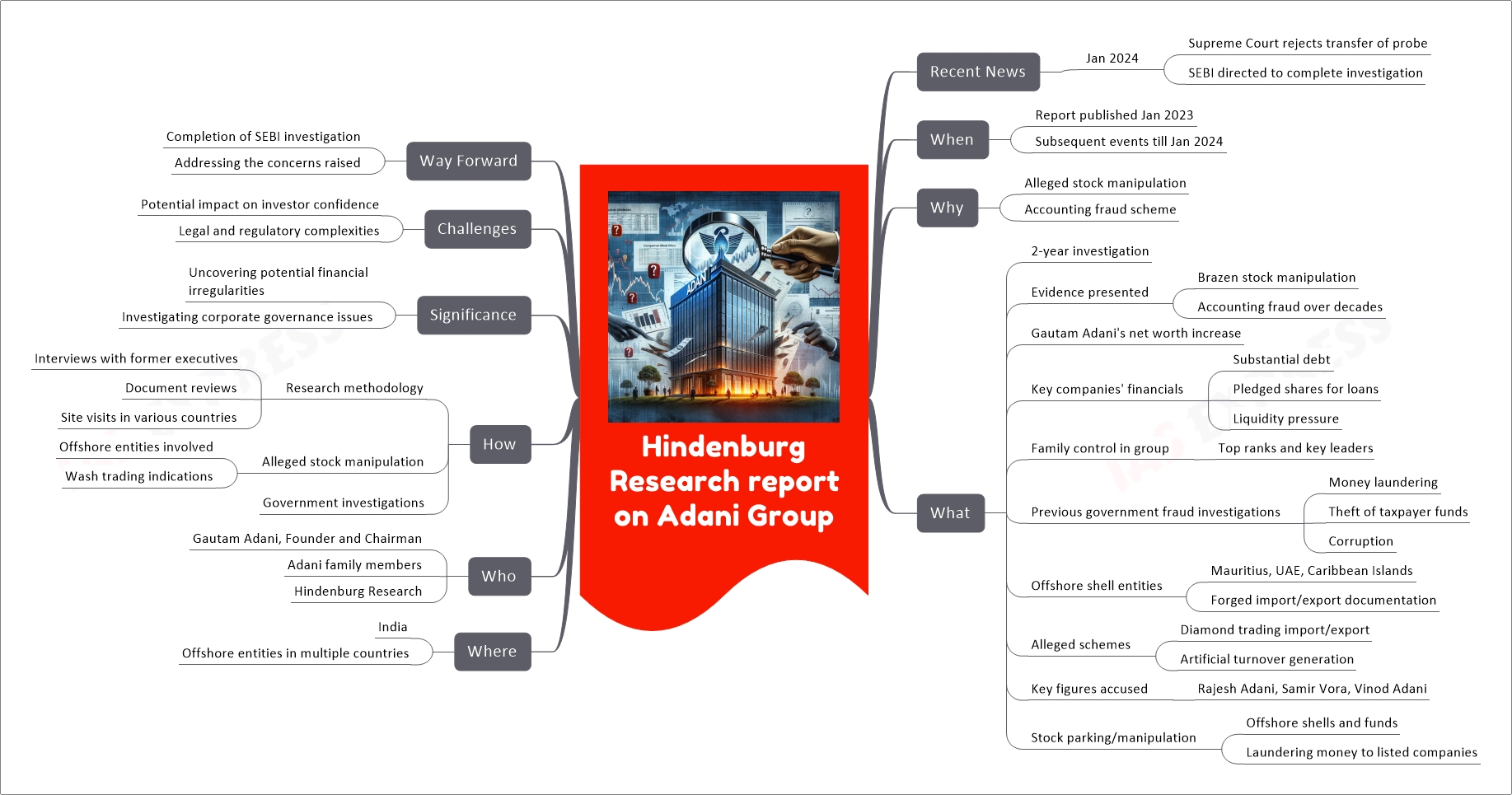
Hindenburg Research report on Adani Group mind map
  Recent News
    Jan 2024
      Supreme Court rejects transfer of probe
      SEBI directed to complete investigation
  When
    Report published Jan 2023
    Subsequent events till Jan 2024
  Why
    Alleged stock manipulation
    Accounting fraud scheme
  What
    2-year investigation
    Evidence presented
      Brazen stock manipulation
      Accounting fraud over decades
    Gautam Adani's net worth increase
    Key companies' financials
      Substantial debt
      Pledged shares for loans
      Liquidity pressure
    Family control in group
      Top ranks and key leaders
    Previous government fraud investigations
      Money laundering
      Theft of taxpayer funds
      Corruption
    Offshore shell entities
      Mauritius, UAE, Caribbean Islands
      Forged import/export documentation
    Alleged schemes
      Diamond trading import/export
      Artificial turnover generation
    Key figures accused
      Rajesh Adani, Samir Vora, Vinod Adani
    Stock parking/manipulation
      Offshore shells and funds
      Laundering money to listed companies
  Where
    India
    Offshore entities in multiple countries
  Who
    Gautam Adani, Founder and Chairman
    Adani family members
    Hindenburg Research
  How
    Research methodology
      Interviews with former executives
      Document reviews
      Site visits in various countries
    Alleged stock manipulation
      Offshore entities involved
      Wash trading indications
    Government investigations
  Significance
    Uncovering potential financial irregularities
    Investigating corporate governance issues
  Challenges
    Potential impact on investor confidence
    Legal and regulatory complexities
  Way Forward
    Completion of SEBI investigation
    Addressing the concerns raised

The Hindenburg Research report on Adani Group, published in January 2023, alleges a decades-long scheme of stock manipulation and accounting fraud involving the Adani Group. The report claims that Gautam Adani, the founder and chairman, amassed significant wealth largely through the appreciation of his group’s stock prices. The investigation by Hindenburg Research, which spanned two years, involved interviews, document reviews, and site visits across several countries. It suggests the involvement of various Adani family members in fraudulent activities and raises concerns about the group’s financial stability and transparency.

The report’s aftermath saw legal developments, including the Supreme Court of India’s directive for the Securities and Exchange Board of India (SEBI) to complete its investigation. The Adani Group’s response was to dismiss the allegations as baseless and a calculated attack on India’s integrity and growth story. They questioned Hindenburg Research’s motives and transparency, particularly regarding the details of its short positions and the profit it has made.

The case brings to the forefront issues related to corporate governance, market manipulation, and the impact of such allegations on investor confidence. It highlights the challenges and complexities in addressing legal and regulatory concerns in such high-profile cases. The way forward includes the completion of the SEBI investigation and addressing the concerns raised by the report to restore confidence in the financial markets.

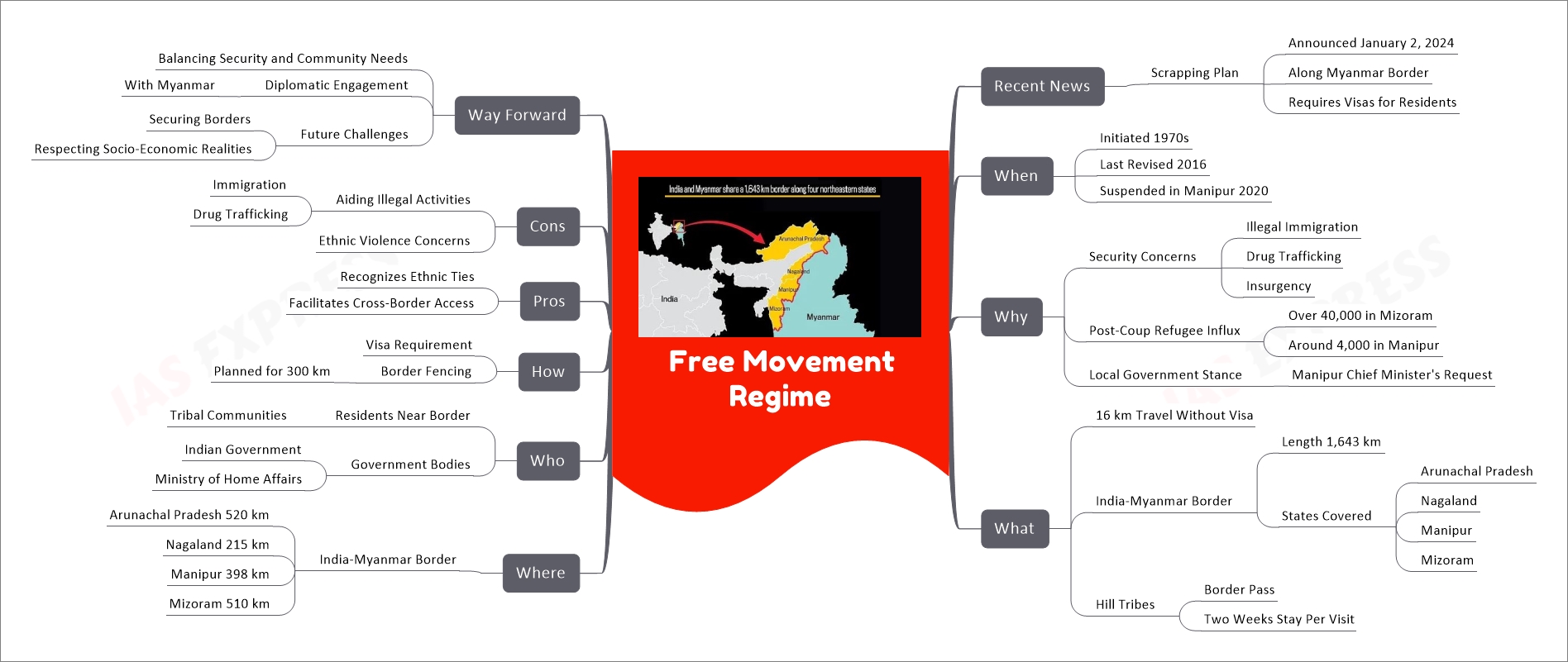
Free Movement Regime mind map
  Recent News
    Scrapping Plan
      Announced January 2, 2024
      Along Myanmar Border
      Requires Visas for Residents
  When
    Initiated 1970s
    Last Revised 2016
    Suspended in Manipur 2020
  Why
    Security Concerns
      Illegal Immigration
      Drug Trafficking
      Insurgency
    Post-Coup Refugee Influx
      Over 40,000 in Mizoram
      Around 4,000 in Manipur
    Local Government Stance
      Manipur Chief Minister's Request
  What
    16 km Travel Without Visa
    India-Myanmar Border
      Length 1,643 km
      States Covered
        Arunachal Pradesh
        Nagaland
        Manipur
        Mizoram
    Hill Tribes
      Border Pass
      Two Weeks Stay Per Visit
  Where
    India-Myanmar Border
      Arunachal Pradesh 520 km
      Nagaland 215 km
      Manipur 398 km
      Mizoram 510 km
  Who
    Residents Near Border
      Tribal Communities
    Government Bodies
      Indian Government
      Ministry of Home Affairs
  How
    Visa Requirement
    Border Fencing
      Planned for 300 km
  Pros
    Recognizes Ethnic Ties
    Facilitates Cross-Border Access
  Cons
    Aiding Illegal Activities
      Immigration
      Drug Trafficking
    Ethnic Violence Concerns
  Way Forward
    Balancing Security and Community Needs
    Diplomatic Engagement
      With Myanmar
    Future Challenges
      Securing Borders
      Respecting Socio-Economic Realities

The Free Movement Regime (FMR) between India and Myanmar, initiated in the 1970s, allows residents within 16 km of the border to travel up to 16 km into the other country without a visa. This regime, covering the 1,643 km border across Arunachal Pradesh, Nagaland, Manipur, and Mizoram, was designed to recognize the close ethnic and familial ties between communities on either side. However, due to security concerns like illegal immigration, drug trafficking, and insurgency, the Indian government announced plans to scrap the FMR in January 2024. The scrapping of FMR is expected to impact the daily lives and cultural connections of the border residents and poses challenges in balancing security needs with the socio-economic realities of these communities.

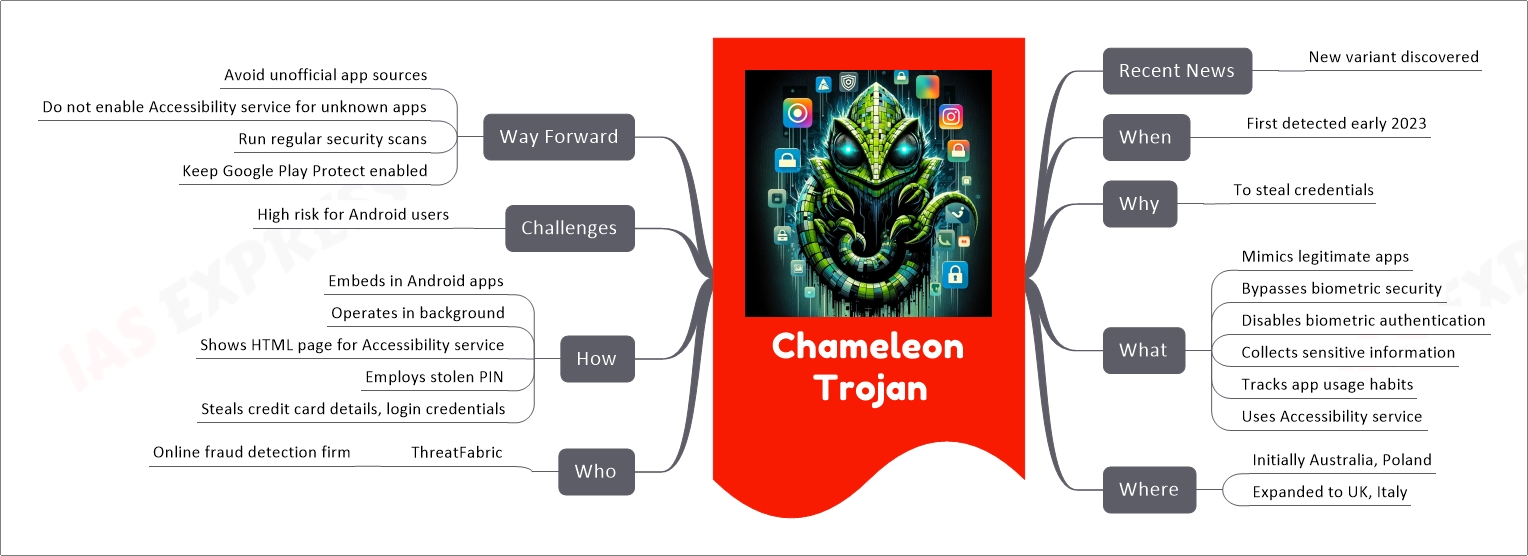
Chameleon Trojan mind map
  Recent News
    New variant discovered
  When
    First detected early 2023
  Why
    To steal credentials
  What
    Mimics legitimate apps
    Bypasses biometric security
    Disables biometric authentication
    Collects sensitive information
    Tracks app usage habits
    Uses Accessibility service
  Where
    Initially Australia, Poland
    Expanded to UK, Italy
  Who
    ThreatFabric
      Online fraud detection firm
  How
    Embeds in Android apps
    Operates in background
    Shows HTML page for Accessibility service
    Employs stolen PIN
    Steals credit card details, login credentials
  Challenges
    High risk for Android users
  Way Forward
    Avoid unofficial app sources
    Do not enable Accessibility service for unknown apps
    Run regular security scans
    Keep Google Play Protect enabled

The Chameleon Trojan is a newly identified variant of Android banking malware first detected in early 2023. It’s known for its ability to mimic legitimate apps, thereby bypassing biometric security measures like fingerprint and face unlock to steal phone PINs and other sensitive information. Initially targeting Australia and Poland, its reach has expanded to the UK and Italy. ThreatFabric, an online fraud detection firm, has been closely monitoring this evolving threat. The Trojan operates by embedding itself in legitimate Android apps like Google Chrome, running undetected in the background. It employs various tactics such as using the Accessibility service to gain unauthorized access and employing stolen PINs to unlock devices and steal data like credit card details and login credentials. To protect against this malware, users are advised to avoid unofficial app sources, refrain from enabling the Accessibility service for unknown apps, run regular security scans, and keep Google Play Protect enabled.

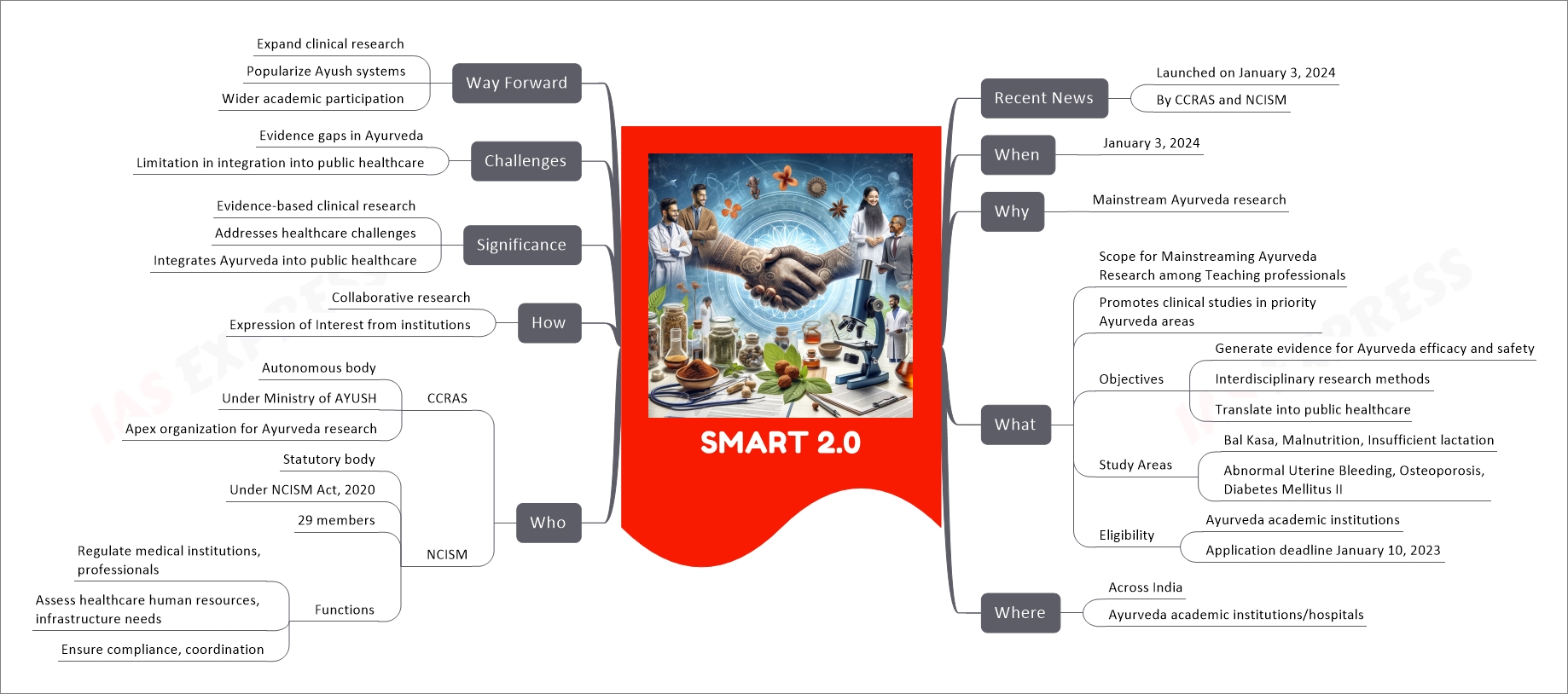
SMART 2.0 mind map
  Recent News
    Launched on January 3, 2024
    By CCRAS and NCISM
  When
    January 3, 2024
  Why
    Mainstream Ayurveda research
  What
    Scope for Mainstreaming Ayurveda Research among Teaching professionals
    Promotes clinical studies in priority Ayurveda areas
    Objectives
      Generate evidence for Ayurveda efficacy and safety
      Interdisciplinary research methods
      Translate into public healthcare
    Study Areas
      Bal Kasa, Malnutrition, Insufficient lactation
      Abnormal Uterine Bleeding, Osteoporosis, Diabetes Mellitus II
    Eligibility
      Ayurveda academic institutions
      Application deadline January 10, 2023
  Where
    Across India
    Ayurveda academic institutions/hospitals
  Who
    CCRAS
      Autonomous body
      Under Ministry of AYUSH
      Apex organization for Ayurveda research
    NCISM
      Statutory body
      Under NCISM Act, 2020
      29 members
      Functions
        Regulate medical institutions, professionals
        Assess healthcare human resources, infrastructure needs
        Ensure compliance, coordination
  How
    Collaborative research
    Expression of Interest from institutions
  Significance
    Evidence-based clinical research
    Addresses healthcare challenges
    Integrates Ayurveda into public healthcare
  Challenges
    Evidence gaps in Ayurveda
    Limitation in integration into public healthcare
  Way Forward
    Expand clinical research
    Popularize Ayush systems
    Wider academic participation

SMART 2.0, initiated by CCRAS and NCISM, aims to integrate Ayurveda into mainstream healthcare through evidence-based research. Launched in January 2024, it encourages collaboration among Ayurveda academic institutions to undertake studies in key health areas. The program seeks to close the evidence gaps in Ayurveda, enhancing its role in public health care and fostering a balance between traditional knowledge and scientific methods.

/ etc), Missiles, Submarines
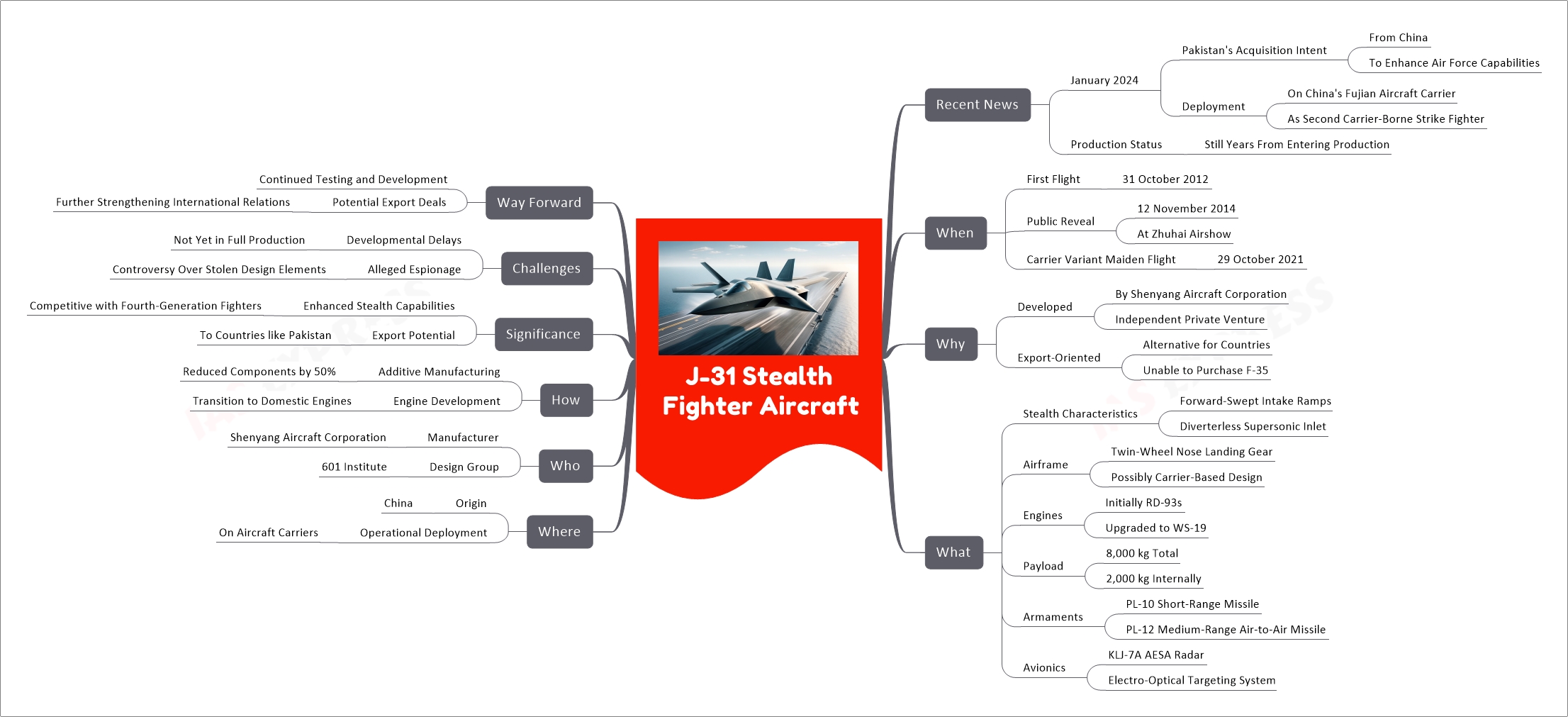
J-31 Stealth Fighter Aircraft mind map
  Recent News
    January 2024
      Pakistan's Acquisition Intent
        From China
        To Enhance Air Force Capabilities
      Deployment
        On China's Fujian Aircraft Carrier
        As Second Carrier-Borne Strike Fighter
    Production Status
      Still Years From Entering Production
  When
    First Flight
      31 October 2012
    Public Reveal
      12 November 2014
      At Zhuhai Airshow
    Carrier Variant Maiden Flight
      29 October 2021
  Why
    Developed
      By Shenyang Aircraft Corporation
      Independent Private Venture
    Export-Oriented
      Alternative for Countries
      Unable to Purchase F-35
  What
    Stealth Characteristics
      Forward-Swept Intake Ramps
      Diverterless Supersonic Inlet
    Airframe
      Twin-Wheel Nose Landing Gear
      Possibly Carrier-Based Design
    Engines
      Initially RD-93s
      Upgraded to WS-19
    Payload
      8,000 kg Total
      2,000 kg Internally
    Armaments
      PL-10 Short-Range Missile
      PL-12 Medium-Range Air-to-Air Missile
    Avionics
      KLJ-7A AESA Radar
      Electro-Optical Targeting System
  Where
    Origin
      China
    Operational Deployment
      On Aircraft Carriers
  Who
    Manufacturer
      Shenyang Aircraft Corporation
    Design Group
      601 Institute
  How
    Additive Manufacturing
      Reduced Components by 50%
    Engine Development
      Transition to Domestic Engines
  Significance
    Enhanced Stealth Capabilities
      Competitive with Fourth-Generation Fighters
    Export Potential
      To Countries like Pakistan
  Challenges
    Developmental Delays
      Not Yet in Full Production
    Alleged Espionage
      Controversy Over Stolen Design Elements
  Way Forward
    Continued Testing and Development
    Potential Export Deals
      Further Strengthening International Relations

The J-31 Stealth Fighter Aircraft, developed by China’s Shenyang Aircraft Corporation, is a fifth-generation, mid-sized, twinjet fighter. First flown in 2012, it remains in the prototype stage as of 2024. Designed independently as a private venture, it aims at the international market, offering an alternative to countries unable to purchase the F-35. Notable features include advanced stealth capabilities, a payload capacity of 8,000 kg, and the use of RD-93 engines initially, later upgraded to the WS-19. It has undergone several modifications for potential carrier-based operations. Despite its promising specifications, the J-31 faces challenges such as developmental delays and controversy over alleged espionage in its design process. The aircraft’s future involves further testing, potential exports, and a role in strengthening international relations for China.

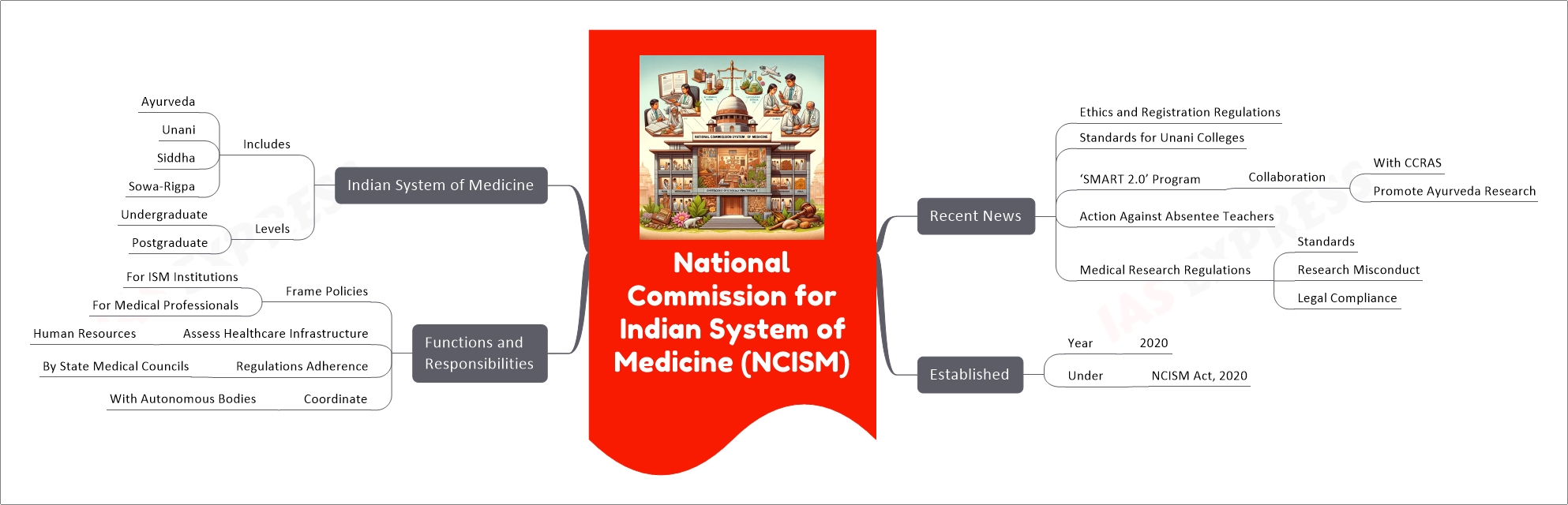
National Commission for Indian System of Medicine (NCISM) mind map
  Recent News
    Ethics and Registration Regulations
    Standards for Unani Colleges
    ‘SMART 2.0’ Program
      Collaboration
        With CCRAS
        Promote Ayurveda Research
    Action Against Absentee Teachers
    Medical Research Regulations
      Standards
      Research Misconduct
      Legal Compliance
  Established
    Year
      2020
    Under
      NCISM Act, 2020
  Functions and Responsibilities
    Frame Policies
      For ISM Institutions
      For Medical Professionals
    Assess Healthcare Infrastructure
      Human Resources
    Regulations Adherence
      By State Medical Councils
    Coordinate
      With Autonomous Bodies
  Indian System of Medicine
    Includes
      Ayurveda
      Unani
      Siddha
      Sowa-Rigpa
    Levels
      Undergraduate
      Postgraduate

The National Commission for Indian System of Medicine (NCISM), established in 2020, is a statutory and regulatory body in India responsible for framing policies and overseeing the Indian System of Medicine, including Ayurveda, Unani, Siddha, and Sowa-Rigpa. Recent activities involve setting ethical and registration standards, enhancing Unani medical education, launching the ‘SMART 2.0’ program for Ayurveda research, and standardizing medical research in ISM. NCISM’s role is crucial in ensuring quality and compliance in the field of traditional Indian medicine.

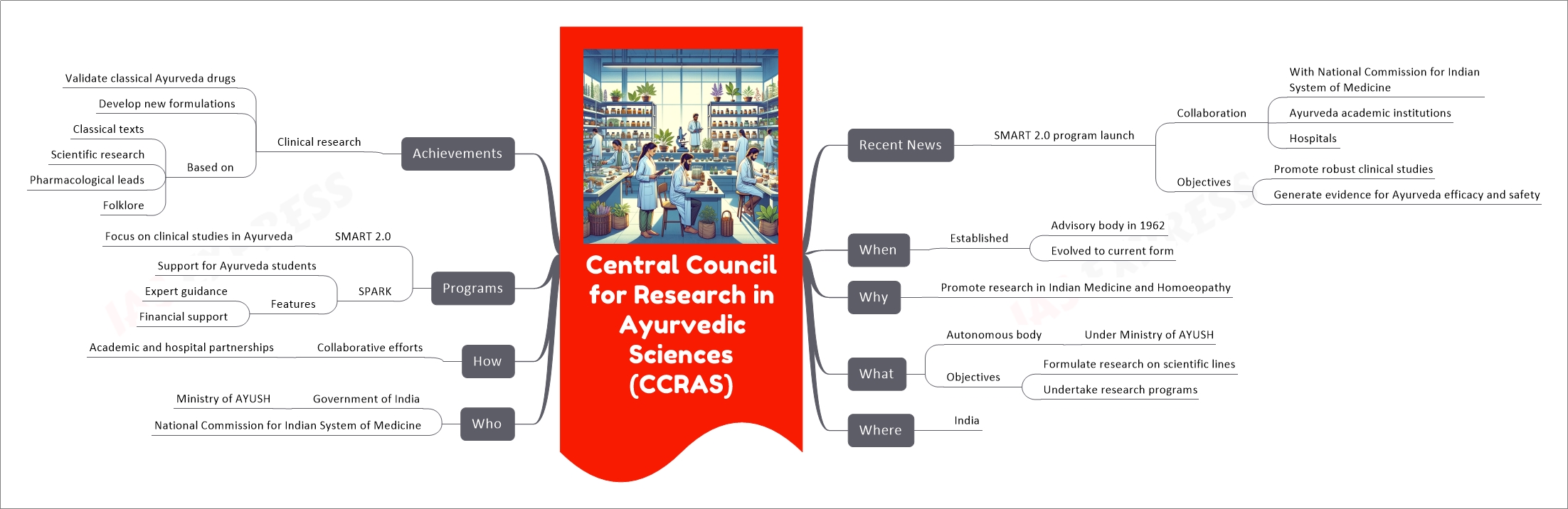
Central Council for Research in Ayurvedic Sciences (CCRAS) mind map
  Recent News
    SMART 2.0 program launch
      Collaboration
        With National Commission for Indian System of Medicine
        Ayurveda academic institutions
        Hospitals
      Objectives
        Promote robust clinical studies
        Generate evidence for Ayurveda efficacy and safety
  When
    Established
      Advisory body in 1962
      Evolved to current form
  Why
    Promote research in Indian Medicine and Homoeopathy
  What
    Autonomous body
      Under Ministry of AYUSH
    Objectives
      Formulate research on scientific lines
      Undertake research programs
  Where
    India
  Who
    Government of India
      Ministry of AYUSH
    National Commission for Indian System of Medicine
  How
    Collaborative efforts
      Academic and hospital partnerships
  Programs
    SMART 2.0
      Focus on clinical studies in Ayurveda
    SPARK
      Support for Ayurveda students
      Features
        Expert guidance
        Financial support
  Achievements
    Clinical research
      Validate classical Ayurveda drugs
      Develop new formulations
      Based on
        Classical texts
        Scientific research
        Pharmacological leads
        Folklore

The Central Council for Research in Ayurvedic Sciences (CCRAS) is an autonomous body under India’s Ministry of AYUSH, established to promote research in Ayurveda and Homoeopathy. It aims to develop research on scientific lines in Ayurvedic Sciences and recently launched the ‘SMART 2.0’ program to foster clinical studies in Ayurveda. CCRAS also supports young researchers through its SPARK program, focusing on validating classical Ayurveda drugs and developing new formulations based on traditional and scientific knowledge.
If you like this post, please share your feedback in the comments section below so that we will upload more posts like this.

Responses

🖍️ Highlight
HomeCoursesPlansAccount