Geothermal Energy in India

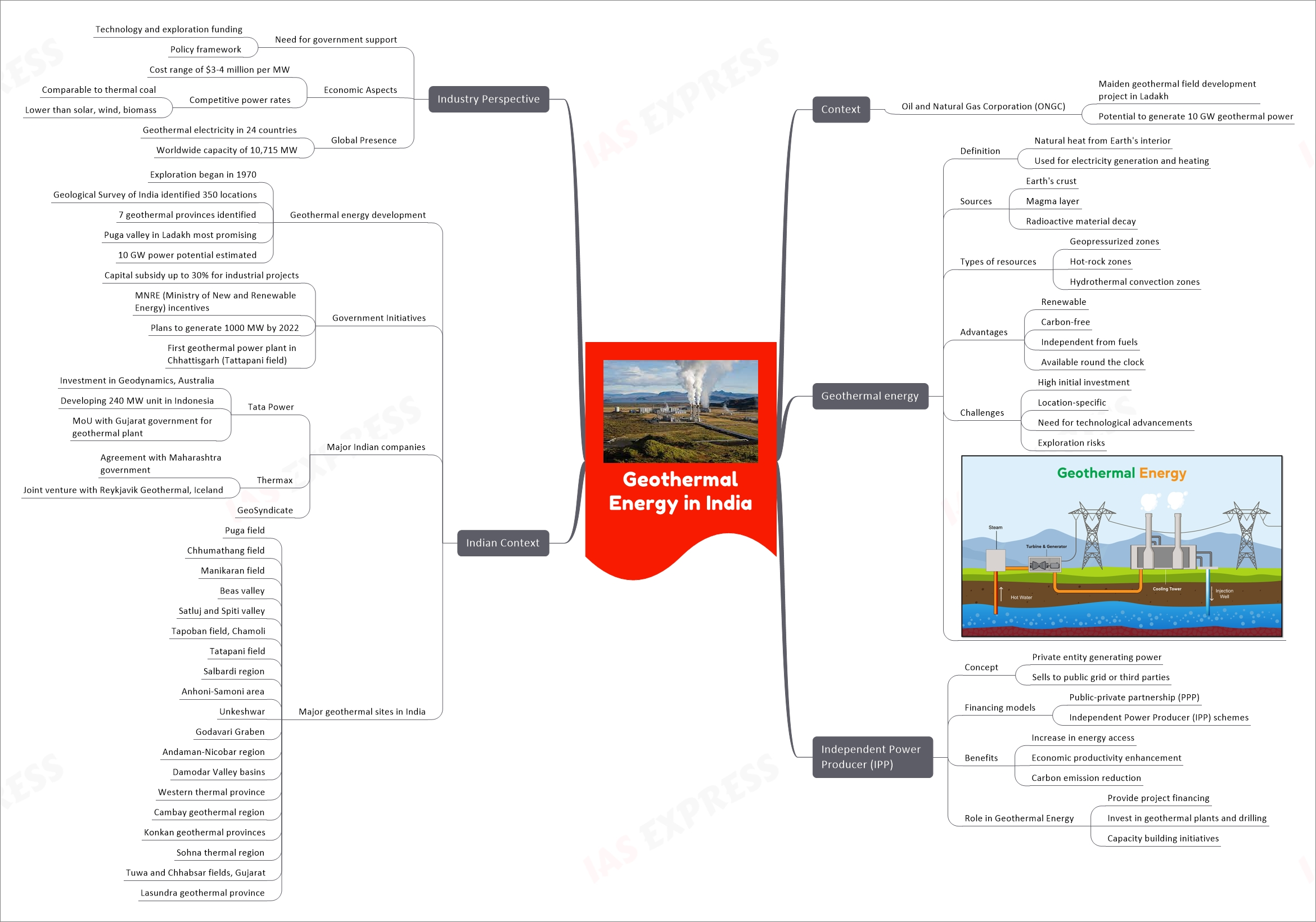
Geothermal Energy in India mind map

  Context
    Oil and Natural Gas Corporation (ONGC)
      Maiden geothermal field development project in Ladakh
      Potential to generate 10 GW geothermal power
  Geothermal energy
    Definition
      Natural heat from Earth's interior
      Used for electricity generation and heating
    Sources
      Earth's crust
      Magma layer
      Radioactive material decay
    Types of resources
      Geopressurized zones
      Hot-rock zones
      Hydrothermal convection zones
    Advantages
      Renewable
      Carbon-free
      Independent from fuels
      Available round the clock
    Challenges
      High initial investment
      Location-specific
      Need for technological advancements
      Exploration risks
  Independent Power Producer (IPP)
    Concept
      Private entity generating power
      Sells to public grid or third parties
    Financing models
      Public-private partnership (PPP)
      Independent Power Producer (IPP) schemes
    Benefits
      Increase in energy access
      Economic productivity enhancement
      Carbon emission reduction
    Role in Geothermal Energy
      Provide project financing
      Invest in geothermal plants and drilling
      Capacity building initiatives
  Indian Context
    Geothermal energy development
      Exploration began in 1970
      Geological Survey of India identified 350 locations
      7 geothermal provinces identified
      Puga valley in Ladakh most promising
      10 GW power potential estimated
    Government Initiatives
      Capital subsidy up to 30% for industrial projects
      MNRE (Ministry of New and Renewable Energy) incentives
      Plans to generate 1000 MW by 2022
      First geothermal power plant in Chhattisgarh (Tattapani field)
    Major Indian companies
      Tata Power
        Investment in Geodynamics, Australia
        Developing 240 MW unit in Indonesia
        MoU with Gujarat government for geothermal plant
      Thermax
        Agreement with Maharashtra government
        Joint venture with Reykjavik Geothermal, Iceland
      GeoSyndicate
    Major geothermal sites in India
      Puga field
      Chhumathang field
      Manikaran field
      Beas valley
      Satluj and Spiti valley
      Tapoban field, Chamoli
      Tatapani field
      Salbardi region
      Anhoni-Samoni area
      Unkeshwar
      Godavari Graben
      Andaman-Nicobar region
      Damodar Valley basins
      Western thermal province
      Cambay geothermal region
      Konkan geothermal provinces
      Sohna thermal region
      Tuwa and Chhabsar fields, Gujarat
      Lasundra geothermal province
  Industry Perspective
    Need for government support
      Technology and exploration funding
      Policy framework
    Economic Aspects
      Cost range of $3-4 million per MW
      Competitive power rates
        Comparable to thermal coal
        Lower than solar, wind, biomass
    Global Presence
      Geothermal electricity in 24 countries
      Worldwide capacity of 10,715 MW

Related Posts

If you like this post, please share your feedback in the comments section below so that we will upload more posts like this.

Responses

🖍️ Highlight
HomeCoursesPlansAccount