How does Moon impact Earth?

Impact of Moon on Earth upsc notes
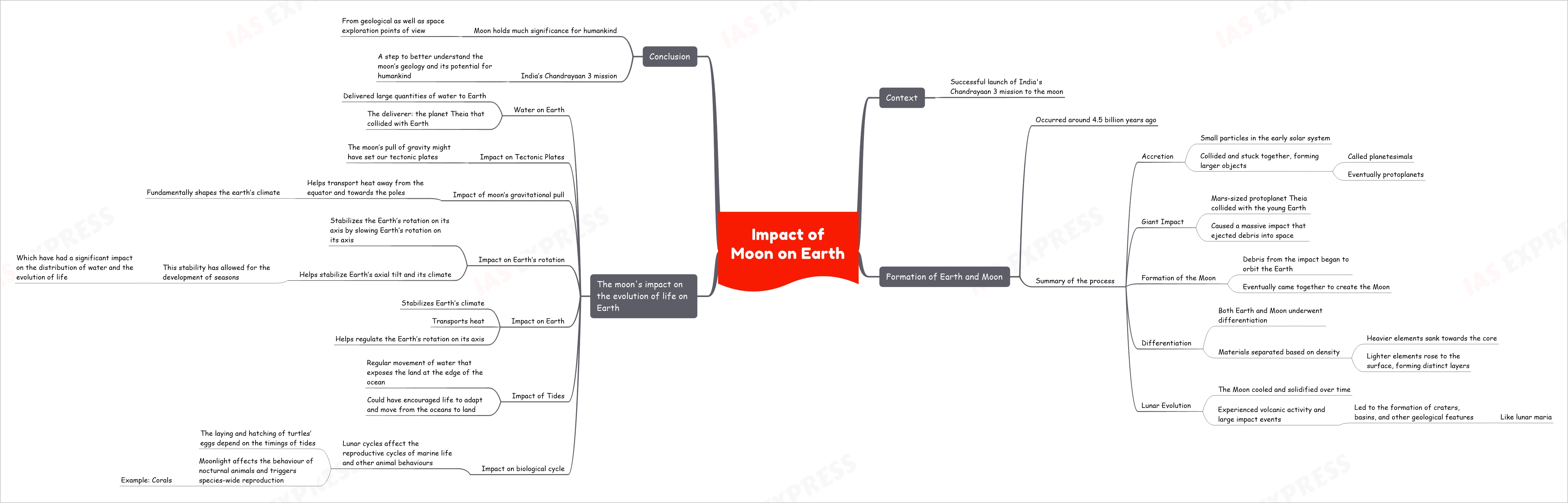
  Context
    Successful launch of India's Chandrayaan 3 mission to the moon
  Formation of Earth and Moon
    Occurred around 4.5 billion years ago
    Summary of the process
      Accretion
        Small particles in the early solar system
        Collided and stuck together, forming larger objects
          Called planetesimals
          Eventually protoplanets
      Giant Impact
        Mars-sized protoplanet Theia collided with the young Earth
        Caused a massive impact that ejected debris into space
      Formation of the Moon
        Debris from the impact began to orbit the Earth
        Eventually came together to create the Moon
      Differentiation
        Both Earth and Moon underwent differentiation
        Materials separated based on density
          Heavier elements sank towards the core
          Lighter elements rose to the surface, forming distinct layers
      Lunar Evolution
        The Moon cooled and solidified over time
        Experienced volcanic activity and large impact events
          Led to the formation of craters, basins, and other geological features
            Like lunar maria
  The moon's impact on the evolution of life on Earth
    Water on Earth
      Delivered large quantities of water to Earth
      The deliverer: the planet Theia that collided with Earth
    Impact on Tectonic Plates
      The moon’s pull of gravity might have set our tectonic plates
    Impact of moon’s gravitational pull
      Helps transport heat away from the equator and towards the poles
        Fundamentally shapes the earth’s climate
    Impact on Earth’s rotation
      Stabilizes the Earth’s rotation on its axis by slowing Earth’s rotation on its axis
      Helps stabilize Earth’s axial tilt and its climate
        This stability has allowed for the development of seasons
          Which have had a significant impact on the distribution of water and the evolution of life
    Impact on Earth
      Stabilizes Earth’s climate
      Transports heat
      Helps regulate the Earth’s rotation on its axis
    Impact of Tides
      Regular movement of water that exposes the land at the edge of the ocean
      Could have encouraged life to adapt and move from the oceans to land
    Impact on biological cycle
      Lunar cycles affect the reproductive cycles of marine life and other animal behaviours
        The laying and hatching of turtles’ eggs depend on the timings of tides
        Moonlight affects the behaviour of nocturnal animals and triggers species-wide reproduction
          Example: Corals
  Conclusion
    Moon holds much significance for humankind
      From geological as well as space exploration points of view
    India’s Chandrayaan 3 mission
      A step to better understand the moon’s geology and its potential for humankind

Related Posts

If you like this post, please share your feedback in the comments section below so that we will upload more posts like this.

Responses

🖍️ Highlight
HomeCoursesPlansAccount