
Viksit Bharat-Guarantee for Rozgar and Ajeevika Mission Gramin (VB-G RAM G) Bill 2025


From Current Affairs Notes for UPSC » Editorials & In-depths » This topic
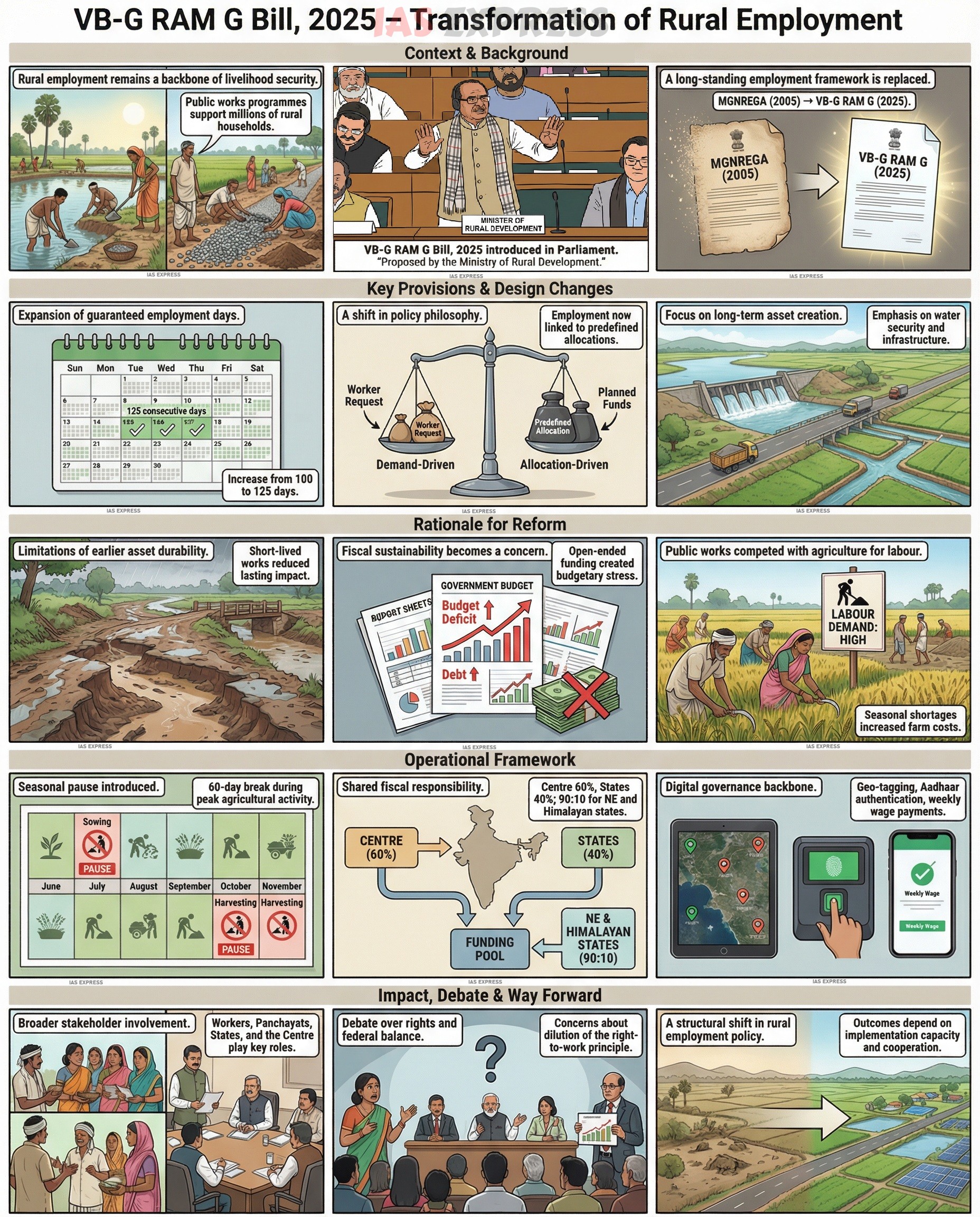
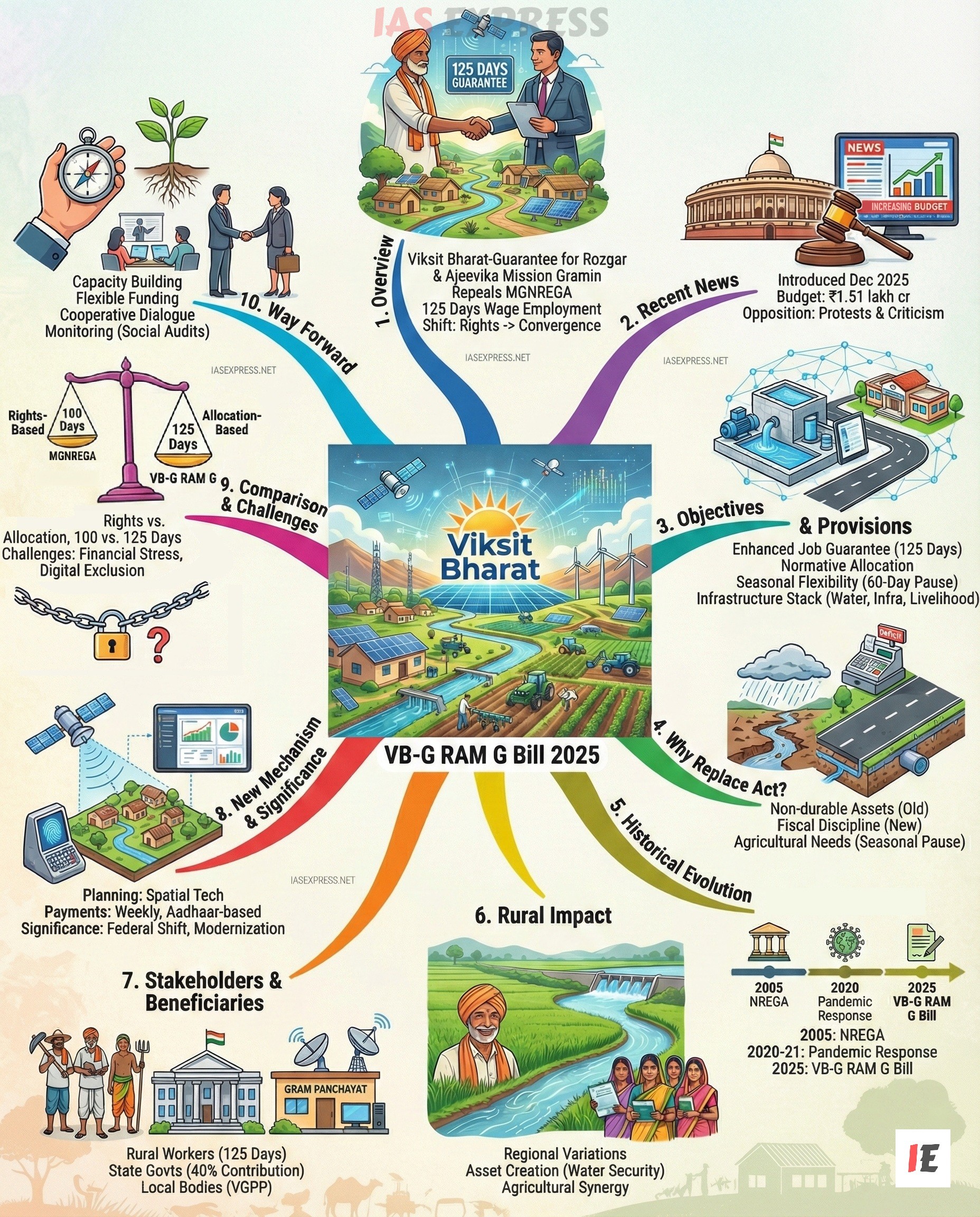
The Narendra Modi government has introduced a landmark piece of legislation, the Viksit Bharat-Guarantee for Rozgar and Ajeevika Mission Gramin (VB-G RAM G) Bill, 2025, in the Lok Sabha to overhaul India’s rural employment landscape. This new Bill seeks to repeal the 20-year-old Mahatma Gandhi National Rural Employment Guarantee Act (MGNREGA), aligning rural work with the vision of Viksit Bharat @2047. Proposed by Union Minister Shivraj Singh Chouhan, it promises to increase guaranteed wage employment to 125 days per year for rural households. The initiative marks a significant shift from a rights-based framework to a convergence-driven model, focusing on creating durable assets like water conservation structures and integrating with digital public infrastructure, while sparking intense debate over funding patterns and federal responsibilities.
What is the recent news regarding this legislation?
- Parliamentary Introduction
- The Bill was introduced in the Lok Sabha on December 16, 2025, by the Ministry of Rural Development.
- The government has allocated a substantial budget provision of over ₹1.51 lakh crore for the new scheme, which is significantly higher than the ₹86,000 crore allocated in the 2024-25 budget for the previous scheme.
- Union Minister Shivraj Singh Chouhan stated that the Modi government has spent over ₹8.53 lakh crore on rural employment in the last decade, compared to ₹2.13 lakh crore during the UPA era.
- Opposition Reaction
- Major opposition parties, including the Congress and CPI, have staged protests, terming the removal of Mahatma Gandhi’s name as a “fascist ideological act” and an insult to the father of the nation.
- Critics argue that the Bill destroys the legal right to work by shifting from a demand-based system to a supply-driven model controlled by central notifications.
- Concerns have been raised about the financial burden on states, with leaders from states like West Bengal and Tamil Nadu expressing fears over the new cost-sharing formula.
What are the key objectives and provisions of the bill?
- Enhanced Job Guarantee
- The Bill provides a statutory guarantee of 125 days of wage employment in a financial year to every rural household willing to do unskilled manual work, a 25% increase over the existing 100 days.
- It aims to provide higher income security to rural families while ensuring the creation of productive assets.
- Normative Allocation Model
- Unlike the previous open-ended funding, the Central Government will now determine a normative allocation of funds for each state based on objective parameters.
- Any expenditure beyond this allocated limit must be borne entirely by the State Government, ending the Centre’s unlimited liability.
- Seasonal Flexibility
- To address the long-standing demand of farmers, the Bill allows states to declare a work pause of up to 60 days during peak sowing and harvesting seasons.
- This provision is designed to ensure that public works do not compete with agriculture for labour availability during critical farming periods.
- Infrastructure Stack
- All projects will be integrated into a Viksit Bharat National Rural Infrastructure Stack, focusing on four priority areas: Water Security, Core Rural Infrastructure, Livelihood Support, and Disaster Mitigation.
Why is the government deciding to replace the act?
- Structural Weaknesses
- The government argues that the old Act led to the creation of non-durable assets (like temporary mud roads) that washed away, failing to provide long-term economic benefits.
- Data showed that in 2024-25, the average employment provided was only 50 days, with very few families completing the full 100-day quota, indicating inefficiencies in the demand-driven system.
- Fiscal Discipline
- The previous demand-driven model made it difficult for the Centre to estimate the budget, often leading to deficits, such as the ₹8,791 crore deficit seen in FY 2023-24.
- By fixing allocations at the start of the year, the Centre aims to bring predictability to government finances and control “open-ended” spending.
- Agricultural Needs
- Farmers in states like Punjab have long complained that government schemes steal labour during harvest time, driving up wages and causing shortages.
- The new 60-day pause mechanism is a direct response to these concerns, aiming to balance the needs of the farm sector with social security.
When did the rural employment scheme evolve historically?
- Origins
- The original NREGA was enacted in 2005 by the UPA government to provide a legal safety net for the rural poor.
- It was renamed the Mahatma Gandhi National Rural Employment Guarantee Act (MGNREGA) in 2009, becoming the world’s largest public works programme.
- Crisis Response
- During the COVID-19 pandemic (2020-21), the scheme proved vital, generating a record 389 crore person-days of work as millions of migrants returned to their villages.
- However, post-pandemic, the budget allocation as a percentage of GDP dropped from 0.56% in 2020-21 to 0.26% in 2024-25.
- Current Reform
- In 2022, a committee was formed to review the scheme’s governance, leading to the introduction of the VB-G RAM G Bill in December 2025.
How will this legislation impact rural India specifically?
- Regional Variations
- Poorer states like Bihar and Uttar Pradesh, which rely heavily on central funds, may face difficulties in providing work if they have to contribute 40% of the wages.
- North-Eastern and Himalayan states will continue to receive favorable funding with a 90:10 split, protecting vulnerable regions like Uttarakhand.
- Asset Creation
- The focus on Water Security is expected to replicate success stories like the revival of the Naganadhi river in Tamil Nadu, where 20,000 women built recharge wells to restore groundwater.
- This shift aims to solve India’s water crisis by making water conservation a mandatory part of rural planning.
- Agricultural Synergy
- By pausing works during harvest, the Bill aims to support the agricultural economy, ensuring that food production in India’s “granary states” is not hampered by labour shortages.
Who are the primary stakeholders and beneficiaries involved?
- Rural Workers
- Millions of unskilled labourers are the core beneficiaries, now promised 125 days of work, though their right to demand work is now tied to available funding.
- Women, who make up a large portion of the workforce, will continue to benefit, with wages now paid weekly directly into bank accounts.
- State Governments
- States are now major financial stakeholders, responsible for 40% of the wage bill in general categories.
- They also bear the full cost of any unemployment allowance if they fail to provide work within 15 days, increasing their administrative burden.
- Local Bodies
- Gram Panchayats are tasked with creating Viksit Gram Panchayat Plans (VGPP), giving them a central role in planning but requiring them to use advanced spatial technology.
How does the new mechanism function in practice?
- Planning Process
- Gram Panchayats prepare local development plans using satellite mapping and AI tools to identify necessary infrastructure projects.
- These plans are aggregated into the Viksit Bharat National Rural Infrastructure Stack, ensuring that local works align with national goals like PM Gati Shakti.
- Wage Payments
- Wages must be paid on a weekly basis, a major improvement over the previous 15-day cycle that often saw months of delays.
- The system uses Aadhaar-based biometric authentication to prevent fraud and ensure money reaches the actual worker.
- Funding Split
- For general states, the Centre pays 60% and the State pays 40%.
- For North-Eastern and Himalayan states, the Centre pays 90% and the State pays 10%.
- If a state wants to provide more work than the Centre’s allocation, it must pay 100% of the extra cost.
What is the broader significance of this legislation?
- Federal Shift
- The Bill redefines fiscal federalism by shifting the financial risk from the Centre to the States, moving away from a purely centrally funded welfare model.
- It encourages states to be more fiscally responsible but may penalize those with weaker economies.
- Modernization
- By mandating digital attendance and geo-tagging of assets, the Bill aims to eliminate corruption and “ghost workers” that plagued the old system.
- It attempts to transform rural work from a safety net into a driver of economic growth through durable infrastructure.
How does the new bill compare with mgnrega?
| Feature | MGNREGA (2005) | VB-G RAM G Bill (2025) |
| Philosophy | Rights-based (Demand-driven) | Allocation-based (Supply-driven) |
| Guaranteed Days | 100 Days | 125 Days |
| Funding Pattern | 100% Centre (Wages) | 60:40 (Centre:State) |
| Budget Limit | Open-ended (Uncapped) | Normative Allocation (Capped) |
| Agriculture Link | Continuous work available | 60-day Pause during harvest |
| Planning Unit | Gram Sabha | Viksit Gram Panchayat Plans |
| Wage Cycle | Within 15 Days | Weekly Payments |
| Unemployment Allowance | State (Rarely paid) | State (Mandatory) |
What are the limitations and challenges facing implementation?
- Financial Stress
- Many states are already facing a debt crisis, and the requirement to pay 40% of wages may lead to a reduction in work offered on the ground.
- Poorer states like West Bengal, which already faced a fund freeze due to irregularities, may struggle to restart the program under stricter financial norms.
- Digital Exclusion
- The reliance on high-tech planning and biometrics may exclude illiterate workers or those in remote areas with poor internet connectivity.
- Gram Panchayats may lack the technical expertise to prepare complex spatial plans, leading to delays in project approval.
- Loss of Rights
- Activists argue that making funding normative effectively ends the legal guarantee, as a worker cannot demand work if the state’s budget for the year is exhausted.
What is the suggested way forward for success?
- Capacity Building
- The Centre must invest in training Panchayat officials in digital tools and planning to ensure they can effectively use the National Stack.
- Flexible Funding
- A contingency fund should be established at the Central level to support states during droughts or natural disasters when demand for work spikes beyond the allocated budget.
- Cooperative Dialogue
- The Centre needs to engage with State Governments to address their concerns about the funding burden, perhaps offering a transition period with higher central support.
- Monitoring
- Strict social audits must be maintained to ensuring that the 125 days of work actually result in durable assets that improve rural livelihoods permanently.
Conclusion
The VB-G RAM G Bill, 2025 represents a paradigm shift in India’s approach to rural welfare, attempting to merge social security with economic development. By promising 125 days of work and leveraging technology, it aims to build a modern, resilient rural infrastructure aligned with the vision of a Viksit Bharat. However, the success of this ambitious overhaul will depend on managing the delicate balance of federal finances and ensuring that the shift to a normative model does not compromise the fundamental right to work for the poorest sections of society.
Q. The transition from a rights-based entitlement under MGNREGA to a normative allocation model under the VB-G RAM G Bill fundamentally alters India’s fiscal federalism. Critically analyze the implications of this shift for state finances and the efficacy of the rural safety net.” (250 words)
Related Posts

If you like this post, please share your feedback in the comments section below so that we will upload more posts like this.

Responses