
US-Greenland Conflict: A Geopolitical Analysis

From Current Affairs Notes for UPSC » Editorials & In-depths » This topic
[ytep url=”https://youtu.be/uDLgelUd52k” duration=”561″]

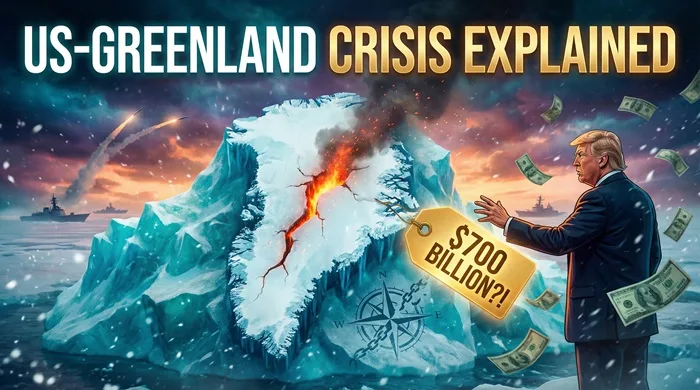
In January 2026, the Arctic‘s geopolitical stability faced a severe test when President Donald Trump reiterated that the United States needs Greenland for national security, specifically linking it to the Golden Dome missile defense system. Reports from NBC News indicate the administration is calculating a purchase price of up to $700 billion to acquire the territory from Denmark, a move NATO allies fear could escalate into military action. While Copenhagen firmly states the island is not for sale, the US has intensified pressure, citing threats from China and Russia and signaling a willingness to act unilaterally to secure the strategic island.
What is the latest news regarding the conflict?
- Renewed Claims: President Trump declared that US ownership of Greenland is a “national security” necessity to deter adversaries and support the Golden Dome defense system.
- Financial Offer: NBC News reported that the White House is preparing a proposal valued at $700 billion to facilitate the transfer of sovereignty.
- Military Threats: The administration has suggested it might pursue the acquisition “the hard way,” implying potential military coercion or unilateral expansion of the Pituffik Space Base.
- Diplomatic Tensions: Vice President JD Vance and Secretary of State Marco Rubio held tense meetings with Danish and Greenlandic ministers in Washington to demand compliance.
- Citizen Payouts: Reports indicate a plan to bypass the Danish government by offering direct cash payments of $10,000 to $100,000 to every Greenlandic citizen to win their support.
What are the fundamental aspects of the dispute?
- Core Conflict: It is a clash between the principles of territorial sovereignty upheld by Denmark and the strategic expansionism pursued by the United States.
- Diplomatic Dimension: A severe strain within the NATO alliance, where one member threatens the territorial integrity of another.
- Economic Dimension: A struggle for control over critical minerals and future Arctic shipping lanes.
- Key Features:
- Asymmetric Power: The dispute involves a global superpower utilizing its economic might against a smaller state.
- Resource Nationalism: The conflict is driven by the desire to monopolize Rare Earth Elements vital for future technologies.
Why is the United States pursuing Greenland?
- National Security: The US aims to secure its Arctic flank to prevent Russia and China from establishing a military foothold near North America.
- Missile Defense: The proposed Golden Dome system requires advanced early warning radars and interceptors stationed in the high north.
- Resource Independence: Controlling Greenland’s Kvanefjeld deposit would break China‘s monopoly on Rare Earth Elements, similar to how India’s KABIL seeks Lithium assets abroad to ensure domestic energy security.
- Strategic Chokepoints: Ownership ensures dominance over the GIUK Gap, a critical naval gateway for monitoring Russian submarines entering the Atlantic.
Where is the conflict geographically centered?
- Greenland: The world’s largest island, strategically located between the Arctic and Atlantic Oceans, acting as a bridge between North America and Europe.
- Pituffik Space Base: Formerly Thule Air Base, this northern facility is essential for space surveillance and tracking ballistic missiles.
- Southern Mining Zone: The conflict also focuses on the Kvanefjeld and Tanbreez sites in the south, which hold massive reserves of uranium and rare earths.
When did the US interest in Greenland originate?
- 1867: Secretary of State William Seward commissioned a report to explore purchasing Greenland and Iceland, viewing them as vital for hemispheric defense.
- 1917: The US purchased the Danish West Indies (now US Virgin Islands) for $25 million, establishing a precedent for buying Danish territory.
- 1946: President Harry Truman offered $100 million in gold bars to Denmark for the island, but the offer was rejected.
- 2019: President Trump first floated the idea as a “real estate deal,” which was dismissed by the Danish Prime Minister.
- 2026: The proposal returned as an urgent national security priority backed by a $700 billion valuation.
Who are the primary stakeholders involved?
- United States: Led by President Trump and JD Vance, seeking to expand American territory and secure strategic resources.
- Denmark: Represented by Prime Minister Mette Frederiksen, defending the Unity of the Realm and refusing to sell its citizens.
- Greenland: The Inuit population and their government (Naalakkersuisut) assert their right to self-determination, stating “nothing about us without us.”
- China: An external actor seeking to build a Polar Silk Road and invest in mining through companies like Shenghe Resources.
How would the acquisition mechanism function?
- Financial Leverage:
- Lump Sum: A massive transfer of wealth (est. $700 billion) to the Danish state.
- Citizen Incentives: Direct payouts of $10,000 to $100,000 to Greenlanders to encourage them to vote for separation from Denmark.
- Legal Loophole:
- The US may encourage Greenland to use Article 21 of the Self-Government Act 2009 to declare independence, after which it would immediately sign a Compact of Free Association with Washington.
- Coercive Measures:
- If diplomacy fails, the US has threatened “the hard way”, which could involve a naval blockade or unilateral expansion of military zones.
What are the consequences for India?
- Resource Security:
- Just as KABIL (Khanij Bidesh India Ltd) scouts for Cobalt in Argentina, India needs diverse sources of Rare Earths; a US monopoly in Greenland could restrict India’s access to non-Chinese critical minerals.
- Scientific Research:
- The NISAR satellite, a joint NASA-ISRO mission launching in 2025/2026, relies on open access to monitor cryosphere changes in Greenland which directly influence global sea levels.
- India’s Arctic Policy 2022 emphasizes scientific cooperation; geopolitical tension could hinder Indian scientists participating in the GROCE project to study climate links to the Indian Monsoon.
- Strategic Autonomy:
- As an Observer in the Arctic Council, India advocates for a rules-based order; US unilateralism forces New Delhi to navigate a polarized Arctic between its partners Russia and the US.
- Trade Relations:
- The US-Greenland standoff creates friction in the Transatlantic alliance, potentially delaying the India-EU Free Trade Agreement negotiations.
Comparison of Major US Territorial Acquisitions
| Feature | Louisiana Purchase (1803) | Alaska Purchase (1867) | Greenland Proposal (2026) |
| Seller | France | Russia | Denmark (Unwilling) |
| Original Price | $15 Million | $7.2 Million | ~$700 Billion (Proposed) |
| Inflation Adj. | ~$340-400 Million | ~$\text{136 Million | N/A |
| Area | ~2.1 million sq km | ~1.7 million sq km | ~2.16 million sq km |
| Strategic Goal | Mississippi River Access | Pacific Trade & Resources | Arctic Control & Rare Earths |
| Consent | None (Indigenous ignored) | None (Indigenous ignored) | No Consent (85\% oppose) |
What are the limitations and challenges?
- Indigenous Resistance: Polls show 85\% of Greenlanders oppose becoming a US territory, fearing the loss of their Nordic welfare system.
- International Law: The UN Charter prohibits the threat or use of force against the territorial integrity of a sovereign state.
- Environmental Concerns: Expanded military infrastructure and uranium mining at Kvanefjeld face fierce opposition due to risks of radioactive contamination.
- NATO Unity: Aggressive actions against Denmark could trigger Article 5, theoretically forcing NATO members to defend Denmark against the US.
What is the way forward?
- Diplomatic Engagement: The US should respect the 2009 Self-Government Act and engage in dialogue rather than coercion.
- Investment Partnership: Instead of purchase, the US could increase investment in Greenland’s infrastructure to secure influence.
- Multilateral Cooperation: Utilization of the Arctic Council to address security concerns without violating sovereignty.
Conclusion
- The US-Greenland conflict marks a return to Great Power Competition where geography and resources define global relations.
- While the United States has legitimate security concerns regarding China and Russia, attempting to “buy” a nation challenges the modern Westphalian system of sovereignty.
- For the global community, including India, the outcome will determine whether the Arctic remains a global common or becomes a closed zone of militarized exclusivity.
Q. Critically analyze how the ‘financialization of sovereignty’ in the US Greenland proposal challenges the Westphalian state system, and evaluate the implications for India’s Arctic Policy regarding the securitization of global commons. (250 words)
High-yield recap
- Core Issue: US seeks to acquire Greenland for }$700 billion for National Security (Golden Dome) and Rare Earths; Denmark refuses.
- Key Players:Donald Trump (Buyer), Mette Frederiksen (Refuser), Greenland (Self-determining entity), China (Silent rival).
- Mechanism: Financial payout ($10k-$100k/person) or Coercion (“The Hard Way”).
- India Link:KABIL needs Rare Earths; NISAR satellite monitors Arctic ice; Arctic Policy seeks open commons.
- Challenges:NATO unity fracture, Indigenous opposition (85%), International Law violation.
- Significance: Marks the shift from Globalisation to Territorial Competition in the Arctic.
Related Posts

If you like this post, please share your feedback in the comments section below so that we will upload more posts like this.

Responses