
2.1 Contribution of Vakil, Gadgil, and V.K.R.V. Rao | The Pre Liberalization Era
1. Theoretical Underpinnings of Development Economics in the Indian Context
The intellectual landscape of India’s pre-liberalization era was not merely a reflection of global economic trends but a distinct theoretical ecosystem forged by domestic imperatives. The contributions of C.N. Vakil, D.R. Gadgil, and V.K.R.V. Rao cannot be understood in isolation; they must be viewed through the prism of the development theories they shaped and critiqued. Their work collectively addressed the fundamental question: How does a nation transition from a low-level equilibrium trap to a self-sustaining growth trajectory amidst structural rigidities?
- The Concept of Economic Growth vs. Economic Development
- Distinction in Theory:
- The pre-liberalization discourse was heavily influenced by the dichotomy between growth and development. As noted in standard economic literature of the time, economic growth was often defined strictly in terms of a sustained increase in real Gross Domestic Product (GDP) or per capita income over a long period.
- However, the scholars of this era, particularly V.K.R.V. Rao, argued that for an underdeveloped country like India, growth alone was insufficient. The increase in GDP had to be accompanied by progressive changes in the socio-economic structure.
- The theoretical consensus, driven by these thinkers, was that development implied growth plus qualitative changes—specifically the reduction of poverty, inequality, and unemployment.1
- The Problem of “Growth Without Development”:
- A central concern for D.R. Gadgil was the phenomenon where an economy could record a rise in GDP due to an enclave sector (like heavy industry or colonial extraction) while the masses remained in subsistence.
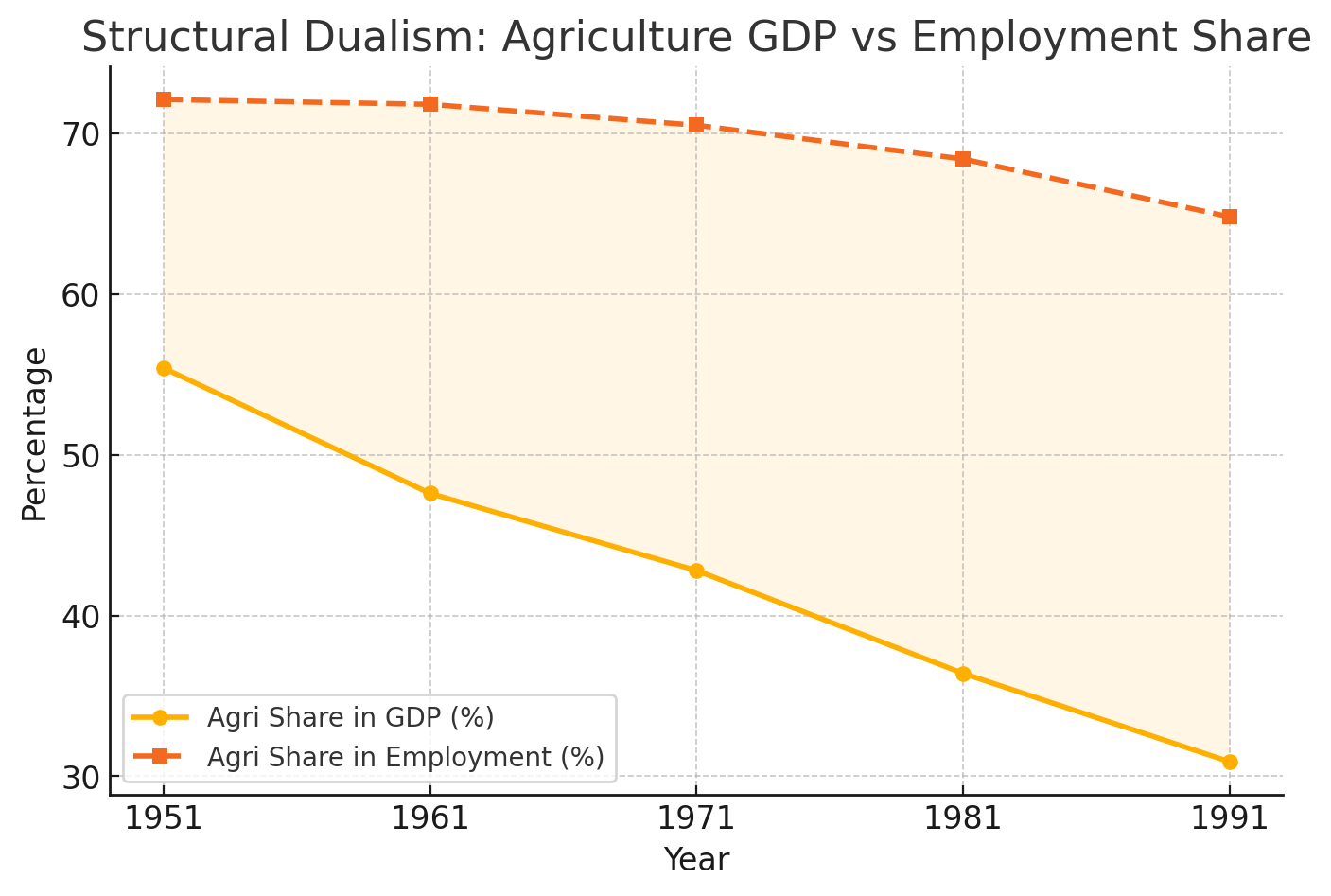
- This theoretical trap was evident in the “Dualism” of the Indian economy—a coexistence of a modern, capital-intensive industrial sector and a primitive, labor-intensive agricultural sector. The failure of the “trickle-down” effect was a theoretical cornerstone for Gadgil’s advocacy of decentralized planning.
- The data from the early planning period validated this concern. While industrial production indices rose, the occupational structure remained stagnant, with agriculture continuing to employ over 70% of the workforce, indicating that the structural transformation central to development was not occurring alongside growth.1
- Measurable Criteria of Underdevelopment:
- The theoretical framework relied on specific indicators to classify India’s underdevelopment, a methodology pioneered by Rao’s national income statistics.
- Low Per Capita Income: The definition of underdevelopment was anchored in the comparison of real income. With a per capita income vastly lower than Western nations (e.g., $612 in low-income economies vs $41,046 in high-income economies in later comparisons), the theoretical imperative was to accelerate capital formation.1
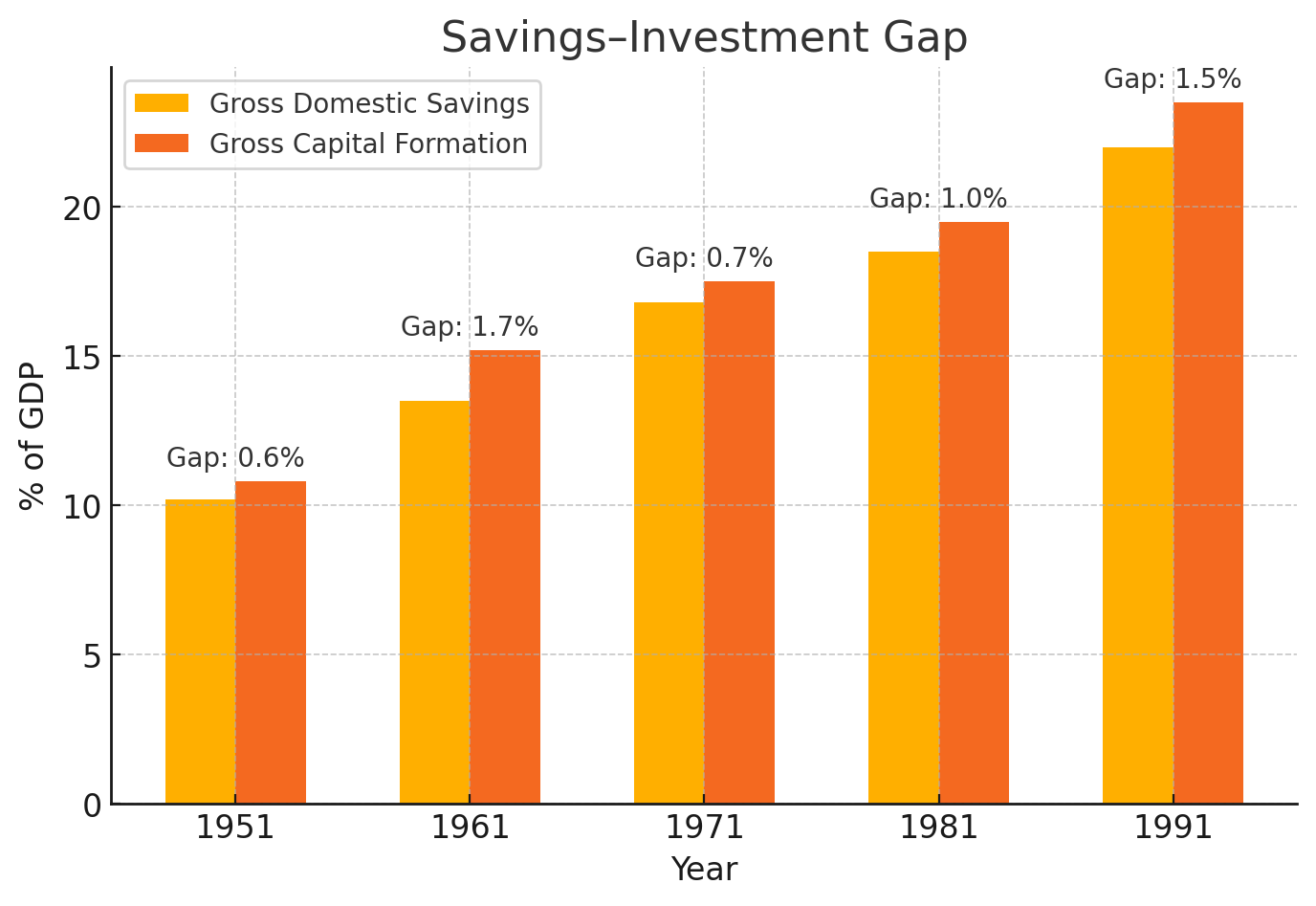
- Capital Scarcity: The “Vicious Circle of Poverty” (Nurkse) was the dominant theoretical model. Low income led to low savings (often <20% of GDP), which led to low investment, resulting in low productivity. Vakil’s “Wage-Goods Model” was a direct theoretical response to breaking this specific link in the chain.1
- Distinction in Theory:
- The Role of the State and Planning:
- The Rationale for State Intervention:
- The theoretical consensus among the “Trinity” (Vakil, Gadgil, Rao) was that the market mechanism, left to itself, would not correct the structural imbalances of the Indian economy.
- This was based on the understanding that the price mechanism fails in an economy with structural rigidities (e.g., immobile labor, lack of infrastructure).
- Therefore, Planning was viewed not just as a resource allocation mechanism but as a tool for structural transformation. The “Directive Principles of State Policy” in the Constitution provided the political mandate for this economic theory.1
- Divergence in Planning Philosophy:
- While all three supported the idea of planning, their theoretical approaches to its execution diverged.
- Gadgil: Viewed planning as a bottom-up process (“Planning from Below”). He argued that a centralized plan could not account for local variations in soil, climate, and social capital. His theory was that development is a localized process of resource mobilization.
- Vakil: Viewed planning through the lens of monetary stability. His theory posited that planning that ignored the “Inflationary Gap” would be self-defeating. If the plan outlay exceeded real savings, it would lead to forced savings through inflation, which was regressive.
- Rao: Viewed planning as a tool for human capital formation. His theoretical contribution was to treat education and health not as consumption expenditure but as investment in human capital, a precursor to modern Endogenous Growth Theory.1
- The Rationale for State Intervention:
2. The Economic Context at Independence: Structural Constraints and Colonial Legacy
To appreciate the interventions of Vakil, Gadgil, and Rao, one must dissect the cadaver of the colonial economy they inherited in 1947. Their theories were not formed in a vacuum but were responses to the visceral reality of a stagnant, exploited, and fractured economy.
- The Legacy of Colonial Exploitation:
- Drain of Wealth:
- The economic narrative was dominated by the “Drain Theory” (Dadabhai Naoroji), which V.K.R.V. Rao scientifically quantified. The colonial government utilized India’s export surplus not to pay for Indian imports but to transfer capital to Britain (Home Charges).
- This resulted in a lack of domestic capital accumulation. The economic surplus that could have been invested in Indian industry was siphoned off, leaving the economy with a low capital base at independence.1
- De-industrialization:
- The colonial policy of “discriminatory intervention” led to the destruction of traditional Indian handicrafts without the concurrent rise of modern industry.
- This forced a “ruralization” of the workforce. As artisans lost their livelihoods, they fell back on the land, increasing the pressure on agriculture. This historical process created the massive “disguised unemployment” that Vakil and Gadgil later sought to address through their respective models.1
- The industrial sector that did emerge (jute, cotton, tea) was largely enclave-based and geared towards export markets rather than domestic consumption, creating a disjointed economic structure.
- Drain of Wealth:
- Structural Retardation and Stagnation:
- The Low-Level Equilibrium Trap:
- At independence, the Indian economy was characterized by a “low-level equilibrium trap.” The growth rate of aggregate output was barely keeping pace with population growth.
- Between 1900 and 1950, the growth rate of the Indian economy was estimated to be near zero in per capita terms. This “stagnation” was the starting point for all post-independence economic theorizing.1
- Demographic Transition and Dependency:
- The population was growing at an accelerating rate (approaching 2% per annum in the post-1951 period). This demographic trend exacerbated the poverty trap.
- A high birth rate combined with falling death rates (due to initial medical improvements) created a “population explosion.”
- Economic Implication: A significant portion of national income had to be diverted solely to maintain the existing miserable standard of living for the additional population (demographic investment), leaving little for economic deepening (increasing capital per worker). This reality profoundly influenced Rao’s later advocacy for population control as an economic imperative.1
- The Low-Level Equilibrium Trap:
- The Agrarian Crisis:
- Feudal Relations of Production:
- The agricultural sector, employing over 70% of the workforce, was shackled by semi-feudal land tenure systems (Zamindari, Mahalwari, Ryotwari).
- Incentives for investment were non-existent. The tiller did not own the land, and the owner (rentier) had no interest in cultivation.
- Productivity: Agricultural productivity was among the lowest in the world. The yield per hectare for major crops was stagnant. This “inelasticity of agricultural supply” became the central pillar of Vakil’s critique of deficit financing—money could be printed, but food could not be printed.1
- Feudal Relations of Production:
3. V.K.R.V. Rao and the Architecture of National Income Accounting
V.K.R.V. Rao serves as the empirical anchor of Indian economics. Before policy could be formulated, the economy had to be measured. Rao’s contribution was to transform the “guesswork” of colonial administrators into the “science” of national income accounting.
- Methodological Innovations in Estimation:
- Scientific Estimation (1925-1929):
- Rao published the first scientific estimate of India’s national income for the period 1925-1929. Unlike previous estimates (by Digby or Findlay Shirras), Rao used a combination of the “Product Method” (for agriculture and industry) and the “Income Method” (for services and government).
- Significance: This dual-method approach laid the foundation for the Central Statistical Organisation’s (CSO) later methodology. It acknowledged that in a data-poor developing economy, a single method would yield erroneous results.1
- Distinction between Domestic and National Income:
- Rao was meticulous in distinguishing between “income generated within the geographic boundaries” (Domestic Product) and “income accruing to residents” (National Product).
- Contextual Relevance: In the colonial context, this was a political bombshell. A significant portion of the income generated in India (profits of British railways, tea plantations, banks) was repatriated abroad.
- By quantifying this “Net Factor Income from Abroad” (NFIA) as a negative figure, Rao provided the empirical validation for the nationalist critique of colonial exploitation. He showed that the GDP might be rising, but the GNP (available to Indians) was suppressed.1
- Scientific Estimation (1925-1929):
- Sectoral Classification and Structural Analysis:
- The Three-Sector Model:
- Rao categorized the economy into Primary (Agriculture), Secondary (Industry), and Tertiary (Services) sectors.
- Insight on Productivity: His analysis revealed the stark productivity differential. The Primary sector employed ~72% of the workforce but contributed only ~50% of the National Income. Conversely, the Tertiary sector showed much higher per-capita productivity.
- This data drove the conclusion that development in India must involve a structural shift—moving labor from the low-productivity primary sector to the high-productivity secondary sector. This became the rationale for the industrialization drive.1
- Imputation of the Non-Monetized Sector:
- One of Rao’s most significant technical contributions was dealing with the “non-monetized” sector. In rural India, a large part of production (food grains, firewood, cattle feed) was consumed by the producers and never entered the market.
- Rao devised methods to “impute” value to this subsistence production. Without this, India’s national income would be grossly underestimated. His methodology ensured that the economic welfare of the subsistence farmer was captured in the national accounts, however meager it might be.
- The Three-Sector Model:
- The Critique of the Keynesian Multiplier in India:
- The K-Multiplier vs. Supply Inelasticity:
- Rao engaged with the dominant Keynesian macroeconomics of the time. Keynes argued that in a depression, government expenditure (deficit financing) creates a multiplier effect ($k$), increasing output and employment.
- Rao’s Thesis: In his seminal paper “Investment, Income and the Multiplier in an Underdeveloped Economy,” Rao argued that the Keynesian multiplier operates only when there is excess capacity and elastic supply.
- The Indian Reality: In India, the supply of wage goods (agriculture) is inelastic in the short run. Therefore, an increase in nominal investment leads not to an increase in real output (employment) but to an increase in the price level.
- Policy Consequence: This theoretical insight was a warning against the indiscriminate use of deficit financing for the Five-Year Plans. Rao predicted that without an agricultural surplus, pump-priming would lead to stagflation—a prediction that unfortunately came true in the mid-1960s.1
- The K-Multiplier vs. Supply Inelasticity:
4. Rao’s Analysis of the Human Factor and Nutritional Poverty
Moving beyond cold statistics, V.K.R.V. Rao was a humanist who argued that the ultimate goal of economics was the improvement of the quality of human life. He pioneered the “Human Capital” approach in India long before it became fashionable in the West.
- The Human Factor in Economic Development:
- Education as Investment:
- Rao argued against the classification of education expenditure as “social services” (consumption). He viewed it as “capital formation.”
- He posited that the low productivity of the Indian worker was not due to laziness but due to a lack of skill and poor health.
- Link to Productivity: Drawing from his national income data, he showed that sectors with higher literacy (services) had higher value-added. He advocated for a massive expansion of primary and technical education as a prerequisite for industrialization. “Machines cannot be run by illiterates,” was the implicit maxim.1
- The Psycho-Social Obstacles:
- Rao also analyzed the non-economic factors. He identified the caste system, fatalism, and the lack of scientific temper as impediments to economic growth.
- He argued that economic development required a “cultural revolution” alongside capital accumulation—a shift from status-based social relations to contract-based economic relations.
- Education as Investment:
- Nutritional Definition of Poverty:
- Defining the Poverty Line:
- Rao was instrumental in shifting the poverty debate from “income” to “nutrition.” He argued that a monetary poverty line is meaningless if the money cannot buy a balanced diet.
- He emphasized the caloric norms (2400 rural / 2100 urban) which became the basis for the Planning Commission’s poverty estimates.
- The Protein Hunger:
- Beyond calories, Rao highlighted “protein hunger.” He noted that the cereal-heavy diet of the Indian poor led to malnutrition even if caloric needs were met.
- Implications for Agriculture: This led him to advocate for the diversification of agriculture—moving beyond rice and wheat to pulses and milk. He argued that “Food Security” must mean “Nutritional Security.”
- Critique of Trickle-Down:
- Rao was skeptical of the view that GDP growth would automatically solve the poverty problem. His analysis of the “size distribution of income” showed that the gains of early planning were being captured by the upper deciles (the “U-sector”).
- He provided the intellectual ammunition for the “Garibi Hatao” programs, arguing for direct state intervention in nutrition (PDS, Mid-day meals) rather than waiting for growth to trickle down.1
- Defining the Poverty Line:
5. C.N. Vakil: The Wage-Goods Model vs. Heavy Industrialization
C.N. Vakil, often in collaboration with P.R. Brahmananda, stands as the great dissenter of Indian planning. When the entire political and economic establishment rallied behind the Nehru-Mahalanobis strategy of heavy industrialization, Vakil offered a rigorous, mathematically sound alternative: the Wage-Goods Model.
- The Mahalanobis Strategy (The Target of Critique):
- The Logic of Heavy Industry:
- The Second Five-Year Plan (1956-61) was based on the Mahalanobis assumption that to achieve self-reliance, India must produce capital goods (machines, steel).
- The model assumed a closed economy where the supply of capital goods was the main constraint on growth. It directed the bulk of investment into the public sector steel and engineering industries.
- The Neglect of Light Industry:
- The strategy deliberately deprioritized consumer goods industries (textiles, food processing), assuming that the small-scale sector would meet this demand.
- It also assumed that agriculture could be managed through institutional reforms (cooperatives) rather than massive investment.1
- The Logic of Heavy Industry:
- The Vakil-Brahmananda Alternative (The Wage-Goods Model):
- The Core Hypothesis:
- Vakil argued that in a labor-surplus economy like India, the binding constraint on employment generation is not “machines” (capital goods) but “wage goods” (food, cloth, essential consumables).
- The Mechanism: To transfer a worker from the farm (disguised unemployment) to a factory/infrastructure project, you must pay them a wage. The worker will spend this wage primarily on food.
- The Wage-Goods Gap: If the supply of food does not increase, the new demand created by the newly employed worker will lead to inflation. This “Wage-Goods Gap” will force the government to stop investment, halting the growth process.
- Policy Prescription:
- Vakil advocated for a strategy that prioritized “Agriculture and Light Industry.”
- Invest in Agriculture: Increase the marketable surplus of food.
- Expand Employment: Use this food surplus to sustain a massive workforce in infrastructure (irrigation, roads) and light manufacturing.
- Capital Formation: This “balanced growth” would generate profits faster (since light industry has a lower gestation period) and allow for faster reinvestment and capital accumulation than the slow-gestating heavy industries.1
- The Core Hypothesis:
- Vindication of the Model:
- The Crisis of the 1960s:
- The history of the Second and Third Plans largely vindicated Vakil. The heavy industry drive led to a severe shortage of food and essential goods.
- Inflation spiked (reaching double digits), and the country faced a Balance of Payments crisis (needing to import food under PL-480).
- The “Plan Holiday” (1966-69) and the shift to the Green Revolution were essentially a belated acceptance of Vakil’s logic: without an agricultural base, the industrial superstructure comes crashing down.1
- The Crisis of the 1960s:
6. Vakil and the Monetary Critique: Inflation and the ‘Falling Rupee’
C.N. Vakil was not just a development theorist but a monetary hawk. His work “The Falling Rupee” is a classic analysis of inflation in a developing economy. He fundamentally disagreed with the “structuralist” view that inflation was a necessary lubricant for growth.
- The Nature of Inflation in India:
- Monetary vs. Structural Factors:
- Vakil analyzed inflation as a result of the mismatch between “Aggregate Monetary Demand” and “Aggregate Real Supply.”
- He critiqued the government’s use of “Deficit Financing” (printing money against ad-hoc treasury bills) to fund Plan expenditure.
- The Mechanism: In the West, printing money might stimulate demand and utilize idle capacity. In India, printing money simply chased a fixed supply of goods (due to supply-side rigidities in agriculture), leading directly to price rises.
- Social Consequences:
- Vakil argued that inflation in India is the “most regressive tax.” It transfers purchasing power from the poor (whose wages are sticky/fixed) to the rich (traders, industrialists, and the government) who benefit from rising prices.
- He posited that “Growth with Stability” should be the objective, and that “Inflation for Growth” was a dangerous fallacy that would undermine the political stability of the nation.1
- Monetary vs. Structural Factors:
- Proposed Remedies:
- SEMIBOMBLA (Scheme of the Economists for Monetary Immobility through Bond Medallions and Blocked Assets):
- In response to the hyper-inflation post-WWII, Vakil (along with other economists) proposed this radical scheme to reduce money supply.
- It involved issuing bonds to sterilize excess purchasing power. While not fully implemented, it demonstrated his commitment to monetary orthodoxy and finding innovative solutions to curb liquidity.
- Fiscal Discipline:
- Vakil was a relentless critic of wasteful public expenditure. He argued that the Public Sector Undertakings (PSUs) were becoming “white elephants.”
- He pointed out that the “Internal and Extra Budgetary Resources” (IEBR) of PSUs were negligible, meaning they relied on the budget for survival rather than contributing to it. He advocated for strict financial accountability long before the era of privatization.1
- SEMIBOMBLA (Scheme of the Economists for Monetary Immobility through Bond Medallions and Blocked Assets):
7. D.R. Gadgil: The Philosophy of Decentralized Planning
D.R. Gadgil was the institutional architect of the cooperative movement and the intellectual conscience of the planning process. His contribution lies in challenging the “Delhi-centric” view of the economy.
- Critique of Centralized Planning:
- The Ivory Tower Problem:
- Gadgil criticized the Planning Commission for operating as a “Super Cabinet.” He argued that the experts in Delhi, however brilliant, could not understand the micro-realities of a district in Maharashtra or Bihar.
- He termed the centralization of power as inefficient and undemocratic. He believed that the “Target Approach” (e.g., specific targets for fertilizer use set by Delhi) led to wasteful allocation because it ignored local soil conditions.
- Bureaucratization:
- Gadgil warned against the stifling grip of bureaucracy. He noted that the “License-Permit Raj” favoured large industrial houses because they had the resources to maintain liaison officers in Delhi to navigate the red tape.
- This, he argued, led to a concentration of economic power—directly contradicting the constitutional mandate of preventing wealth concentration.1
- The Ivory Tower Problem:
- The Model of “Planning from Below”:
- District Planning Committees:
- Gadgil proposed a multi-level planning structure. The center should only plan for national infrastructure (railways, defense, heavy industry).
- Agriculture, small industry, and social services should be planned at the District and State levels.
- Local Resource Mobilization: He argued that local planning would encourage local resource mobilization. If villagers saw their taxes being used for a local school or tank, they would be more willing to contribute than if the money went to a distant central pool.1
- The Cooperative Commonwealth:
- Gadgil’s vision for the Indian economy was neither Capitalist nor Statist, but Cooperative.
- He believed the “Cooperative” was the ideal organization for the small Indian farmer and artisan. It combined the “economies of scale” (pooling resources) with “autonomy” (democratic ownership).
- Success of Sugar Cooperatives: He proved his theory by helping establish the Pravara Sugar Cooperative in Maharashtra. This showed that illiterate peasants could successfully run a modern industrial enterprise if organized cooperatively. This became a model for the dairy cooperatives (Amul) later.
- District Planning Committees:
8. The Gadgil Formula and Center-State Financial Relations
Perhaps D.R. Gadgil’s most enduring administrative legacy is the formula that bears his name, which sought to bring objectivity to the murky waters of fiscal federalism.
- The Problem of Vertical and Horizontal Imbalance:
- Vertical Imbalance: The Constitution assigned the most buoyant taxes (Income Tax, Customs, Excise) to the Center, while assigning the most expenditure-heavy sectors (Health, Education, Agriculture) to the States. This created a structural deficit for the States.
- Horizontal Imbalance: There were vast disparities between rich states (Maharashtra, Punjab) and poor states (Bihar, Orissa).
- Discretionary Transfers: Before Gadgil, a large portion of “Plan Assistance” was given by the Planning Commission to states on a discretionary basis. This led to political bargaining and instability.1
- The Gadgil Formula (1969):
- To depoliticize resource transfer, Gadgil (as Deputy Chairman of the Planning Commission) formulated a weighted criteria for distributing Central Assistance for State Plans.
- The Weights:
- Population (60%): Ensuring that the most populous states got the bulk of funds (Equity).
- Per Capita Income (10%): Specifically targeting states with income below the national average (Redistribution).
- Tax Effort (10%): Rewarding states that mobilized their own resources efficiently (Incentive for Efficiency).
- Ongoing Irrigation/Power Projects (10%): Ensuring continuity of critical infrastructure.
- Special Problems (10%): For states with unique challenges (floods, drought, tribal areas).
- Impact:
- This formula transformed Center-State relations. It shifted the power from the “whim” of the central planner to an “objective rule.”
- It acknowledged that equity and efficiency must be balanced—giving funds to the poor (Population/Income) while incentivizing performance (Tax Effort).
- Though modified by subsequent Finance Commissions (removing the “Projects” weight, increasing “Fiscal Discipline”), the core philosophy of formula-based transfers remains the bedrock of Indian Fiscal Federalism today.1
9. Structural Dualism and the Agriculture-Industry Debate
The “Trinity” engaged in a fierce debate over the structural relationship between the two giants of the Indian economy: Agriculture and Industry.
- The Terms of Trade Debate:
- Gadgil’s Perspective:
- Gadgil was concerned about the “Internal Terms of Trade” (the price of agricultural goods relative to industrial goods).
- He argued that the government often suppressed agricultural prices (through levy prices and export bans) to provide cheap food to the urban proletariat and cheap raw materials to industry.
- Consequence: This “urban bias” squeezed the surplus out of agriculture, preventing capital formation in the rural sector. Gadgil warned that an impoverished peasantry provides no market for industrial goods, leading to a demand constraint for industry.
- Vakil’s Perspective:
- Vakil viewed the relationship through the “Wage Fund.” Agriculture was the supplier of the wage fund.
- If agriculture stagnated, food prices would rise. This would force industrial wages up (to maintain subsistence), which would eat into industrial profits.
- Therefore, industrialization depended on agricultural productivity. You cannot have a thriving industry with a stagnant agriculture.
- Rao’s Perspective:
- Rao emphasized the “linkages.” He noted that agriculture provided the “demand linkage” (buying tractors, fertilizers, consumer goods) and the “supply linkage” (cotton, jute, sugar cane).
- He argued for “agro-based industries” as the bridge. Instead of jumping to steel mills, India should focus on processing its agricultural output, creating rural employment.1
- Gadgil’s Perspective:
- The Reality of Structural Retrogression:
- The Data:
- Despite the debates, the pre-liberalization era witnessed a peculiar structural change.
- Share in GDP: Agriculture’s share fell from ~55% (1950) to ~35% (1980).
- Share in Employment: The workforce in agriculture remained stuck at ~70%.
- Implication: This meant that the per capita GDP in agriculture was falling relative to the non-agricultural sector. The gap between the “Bharat” (Rural) and “India” (Urban) was widening.
- This “structural retrogression” (a term used by V.K.R.V. Rao) vindicated the fear that industrialization was failing to absorb the surplus labor, leaving the burden on the land.1
- The Data:
10. The Institutional Legacy: Building the Framework for Economic Research
The contribution of these three scholars was not limited to books and papers; they built the institutions that produce the data and policy analysis for India.
- V.K.R.V. Rao: The Institution Builder:
- Delhi School of Economics (DSE): Rao founded DSE to create a center of excellence for economic theory in India, modeled on the London School of Economics. It became the training ground for India’s top policymakers (including Manmohan Singh and Amartya Sen).
- Institute of Economic Growth (IEG): Recognizing the need for applied research, he founded IEG to focus on demography, agriculture, and planning issues.
- Indian Council of Social Science Research (ICSSR): He established the ICSSR to fund and coordinate social science research across the country, ensuring that policy was backed by empirical data.1
- D.R. Gadgil: The Conscience Keeper:
- Gokhale Institute of Politics and Economics (GIPE): Under Gadgil, GIPE in Pune became the premier center for agricultural economics. Their detailed surveys of rural India provided the counter-narrative to the official government statistics.
- Reserve Bank of India (Director): As a director on the RBI board, Gadgil pushed for the “social control” of banks and eventually the nationalization of banks (1969) to ensure credit reached the rural sector and not just big industry.
- C.N. Vakil: The Bombay School:
- Department of Economics, University of Bombay: Vakil turned this department into a stronghold of monetary economics.
- The Tradition of Dissent: He fostered a culture of independent critique. The “Bombay School” became known for its opposition to the official line of the Planning Commission, ensuring that there was always a robust debate on policy choices.1
11. Quantitative Assessment of the Pre-Liberalization Era (Data Analysis)
To objectively evaluate the era these economists shaped, we must look at the hard numbers. The data reflects the struggle between their theories and the political realities.
- The “Hindu Rate of Growth”:
- For the first three decades (1950-1980), the Indian economy grew at an average rate of 3.5% per annum.
- Per Capita Stagnation: With population growing at ~2.1%, the per capita income growth was a meager 1.3% to 1.5%.
- Analysis: This slow growth confirmed the “low-level equilibrium” concerns. The economy was running just to stay in the same place. It failed to generate the “big push” envisaged by the Mahalanobis model, largely due to the “wage-goods constraint” identified by Vakil.1
- Savings and Capital Formation:
- Success in Savings: One major achievement was the rise in the savings rate. Gross Domestic Savings rose from 10.2% of GDP (1950-51) to 21.2% (1980-81).
- Failure in Efficiency: While savings doubled, the growth rate did not double. This implies a sharp rise in the Incremental Capital Output Ratio (ICOR).
- The ICOR Problem: The ICOR rose from ~3.5 in the First Plan to ~6.0 in the Third/Fourth Plans. This indicates massive inefficiency in capital use, largely driven by the poor performance of the Public Sector Undertakings (PSUs) and the long gestation periods of heavy industry—a point Vakil had warned against.1
- Poverty and Unemployment:
- Headcount Ratio: The poverty ratio remained stubbornly high, fluctuating between 45% and 55% throughout the pre-liberalization period.
- Absolute Numbers: Due to population growth, the absolute number of poor doubled.
- Employment Elasticity: The employment elasticity of the manufacturing sector was low. The organized manufacturing sector grew in output but not in jobs (capital intensive). This left the unorganized sector to absorb the labor force, leading to “casualization” and low wages.1
12. Critical Appraisal: The Relevance of the Trinity in the Post-Reform Era
While the 1991 reforms dismantled the “License Raj” and opened the economy, the insights of Vakil, Gadgil, and Rao remain hauntingly relevant.
- The Unfinished Agenda of Employment:
- The post-1991 era has seen high growth (6-8%) but has been termed “Jobless Growth.”
- Relevance: This echoes Vakil’s “Wage-Goods” critique. The growth has been driven by services and capital-intensive industry, bypassing the labor-intensive sectors. Vakil’s argument that “employment depends on the supply of wage goods” is now “employment depends on the labor-intensity of growth.” The neglect of labor-intensive manufacturing remains India’s Achilles heel.1
- The Crisis of Agriculture:
- The agrarian distress visible today (farmer suicides, low income) is a continuation of the “Terms of Trade” debate.
- Relevance: Gadgil’s warning about the “urban bias” and the need for decentralized “District Planning” is more relevant than ever. The centralized schemes (PM-Kisan etc.) still face the “last mile” problem that Gadgil identified 50 years ago.
- Human Development Disparities:
- India’s poor ranking on the Human Development Index (HDI) despite being a large economy vindicates V.K.R.V. Rao.
- Relevance: Rao’s insistence that “economic growth without human capital is unsustainable” is now the mainstream consensus. The focus on health and education in recent budgets is a belated tribute to Rao’s vision that people are the primary asset of a nation.
13. Comparison Charts: The Trinity’s Economic Perspectives
The following table synthesizes the distinct economic philosophies of C.N. Vakil, D.R. Gadgil, and V.K.R.V. Rao, highlighting their divergences on key issues of the pre-liberalization era.
| Feature | C.N. Vakil | D.R. Gadgil | V.K.R.V. Rao |
| Primary Economic Focus | Monetary Economics, Inflation, Supply-side constraints. | Planning Architecture, Cooperative Federalism, Decentralization. | National Income Statistics, Human Capital, Nutrition. |
| Stance on Industrialization | Skeptical of Heavy Industry: Favored “Wage-Goods” model (Agri + Light Industry) for faster employment. | Critical of Centralization: Favored dispersed, decentralized industrialization through cooperatives. | Nuanced Support: Supported industrialization but warned against neglecting the “human factor” and “services.” |
| Planning Philosophy | Market-Correction: Planning must respect monetary limits; anti-inflationary focus. | “Planning from Below”: District-level planning; empowerment of local bodies. | Scientific Planning: Planning based on rigorous data; “Credit Planning” for priority sectors. |
| Key Conceptual Contribution | The Wage-Goods Gap: Inflation is caused by a shortage of consumer goods, not just money supply. | Gadgil Formula: Objective, formula-based criteria for transferring funds to states. | K-Multiplier Limit: Keynesian multiplier fails in India due to inelastic agricultural supply. |
| View on Deficit Financing | Hawkish: Viewed it as the primary cause of the “Falling Rupee” and regressive inflation. | Moderate: Accepted it if channeled into productive cooperative assets; concerned about urban bias. | Structuralist: Argued it leads to price rise, not output rise; advocated “Functional Finance” cautiously. |
| Institutional Legacy | The Bombay School: Tradition of monetary dissent. | Gokhale Institute: Tradition of rural surveys and cooperative research. | Delhi School / IEG: Tradition of theoretical and applied economic research. |
14. Numerical Problems and Solutions
Problem 1: National Income Estimation (Rao’s Distinction)
Context: V.K.R.V. Rao emphasized the difference between Domestic Product and National Product, especially in a colonial context where wealth was drained.
Problem:
Consider a pre-liberalization economy with the following data:
- GDP at Market Prices ($GDP_{MP}$): ₹ 100,000 Crores
- Depreciation (Consumption of Fixed Capital): ₹ 10,000 Crores
- Income earned by foreign companies in India: ₹ 5,000 Crores
- Income earned by Indian residents abroad: ₹ 1,000 Crores
- Indirect Taxes: ₹ 8,000 Crores
- Subsidies: ₹ 3,000 Crores
Calculate the Net National Product at Factor Cost ($NNP_{FC}$), which represents the true National Income as per Rao’s framework.
Solution:
- Step 1: Calculate Net Domestic Product at Market Prices ($NDP_{MP}$)$$NDP_{MP} = GDP_{MP} – \text{Depreciation}$\text{\$\$}$NDP_{MP} = 100,000 – 10,000 = 90,000 \text{ Crores}$$
- Step 2: Calculate Net Factor Income from Abroad (NFIA)$$\text{NFIA} = \text{Income from Abroad} – \text{Income to Abroad}$\text{\$\$}$\text{NFIA} = 1,000 – 5,000 = -4,000 \text{ Crores}$$(Note: The negative NFIA reflects the “drain” or repatriation of profits).
- Step 3: Calculate Net National Product at Market Prices ($NNP_{MP}$)$$NNP_{MP} = NDP_{MP} + \text{NFIA}$\text{\$\$}$NNP_{MP} = 90,000 + (-4,000) = 86,000 \text{ Crores}$$
- Step 4: Calculate Net National Product at Factor Cost ($NNP_{FC}$)$$\text{Net Indirect Taxes (NIT)} = \text{Indirect Taxes} – \text{Subsidies}$\text{\$\$}$\text{NIT} = 8,000 – 3,000 = 5,000 \text{ Crores}$\text{\$\$}$NNP_{FC} = NNP_{MP} – \text{NIT}$\text{\$\$}$NNP_{FC} = 86,000 – 5,000 = 81,000 \text{ Crores}$$
Result: The National Income is ₹ 81,000 Crores.
Insight: Notice how the NFIA reduces the available income. Rao highlighted this “invisible” loss in his colonial estimates.
Problem 2: The Wage-Goods Inflation Model (Vakil)
Context: Vakil argued that employment generation is constrained by the supply of wage goods. If money is printed to hire workers without extra food, prices rise.
Problem:
- Total Supply of Wage Goods (S): 2,000 units
- Real Wage per worker (W): 2 units
- Current Employment ($N_0$): 1,000 workers
- Government Plan: Prints money to hire 200 additional workers ($dN$) for a heavy industry project.
- Supply Elasticity: 0 (Short run supply of wage goods is fixed).
Calculate the Inflationary Rise in Prices (%) of wage goods required to equilibrate the market.
Solution:
- Initial Equilibrium:$$\text{Demand}_0 = N_0 \times W = 1,000 \times 2 = 2,000 \text{ units}.$\text{\$\$}$\text{Supply}_0 = 2,000 \text{ units}.$\text{\$\$}$\text{Market is clear}.$$
- New Demand:$$\text{Total Workers} = 1,000 + 200 = 1,200.$\text{\$\$}$\text{New Demand} = 1,200 \times 2 = 2,400 \text{ units}.$$
- The Wage-Goods Gap (Inflationary Gap):$$\text{Gap} = \text{New Demand} – \text{Supply} = 2,400 – 2,000 = 400 \text{ units}.$$
- Price Adjustment:Since supply is fixed at 2,000, the price ($P$) must rise to reduce the real consumption of the workers back to the available supply.The nominal expenditure has risen by the ratio of new workers: $\text{1200/1000 = 1.2}$.To clear the market, Price ($P$) must rise by the ratio of Demand/Supply.$$\text{Price Index} = \frac{\text{New Demand}}{\text{Supply}} = \frac{2,400}{2,000} = 1.2$$
Result: Prices must rise by 20%.
Insight: This illustrates Vakil’s theory: A 20% increase in employment without an increase in wage goods leads directly to 20% inflation, which is a “forced saving” imposed on the workers (their real wage falls).
Problem 3: Gadgil Formula Allocation
Context: Allocating central funds based on weighted criteria.
Problem:
Allocate a grant of ₹ 10,000 Crores between State A and State B using a simplified Gadgil Formula:
- Population (Weight: 60%)
- Per Capita Income Deviation (Weight: 20%)
- Tax Effort (Weight: 20%)
Data:
- State A: Population = 40 Million; Per Capita Income = ₹ 10,000; Tax Effort Score = 0.8
- State B: Population = 60 Million; Per Capita Income = ₹ 8,000; Tax Effort Score = 1.2(Note: Lower income gets higher share in deviation criterion. Assume State B gets 60% of income weight due to poverty. Assume Tax Effort is proportional to score).
Solution:
- Population Allocation (Total: ₹ 6,000 Cr)
- State A Share: $40/(40+60) = 40\% \rightarrow 0.4 \times 6000 = \text{₹ } 2,400 \text{ Cr}$.
- State B Share: $60/(40+60) = 60\% \rightarrow 0.6 \times 6000 = \text{₹ } 3,600 \text{ Cr}$.
- Income Deviation Allocation (Total: ₹ 2,000 Cr)
- Given: State B is poorer, gets 60% of this pot.
- State A Share: $40\% \rightarrow 0.4 \times 2000 = \text{₹ } 800 \text{ Cr}$.
- State B Share: $60\% \rightarrow 0.6 \times 2000 = \text{₹ } 1,200 \text{ Cr}$.
- Tax Effort Allocation (Total: ₹ 2,000 Cr)
- Total Score = $\text{0.8 + 1.2 = 2.0}$.
- State A Share: $0.8 / 2.0 = 40\% \rightarrow 0.4 \times 2000 = \text{₹ } 800 \text{ Cr}$.
- State B Share: $1.2 / 2.0 = 60\% \rightarrow 0.6 \times 2000 = \text{₹ } 1,200 \text{ Cr}$.
- Total Allocation:
- State A: $2,400 + 800 + 800 = \textbf{₹ 4,000 Cr}$.
- State B: $3,600 + 1,200 + 1,200 = \textbf{₹ 6,000 Cr}$.
Insight: State B gets more due to higher population, higher poverty (Income criteria), and better tax effort.
15. Analytical Charts
Conclusion
The economic history of Pre-Liberalization India is often simplified as a period of “statist stagnation.” However, a deeper analysis reveals it as a period of intense intellectual ferment, where C.N. Vakil, D.R. Gadgil, and V.K.R.V. Rao wrestled with the fundamental problems of development. They did not merely import Western theories; they indigenized economics. Rao gave the country its statistical skeleton; Gadgil provided its federal and cooperative soul; and Vakil offered the cautionary voice of monetary discipline.
Their legacy is not of failure, but of foundational struggle. They identified the structural constraints—low savings, population pressure, and agricultural stagnation—that defined the “Hindu Rate of Growth.” If the post-1991 reforms have succeeded, it is partly because they stand on the institutions built by Rao, the federal framework designed by Gadgil, and the monetary prudence advocated by Vakil. In the modern era of “Jobless Growth” and “Agrarian Distress,” the ghosts of the Trinity continue to whisper the same lessons: you cannot have sustainable growth without employment, you cannot have industry without agriculture, and you cannot have development without the human factor.
- On Planning Strategy:
- Question: “The Mahalanobis strategy of heavy industrialization was theoretically sound for a closed economy but structurally flawed for a labor-surplus economy.” Critically evaluate this statement using C.N. Vakil’s ‘Wage-Goods’ model. Did the ‘Plan Holiday’ of 1966-69 vindicate Vakil’s concerns?
- Hint: Discuss the capital-intensive nature of Mahalanobis vs. labor-intensive Wage-Goods. Analyze the food shortage crisis of the mid-60s as a consequence of neglecting the wage-goods sector.
- On Fiscal Federalism:
- Question: “D.R. Gadgil’s formula was an attempt to replace ‘political discretion’ with ‘economic objectivity’ in center-state transfers. However, the rise of ‘Centrally Sponsored Schemes’ has diluted this objective.” Discuss the evolution of the Gadgil Formula and its relevance in the context of the tension between the Planning Commission (now NITI Aayog) and the Finance Commission.
- Hint: Focus on the weightage of ‘Population’ vs ‘Performance’. Discuss how discretionary transfers bypassed the formula, re-politicizing fiscal federalism.
- On Poverty and Growth:
- Question: “V.K.R.V. Rao argued that the ‘Keynesian Multiplier’ works only in nominal terms in India, leading to inflation rather than output growth.” Explain the supply-side rigidities that render demand-side management ineffective in India. How does this connect to Rao’s transition from ‘National Income’ analysis to ‘Nutritional Poverty’ analysis?
- Hint: Explain inelastic agricultural supply. Connect it to the fact that inflation hurts the poor most, necessitating a focus on real variables (nutrition) rather than monetary variables (income) for defining poverty.

Responses