

RTE Act & Minority Educational Institutions: Balancing Article 21A and 30

From Current Affairs Notes for UPSC » Editorials & In-depths » This topic
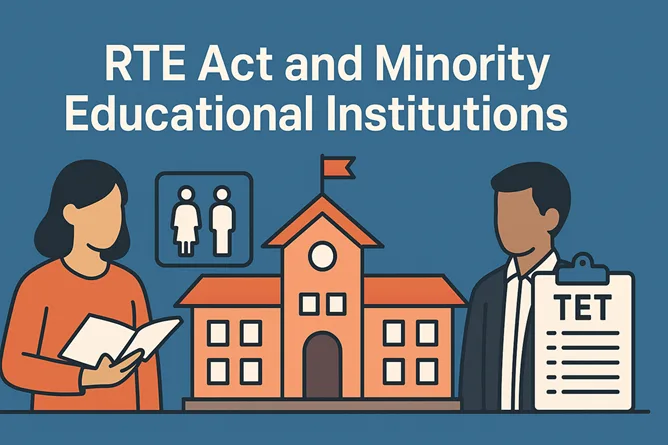
The landscape of Indian education law is currently witnessing a significant churn, particularly concerning the rights of minority educational institutions. A recent observation by the Supreme Court has cast doubt on a decade-old judgment that had shielded these institutions from the requirements of the Right of Children to Free and Compulsory Education Act, 2009 (RTE Act). A two-judge Bench, while examining the necessity of the Teacher Eligibility Test (TET) for minority schools, suggested that the 2014 Pramati judgment, which granted this exemption, requires reconsideration by a larger bench. The court’s primary concern is that by keeping minority schools outside the RTE’s framework, the fundamental right to quality education for children enrolled in them might be compromised, creating a potential conflict between the rights of minority institutions and the rights of children. This development has reignited a crucial debate on balancing constitutional protections with the national goal of universal, quality education.
What is the Right to Education Act of 2009?
The Right to Education (RTE) Act, 2009, is a landmark piece of legislation that provides the legal framework for implementing the fundamental right to education for children.
- Core Mandate
- It makes education a fundamental right for every child between the ages of 6 and 14 years.
- This right is guaranteed under Article 21-A of the Indian Constitution, which was inserted through the 86th Constitutional Amendment in 2002.
- The Act mandates free and compulsory elementary education in a neighbourhood school.
- Key Features of the RTE Act
- 25% Reservation for Weaker Sections:
- It requires all private unaided schools to reserve 25% of their entry-level seats for children from Economically Weaker Sections (EWS) and disadvantaged groups.
- The government reimburses the schools for the expenditure incurred on these students. For instance, the per-child reimbursement cost was set at around ₹18,000 per annum in some states, though this figure varies.
- Norms and Standards:
- The Act lays down specific norms for school infrastructure, teacher-pupil ratios, and teacher qualifications.
- For example, it mandates a teacher-pupil ratio of 1:30 for the primary level.
- It also requires schools to have basic facilities like drinking water, toilets, and a library.
- Prohibitions and Regulations:
- It prohibits practices like charging a capitation fee (donation) for admission and conducting screening procedures or interviews for children or their parents.
- It also forbids physical punishment and mental harassment.
- Teacher Qualifications:
- The Act makes it mandatory for teachers to pass the Teacher Eligibility Test (TET) to ensure a minimum standard of quality.
- 25% Reservation for Weaker Sections:
Why was the RTE Act Enacted?
The primary purpose behind the enactment of the RTE Act was to ensure that education is not a privilege but a right, accessible to every child, thereby promoting social inclusion and equity.
- To Universalize Elementary Education:
- Before the Act, despite policies like the Sarva Shiksha Abhiyan, a significant number of children remained out of school.
- The Act provides the legal backing to achieve universal enrollment and retention in elementary education. Post-RTE, the Gross Enrolment Ratio (GER) for elementary education crossed 100%, indicating that enrollment for the age group became nearly universal, though retention remained a challenge.
- To Promote Social Justice and Equity:
- The 25% reservation clause is a critical tool for social integration.
- It aims to break down social stratification in classrooms by bringing children from diverse socio-economic backgrounds together.
- To Improve the Quality of Education:
- By setting minimum standards for schools and teachers, the Act aims to move the focus from mere access to education to providing quality education.
- It seeks to ensure that children have a conducive learning environment and are taught by qualified professionals.
Where and to Whom Does the RTE Act Apply?
The RTE Act has a broad scope, but its application has been a subject of legal interpretation, especially concerning certain types of institutions.
- Institutions Covered:
- It applies to all government schools, government-aided schools, and private unaided schools across India.
- It covers education from Class 1 to Class 8.
- Beneficiaries:
- The primary beneficiaries are children aged 6 to 14 years.
- Special focus is given to children from disadvantaged groups (like Scheduled Castes, Scheduled Tribes) and Economically Weaker Sections (EWS).
- Exemptions Before Recent Developments:
- The Act initially applied to all schools except those administered by minorities.
- The Supreme Court in the Pramati Educational and Cultural Trust v. Union of India case in 2014 ruled that the RTE Act does not apply to minority educational institutions, whether they are government-aided or unaided.
- This exemption was based on protecting the rights of minorities under Article 30 of the Constitution to establish and administer their own educational institutions.
What is the Controversy Around Minority Schools?
The core of the controversy lies in the apparent conflict between two fundamental rights: the child’s right to education under Article 21-A and the minority community’s right to administer its institutions under Article 30.
- The 2014 Pramati Judgment:
- A five-judge Constitution Bench held that forcing minority schools to admit 25% of students from other communities would erode their minority character.
- It was argued that the state’s mandate would interfere with their autonomy and their right to preserve their language, script, and culture through education.
- Therefore, the court carved out a complete exemption for all minority-run schools.
- The Recent 2024 Supreme Court Observation:
- A smaller bench of two judges has now questioned this blanket exemption.
- The judges observed that the right under Article 30 is not absolute and cannot be used to disregard the fundamental right to quality education for children studying in those very institutions.
- They noted that if minority schools are kept out of the RTE’s ambit, they are not obligated to adhere to its quality standards, such as hiring TET-qualified teachers. This could lead to a situation where the education provided in these schools is of a lower quality, which harms the children.
- The bench has proposed that a larger seven-judge bench should reconsider the Pramati judgment to harmonize the two rights.
How are Rights Balanced in This Context?
Balancing these constitutional rights requires a nuanced approach that respects minority autonomy while upholding national educational standards for children.
- Arguments for Exemption:
- Minority institutions argue that they serve their community’s specific educational and cultural needs.
- They believe that state interference in admissions and administration violates their constitutional protection under Article 30.
- Arguments Against Blanket Exemption:
- Child rights advocates argue that the right to quality education is universal and should apply to every child, regardless of the school they attend.
- Exempting a large number of schools from national quality norms creates an unequal system where some children are denied basic standards.
- For example, if a minority school does not have to maintain a 1:30 teacher-pupil ratio, it could lead to overcrowded classrooms and ineffective teaching, directly impacting the child’s learning outcome.
- The Middle Path:
- A possible way forward could be to apply only the quality-related provisions of the RTE Act to minority schools, such as those concerning teacher qualifications and infrastructure, without enforcing the 25% reservation.
- This would ensure that the educational standards are maintained without altering the demographic composition of the student body, thereby respecting the institution’s minority character.
Comparison of Provisions: RTE Act vs. Minority School Exemption
| Provision | Mandate under RTE Act | Status for Exempted Minority Schools |
|---|---|---|
| 25% EWS Reservation | Mandatory for private unaided schools. | Not applicable. They can set their own admission policy. |
| Teacher Eligibility Test (TET) | Mandatory for all teachers. | Not mandatory. They can set their own hiring criteria. |
| Infrastructure Norms | Mandatory (e.g., playground, library). | Not mandatory under the RTE Act. |
| Pupil-Teacher Ratio (PTR) | Mandatory (e.g., 1:30 at primary level). | Not mandatory. Can have higher PTR. |
| No-Detention Policy (Amended) | Was applicable until Class 8 (now modified). | Not applicable. Can have their own promotion policy. |
What are the Limitations and Challenges?
Despite its noble intentions, the implementation of the RTE Act and the debate surrounding it are fraught with challenges.
- Financial Burden:
- States have struggled with the financial cost of reimbursing private schools for the 25% quota, leading to delayed payments and disputes. The estimated annual cost to the exchequer is over ₹50,000 crores.
- Poor Learning Outcomes:
- While enrollment has increased, learning levels remain a major concern. National surveys like the Annual Status of Education Report (ASER) have consistently shown that a large percentage of children in Class 5 cannot read a Class 2 level text. For example, ASER 2023 reported that about 25% of youth in the 14-18 age group still cannot read a Class 2 text fluently in their regional language.
- Teacher Shortage and Quality:
- There is a massive shortage of professionally qualified teachers across the country, with over 1 million teacher posts vacant.
- Discrimination and Segregation:
- Children admitted under the 25% quota often face discrimination and struggle to integrate socially and academically in elite private schools.
What is the Way Forward?
To resolve this complex issue, a clear and balanced legal framework is needed that upholds the rights of all stakeholders.
- Reconsideration by a Larger Bench:
- The Supreme Court needs to constitute a larger bench to urgently review the Pramati judgment and provide a definitive ruling on the applicability of the RTE Act to minority institutions.
- Harmonizing Rights:
- The court could devise a formula where the secular and quality-focused aspects of the RTE Act (like teacher standards and infrastructure) are made applicable to minority schools, while provisions that could affect their administrative autonomy (like reservations) might be applied differently.
- Focus on Universal Quality:
- The ultimate goal should be to ensure that every child, whether in a minority or non-minority school, receives a high-quality education. The debate should move from one of rights in isolation to the collective responsibility of building a better future for all children.
In conclusion, the renewed legal scrutiny of the exemption granted to minority schools under the RTE Act marks a pivotal moment. It forces a re-evaluation of the balance between protecting minority rights and fulfilling the state’s constitutional promise of free, compulsory, and, most importantly, quality education for every child. The outcome of this debate will profoundly shape the future of elementary education in India, determining whether the nation moves towards a more uniform standard of schooling or continues with a system of differentiated rights and qualities.
Q. Critically analyze the potential consequences of applying the Right to Education Act’s provisions to minority educational institutions on their autonomy and the goal of universal quality education. (250 words)

Related Posts

If you like this post, please share your feedback in the comments section below so that we will upload more posts like this.

Responses