
🏅 Nobel Peace Prize 2025: Maria Corina Machado’s Win & What It Means for Global Democracy

From Current Affairs Notes for UPSC » Editorials & In-depths » This topic
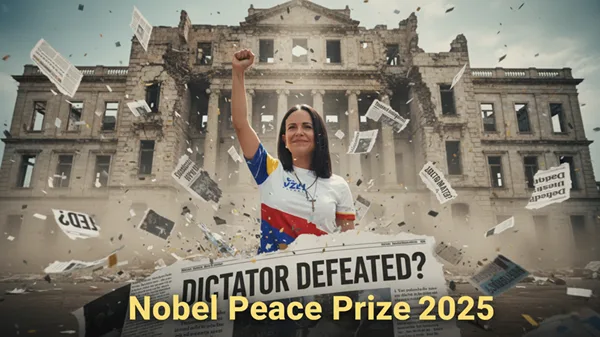
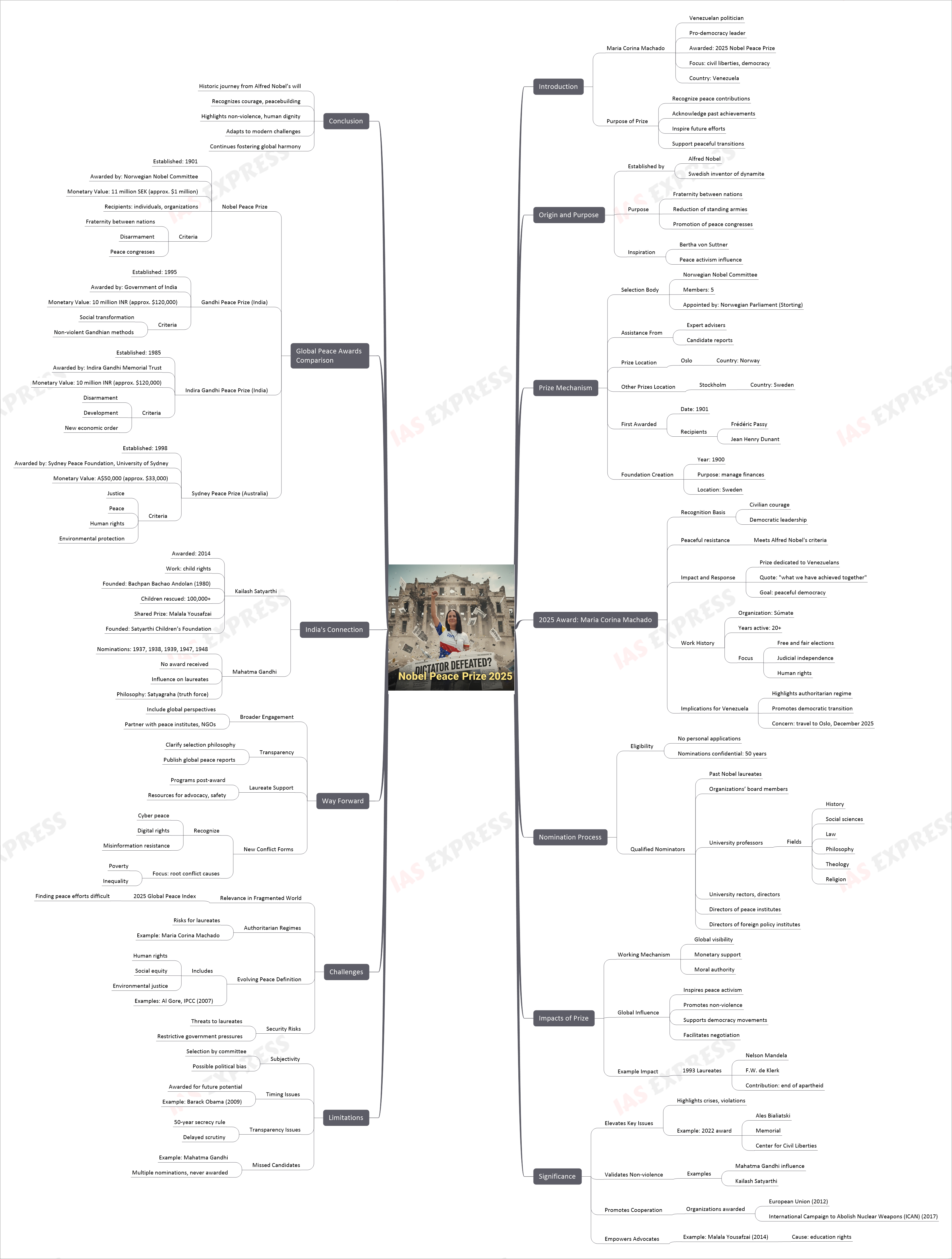
Maria Corina Machado, a Venezuelan politician who has fought for decades for democracy and civil liberties in the Latin American country, was awarded the Nobel Peace Prize 2025. This significant recognition highlights her tireless efforts and courageous leadership against authoritarianism, aiming for peaceful democratic change. The prize serves as both an acknowledgement of her past achievements and an impetus for the ongoing struggle for freedom and a just transition to democracy in Venezuela. Her work embodies the spirit of the Nobel Peace Prize, reinforcing its role in recognizing individuals who champion human rights and peace globally.
What is the Nobel Peace Prize and Why is it Given?
The Nobel Peace Prize is one of the world’s most prestigious awards, recognizing outstanding contributions to peace and human welfare.
- Meaning and Purpose of the Prize
- The Nobel Peace Prize honors individuals or organizations that have made significant efforts towards fraternity between nations, reducing standing armies, and promoting peace congresses.
- It was established by Alfred Nobel, a Swedish inventor known for dynamite, who dedicated his fortune to create awards that benefit humanity.
- The prize aims to inspire and encourage continued work in peacebuilding and conflict resolution worldwide.
- Why is the Nobel Peace Prize Given?
- To recognize and celebrate those who have “done the most or the best work” for peace as defined by Alfred Nobel’s will.
- To promote disarmament and the peaceful resolution of international conflicts.
- Alfred Nobel was influenced by peace activists like Bertha von Suttner, reflecting his personal interest in cultural and peace-related issues.
- The prize seeks to highlight efforts that advance human rights, democracy, and social justice, often seen as foundations for lasting peace.
Recent News: Maria Corina Machado and the 2025 Nobel Peace Prize
The Nobel Peace Prize 2025 was awarded to Maria Corina Machado, a Venezuelan opposition leader, for her unwavering commitment to democratic rights and a peaceful transition from dictatorship to democracy in Venezuela.
- Recognition of Courageous Leadership
- The Norwegian Nobel Committee lauded Machado as “one of the most extraordinary examples of civilian courage in Latin America in recent times.”
- Her efforts have been focused on keeping “the flame of democracy burning amid a growing darkness” in her country.
- She meets the three core criteria outlined in Alfred Nobel’s will for a Peace Prize laureate through her work.
- Machado’s Response and Impact
- Upon receiving the news, Machado expressed deep gratitude, stating that the prize belongs to the people of Venezuela.
- She views it as a “recognition of what we have achieved together and a reminder of what still remains,” hoping it will propel Venezuelans towards freedom.
- Her work, spanning over 20 years with organizations like Súmate, has consistently advocated for free and fair elections, judicial independence, and human rights, choosing “ballots over bullets.”
- Implications for Venezuela
- The award draws significant international attention to the authoritarian situation in Venezuela, marked by human rights abuses and suppression of dissent.
- There is hope that the recognition will add pressure for a peaceful democratic transition.
- Concerns remain about her ability to attend the award ceremony in Oslo in December 2025 due to the political climate and security situation in Venezuela.
Where and When are Nobel Peace Prize Decisions Made?
The Nobel Peace Prize has a distinct location and a rich history, with its decisions rooted in a specific process.
- Where are Nobel Peace Prize Decisions Made?
- The Nobel Peace Prize is decided and awarded in Oslo, Norway, uniquely distinguishing it from the other Nobel Prizes, which are awarded in Stockholm, Sweden.
- The Norwegian Nobel Committee, consisting of five members appointed by the Storting (Norwegian Parliament), is solely responsible for selecting the laureates.
- This committee receives assistance from specially appointed expert advisers who prepare detailed reports on shortlisted candidates.
- When was the Nobel Peace Prize Established?
- Historical Background
- The Nobel Prizes, including the Peace Prize, were established through the will of Alfred Nobel, dated November 27, 1895.
- After a lengthy legal battle over Nobel’s will, the Nobel Foundation was established in Sweden in 1900 to manage financial matters.
- The first Nobel Prizes were awarded in 1901.
- The first Nobel Peace Prize was shared between Frenchman Frédéric Passy and Swiss Jean Henry Dunant for their respective efforts in peace conferences and humanitarian aid.
- The prize has been awarded annually since 1901, with 19 instances where it was not awarded, often during periods of global conflict like World Wars I and II.
- Historical Background
Who Can Be Nominated for the Nobel Peace Prize?
The nomination process for the Nobel Peace Prize is structured and exclusive, ensuring that only qualified individuals and organizations are considered.
- Eligibility for Nomination
- Nominations do not require an invitation but must be submitted by individuals who meet specific criteria.
- Personal applications for the award are explicitly not considered.
- The Nobel statutes mandate that all proposals and related investigations remain confidential for 50 years before being made public.
- Qualified Nominators
- Individuals who have previously received the Nobel Peace Prize.
- Members of the main board of directors or equivalent of organizations that have been awarded the Nobel Peace Prize.
- University professors, professors emeriti, and associate professors in specific fields:
- History
- Social sciences
- Law
- Philosophy
- Theology
- Religion
- University rectors and directors (or their equivalents).
- Directors of peace research institutes and foreign policy institutes.
- This stringent process ensures a high level of expertise and credibility in the nominations received by the Norwegian Nobel Committee.
How Does the Nobel Peace Prize Impact Global Peace?
The Nobel Peace Prize serves as a significant catalyst, influencing global peace efforts through its recognition and moral authority.
- Working Mechanism of the Prize
- Visibility and Advocacy: The prize brings immense global attention to specific peace issues and the work of laureates.
- Financial Support: The monetary award provides resources for laureates to continue and expand their peace initiatives.
- Moral Authority: Laureates gain a powerful platform to advocate for their causes on an international stage, influencing public opinion and policy makers.
- Impacts on Global Peace
- Inspiring Action: The recognition often inspires others to engage in peacebuilding, human rights advocacy, and conflict resolution.
- Shaping Narratives: The prize highlights the importance of non-violent resistance, diplomacy, and international cooperation, promoting these values globally.
- Supporting Movements: It can provide crucial support and legitimacy to nascent or struggling peace and democracy movements, as seen with Maria Corina Machado’s award.
- Facilitating Dialogue: By honoring individuals and organizations committed to dialogue and negotiation, the prize reinforces these methods as essential tools for peace.
- For example, the 1993 prize to Nelson Mandela and F.W. de Klerk for ending apartheid in South Africa showcased the power of reconciliation and transition.
What are the Key Significances of the Nobel Peace Prize?
The Nobel Peace Prize holds multifaceted significance that extends beyond mere recognition, impacting global discourse and action.
- Elevating Critical Issues
- It draws global attention to pressing humanitarian crises, human rights violations, and urgent peace efforts, effectively putting them on the international agenda.
- For instance, the award to Ales Bialiatski, Memorial, and the Center for Civil Liberties in 2022 highlighted the critical importance of human rights documentation and advocacy in conflict zones.
- Validation of Non-violent Approaches
- The prize often validates and strengthens movements and individuals employing non-violent methods for social and political change.
- Laureates like Mahatma Gandhi, though never awarded, heavily influenced the philosophy behind many recipients. Kailash Satyarthi, an Indian laureate, explicitly follows Gandhi’s non-violent tradition.
- Encouraging International Cooperation
- Awards to organizations like the European Union (2012) or the International Campaign to Abolish Nuclear Weapons (ICAN) (2017) underscore the value of multilateralism and collective action in achieving peace and stability.
- The prize promotes the idea of “fraternity between nations,” a core tenet of Alfred Nobel’s will.
- Empowering Voices
- It empowers individuals and groups, particularly those working in challenging environments, by amplifying their voices and providing a platform for their advocacy.
- Recipients like Malala Yousafzai (2014) became global symbols for education rights, reaching millions worldwide.
What are the Limitations of the Nobel Peace Prize?
Despite its prestige, the Nobel Peace Prize faces certain limitations that can sometimes affect its perceived impartiality and effectiveness.
- Subjectivity and Political Bias
- The selection process, though rigorous, is ultimately made by a five-member committee, leading to potential subjective interpretations of “peace.”
- Decisions can sometimes be seen as reflecting the political leanings or prevailing ideologies of the Norwegian Nobel Committee.
- For example, some awards have been criticized for being premature or for honoring figures whose later actions contradicted the spirit of the prize.
- Timing and Impact
- The prize is sometimes awarded based on future potential rather than fully realized peace achievements, such as Barack Obama’s award in 2009 early in his presidency.
- The actual impact of the prize on ongoing conflicts or political situations can be limited, especially in deeply entrenched conflicts.
- Confidentiality and Lack of Transparency
- The 50-year secrecy rule regarding nominations and deliberations means that the rationale behind certain decisions cannot be immediately scrutinized, leading to speculation.
- This lack of immediate transparency can fuel criticisms regarding the committee’s choices.
- Exclusion of Deserving Candidates
- Despite many nominations (338 candidates in 2025), only a few are chosen, inevitably leading to questions about other highly deserving individuals or organizations who are overlooked.
- The historical omission of figures like Mahatma Gandhi remains a notable point of contention for many observers.
What Challenges Face the Nobel Peace Prize?
The Nobel Peace Prize navigates several challenges in an evolving global landscape, affecting its relevance and authority.
- Maintaining Relevance in a Fragmented World
- The 2025 Global Peace Index indicates a decline in global peacefulness, with rising conflict deaths and geopolitical tensions, making the prize’s mission more challenging.
- In a world increasingly characterized by a “Great Fragmentation,” identifying universally recognized peace efforts becomes complex.
- Authoritarian Regimes and Suppressed Dissent
- Honoring activists from authoritarian states, like Maria Corina Machado, often puts laureates at risk and can strain diplomatic relations.
- The ability of laureates to freely accept the award or continue their work can be severely hampered by restrictive governments.
- Defining “Peace” in Modern Contexts
- The definition of “peace” has expanded beyond the absence of war to include environmental justice, human rights, and social equity, requiring the committee to adapt its selection criteria.
- Awards related to climate change, like to Al Gore and the IPCC in 2007, reflect this evolving understanding.
- Security Concerns for Laureates
- For laureates working in conflict zones or oppressive regimes, the award can elevate their profile but also increase personal risk and security threats.
- The committee often faces the challenge of ensuring the safety and well-being of its awardees.
What is the Way Forward for the Nobel Peace Prize?
To sustain its impact and relevance, the Nobel Peace Prize must adapt and evolve in its approach and outreach.
- Broader Engagement and Inclusivity
- The committee could consider broadening its network of nominators and expert advisers to include a more diverse range of perspectives from different geopolitical regions.
- Increased dialogue with international peace research institutes and NGOs could enrich the nomination pool and evaluation process.
- Enhanced Transparency and Communication
- While the 50-year secrecy rule is enshrined, the committee could explore ways to communicate more openly about its general selection philosophy and the criteria applied in specific contexts.
- Publishing thematic reports on global peace trends that inform their decisions could add valuable context.
- Strategic Follow-up and Support
- Beyond the award ceremony, the Nobel Foundation could develop more structured programs to support laureates, particularly those facing political persecution or security risks.
- This could involve providing resources for continued advocacy, protection, or platforms for their message.
- Adapting to New Forms of Conflict
- Recognizing peace efforts in emerging areas like cyber peace, digital rights, and the fight against misinformation could ensure the prize remains relevant to contemporary challenges.
- Focusing on preventive diplomacy and the root causes of conflict, such as poverty and inequality, will remain crucial.
India’s Connection to the Nobel Peace Prize
India has a significant, albeit limited, connection to the Nobel Peace Prize, primarily through one distinguished laureate and the enduring influence of its philosophy of non-violence.
- Kailash Satyarthi: A Beacon for Child Rights
- In 2014, Kailash Satyarthi, an Indian children’s rights activist, was awarded the Nobel Peace Prize.
- He was recognized for his “struggle against the suppression of children and young people and for the right of all children to education.”
- Satyarthi, born in 1954, followed the non-violent tradition of Mahatma Gandhi, founding the Bachpan Bachao Andolan (Save the Childhood Movement) in 1980.
- His efforts led to the rescue of over 100,000 children from child labor and slavery.
- He shared the prize with Malala Yousafzai of Pakistan, a symbolic gesture by the committee to highlight fraternity between nations and a common struggle for education.
- His Nobel Prize led to the establishment of the Kailash Satyarthi Children’s Foundation, dedicated to ending child exploitation globally.
- The Enduring Legacy of Mahatma Gandhi
- Although Mahatma Gandhi was nominated multiple times (in 1937, 1938, 1939, 1947, and finally in 1948 shortly before his assassination), he was never awarded the Nobel Peace Prize.
- The Norwegian Nobel Committee has expressed regret over this omission, acknowledging his profound influence on numerous subsequent laureates and the global non-violent movement.
- His philosophy of Satyagraha (truth force) continues to inspire peace movements and individuals worldwide, embodying the very essence of the Peace Prize’s ideals.
- His influence is implicitly recognized in many awards that celebrate non-violent resistance and peaceful social change.
Comparing Global Peace Awards
Here is a comparison of the Nobel Peace Prize with other notable international peace awards, highlighting their distinct features.
| Feature | Nobel Peace Prize | Gandhi Peace Prize (India) | Indira Gandhi Prize for Peace, Disarmament & Development (India) | Sydney Peace Prize (Australia) |
|---|---|---|---|---|
| Established Year | 1901 | 1995 | 1985 | 1998 |
| Awarded By | Norwegian Nobel Committee | Government of India | Indira Gandhi Memorial Trust | Sydney Peace Foundation (University of Sydney) |
| Key Criteria | – Fraternity between nations | – Social, economic, political transformation | – International peace, development, disarmament | – Courage for justice, peace, non-violence |
| – Abolition/reduction of standing armies | – Non-violent, Gandhian methods | – New international economic order | – Human rights, environmental protection | |
| – Promotion of peace congresses | – Use of scientific discoveries for humanity | |||
| Monetary Award (approx.) | 11 million Swedish Kronor (approx. $1 million) | 10 million Indian Rupees (approx. $120,000) | 10 million Indian Rupees (approx. $120,000) | A$50,000 (approx. $33,000) |
| Awarded To | Individuals & Organizations (142 laureates as of 2024) | Individuals & Organizations | Individuals & Organizations | Individuals & Organizations |
| Focus | Broad international peace, disarmament, human rights | Gandhian principles, non-violent social change | Global harmony, human development, scientific advancement | Global peace, justice, human rights |
| Example Laureates | Martin Luther King Jr., Nelson Mandela, EU | Julius Nyerere, Nelson Mandela, Sultan Qaboos | Mikhail Gorbachev, UNHCR, Angela Merkel | Desmond Tutu, Mary Robinson, Black Lives Matter |
Conclusion
The Nobel Peace Prize stands as a beacon of hope and recognition in a world often beset by conflict. Its historical journey, from Alfred Nobel’s visionary will to the present-day recognition of figures like Maria Corina Machado, reflects an enduring commitment to fostering global harmony. While facing challenges such as political complexities and the ever-evolving nature of peace, the prize continues to wield significant influence by spotlighting critical issues, validating non-violent movements, and empowering peace advocates worldwide. As global peacefulness faces new threats, the prize’s role in inspiring courage, promoting dialogue, and advocating for human dignity remains more vital than ever, urging continuous efforts towards a more just and peaceful world.
Q. Analyze the evolving definition of “peace” in the context of Nobel Peace Prize awards, considering geopolitical shifts and contemporary global challenges. (250 words)
Related Posts
If you like this post, please share your feedback in the comments section below so that we will upload more posts like this.
Responses