[Newsbits] 28.12.2023: Zombie Deer Disease, God of Chaos Asteroid & more

newsbits mindmap notes
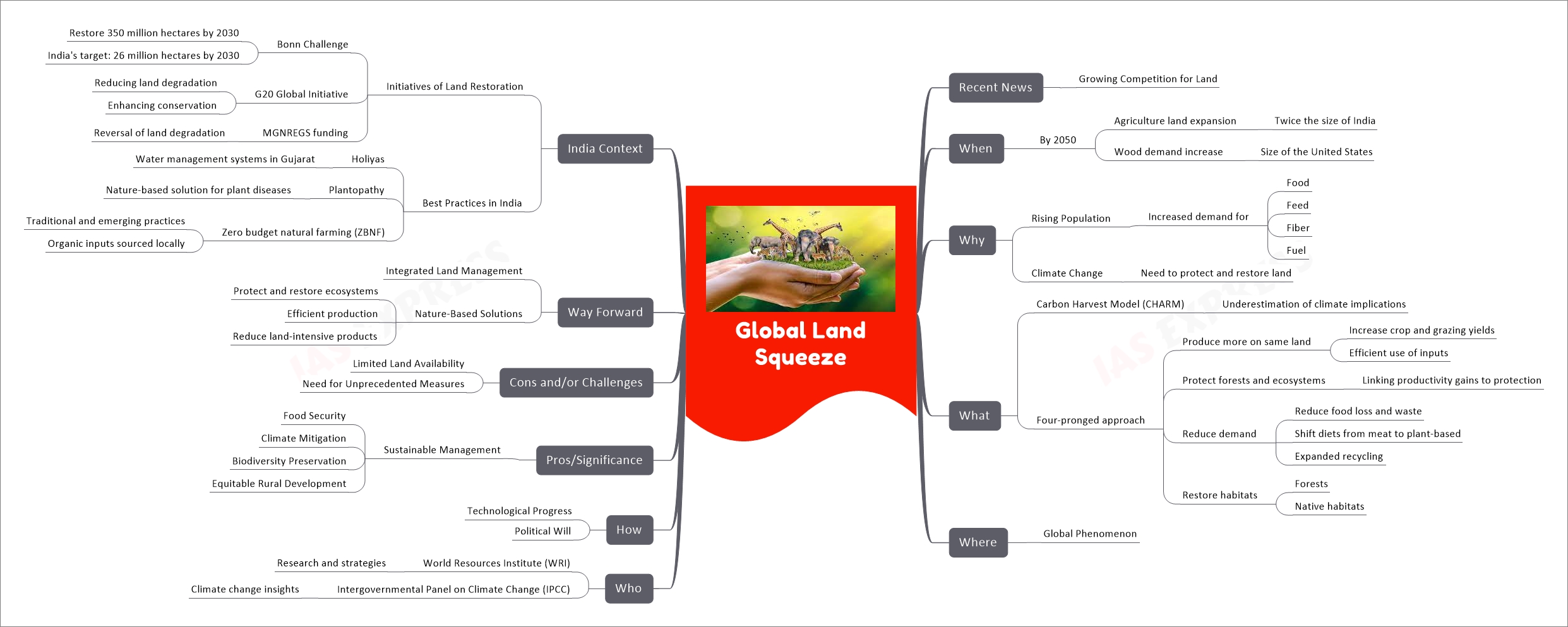
Global Land Squeeze mind map
  Recent News
    Growing Competition for Land
  When
    By 2050
      Agriculture land expansion
        Twice the size of India
      Wood demand increase
        Size of the United States
  Why
    Rising Population
      Increased demand for
        Food
        Feed
        Fiber
        Fuel
    Climate Change
      Need to protect and restore land
  What
    Carbon Harvest Model (CHARM)
      Underestimation of climate implications
    Four-pronged approach
      Produce more on same land
        Increase crop and grazing yields
        Efficient use of inputs
      Protect forests and ecosystems
        Linking productivity gains to protection
      Reduce demand
        Reduce food loss and waste
        Shift diets from meat to plant-based
        Expanded recycling
      Restore habitats
        Forests
        Native habitats
  Where
    Global Phenomenon
  Who
    World Resources Institute (WRI)
      Research and strategies
    Intergovernmental Panel on Climate Change (IPCC)
      Climate change insights
  How
    Technological Progress
    Political Will
  Pros/Significance
    Sustainable Management
      Food Security
      Climate Mitigation
      Biodiversity Preservation
      Equitable Rural Development
  Cons and/or Challenges
    Limited Land Availability
    Need for Unprecedented Measures
  Way Forward
    Integrated Land Management
    Nature-Based Solutions
      Protect and restore ecosystems
      Efficient production
      Reduce land-intensive products
  India Context
    Initiatives of Land Restoration
      Bonn Challenge
        Restore 350 million hectares by 2030
        India's target: 26 million hectares by 2030
      G20 Global Initiative
        Reducing land degradation
        Enhancing conservation
      MGNREGS funding
        Reversal of land degradation
    Best Practices in India
      Holiyas
        Water management systems in Gujarat
      Plantopathy
        Nature-based solution for plant diseases
      Zero budget natural farming (ZBNF)
        Traditional and emerging practices
        Organic inputs sourced locally

The Global Land Squeeze refers to the increasing competition for land due to the rising demand for food, wood, and shelter, alongside the need to store carbon and protect biodiversity. With a growing global population, an area twice the size of India is projected to be converted to agriculture by 2050, and an area as large as the United States will be needed to meet wood demand. World Resources Institute’s report suggests a four-pronged strategy: produce more on the same land, protect forests, reduce demand for land-intensive products, and restore native habitats. In the Indian context, initiatives like the Bonn Challenge, the G20 Global Initiative, and practices like Holiyas, Plantopathy, and Zero budget natural farming are notable efforts towards addressing this challenge. The Global Land Squeeze underscores the need for sustainable land management, balancing human needs with ecological preservation.
/ Diseases
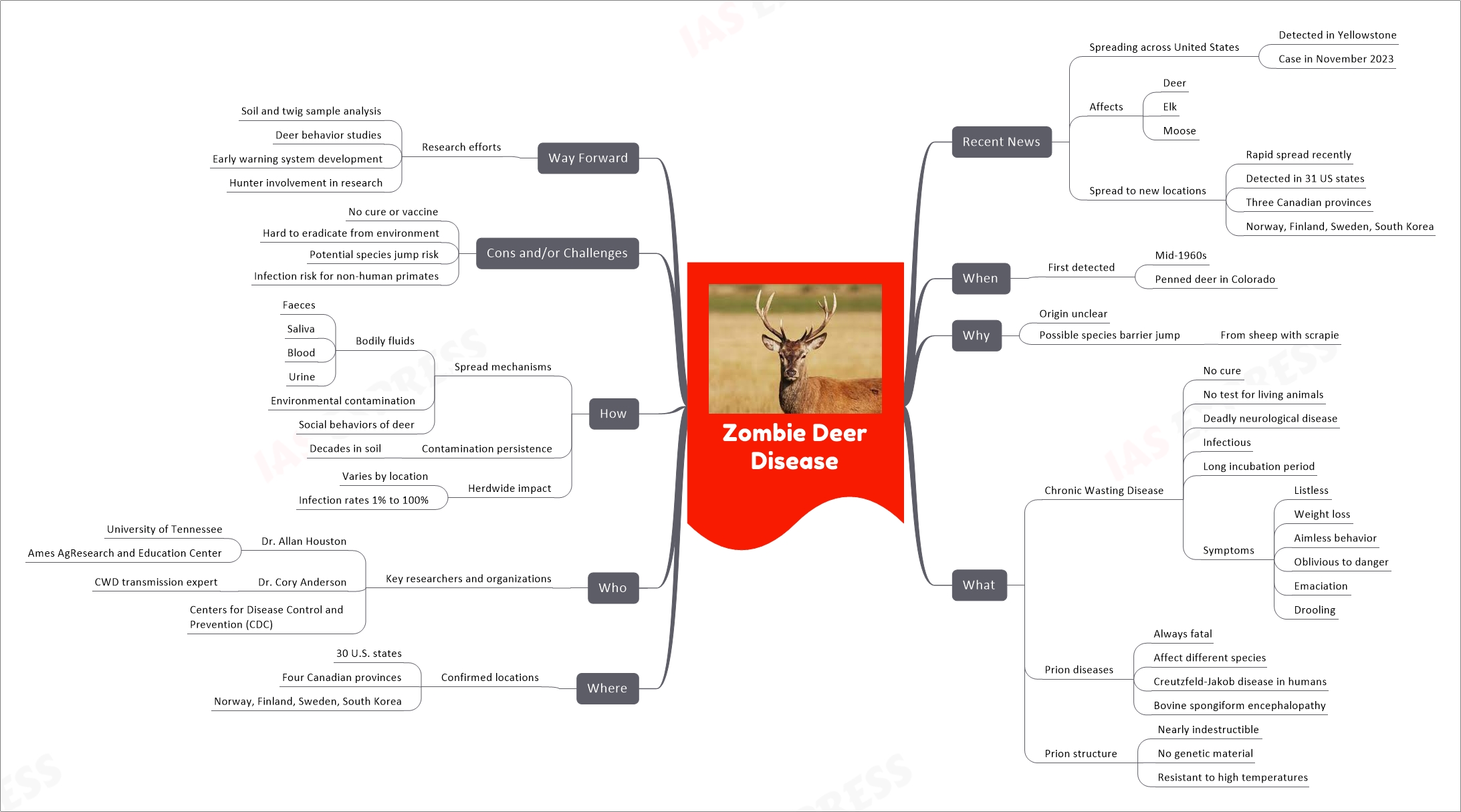
Zombie Deer Disease mind map
  Recent News
    Spreading across United States
      Detected in Yellowstone
      Case in November 2023
    Affects
      Deer
      Elk
      Moose
    Spread to new locations
      Rapid spread recently
      Detected in 31 US states
      Three Canadian provinces
      Norway, Finland, Sweden, South Korea
  When
    First detected
      Mid-1960s
      Penned deer in Colorado
  Why
    Origin unclear
    Possible species barrier jump
      From sheep with scrapie
  What
    Chronic Wasting Disease
      No cure
      No test for living animals
      Deadly neurological disease
      Infectious
      Long incubation period
      Symptoms
        Listless
        Weight loss
        Aimless behavior
        Oblivious to danger
        Emaciation
        Drooling
    Prion diseases
      Always fatal
      Affect different species
      Creutzfeld-Jakob disease in humans
      Bovine spongiform encephalopathy
    Prion structure
      Nearly indestructible
      No genetic material
      Resistant to high temperatures
  Where
    Confirmed locations
      30 U.S. states
      Four Canadian provinces
      Norway, Finland, Sweden, South Korea
  Who
    Key researchers and organizations
      Dr. Allan Houston
        University of Tennessee
        Ames AgResearch and Education Center
      Dr. Cory Anderson
        CWD transmission expert
      Centers for Disease Control and Prevention (CDC)
  How
    Spread mechanisms
      Bodily fluids
        Faeces
        Saliva
        Blood
        Urine
      Environmental contamination
      Social behaviors of deer
    Contamination persistence
      Decades in soil
    Herdwide impact
      Varies by location
      Infection rates 1% to 100%
  Cons and/or Challenges
    No cure or vaccine
    Hard to eradicate from environment
    Potential species jump risk
    Infection risk for non-human primates
  Way Forward
    Research efforts
      Soil and twig sample analysis
      Deer behavior studies
      Early warning system development
      Hunter involvement in research

Zombie Deer Disease, officially known as Chronic Wasting Disease (CWD), is a fatal, contagious neurological disorder affecting deer, elk, and moose. First detected in Colorado in the 1960s, it has since spread across various parts of the United States, Canadian provinces, and countries like Norway, Finland, Sweden, and South Korea. The disease, caused by prions, has no known cure or vaccine and is challenging to eradicate from the environment. It can spread through bodily fluids, and infected animals display symptoms like weight loss, listlessness, and drooling. While there are no recorded cases in humans, there is concern about its potential to jump species.
/ Space
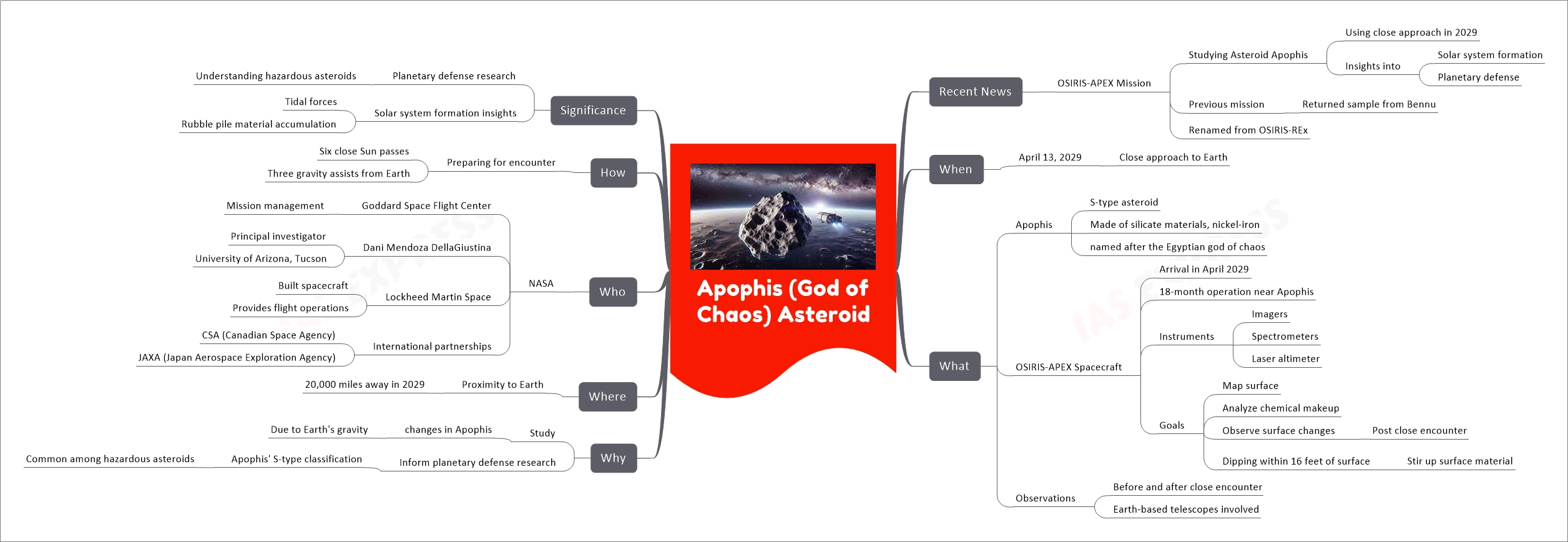
Apophis (God of Chaos) Asteroid mind map
  Recent News
    OSIRIS-APEX Mission
      Studying Asteroid Apophis
        Using close approach in 2029
        Insights into
          Solar system formation
          Planetary defense
      Previous mission
        Returned sample from Bennu
      Renamed from OSIRIS-REx
  When
    April 13, 2029
      Close approach to Earth
  What
    Apophis
      S-type asteroid
      Made of silicate materials, nickel-iron
      named after the Egyptian god of chaos
    OSIRIS-APEX Spacecraft
      Arrival in April 2029
      18-month operation near Apophis
      Instruments
        Imagers
        Spectrometers
        Laser altimeter
      Goals
        Map surface
        Analyze chemical makeup
        Observe surface changes
          Post close encounter
        Dipping within 16 feet of surface
          Stir up surface material
    Observations
      Before and after close encounter
      Earth-based telescopes involved
  Why
    Study
      changes in Apophis
        Due to Earth's gravity
    Inform planetary defense research
      Apophis' S-type classification
        Common among hazardous asteroids
  Where
    Proximity to Earth
      20,000 miles away in 2029
  Who
    NASA
      Goddard Space Flight Center
        Mission management
      Dani Mendoza DellaGiustina
        Principal investigator
        University of Arizona, Tucson
      Lockheed Martin Space
        Built spacecraft
        Provides flight operations
      International partnerships
        CSA (Canadian Space Agency)
        JAXA (Japan Aerospace Exploration Agency)
  How
    Preparing for encounter
      Six close Sun passes
      Three gravity assists from Earth
  Significance
    Planetary defense research
      Understanding hazardous asteroids
    Solar system formation insights
      Tidal forces
      Rubble pile material accumulation

The ‘God of Chaos’ asteroid, known as Apophis, is an S-type asteroid that NASA’s OSIRIS-APEX mission is set to study in 2029. This mission aims to observe the asteroid’s close approach to Earth, which will be within 20,000 miles, closer than some satellites. Scientists anticipate that Earth’s gravity will affect Apophis, potentially leading to surface changes like quakes and landslides. This mission is significant for understanding hazardous asteroids and solar system formation, contributing to planetary defense research.
/ Banking, Indices/Reports
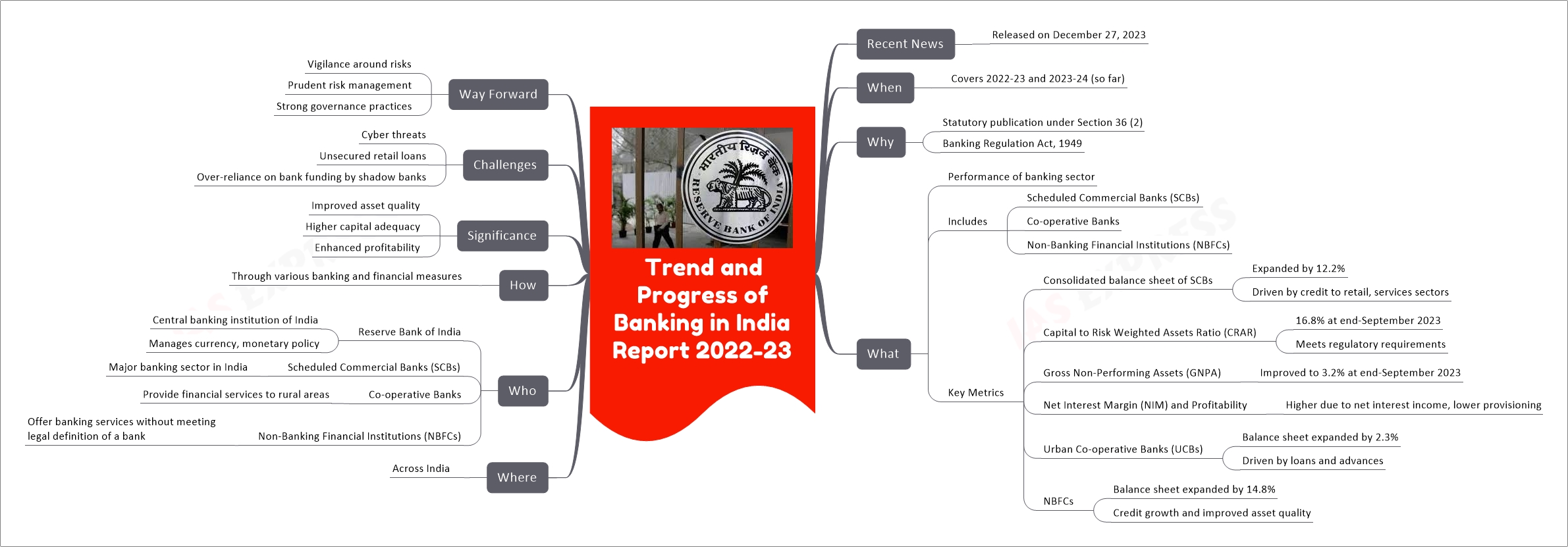
Trend and Progress of Banking in India Report 2022-23 mind map
  Recent News
    Released on December 27, 2023
  When
    Covers 2022-23 and 2023-24 (so far)
  Why
    Statutory publication under Section 36 (2)
    Banking Regulation Act, 1949
  What
    Performance of banking sector
    Includes
      Scheduled Commercial Banks (SCBs)
      Co-operative Banks
      Non-Banking Financial Institutions (NBFCs)
    Key Metrics
      Consolidated balance sheet of SCBs
        Expanded by 12.2%
        Driven by credit to retail, services sectors
      Capital to Risk Weighted Assets Ratio (CRAR)
        16.8% at end-September 2023
        Meets regulatory requirements
      Gross Non-Performing Assets (GNPA)
        Improved to 3.2% at end-September 2023
      Net Interest Margin (NIM) and Profitability
        Higher due to net interest income, lower provisioning
      Urban Co-operative Banks (UCBs)
        Balance sheet expanded by 2.3%
        Driven by loans and advances
      NBFCs
        Balance sheet expanded by 14.8%
        Credit growth and improved asset quality
  Where
    Across India
  Who
    Reserve Bank of India
      Central banking institution of India
      Manages currency, monetary policy
    Scheduled Commercial Banks (SCBs)
      Major banking sector in India
    Co-operative Banks
      Provide financial services to rural areas
    Non-Banking Financial Institutions (NBFCs)
      Offer banking services without meeting legal definition of a bank
  How
    Through various banking and financial measures
  Significance
    Improved asset quality
    Higher capital adequacy
    Enhanced profitability
  Challenges
    Cyber threats
    Unsecured retail loans
    Over-reliance on bank funding by shadow banks
  Way Forward
    Vigilance around risks
    Prudent risk management
    Strong governance practices

The “Trend and Progress of Banking in India” Report for 2022-23 by the RBI provides an extensive analysis of the banking sector’s performance in India. It highlights the expansion and improvement in various areas such as the balance sheets of commercial and co-operative banks, asset quality, and profitability. The report also emphasizes the challenges such as cyber threats and the need for prudent risk management and governance practices to ensure resilient and inclusive growth in the banking sector.
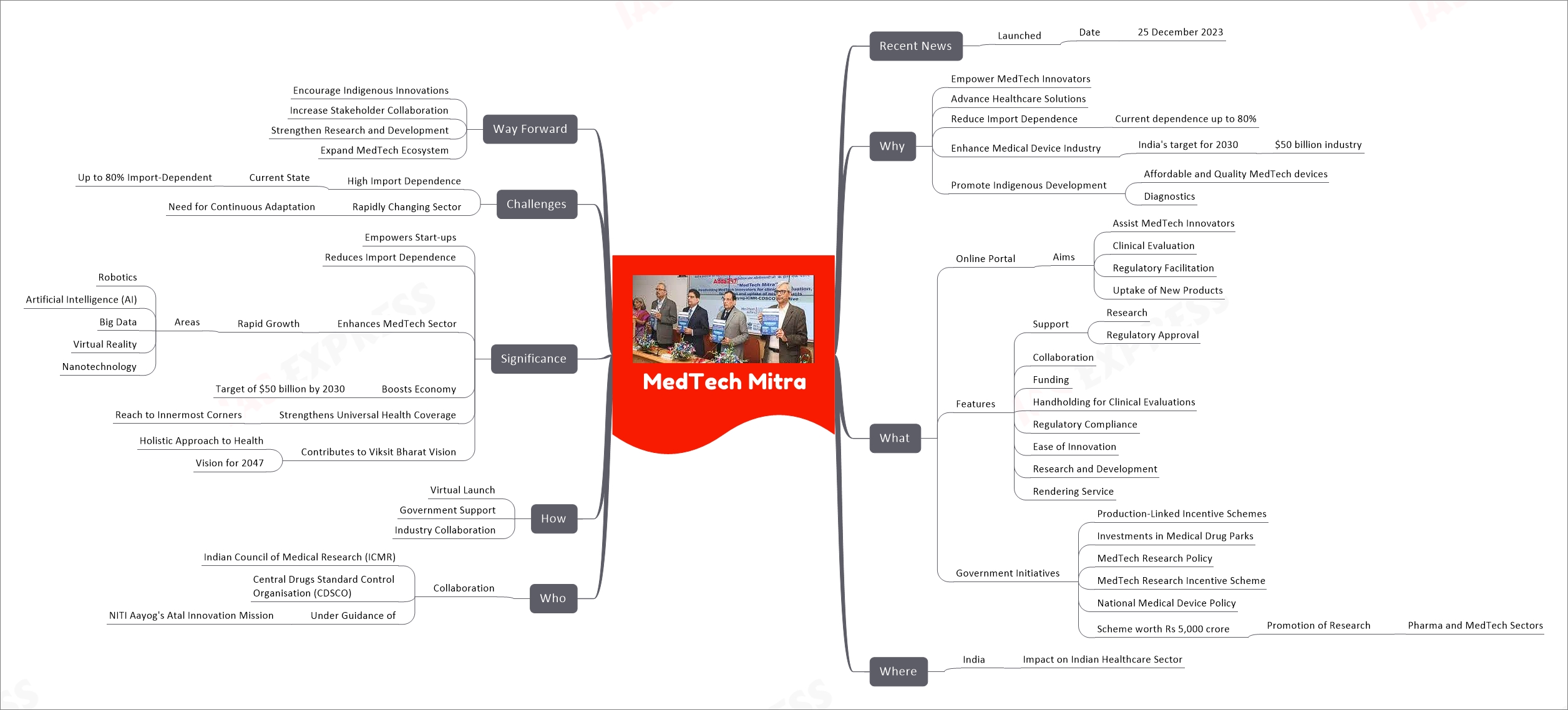
MedTech Mitra mind map
  Recent News
    Launched
      Date
        25 December 2023
  Why
    Empower MedTech Innovators
    Advance Healthcare Solutions
    Reduce Import Dependence
      Current dependence up to 80%
    Enhance Medical Device Industry
      India's target for 2030
        $50 billion industry
    Promote Indigenous Development
      Affordable and Quality MedTech devices
      Diagnostics
  What
    Online Portal
      Aims
        Assist MedTech Innovators
        Clinical Evaluation
        Regulatory Facilitation
        Uptake of New Products
    Features
      Support
        Research
        Regulatory Approval
      Collaboration
      Funding
      Handholding for Clinical Evaluations
      Regulatory Compliance
      Ease of Innovation
      Research and Development
      Rendering Service
    Government Initiatives
      Production-Linked Incentive Schemes
      Investments in Medical Drug Parks
      MedTech Research Policy
      MedTech Research Incentive Scheme
      National Medical Device Policy
      Scheme worth Rs 5,000 crore
        Promotion of Research
          Pharma and MedTech Sectors
  Where
    India
      Impact on Indian Healthcare Sector
  Who
    Collaboration
      Indian Council of Medical Research (ICMR)
      Central Drugs Standard Control Organisation (CDSCO)
      Under Guidance of
        NITI Aayog's Atal Innovation Mission
  How
    Virtual Launch
    Government Support
    Industry Collaboration
  Significance
    Empowers Start-ups
    Reduces Import Dependence
    Enhances MedTech Sector
      Rapid Growth
        Areas
          Robotics
          Artificial Intelligence (AI)
          Big Data
          Virtual Reality
          Nanotechnology
    Boosts Economy
      Target of $50 billion by 2030
    Strengthens Universal Health Coverage
      Reach to Innermost Corners
    Contributes to Viksit Bharat Vision
      Holistic Approach to Health
      Vision for 2047
  Challenges
    High Import Dependence
      Current State
        Up to 80% Import-Dependent
    Rapidly Changing Sector
      Need for Continuous Adaptation
  Way Forward
    Encourage Indigenous Innovations
    Increase Stakeholder Collaboration
    Strengthen Research and Development
    Expand MedTech Ecosystem

In simpler terms, the MedTech Mitra initiative is a groundbreaking effort by the Indian government to bolster the medical technology sector. Launched in December 2023, it aims to support and guide MedTech startups and innovators in India. This initiative will assist them in clinical evaluation, regulatory facilitation, and market entry of new healthcare products. It is expected to reduce India’s reliance on imported medical technology, stimulate indigenous innovation, and make healthcare solutions more affordable and accessible across the country. The MedTech Mitra initiative represents a significant step towards India’s goal of becoming a global leader in medical technology and healthcare by 2047.

If you like this post, please share your feedback in the comments section below so that we will upload more posts like this.

Responses

🖍️ Highlight
HomeCoursesPlansAccount