
Mizoram’s Refugee Crisis: Background and Response

From Current Affairs Notes for UPSC » Editorials & In-depths » This topic
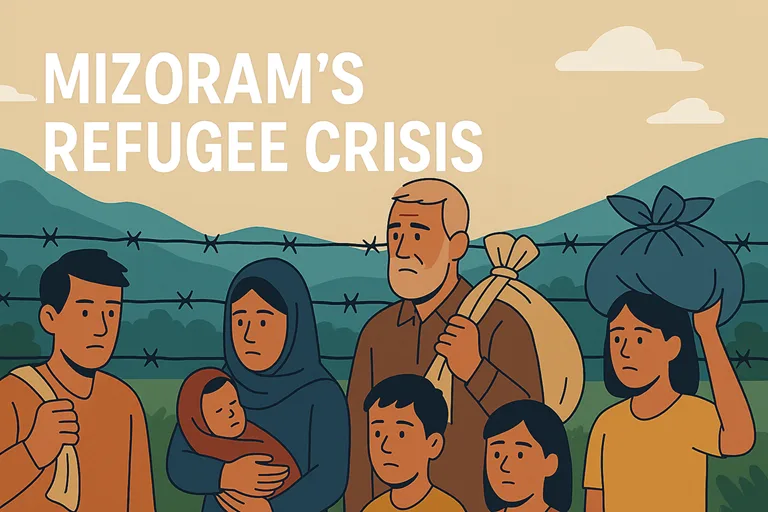
In early 2025, Mizoram faced a growing refugee crisis triggered by Myanmar’s 2021 military coup. Intense clashes between two Chin insurgent factions in mid-2025 led around 4,000 nationals from Myanmar into Mizoram. These refugees share ethnic ties with Mizoram’s own Mizo population, creating a strong urge to help but also a strain on resources. The state government is caught between limited resources for relief and pressure from the central government to secure the border. The conflict has highlighted tensions between humanitarian concerns and national security. The unfolding crisis in Mizoram has exposed gaps in both policy and planning.
What triggered the influx of refugees into Mizoram?
- Myanmar’s February 2021 coup created major unrest. Many ethnic Chin (and related Kuki-Chin) communities fled persecution by the military junta, seeking safety across the border.
- Violence in Myanmar’s Chin State repeatedly spills over into Mizoram. In July 2025, intense clashes between the Chin National Defence Force (CNDF) and Chinland Defence Force (CDF-Hualngoram) forced around 4,000 civilians into Mizoram over a few days.
- For example, one official reported nearly 4,000 refugees in just two border villages (Zokhawthar and Saikhumphai) in early July 2025.
- Earlier incidents also drove arrivals: a 2023 Myanmar airstrike hit Zokhawthar village, and crackdowns on Kuki-Chin groups have sent people toward Mizoram from Bangladesh.
Why have refugees been fleeing to Mizoram?
- Ethnic kinship: The migrants are mostly Chin and Kuki-Chin communities, sharing culture and language with the Mizos. State leaders say these refugees are “like family” and should not be turned away.
- Mizoram’s government and civil society stress humanitarian duty, despite a 2021 directive calling the influx “illegal foreigners.”
- Persecution in Myanmar: Ethnic minorities face brutal abuse under the junta, including forced labor and violence. Many flee simply to survive, preferring temporary safety in Mizoram to staying in conflict zones.
- Close proximity: Mizoram’s long border with Myanmar means fighting quickly spills over. When clashes reach border villages, women, children and elders often cross on foot to camps in Champhai or Saiha districts.
- Alternate routes blocked: Some refugees also escape via Bangladesh, but crackdowns in that region push Kuki-Chin fighters toward India instead of Bangladesh. When one route closes, people look to neighboring Mizoram for refuge.
Where are the refugees coming from and entering in Mizoram?
- The refugees mainly come from Myanmar’s Chin State (northwest Myanmar) and nearby Chin-majority areas of Sagaing Region. These areas have seen the fiercest fighting, so villagers flee across the border.
- They enter Mizoram primarily in Champhai district. Key crossing points include the border villages of Zokhawthar and Saikhumphai, which face Myanmar’s Falam district and Rakhine State.
- Champhai (population ~125,000) has seen the largest influx – local officials reported nearly 30,000 refugees there by mid-2025.
- Mizoram’s international border (about 500 km long) runs through six districts. Besides Champhai, smaller flows have occurred in Siaha and Lawngtlai districts where people also cross from Myanmar or Bangladesh.
- Many refugees are hosted just inside the border. Makeshift camps and church halls (often managed by the Young Mizo Association and local volunteers) have been used to shelter newcomers, with thousands waiting for news and support.
When did the refugee crisis in Mizoram intensify?
- Post-coup arrivals (2021-2022): After Myanmar’s February 2021 military takeover, refugees began trickling into Mizoram. By early 2025, an estimated 30,000–35,000 refugees from Myanmar were sheltering in the state, according to official reports.
- July 2025 surge: The crisis spiked in July 2025. From July 2 onward, renewed fighting in Myanmar sent a fresh wave of refugees. Reports in early July 2025 estimated around 4,000 new arrivals within a few days.
- Earlier waves: Smaller spikes occurred whenever nearby fighting flared. For example, a 2023 Myanmar air raid on border camps drove more villagers over. Each new clash in Myanmar’s borderlands tends to push more people into Mizoram.
Who are the people and groups involved in Mizoram’s refugee crisis?
- Refugees: Mostly ethnic Chin (and related Kuki-Chin) families from Myanmar. Civilians—including many women, children and elders—have fled villages in Chin State. They often arrive at Mizoram border villages and stay with relatives or in temporary camps.
- Rebel groups: Clashes among Chin insurgent factions (CNDF vs CDF-Hualngoram) and skirmishes with Myanmar’s army drive the exodus. These armed groups are fighting for control in their home region, indirectly causing civilian displacement.
- Mizoram authorities and NGOs: The state government (ruling Mizo National Front) is coordinating relief efforts. Local committees and NGOs, especially the Young Mizo Association (YMA) and various churches, are providing food, water and shelter. Community halls in towns like Zokhawthar have been turned into refugee centers by volunteer groups.
- Central government: India’s Home Ministry and security forces treat the new arrivals as illegal migrants under law. The central government has funded a biometric registration of about 35,000 Myanmar nationals in Mizoram (with roughly ₹38 lakh allocated for this exercise). It is also beginning to reinforce the Indo-Myanmar border with fencing and extra patrols.
How has Mizoram responded to this refugee crisis?
- Local relief: Mizoram’s government and volunteers have set up temporary camps. YMA chapters and church groups distribute rice, blankets and medicines. For example, committees in Zokhawthar and Saikhumphai provide meals and sleeping mats for hundreds of refugees each day.
- Data collection: The state agreed to conduct a biometric registration of the roughly 35,000 refugees taking shelter in Mizoram, using India’s Foreigner ID system. About ₹38 lakh was approved to register these entrants, to help distinguish long-term refugees from recent arrivals.
- Border security: India’s Home Ministry has begun constructing a fence along the Indo-Myanmar border to curb illegal crossings, although officials say completion may take years. Army and Border Security Force units have increased patrols and checkpoints near key crossing points.
- Other measures: The Mizoram government has not forcibly sent back any refugees; instead it has largely kept borders open on humanitarian grounds. Some refugees have found part-time work or even opened small shops in Mizoram, and many children attend local schools. Injured people from Myanmar clashes have been treated in Mizoram hospitals (Champhai and Aizawl), showing the state’s open policy toward providing aid.
How does Mizoram’s situation compare with other refugee crises in India?
| Aspect | Mizoram (Myanmar refugees) | Assam/Bangladesh migrants |
|---|---|---|
| Trigger | Myanmar’s 2021 coup and ethnic conflict | Bangladesh Liberation War (1971) and ongoing migration flows |
| Origin population | Ethnic Chin/Kuki (closely related to locals) | Bengali-speaking migrants (culturally distinct) |
| Scale of influx | ~30,000–35,000 total (with ~4,000 in one week) | Millions over decades (Assam NRC estimates ~4 million migrants) |
| State response | Largely welcoming due to kinship; local NGOs (YMA) aid refugees | Mixed: protests and riots in Assam; NRC registration; CAA legislation |
| Central action | Border fence planned; biometric registration of migrants | NRC process; Citizenship Act changes; some deportation of illegal immigrants |
| Cultural ties | High (refugees and Mizos share language/culture) | Low (different language/religion from locals) |
| Major challenges | Small state with limited resources; ongoing conflict | Massive numbers; social and ethnic tensions; legal disputes |
Why is Mizoram’s refugee crisis significant for the state and India?
- Population impact: Mizoram’s population is only about 1.2 million. Hosting 30,000–35,000 refugees (≈3% of residents) quickly strains food, shelter and public services in the state.
- Security and policy test: A large uncontrolled influx raises security concerns (risk of arms or drug trafficking across the border). The crisis exposes gaps in India’s refugee policy (no clear asylum law) and tests border-management plans.
- Ethnic solidarity: Refugees share Mizo ethnicity with locals, so Mizoram treats them as kin. This contrasts with situations like Assamese-Bengali migrants, highlighting how cultural identity shapes response and political debate.
- Economic and social effects: Many refugees find work or open small businesses in border towns, adding to local markets. For example, some Myanmar refugees have opened kiosks and joined the local workforce. However, thousands of extra people also mean overcrowded schools, clinics and limited land.
- Regional stability: Ongoing unrest in Myanmar’s borderlands means this crisis could continue for years. India’s handling of Mizoram’s situation may influence its relations with Myanmar and set precedents for dealing with future refugee flows from nearby conflicts.
What limitations hinder Mizoram’s management of the refugee influx?
- Resource constraints: Mizoram is a small, relatively poor state. It has few formal refugee camps, so relief depends on churches and volunteers. Central funds (e.g. ₹38 lakh for ID registration) are tiny compared to needs, leaving many areas under-supported.
- Legal framework: India has no specific refugee law. Legally, these newcomers are “illegal migrants,” so Mizoram cannot grant them official status or long-term rights. This limits options for formal aid, employment, or education for refugees.
- Border control: The Indo-Myanmar boundary is long and mountainous. A border fence is under construction, but completion will take years. In the meantime, people can still cross undetected in many remote areas.
- Infrastructure strain: The state’s schools, hospitals and sanitation systems were not built for tens of thousands of extra people. Hundreds of refugee children now join overcrowded classrooms, and clinics must care for more patients, stretching supplies and staff.
- Coordination gaps: Relief relies on local networks (YMA, church groups, village committees) without a unified system. Aid distribution can be inconsistent. Also, language differences among Chin sub-groups mean communication and community outreach can be challenging.
What challenges does Mizoram face in dealing with the refugee crisis?
- Sustaining aid: Providing continuous food, clean water and healthcare to thousands is difficult. Monsoon rains can cut off roads, and crowded conditions risk disease outbreaks. Storing and replenishing supplies year-round is a major task.
- Political pressure: State leaders must balance local sympathy with pressure from New Delhi. The central government wants tighter borders, while Mizoram’s government demands more humanitarian support. Navigating this tug-of-war is politically tricky.
- Social tension: While Mizoram has helped refugees so far, long-term strain could erode goodwill. There have been isolated protests against “foreigners” in Mizoram before. If resources run short, some citizens might blame refugees, causing ethnic friction.
- Indefinite duration: There is no clear end to the crisis. Continued conflict in Myanmar suggests many refugees may stay for years. Planning for long-term housing, schooling and jobs (instead of short-term relief) adds complexity to the response.
- Geographic constraints: Mizoram’s remote terrain and limited roads make reaching camps hard. Delivering supplies or building infrastructure in distant border villages is logistically challenging, especially when paths become impassable in bad weather.
What are possible ways forward in addressing this crisis?
- More federal support: The central government can increase funding and resources. For example, completing the border fence sooner and sending extra security patrols would help stabilize the situation. Direct financial aid to Mizoram for refugee camps would ease the burden.
- Legal and policy adjustments: India could issue temporary permits or IDs to these refugees, easing access to work, schooling and healthcare without full citizenship. Negotiating with regional partners (Myanmar’s opposition or Bangladesh) for safe zones or voluntary repatriation could also be explored.
- Expand local infrastructure: Mizoram can build more classrooms, health clinics and water facilities in Champhai and other border districts to serve both refugees and locals. Partnerships with NGOs, UN agencies or other states could bring in technical and financial assistance.
- Community coordination: Continued involvement of the YMA, churches and volunteers is crucial. The state could also run awareness campaigns so local communities understand the refugees’ situation. Training local officials in refugee relief and language support would improve coordination.
- Regional cooperation: India might seek support from ASEAN countries or UN bodies to address the humanitarian need. Joint border management discussions and coordinated aid efforts with Myanmar’s neighbours could help share responsibility and stabilize the border region.
In summary, Mizoram’s refugee crisis highlights deep humanitarian instincts but also heavy burdens. Mizoram (population ~1.2 million) has provided shelter and aid via local groups, yet stretched resources and no formal refugee law mean assistance remains insufficient. With Myanmar violence ongoing, the burden on Mizoram is likely to persist. Going forward, more federal support (funding and legal flexibility) and regional cooperation will be needed. In the meantime, Mizoram continues to balance compassion with caution, seeking sustainable ways to help those in need. Mizoram’s approach may set an example for how India manages future refugee inflows.
Q. What are the underlying causes of the recent refugee influx into Mizoram and how do they reflect regional instability? (250 words)

Related Posts
If you like this post, please share your feedback in the comments section below so that we will upload more posts like this.

Responses