India’s Updated GMP for Drug Makers

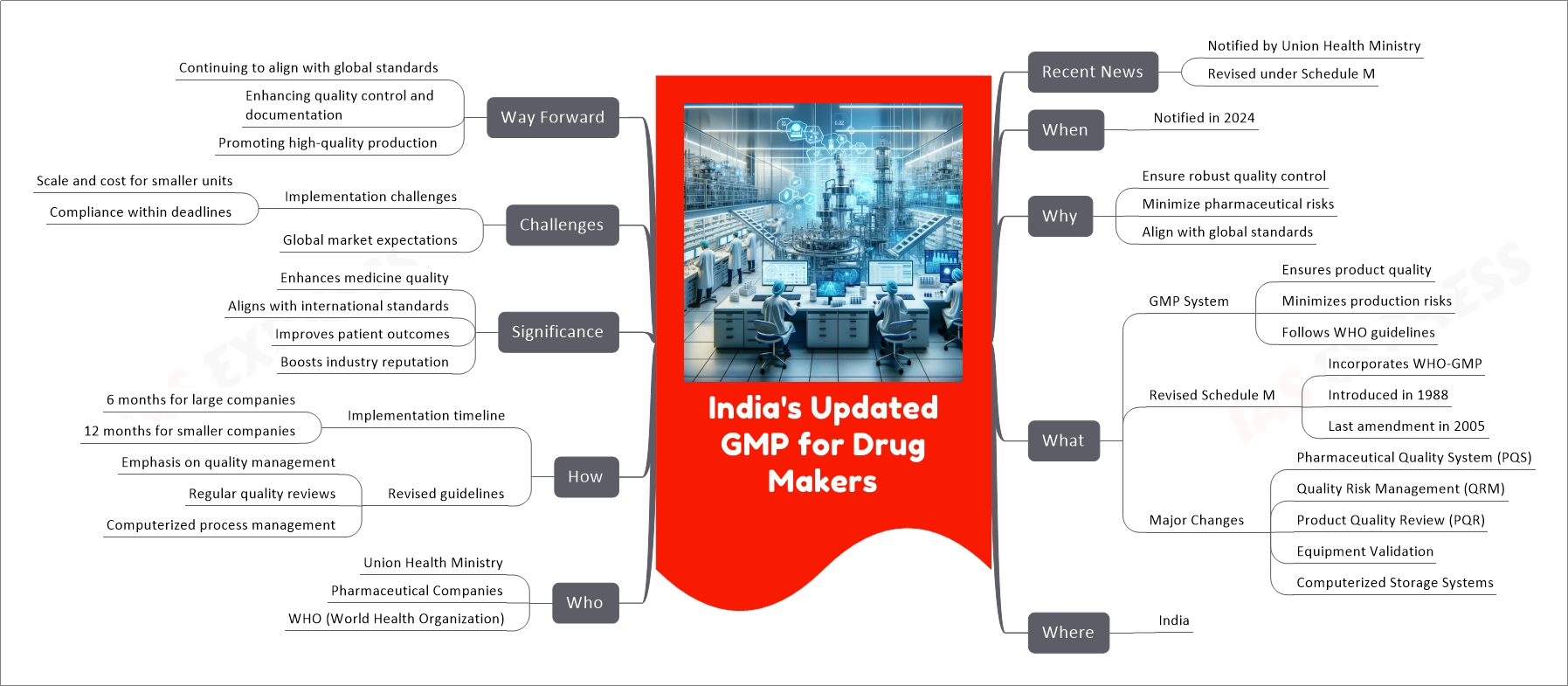
India's Updated GMP for Drug Makers mind map
  Recent News
    Notified by Union Health Ministry
    Revised under Schedule M
  When
    Notified in 2024
  Why
    Ensure robust quality control
    Minimize pharmaceutical risks
    Align with global standards
  What
    GMP System
      Ensures product quality
      Minimizes production risks
      Follows WHO guidelines
    Revised Schedule M
      Incorporates WHO-GMP
      Introduced in 1988
      Last amendment in 2005
    Major Changes
      Pharmaceutical Quality System (PQS)
      Quality Risk Management (QRM)
      Product Quality Review (PQR)
      Equipment Validation
      Computerized Storage Systems
  Where
    India
  Who
    Union Health Ministry
    Pharmaceutical Companies
    WHO (World Health Organization)
  How
    Implementation timeline
      6 months for large companies
      12 months for smaller companies
    Revised guidelines
      Emphasis on quality management
      Regular quality reviews
      Computerized process management
  Significance
    Enhances medicine quality
    Aligns with international standards
    Improves patient outcomes
    Boosts industry reputation
  Challenges
    Implementation challenges
      Scale and cost for smaller units
      Compliance within deadlines
    Global market expectations
  Way Forward
    Continuing to align with global standards
    Enhancing quality control and documentation
    Promoting high-quality production

India’s Updated Good Manufacturing Practices (GMP) for Drug Makers, notified in 2024 by the Union Health Ministry, mark a significant revision of the existing standards under Schedule M of the Drugs and Cosmetics Rules. The update aims to ensure robust quality control in pharmaceutical production, aligning India’s standards with global norms, especially those of the World Health Organization (WHO). Major changes include the introduction of a Pharmaceutical Quality System (PQS), Quality Risk Management (QRM), Product Quality Review (PQR), validation of equipment, and computerized storage systems. The revisions require large companies to implement these changes within six months and smaller companies within a year. This move is expected to elevate the quality of medicines, improve patient outcomes, and enhance the reputation of the Indian pharmaceutical industry on a global scale.

Related Posts
If you like this post, please share your feedback in the comments section below so that we will upload more posts like this.

Responses

🖍️ Highlight
HomeCoursesPlansAccount