
India’s R&D Crisis: Why Indian Science Still Lacks Nobel Laureates in 2025


From Current Affairs Notes for UPSC » Editorials & In-depths » This topic
India has not produced a Nobel laureate in science working within the country for almost a century, a gap that stands out sharply against the nation’s growing global presence. Recent news, such as the 2025 Physics Nobel Prize awarded to American scientists John Clarke, Michel Devoret, and John Martinis for their work on quantum phenomena, has reignited discussions on this issue. Many point to India’s modest public investment in research and development (R&D), which hovers around 0.64% of GDP, far below the 3% recommended for fostering innovation. Yet, experts question if funding alone explains the drought, highlighting deeper systemic barriers that prevent Indian scientists from achieving such recognition despite their talent and potential.
What Defines a Nobel Prize and Its Role in Science?
- The Nobel Prize serves as a global symbol of excellence in key human endeavors.
- It honors individuals or groups for work that brings the greatest benefit to humanity in fields like physics, chemistry, and physiology or medicine.
- Established by Alfred Nobel’s 1895 will, it includes a gold medal, diploma, and cash prize awarded annually since 1901.
- The science categories focus on discoveries that advance knowledge, such as breakthroughs in quantum mechanics or genetic research.
- In science, the prize recognizes transformative contributions that shape future progress.
- Winners often come from collaborative efforts spanning decades, like the 2025 medicine prize to researchers on immune tolerance.
- It highlights work in specific disciplines, with physics prizes clustering around particle physics and cosmology over the years.
- The award elevates recipients to icons, inspiring global funding and policy shifts toward bold research.
Why Do Concerns Persist About India’s Scientific Achievements?
- India’s scientific community faces scrutiny for lacking high-impact global honors like the Nobel.
- No scientist based in India has won a science Nobel since C.V. Raman in 1930 for his discovery of light scattering, known as the Raman effect.
- While Indian-origin winners like Har Gobind Khorana (1968 medicine, for genetic code interpretation) and Subrahmanyan Chandrasekhar (1983 physics, for stellar evolution theories) succeeded abroad, this underscores a pattern of talent thriving outside the country.
- Venkatraman Ramakrishnan’s 2009 chemistry prize for ribosome structure studies, earned while working in the UK and US, further illustrates this trend.
- Low investment in fundamental research limits the scope for groundbreaking work.
- Public R&D spending at 0.64% of GDP pales against global leaders, restricting access to advanced tools needed for Nobel-level discoveries.
- Nobel laureate David Gross expressed deep disappointment in 2023 over India’s untapped potential, citing funding shortfalls that hinder visionary projects.
- Academic rigidity often blocks unconventional ideas, favoring safe, incremental studies over risky innovations that yield prizes.
- Broader cultural and systemic factors contribute to the lag.
- A focus on applied research for immediate needs, like agriculture or defense, overshadows pure science pursuits.
- Brain drain sees over 1 million skilled professionals emigrate annually, with many top IIT graduates opting for foreign labs with better resources.
Where Do Indian Research Centers Rank Worldwide?
- Indian institutions show steady climbs in global metrics but trail in elite science output.
- The Indian Institute of Science (IISc) topped the 2024 Nature Index with a share of 103.52, ahead of IIT Bombay at 58.07, yet India’s total output ranks 12th globally.
- In QS World University Rankings 2024, IITs improved in engineering but none cracked the top 50 for pure sciences like physics or chemistry.
- NIRF 2024 placed IISc first nationally with 84.98 points, followed by IIT Madras at 83.29, reflecting strong domestic performance amid infrastructure gaps.
- Comparisons reveal gaps in high-citation research essential for Nobels.
- India’s 2822 publications in Nature Index journals lag behind China’s 28,231, with only 1844.32 share versus the US’s 21,160.
- Fields like chemistry dominate Indian output (1261 counts), but biology and physics trail, limiting visibility in prize-heavy areas.
- Emerging strengths in space and biotech, like ISRO’s missions, boost rankings but rarely translate to individual Nobel-caliber recognitions.
When Did India’s Science Path Start and Change Over Time?
- Modern Indian science traces roots to colonial influences but surged post-independence.
- Ancient contributions like zero’s invention by Aryabhata in the 5th century laid mathematical foundations, evolving into medieval astronomy by Bhaskara II.
- British rule introduced institutions like the Indian Institute of Science in 1909, fostering early talents like Raman, whose 1930 Nobel came amid growing nationalism.
- Post-1947, Nehru’s vision drove the 1958 Scientific Policy Resolution, establishing CSIR labs and IITs to build self-reliance.
- Key milestones mark evolution from basics to advanced pursuits.
- The 1960s Green Revolution, led by M.S. Swaminathan’s high-yield crops, boosted food security and earned global acclaim without a Nobel.
- 1974’s Pokhran nuclear test showcased atomic prowess, followed by 1998 tests affirming strategic science.
- Space achievements peaked with Chandrayaan-3’s 2023 lunar south pole landing, making India the fourth nation to reach the moon after spending just $\text{74 million.
- Recent shifts include the 2024 National Quantum Mission with Rs 6,003 crore budget, aiming to rival global leaders in emerging tech.
- The journey reflects adaptation to challenges like wars and economic reforms.
- 1991 liberalization spurred private R&D, doubling spending from Rs 60,197 crore in 2010-11 to Rs 127,381 crore by 2020-21.
- Yet, the Nobel drought persists, with no home-based wins since Raman, highlighting stalled progress in fundamental fields.
Who Shapes India’s Core Scientific Efforts?
- Government agencies lead funding and coordination for national priorities.
- The Department of Science and Technology allocates over 70\% of public R&D funds, supporting 50+ CSIR labs focused on chemistry and biology.
- ISRO employs 17,000 scientists, driving missions like Aditya-L1’s 2023 solar probe with indigenous tech.
- DRDO’s 52 labs advance defense innovations, including missile systems tested in 2024.
- Academic hubs nurture talent and host major projects.
- IISc Bengaluru, with 6,239 top 2\% global scientists per 2025 Stanford list, leads in physics and materials science.
- IITs like Bombay and Delhi produce 10,000 engineers yearly, many contributing to patents rising 31.6\% in 2022 per WIPO.
- TIFR Mumbai pioneers particle physics, with output up 24.2\% in 2024 Nature Index.
- Individual pioneers and diaspora drive impact.
- Homegrown figures like A.P.J. Abdul Kalam advanced rocketry, while diaspora like Ramakrishnan (2009 Nobel) inspire returns.
- In 2025, 11 Indian-origin scientists became APS Fellows, recognizing physics contributions from US-based labs.
- Private players like Tata and Reliance invest in biotech, with pharmaceuticals claiming 36\% of R&D spend.
How Does Science Research Function and Affect Society?
- Research operates via a mix of public grants, collaborations, and evaluations.
- Funding flows through bodies like UGC and ICAR, prioritizing peer-reviewed proposals for projects lasting 3-5 years.
- Labs use mechanisms like synchrotron facilities at RRCAT for experiments in materials and biology, producing 100,000 patents in FY24.
- International ties, via INDO-US pacts, enable joint ventures like genome sequencing under GenomeIndia’s 10,000-sample goal.
- Mechanisms ensure quality but face bottlenecks.
- Ethical reviews by ICMR guide medical trials, as in COVID vaccine development by Bharat Biotech in 2021.
- Publication drives progress, with India’s 177,000 papers in 2023 per Scopus, though only 5\% in top-quartile journals.
- Evaluation metrics like h-index track impact, favoring collaborative work over solo breakthroughs.
- Impacts ripple across economy and daily life.
- Biotech advances cut drug costs, with India supplying 60\% of global vaccines, aiding 2 billion doses yearly.
- Environmental research from Chipko-inspired studies informs policies, reducing deforestation by 20\% in Himalayan regions since 1980s.
- Space tech boosts GDP by 2\% via satellites for weather forecasting, saving Rs 10,000 crore in disaster management annually.
What Recent News Highlights India’s Nobel Gap?
- The 2025 Nobel announcements amplified India’s long-standing absence from science prizes.
- Physics went to US trio for quantum tunneling, echoing 1930’s Raman win as the last Indian-based science Nobel.
- Medicine recognized immune cell discoveries, prompting debates on why Indian researchers like those at CCMB Hyderabad lag in such fields despite 262 biology publications in Nature Index.
- No Indian-origin winner this year, unlike past diaspora successes, fueled calls for reform.
- Public discourse centers on R&D funding as a core issue.
- Current 0.64\% GDP spend contrasts with 3\% targets, as voiced by experts post-announcements.
- Nobel laureate Gross reiterated in 2025 interviews that India’s talent pool, with 6,239 top scientists, remains underfunded, blocking paths to prizes.
- Brain drain worsened, with 2024 data showing 30\% of PhDs emigrating, per a IIT alumni study.
- Broader implications tie to national goals.
- News linked the gap to Viksit Bharat visions, urging 2\% GDP hike by 2030 for fundamental research.
- Successes like Chandrayaan-3 were praised but critiqued for applied focus over pure science Nobels demand.
- Media highlighted Khorana and Chandrasekhar’s abroad wins, stressing ecosystem changes for home-based triumphs.
How Does India’s Science Landscape Compare Globally?
- India’s setup blends strengths in scale with weaknesses in depth.
- Vast network of 1,000+ universities produces 1.5 million STEM graduates yearly, outpacing many nations but with lower per-capita output.
- Historical push post-1958 built CSIR’s 38 labs, yet global share of high-impact papers is just 3\%, versus US’s 25\%.
- Current efforts like Atmanirbhar Bharat allocate Rs 50,000 crore for tech self-reliance, focusing on AI and quantum.
- Challenges stem from uneven development.
- Rural labs lack basics, with only 10\% of institutions having advanced spectrometers needed for chemistry Nobels.
- Private sector’s 36\% R&D share grows via pharma giants like Serum Institute, producing 1.5 billion doses in 2021.
- Diaspora remittances fund 20\% of research, bridging gaps in public investment.
What Makes Scientific Advances Truly Important?
- Breakthroughs drive human progress and solve pressing problems.
- They expand knowledge, like Raman’s effect enabling spectroscopy used in 90\% of modern labs for material analysis.
- In medicine, Khorana’s code work paved way for gene therapies treating 500,000 patients yearly worldwide.
- Economic boosts follow, with Chandrasekhar’s theories informing astrophysics tools generating }$10 billion in space industry revenue.
- Global influence elevates nations and inspires equity.
- Prizes spotlight underrepresented voices, as Tagore’s 1913 literature win did for Asian perspectives.
- They foster collaborations, like Indo-US pacts yielding 1,000 joint papers annually.
- Long-term, advances ensure sustainability, from green tech reducing India’s 7% emission growth to equitable health access.
What Limits and Hurdles Block Indian Science Growth?
- Funding shortages cap ambition and resources.
- At 0.64% GDP, R&D trails South Korea’s 4.8%, forcing labs to share equipment and delay projects by 2-3 years.
- Public sector dominates 64%, leaving private innovation sporadic despite 100,000 patents in 2024.
- Institutional barriers stifle creativity.
- Bureaucratic approvals take 6-12 months, versus 1-2 in the US, deterring high-risk fundamental work.
- Seniority over merit in hiring affects 70% of promotions, per 2023 surveys, limiting young talent like post-PhD researchers.
- Talent and infrastructure deficits persist.
- Brain drain claims 25% of top scientists yearly, with returnees facing 30% salary cuts.
- Only 5% of labs have supercomputers, hampering simulations for physics breakthroughs.
- Gender gaps see women at 15% of researchers, reducing diverse inputs for innovative solutions.
What Steps Lead to Better Indian Science Outcomes?
- Boost funding with targeted strategies.
- Aim for 3% GDP by 2030 via tax incentives, channeling 40% to basic sciences like physics.
- Public-private partnerships could triple private spend, as in Israel’s model yielding 4% GDP investment.
- Reform systems for merit and openness.
- Adopt peer-led funding like ERC grants, cutting bureaucracy by 50% for faster approvals.
- Train 10,000 leaders yearly in innovation management to replace rigid hierarchies.
- Build talent pipelines and infrastructure.
- Offer Rs 1 crore startup grants for returnees, reversing 20% brain drain as seen in 2024 US uncertainty.
- Create 100 national facilities, like particle accelerators, accessible to all states.
- Promote culture of bold inquiry.
- Integrate curiosity-based curricula in schools, increasing STEM enrollment by 30%.
- Engage public via science festivals, building support for 2% budget hikes.
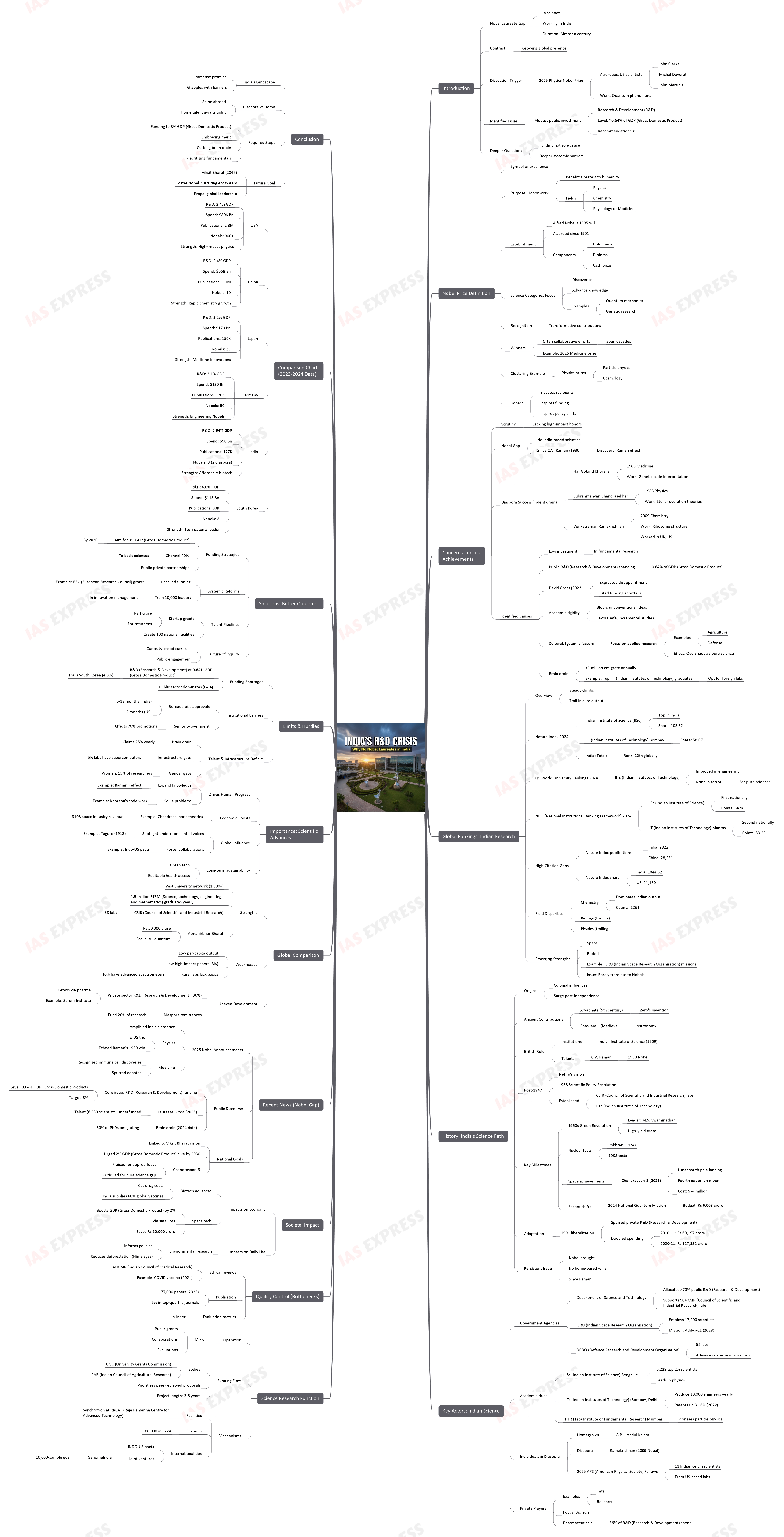
Comparison Chart: R&D Spending and Output Across Nations (2023-2024 Data)
| Nation | R&D as % GDP | Total Spend (USD Bn) | Publications (Scopus) | Nobel Science Wins (1901-2024) | Key Strength |
|---|---|---|---|---|---|
| USA | 3.4% | 806 | 2.8M | 300+ | High-impact physics |
| China | 2.4% | 668 | 1.1M | 10 | Rapid chemistry growth |
| Japan | 3.2% | 170 | 150K | 25 | Medicine innovations |
| Germany | 3.1% | 130 | 120K | 50 | Engineering Nobels |
| India | 0.64% | 50 | 177K | 3 (2 diaspora) | Affordable biotech |
| South Korea | 4.8% | 115 | 80K | 2 | Tech patents leader |
Notes: Global R&D neared $3T in 2023. India’s output grew 15% yearly but citations per paper are 40% below US averages.
Conclusion
India’s scientific landscape, from ancient ingenuity to modern feats like Chandrayaan-3, holds immense promise yet grapples with barriers to Nobel glory. While diaspora stars like Ramakrishnan shine abroad, home-based talent awaits systemic uplift. Beyond funding to 3% GDP, embracing merit, curbing brain drain, and prioritizing fundamentals can unlock breakthroughs. For UPSC aspirants eyeing governance roles, understanding these dynamics underscores the need for policies blending investment with innovation. As India eyes 2047 centenary goals, fostering a Nobel-nurturing ecosystem will not only honor past pioneers like Raman but propel future global leadership.
Q. Analyze how increased R&D funding alone may not suffice to elevate India’s science to Nobel levels. (250 words)
Related Posts



If you like this post, please share your feedback in the comments section below so that we will upload more posts like this.

Responses