
India-China Trade Deficit: Stats, Causes, Impacts, Way Forward

From Current Affairs Notes for UPSC » Editorials & In-depths » This topic
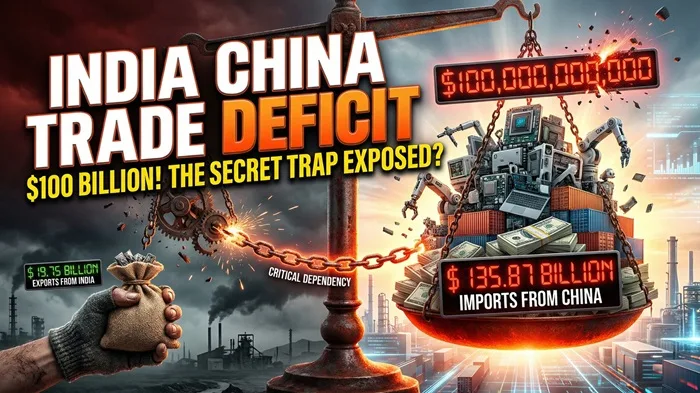
The latest reports show a major economic event as India's trade deficit with China crossed the historic $100 billion mark for the first time ever, reaching about $102 billion during the period of April to February in the financial year 2025-26. This massive number simply means that the country is buying far more foreign goods than it is actually selling. Such a huge financial gap creates deep worries about our national economic security and local job growth. For students preparing for civil services, understanding this wide gap is very important because it deeply impacts our currency value, foreign policies, and local factory survival.
What exactly is the meaning of this concept?
Meaning of the gap
- A trade deficit is a simple economic situation that happens when a country sends more money out to buy foreign goods than it earns back from selling its own goods to that same nation.
- In this specific case, the money going out from our local economy is much greater than the money coming in, making it the largest negative balance we have with any single trading partner globally.
- This constant unequal exchange means our local wealth is slowly transferring outside, which puts heavy pressure on our national savings and daily currency value.
Types of exchanged items
- The exchange mostly involves physical merchandise goods, which are solid items you can touch like heavy machines, mobile phones, and chemical powders.
- It also includes some services trade, like computer software and customer support, but the physical goods are what create the biggest financial hole in our national accounts.
Main observed features
- The most clear feature is persistent import dependence, meaning our local factories completely rely on foreign parts to keep their daily work running smoothly.
- There is a clear sectoral imbalance because we mostly buy highly advanced and expensive computer parts, while we only sell very basic and cheap raw materials.
- We also see huge market access asymmetry, which means foreign markets have very strict rules that stop our sellers from entering, while foreign goods enter our markets very easily.
Why is this trade gap constantly increasing today?
Differences in making goods
- The neighboring country has built huge manufacturing dominance over many years, creating massive factory zones that produce goods for the entire world.
- Because they make things on such a massive scale, their production costs are incredibly low, making their final items much cheaper than anything our local factories can currently produce.
- Our country has a very narrow export basket, meaning we rely on selling basic raw materials like iron ore, raw cotton, and raw seafood, which do not earn a high profit.
- When you constantly sell cheap raw materials and buy very expensive electronic machines, the financial gap will naturally grow wider and wider every single year.
Unfair selling rules
- Foreign governments often use complex rules called non-tariff barriers to safely protect their own local markets from outside competition.
- They use very strict health and safety tests, known as sanitary and phytosanitary measures, to purposely delay or reject our agricultural exports like fresh grapes, mangoes, and basmati rice.
- Our highly successful pharmaceutical products also face extremely slow approvals and confusing testing rules, which effectively blocks our strong medical industry from selling high-quality medicines there.
- Additionally, foreign factories get huge financial subsidies from their government, allowing them to sell their extra stock here at completely unrealistic low prices, a harmful practice called dumping.
Where are the biggest impacts mostly seen now?
Electronics and hardware sector
- The most visible impact is in the electronics market, where we completely depend on outside sources for vital internal parts like integrated circuits, memory chips, and solar panels.
- In the year 2024 alone, we bought electrical and electronic equipment worth a massive $47.67 billion, making it the absolute highest category of things we buy from them.
- Our local mobile phone assembly factories cannot build a single smartphone without first buying these essential electronic boards and lithium-ion batteries from foreign suppliers.
Medicine raw materials
- Our famous medicine makers rely deeply on foreign countries for Active Pharmaceutical Ingredients, which are the basic raw chemical powders absolutely needed to create human medicines.
- Buying these raw chemical powders from outside saves our local drug makers about 15 to 20 percent in their total daily production costs.
- However, this heavy reliance creates a terrifying health risk, because if those supply ships stop coming, our hospitals could face severe shortages of life-saving antibiotics and pain killers.
When did this historical relationship actually begin?
Early peaceful years
- Our modern diplomatic relations officially began in April 1950, when we became the very first non-socialist nation to openly recognize the newly formed foreign government.
- By 1954, both nations happily signed the famous Panchsheel Agreement, which proudly promised peaceful living, mutual respect, and completely shared growth for both sides.
- Sadly, this early period of friendship broke down completely during the terrible border conflict of 1962, which forced both sides to freeze all official talks and trade for many years.
Modern trade growth
- Full official relations and friendly talks were finally restored in 1976 after a long and difficult gap of fifteen quiet years.
- In 1984, both sides signed the important Most Favoured Nation trade agreement, which officially allowed businesses to start buying and selling across the borders again.
- The buying and selling grew very quickly in the early 2000s, but the financial gap really started widening out of control after 2010, growing from just $1.1 billion in 2003 to over $99 billion in 2024.
Who are the main people and groups involved?
Government rule makers
- The Ministry of Commerce and Industry carefully tracks all the daily buying and selling numbers to create smart policies that can safely manage our national money balance.
- The Directorate General of Trade Remedies works hard to investigate any unfair foreign selling tricks and actively applies special border taxes to protect our local shop owners.
Local factory owners
- Large domestic corporations that assemble electric vehicles and mobile phones are the biggest daily buyers of foreign intermediate goods because they need cheap parts to make a profit.
- Millions of small local business owners, who run our Micro, Small and Medium Enterprises, are the ones suffering the most because they simply cannot match the super low prices of imported plastic toys and machine parts.
How does this entire trade mechanism actually work?
Supply chain working
- The whole process begins when a local factory urgently needs a highly specific technical part, like a flat television screen or a tiny computer chip, to finish building a consumer product.
- Because local suppliers cannot make these tiny parts at a fast speed or a cheap price, the factory manager instantly places a huge bulk order with a massive foreign supplier.
- These foreign parts are quickly shipped across the ocean, assembled into shiny finished products by our local workers, and then sold to local families or shipped out to Western countries.
Financial market impacts
- When we constantly buy massive amounts of these foreign goods, we have to pay the bills using international money, mostly US Dollars, which drains our foreign exchange reserves.
- This non-stop outflow of Dollars makes our own local currency lose its natural value, meaning we have to spend more local money just to buy the exact same foreign item.
- A weaker local currency makes all future foreign purchases much more expensive, which slowly forces local shop owners to raise their prices, leading to widespread national inflation.
What is the main significance of this specific topic?
National economic safety
- Relying on a single foreign neighbor for over 70 percent of our basic needs in important sectors like computers and solar panels heavily threatens our core national safety.
- If global shipping routes suddenly break down due to a war, or if the supplier permanently stops sending critical materials like rare earth metals, our entire local industry would instantly stop working.
Independent decision making
- Having such a massive reliance on foreign goods makes it extremely difficult for our leaders to take strict, independent actions during serious border fights or global political arguments.
- True strategic autonomy, which means the complete freedom to make independent national choices, requires a country to smoothly produce its own essential goods without constantly begging a rival nation.
What are the current limitations and tough challenges?
Weak local factories
- Our current local manufacturing sector simply lacks the massive physical scale and the highly advanced robotic technology needed to instantly replace millions of cheap foreign imports.
- There is a very severe lack of money spent on Research and Development, which stops our bright engineers from inventing new high-tech products like advanced microchips right here at home.
High transport costs
- Historically, the cost of moving heavy goods around our country on trucks and trains, known as logistics cost, was painfully high at around 14 percent of our total national income.
- Although recent government highway projects have beautifully dropped this cost to roughly 7.97 percent, moving delicate electronic goods quickly across different states still faces poor road conditions and slow state border checks.
- We also face a huge skill gap, because while we have millions of young workers, they lack the specific technical training needed to safely operate highly advanced electronic assembly machines.
What is the latest news regarding this urgent issue?
Crossing the huge mark
- The most recent data clearly shows a deeply worrying trend as our negative trade balance with our neighbor officially crossed the huge $100 billion mark for the very first time in history.
- Specifically, between the months of April and February in the financial year 2025-26, this massive negative gap actually touched roughly $102 billion, breaking all previous historical records.
- This is a very loud warning alarm for our economy because it openly proves that despite many loud local campaigns to buy domestic goods, our daily hunger for foreign industrial parts is still growing rapidly.
Small export gains
- In a slightly positive turn, our total exports to this neighbor actually grew by 9.7 percent in the recent calendar year, reaching a slightly better total of $19.75 billion.
- This small but important growth was driven by selling more specific items like telecom instruments, oil meals, and marine products, which showed that we are slowly breaking into their tough local market.
- However, this tiny victory was totally wiped out because their massive imports into our country grew much faster, rising by 12.8 percent to hit an unbelievable $135.87 billion.
How does India stand in this highly specific situation?
Growing local schemes
- To actively fight this dangerous problem, our government aggressively launched the Atmanirbhar Bharat mission, which strongly promotes self-reliance by heavily funding our own local factory owners.
- The government introduced powerful Production Linked Incentive schemes across 14 critical sectors, offering massive financial cash rewards to local companies that successfully build mobile phones, powerful batteries, and raw medicines entirely inside our borders.
- This smart cash reward system has already helped our country become a very famous global hub for assembling smart televisions and mobile phones, creating millions of fresh new jobs.
Protecting small sellers
- To safely protect our small street sellers and tiny factory owners, the government started issuing strict Quality Control Orders that firmly demand very high safety standards for all imported items.
- These strict quality rules legally block cheap, toxic, and low-quality plastic toys or dangerous electronics from easily flooding into our local neighborhood stores.
- Our customs officers also strictly apply special extra taxes, known as anti-dumping duties, on heavily discounted foreign goods to make sure our local factory prices stay fairly competitive.
What does the comparison chart clearly show?
| Comparison Feature Area | India National Data | China National Data | Clear Meaning of this Difference |
| Manufacturing Labor Cost (per hour) | $1.40 | $7.20 | Our country has a massive advantage in offering much cheaper basic labor costs for factory work. |
| Average Monthly Factory Worker Wage | $150 to $300 | $600+ | This clearly highlights our highly cost-effective young workforce for global investors. |
| Industrial Electricity Cost (per kWh) | $0.09 | $0.12 | We proudly offer slightly cheaper power rates for running huge, heavy factory machines all day. |
| Top Exported Item (sent to each other) | Iron Ore | Telephones | This deeply proves we mostly sell cheap raw dirt, while they sell us highly expensive finished computers. |
| Total Export Value (recorded in 2024) | $14.25 Billion | $113.45 Billion | This openly exposes the terrifying, massively unequal financial scale of our daily buying and selling habits. |
What is the clear way forward for us today?
Building better factories
- We must quickly move far beyond just simply joining together basic parts that arrive from outside, and we must urgently start making the actual core computer chips locally.
- This urgently requires spending massive amounts of money to rapidly build extremely advanced technology centers like semiconductor fabrication plants and massive electric battery cell factories.
- Trade experts strongly recommend a smart plan called the Localize-100 strategy, which simply means identifying the top 100 most expensive imported parts and forcing local companies to make them here.
Finding new partners
- Instead of blindly buying absolutely everything from just one single powerful neighbor, we desperately need to spread our risks by actively buying our raw materials from many different friendly countries.
- We must quickly strengthen our deep trade agreements with friendly developing nations in Southeast Asia, Latin America, and Africa to secure much safer and highly reliable supply routes.
- Finally, our local business owners must heavily invest in modern digital technology to vastly improve the overall quality and beautiful design of the goods they try to sell abroad, moving us up the global value chain.
The complex economic relationship clearly shows a deeply unbalanced connection that harms our local financial strength, openly proven by the terrifying new record of a $102 billion negative trade gap. While buying extremely cheap foreign parts greatly helps our local assembly shops survive today, it completely destroys the future growth of our own real domestic manufacturing base and creates a terrifying strategic weakness. Our recent bold government policies, including massive financial cash rewards and very strict border quality controls, are certainly strong and positive steps in the correct direction. However, to truly secure our long-term economic independence, we must completely restructure our entire supply chain network, heavily fund deep technological research, and proudly build a truly self-reliant industrial powerhouse that can confidently compete on the world stage.
Q. Analyze how structural gaps and non-tariff barriers expand the current trade deficit, and evaluate policy measures needed to build long-term economic self-reliance. (250 words)

[ytep url="https://youtu.be/evxTuFglAUM" duration="535″]
Related Posts

If you like this post, please share your feedback in the comments section below so that we will upload more posts like this.

Responses