
US Visa Types Explained: H-1B, L-1, and Policy Shifts Impacting India-US Relations

From Current Affairs Notes for UPSC » Editorials & In-depths » This topic
The intricate relationship between India and the United States is significantly shaped by the movement of people, with the US visa system serving as the primary gateway. For countless Indian citizens aspiring to travel, study, or work in the U.S., navigating this system is a pivotal step. Recent policy shifts have thrust this process into the spotlight. At a time when the President Donald Trump administration has announced a steep new $\text{100,000 fee on fresh H-1B applications, many are asking if the lesser-known L-1 visa could be an alternative. The L-1 has been used for decades by multinational firms to shuffle executives and staff between overseas and US offices, making its potential as a substitute a critical question for companies and professionals alike.
What are the different types of US visas available?
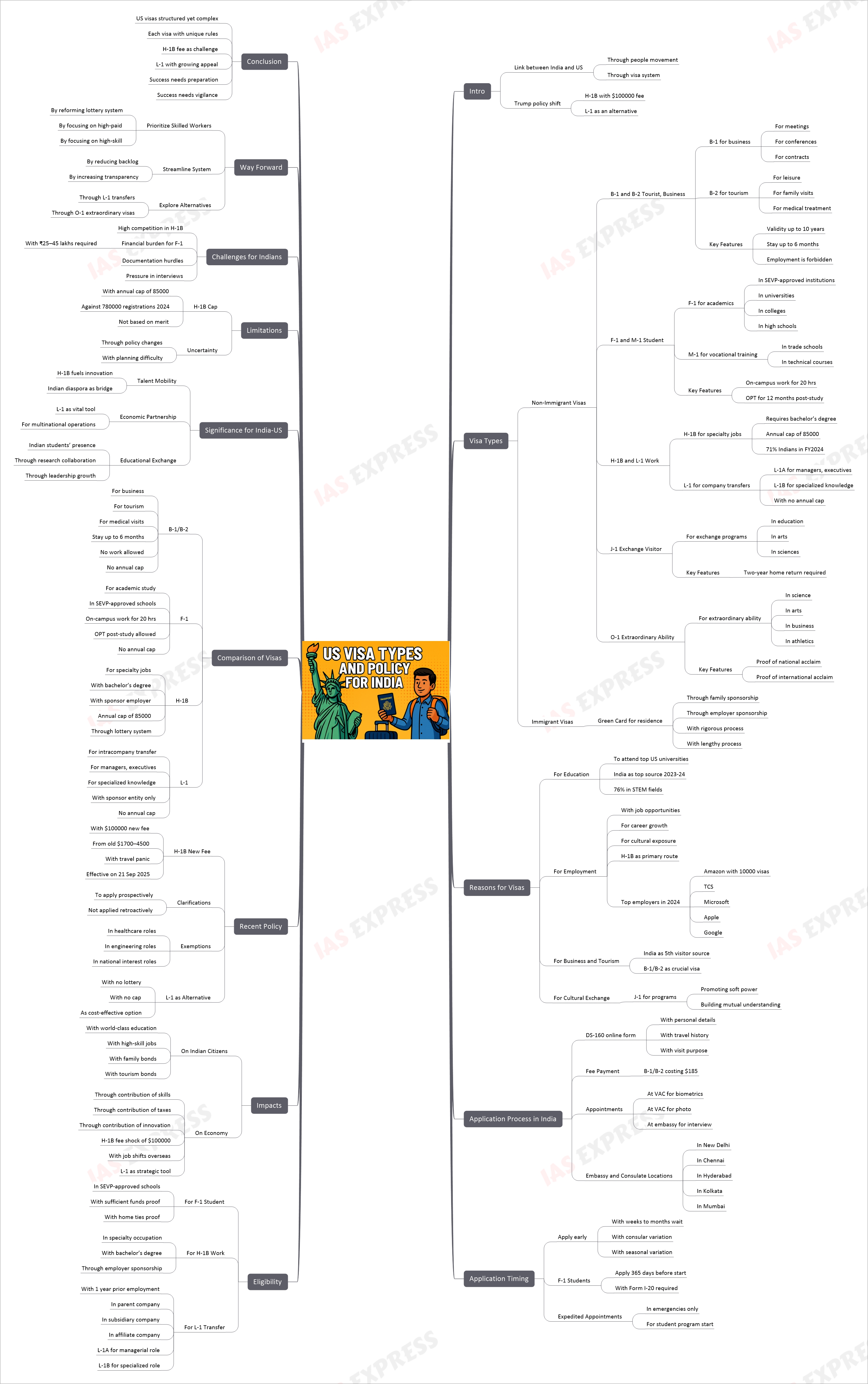
The United States offers a wide array of visas, which are broadly categorized into two primary types: non-immigrant visas for individuals planning a temporary stay, and immigrant visas for those seeking to establish permanent residency. For the vast majority of Indian citizens, the focus is on the various non-immigrant visa options.
- Non-Immigrant Visas
- Tourist or Business Visa (B-1/B-2): This is one of the most common visa types, often issued as a combination visa to facilitate both business and leisure travel.
- B-1 Visa: This stream is specifically for individuals engaging in temporary business activities. This includes attending meetings, professional conferences, or negotiating contracts with U.S. counterparts .
- B-2 Visa: This visa is intended for tourism, leisure travel, visiting friends and family members, or seeking medical treatment in the U.S. .
- Key Features: A combined B-1/B-2 visa is typically granted with a validity of up to 10 years. It permits stays of up to six months per visit, though the final duration is determined by immigration officials upon arrival. It is crucial to note that any form of employment is strictly forbidden under this visa category .
- Student Visa (F-1, M-1): These visas cater to the large number of Indian students pursuing education in the United States.
- F-1 Visa: This is the primary visa for international students enrolled in full-time academic programs at an institution approved by the Student and Exchange Visitor Program (SEVP). This includes universities, colleges, and high schools .
- M-1 Visa: This category is for students pursuing vocational or other recognized non-academic programs, such as trade schools or technical courses .
- Key Features: F-1 students are generally allowed to work on-campus for up to 20 hours per week during the academic session. A significant benefit is the potential eligibility for Optional Practical Training (OPT), which allows them to gain up to 12 months of work experience related to their field of study after graduation .
- Work Visa (H-1B, L-1): These visas are the primary pathway for Indian professionals to work in the U.S.
- H-1B Visa: This highly sought-after visa is designed for professionals in specialty occupations. These are roles that typically require a bachelor’s degree or a higher level of education as a minimum entry requirement. It is particularly popular among professionals in the Indian IT and technology sectors .
- L-1 Visa: This is an intracompany transferee visa. It enables multinational corporations to transfer employees from their international offices to a related office in the U.S. It has two subcategories: L-1A for managers and executives, and L-1B for employees who possess specialized knowledge about the company’s products, services, or procedures .
- Key Features: The H-1B visa is subject to a congressionally mandated annual cap of 85,000, which has led to a highly competitive lottery system due to overwhelming demand. In fiscal year 2024, an estimated 71\% of all approved H-1B petitions were for applicants from India, highlighting its importance . In contrast, the L-1 visa has no annual cap, making it a more predictable and increasingly attractive alternative for eligible companies .
- Exchange Visitor Visa (J-1):
- Purpose: This visa is intended for participants in approved exchange programs. These programs are designed to promote the exchange of knowledge and skills in various fields, including education, arts, and sciences, fostering cultural diplomacy .
- Key Features: A notable condition for some J-1 visa holders is the “two-year home-country physical presence requirement,” which mandates that they must return to their home country for a cumulative period of at least two years after their program ends before they can apply for certain other U.S. visas, including H-1B or permanent residency .
- Extraordinary Ability Visa (O-1):
- Purpose: The O-1 visa is for individuals who can demonstrate extraordinary ability or significant achievement in their respective fields, such as sciences, arts, education, business, or athletics .
- Key Features: This visa requires a high burden of proof, including evidence of sustained national or international acclaim. It has become a popular alternative for highly accomplished professionals who may not wish to participate in the H-1B lottery.
- Tourist or Business Visa (B-1/B-2): This is one of the most common visa types, often issued as a combination visa to facilitate both business and leisure travel.
- Immigrant Visas
- Purpose: An immigrant visa, also known as a Green Card, grants a foreign citizen the right to live and work permanently in the United States. The path to an immigrant visa is often initiated through sponsorship by a U.S. citizen or lawful permanent resident relative, or through a prospective U.S. employer . The application and vetting process for an immigrant visa is significantly more rigorous and lengthy compared to non-immigrant visas.
Why do Indian citizens need US visas?
The motivations for Indian citizens to seek U.S. visas are diverse and deeply rooted in the opportunities and connections that the United States offers.
- Educational Pursuits:
- The U.S. hosts many of the world’s most prestigious universities, making it a top destination for Indian students seeking higher education. In the 2023-24 academic year, India overtook China to become the single largest source of international graduate students in the United States, underscoring this trend .
- A significant majority, approximately 76\% of all students from India who traveled to the U.S. in the 2023-24 academic year, were enrolled in programs within STEM (Science, Technology, Engineering, or Math) fields, reflecting a strategic focus on high-demand skills .
- Employment Opportunities:
- The U.S. economy presents a wide range of job opportunities, career advancement prospects, and cross-cultural exposure that attracts a large pool of talented Indian professionals. The H-1B visa serves as the primary mechanism for these skilled workers to secure employment in the U.S. .
- Major technology companies are among the top employers of H-1B workers. For instance, in 2024, Amazon was the leading recipient with over 10,000 H-1B visas awarded, followed closely by global firms like Tata Consultancy Services, Microsoft, Apple, and Google .
- Business and Tourism:
- India ranks as the fifth-largest country of origin for international visitors to the U.S. The versatile B-1/B-2 visa is instrumental in facilitating this travel, whether for crucial business meetings, exploring landmarks, or maintaining family connections .
- Cultural Exchange:
- The J-1 visa plays a vital role in promoting soft power and mutual understanding. It allows Indian citizens to participate in structured programs that foster cultural and educational exchange, building lasting bridges between the two democracies .
Where can one apply for a US visa in India?
The application procedure for a U.S. visa in India is a well-defined, multi-step process that is managed through the U.S. diplomatic missions across the country.
- Application Submission:
- The journey typically begins with the online submission of the DS-160 application form. This comprehensive form collects detailed information regarding the applicant’s personal background, travel history, and the specific purpose of their visit .
- Following the form submission, the applicant is required to pay a non-refundable visa application fee. For the popular B-1/B-2 visa, this fee is currently around }$185 .
- Scheduling Appointments:
- Applicants must then schedule two separate appointments. The first is at a Visa Application Center (VAC) for the collection of biometric data, which includes fingerprints and a photograph. The second is the formal visa interview at a U.S. Embassy or Consulate .
- U.S. Embassies and Consulates in India:
- The final and most critical step, the visa interview, is conducted at one of the U.S. diplomatic posts in India. These include the U.S. Embassy in New Delhi and the U.S. Consulates General in Chennai, Hyderabad, Kolkata, and Mumbai .
When is the best time to apply for a US visa?
Timing is an exceptionally important consideration in the visa application process, and planning ahead is crucial to avoid potential disruptions to travel plans.
- Application Timeline:
- It is strongly recommended to initiate the visa application process well in advance of the planned travel date. The entire procedure, from filling out the form to securing an interview slot and receiving a decision, can range from several weeks to a few months. Appointment wait times fluctuate significantly based on the consular location and the seasonal volume of applications .
- For students applying for F-1 visas, the U.S. Department of State allows applications to be submitted up to 365 days before the academic program’s start date. It is advisable to apply as soon as the Form I-20 (Certificate of Eligibility for Nonimmigrant Student Status) is received from the university .
- Expedited Appointments:
- In cases of genuine emergencies or urgent travel needs, such as a student whose program is starting imminently, it is possible to request an expedited interview appointment. However, applicants must first complete the standard steps of submitting the DS-160 form and paying the application fee before such a request can be considered .
Who is eligible for specific US visas?
Each U.S. visa category has a distinct set of eligibility criteria that every applicant must rigorously meet to be considered for approval.
- F-1 Student Visa:
- Prospective students must be accepted and enrolled in a full-time academic program at a SEVP-approved school. A key requirement is to demonstrate access to sufficient liquid funds to cover the full cost of their education and living expenses for the duration of their studies .
- Furthermore, applicants must convincingly prove to the consular officer their strong ties to their home country and their unequivocal intent to return after the completion of their academic program.
- H-1B Work Visa:
- Eligibility for this visa is restricted to individuals who will be employed in a specialty occupation. This is professionally defined as a role that requires the theoretical and practical application of a body of highly specialized knowledge, typically evidenced by a bachelor’s degree or its equivalent in a specific field. The U.S. employer is responsible for sponsoring the visa petition on behalf of the applicant .
- L-1 Intracompany Transferee Visa:
- To qualify, the employee being transferred must have been employed by the foreign entity of the multinational company for at least one continuous year within the preceding three years. There must be a qualifying corporate relationship between the foreign and U.S. entities, such as a parent company, subsidiary, or affiliate .
- The L-1A visa is for individuals being transferred in a managerial or executive capacity, while the L-1B visa is for employees who possess specialized knowledge of the company’s proprietary products, services, research, or management techniques .
How do US visas impact Indian citizens and the economy?
The U.S. visa system has a far-reaching and profound impact, influencing the personal and professional lives of Indian citizens as well as the economic landscapes of both nations.
- Impact on Indian Citizens:
- For individuals, these visas provide invaluable access to world-class education and career-defining, high-skilled job opportunities. This exposure often leads to significant personal and professional growth.
- On a personal level, the ability to travel for tourism and visit family members living in the U.S. strengthens familial and cultural bonds.
- Economic Impact:
- Indian professionals on work visas, especially those in the technology and engineering sectors, make substantial contributions to the U.S. economy through their skills, innovation, and tax contributions.
- The recent proclamation by the Trump administration announcing a potential $100,000 fee for new H-1B applications has sent shockwaves through the industry. Critics argue that such a prohibitive cost could deter U.S. companies from hiring foreign talent and may even incentivize them to shift more jobs and operations overseas .
- This development has simultaneously cast a spotlight on the L-1 visa as a viable strategic alternative. Because the L-1 visa is designed for intracompany transfers and crucially, has no annual numerical cap, it could become an increasingly important tool for multinational firms seeking to bring essential personnel to their U.S. operations .
What is the recent news about US visa policies?
A proclamation by President Donald Trump has introduced a potentially radical change to the H-1B visa program, causing significant confusion and apprehension among employers and applicants.
- The $100,000 H-1B Fee:
- The administration announced a new $100,000 fee for most new H-1B petitions. This represents a monumental increase from the existing fee structure, which typically ranges from approximately $1,700 to $\text{4,500 depending on various factors .
- The initial news of this policy led to widespread panic and confusion. There were reports of some current H-1B visa holders abroad canceling their travel plans and scrambling to return to the U.S. before the proposed effective date of September 21, 2025 .
- Clarifications and Exemptions:
- Following the initial uproar, subsequent guidance from government agencies clarified the policy’s scope. The new fee is intended to only apply prospectively to new H-1B petitions for beneficiaries who are physically outside the U.S. It will not retroactively affect current visa holders or petitions that were filed before the rule’s effective date .
- Importantly, certain exemptions to this massive fee have been outlined. These include roles within the healthcare and engineering industries, as well as other positions that are deemed vital to the national interest of the United States .
- The L-1 Visa as an Alternative:
- The prospect of such a steep fee for the H-1B visa has made the L-1 visa an increasingly appealing option for multinational companies. Since it facilitates the transfer of existing, proven employees and is not subject to a lottery or an annual numerical limit, it provides a level of certainty and cost-effectiveness that the H-1B program may no longer offer .
Comparison of Popular US Visas for Indians
| Visa Type | Purpose | Key Features | Work Authorization | Annual Cap |
| B-1/B-2 | Business, Tourism, Medical Treatment | Designed for temporary visits, typically allowing stays of up to 6 months per entry. | Not permitted. | No |
| F-1 | Academic Study | For full-time students enrolled at SEVP-approved academic institutions. | Limited on-campus work (up to 20 hrs/week) is allowed. Post-graduation work through OPT is available. | No |
| H-1B | Specialty Occupation Work | For professionals with at least a bachelor’s degree or its equivalent in a specific field. | Permitted for the sponsoring employer only. Can be transferred to a new employer. | Yes (85,000 annually), leading to a lottery. |
| L-1 | Intracompany Transfer | For managers, executives, or employees with specialized knowledge within a multinational company. | Permitted for the sponsoring employer’s U.S. entity. | No |
What is the significance of US visas for India-US relations?
Visa policies are not merely administrative procedures; they are a fundamental pillar of the strategic partnership between India and the United States, deeply influencing economic, cultural, and people-to-people ties.
- Talent Mobility:
- The flow of skilled professionals from India to the U.S., facilitated primarily by the H-1B program, has been a critical catalyst for innovation and growth, especially in the American technology sector. This has also led to the creation of a large and influential Indian diaspora, which acts as a living bridge strengthening the bonds between the two nations.
- Economic Partnership:
- Flexible and efficient visa policies that ease business travel and intracompany transfers are essential for nurturing the expanding trade and investment relationship. The L-1 visa, for example, is indispensable for the seamless operation of multinational corporations with footprints in both India and the U.S.
- Educational Exchange:
- The presence of a large contingent of bright Indian students in American universities fosters rich academic collaboration and research partnerships. It also cultivates a new generation of global leaders, entrepreneurs, and thinkers who possess a deep, firsthand understanding of both societies.
What are the limitations of the current US visa system?
While the U.S. visa system is comprehensive, it possesses inherent limitations that pose significant hurdles for many applicants.
- H-1B Cap and Lottery:
- The most significant limitation is the arbitrary annual cap on H-1B visas. The current limit of 85,000 is grossly insufficient to meet the staggering demand, which forces the government to use a lottery system. This process is widely criticized as being unpredictable and failing to select candidates based on merit or skill. In 2024, there were over 780,000 H-1B registrations competing for just 85,000 available visas .
- Uncertainty for Applicants:
- The lottery-based selection and the potential for sudden policy changes create profound uncertainty for both U.S. employers looking to hire talent and for the prospective employees themselves. This unpredictability makes long-term planning extremely difficult for businesses and individuals.
What challenges do Indian applicants face with US visas?
In addition to systemic limitations, Indian applicants often grapple with a unique set of challenges while navigating the U.S. visa process.
- High Competition:
- The sheer volume of applications from India for visas like the H-1B creates an environment of intense competition. This means that a large number of highly qualified and deserving applicants are denied the opportunity to work in the U.S. each year simply due to the lottery’s random nature.
- Financial Requirements:
- For F-1 student visas, applicants face the significant challenge of proving they have sufficient funds to cover their entire course of study and living expenses. This often requires showing liquid assets worth a minimum of ₹25–45 lakhs, which can be a substantial financial barrier for many middle-class Indian families .
- Documentation and Interviews:
- The visa application demands meticulous and flawless documentation. Any minor error, omission, or inconsistency can result in processing delays or an outright rejection. The visa interview, while typically brief, is a high-pressure situation that requires applicants to articulate their intentions clearly and confidently.
What is the way forward for US visa policies?
The future trajectory of U.S. visa policies will likely be defined by an ongoing effort to strike a better balance between America’s economic imperatives and its national security interests.
- Prioritizing High-Skilled Workers:
- There is a significant and growing momentum to reform the H-1B system away from a random lottery. A key proposal is to implement a system that prioritizes higher-paid, higher-skilled workers, ensuring that the visas go to the most valuable talent. The Trump administration’s recent proclamation included directives to explore updating the lottery to favor such individuals .
- Streamlining Processes:
- A concerted effort to simplify the convoluted application process, reduce backlogs, and provide greater transparency and predictability would be highly beneficial for both employers and applicants, making the system more efficient and user-friendly.
- Exploring Alternatives:
- As the H-1B visa becomes more restrictive and expensive, alternative pathways for skilled professionals will inevitably gain more prominence. Visas like the L-1 for intracompany transfers and the O-1 for individuals with extraordinary ability will likely be explored more frequently by companies and top-tier talent.
Conclusion
The United States visa system provides a structured, albeit complex, series of pathways for Indian citizens to pursue education, employment, and travel in America. Each visa category, from the commonly used B-1/B-2 for short-term visits to the fiercely competitive H-1B for specialized professionals, is tailored to a specific purpose and comes with its own set of rules and requirements. The landscape is constantly evolving, with recent policy proposals like the new }$100,000 fee for H-1B applications creating fresh challenges while simultaneously enhancing the appeal of alternative routes like the L-1 intracompany transfer visa. For Indian aspirants, the key to success lies in diligently understanding the nuances of each visa, preparing meticulously for the application process, and remaining vigilant about the dynamic nature of U.S. immigration policy.
Q. Do you think the increasing restrictions on the H-1B visa will benefit India in the long run? (250 words)
Related Posts
![[Premium] US's Withdrawal from INF Treaty - Is it the End of Arms Control?](https://www.iasexpress.net/wp-content/uploads/2018/11/INF-treaty-upsc-ias-600x300.png)
If you like this post, please share your feedback in the comments section below so that we will upload more posts like this.

Responses