
China Vs Trump’s Tariffs: A Comprehensive Analysis

From Current Affairs Notes for UPSC » Editorials & In-depths » This topic
The recent economic data from Beijing offers a surprising narrative in the ongoing global trade saga. On July 15, China’s National Bureau of Statistics revealed that despite the intense pressure from US tariffs, the economy showcased remarkable resilience. The GDP growth for the first half of the year beat most global estimates, with a 5.4% year-on-year increase in the first quarter and 5.2% in the second. These figures are particularly noteworthy as they cover a period of significant upheaval in global trade, largely instigated by the tariffs imposed by United States President Donald Trump, suggesting that the intended economic impact of the trade war may not have been as severe as Washington had anticipated.
What Exactly Are These Tariffs?
- The tariffs are essentially taxes imposed on imported goods.
- In this case, the United States, under President Trump, initiated a series of high tariffs on goods imported from China.
- The primary goal was to make Chinese products more expensive for American consumers and businesses.
- The range of products targeted was extensive and grew over time.
- Initially, the tariffs focused on industrial goods and technology related to China’s “Made in China 2025” strategic plan, such as machinery and electronics.
- As the conflict escalated, the lists expanded to include a vast array of consumer goods, impacting everyday items.
- The initial wave in July 2018 saw a 25% tariff on $34 billion of Chinese goods.
- China did not absorb these measures passively and responded with its own set of retaliatory tariffs.
- These were strategically aimed at key sectors of the US economy.
- Prominent targets included agricultural products like soybeans, which are politically sensitive in many US states, as well as automobiles and energy products.
Why Were the Tariffs Imposed?
- The primary justification cited by the US administration was the massive trade deficit with China.
- A trade deficit occurs when a country imports more than it exports.
- In 2018, the US goods trade deficit with China was over $419 billion, a figure the administration aimed to reduce.
- Another core issue was the protection of intellectual property (IP).
- The US accused China of engaging in unfair trade practices for decades.
- This included widespread IP theft, where Chinese companies were accused of stealing American technology and trade secrets, costing the US economy billions annually.
- Another complaint was forced technology transfer, where US companies were allegedly required to share their technology with Chinese partners as a precondition for accessing the Chinese market.
- The US accused China of engaging in unfair trade practices for decades.
- The tariffs were also a tool to pressure China to open its markets further.
- The US argued that the Chinese market had significant barriers for foreign companies, creating an uneven playing field.
- By imposing tariffs, the US hoped to leverage its position as a major consumer market to force policy changes within China.
Where Did the Impacts Manifest Globally?
- The trade war created significant disruptions in global supply chains.
- Many multinational companies had built their manufacturing and sourcing networks around China.
- The tariffs increased production costs and created uncertainty, forcing businesses to look for alternative manufacturing locations.
- Countries in Southeast Asia, such as Vietnam and Malaysia, saw an influx of manufacturing as companies shifted production out of China to avoid the tariffs.
- The conflict contributed to a slowdown in global economic growth.
- The uncertainty and rising costs acted as a drag on international trade and investment.
- International organizations like the IMF and World Bank repeatedly warned that the escalating tensions were a significant risk to the global economy.
- Other trading partners of the US and China were also affected.
- Some countries faced collateral damage as global trade volumes shrank.
- Others, however, found opportunities to increase their exports to either the US or China to fill the gaps left by the other.
When Did This Trade War Unfold?
- The groundwork was laid in 2017, but the trade war officially began in 2018.
- March 2018: President Trump announced plans for tariffs on Chinese goods, following a Section 301 investigation into China’s trade practices.
- July 2018: The first round of US tariffs took effect, targeting $34 billion of Chinese products. China immediately retaliated with tariffs on the same value of US goods.
- September 2018: The US imposed tariffs on an additional $200 billion of Chinese goods, and China retaliated with tariffs on $60 billion of US goods.
- The conflict saw periods of escalation and temporary truces.
- 2019: Tensions continued to rise with further tariff increases from both sides.
- January 2020: The “Phase One” trade deal was signed.
- In this deal, China committed to purchasing an additional $200 billion in US goods and services over two years.
- The US agreed to slightly roll back some tariffs, but the majority remained in place, leaving the core issues unresolved.
Who Were the Key Actors Involved?
- On the American side, the central figure was President Donald Trump.
- He championed the tariffs as a key part of his “America First” economic policy.
- Key advisors, such as US Trade Representative Robert Lighthizer and Treasury Secretary Steven Mnuchin, were instrumental in negotiations and policy implementation.
- On the Chinese side, President Xi Jinping led the response.
- He and his administration portrayed the US actions as protectionism and a threat to the global trading system.
- Vice Premier Liu He was the lead negotiator for China, engaging in multiple rounds of high-stakes talks with his American counterparts.
How Did the Conflict Escalate?
- The conflict operated on a tit-for-tat basis.
- For almost every tariff action taken by the US, China responded with a counter-measure.
- This created a cycle of escalation where each side tried to inflict economic pain on the other.
- The scope of the tariffs widened significantly over time.
- What started with a focus on specific industrial sectors quickly expanded to cover a large percentage of bilateral trade.
- By the end of 2019, the US had imposed tariffs on over $550 billion of Chinese goods, and China had retaliated with tariffs on over $185 billion of US goods.
- The rhetoric from both sides became increasingly confrontational.
- This war of words further destabilized global markets and created an atmosphere of unpredictability for businesses and investors.
What Is the Significance of Recent News?
- The recently announced GDP figures from China challenge the narrative that the US tariffs were crippling its economy.
- A growth rate of over 5% in the first half of the year, while slower than in previous years, is robust.
- This suggests that the Chinese economy has been able to withstand the external pressure, partly by stimulating domestic demand and diversifying its export markets.
- This economic resilience gives China a stronger hand in negotiations.
- If its economy can continue to grow despite the tariffs, it has less incentive to agree to a deal that it perceives as unfavorable.
- This development indicates that the trade dispute is not a simple case of one side having all the leverage, but a complex contest between two economic giants.
What is the Overall Significance?
- The trade war marked a major shift away from the post-Cold War consensus on globalization.
- It signaled a rise in economic nationalism, where countries prioritize their domestic economic interests over global cooperation.
- It has forced a fundamental rethinking of global supply chains.
- The “just-in-time” model that relied heavily on China as the world’s factory is now seen as risky.
- This has accelerated the trend of decoupling or “de-risking,” where companies diversify their suppliers to reduce dependence on a single country.
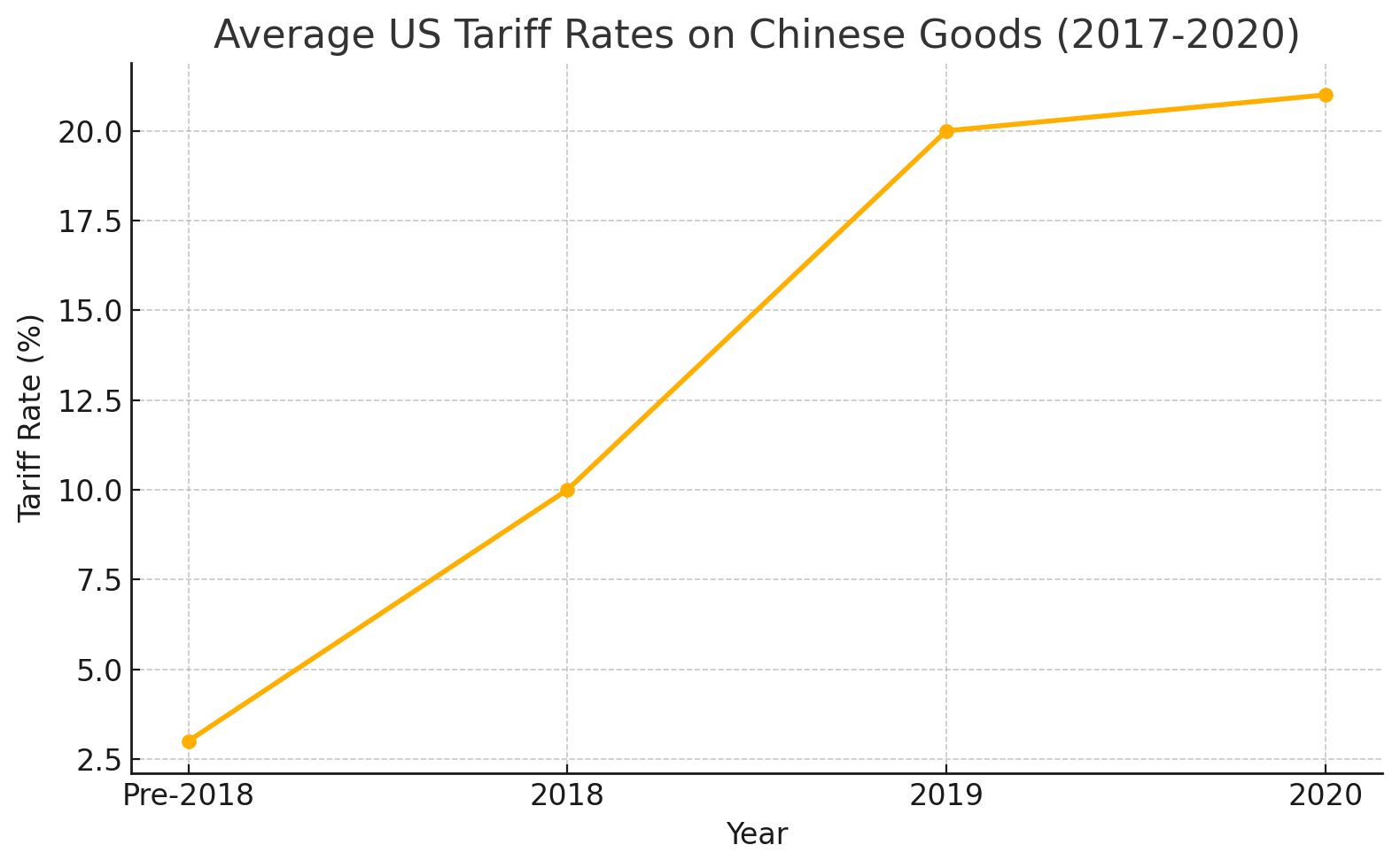
- A visual representation of the escalating average tariff rates could be shown as:
Chart: Average US Tariff Rates on China
What Are the Trade War’s Limitations?
- The tariffs did not lead to a significant reduction in the overall US trade deficit.
- While the bilateral deficit with China decreased, the US overall deficit with the world continued to grow, as imports were simply diverted from other countries.
- The economic costs of the tariffs were largely borne by American consumers and businesses.
- Multiple studies found that Chinese exporters did not lower their prices to absorb the cost of the tariffs.
- Instead, US importers paid the tax and passed the cost on to consumers in the form of higher prices. A family, for instance, ended up paying more for appliances and electronics.
- Retaliatory tariffs hurt American exporters.
- Farmers, in particular, lost a significant portion of their market in China, leading to financial hardship and requiring government bailouts.
How Does This Affect India?
- The trade war presents both opportunities and challenges for India.
- Opportunities:
- Export Promotion: With US and Chinese buyers looking for alternatives, India has a chance to increase its exports of goods like textiles, chemicals, and auto components. For example, as US buyers sought alternatives to Chinese-made textiles, Indian garment exporters saw a potential rise in orders.
- Attracting Investment: Global companies looking to diversify their supply chains away from China may consider India as an attractive destination for new manufacturing investment under the “China Plus One” strategy.
- Challenges:
- Dumping: There is a risk that China might dump its surplus products, such as steel and electronics, into the Indian market at low prices, hurting domestic manufacturers.
- Global Slowdown: A general slowdown in the global economy caused by the trade dispute can negatively impact India’s own growth prospects and export earnings. The Indian stock market also showed volatility, losing significant value in short periods following major tariff announcements.
Comparison Chart: US vs. China in the Trade War
| Aspect | United States | China |
|---|---|---|
| Primary Goal | Reduce trade deficit, protect intellectual property (IP), and gain market access. | Maintain economic stability, counter US protectionism. |
| Key Strategy | Imposing high tariffs on Chinese goods. | Retaliatory tariffs, boosting domestic demand, diversifying exports. |
| Key Sectors Hit | Consumers (faced higher prices), agriculture (e.g., soybeans, pork). | Exporters (lost US market share), tech sector (hit by US sanctions). |
| Reported Impact | Higher consumer costs, farm sector distress, supply chain reconfigurations. | Slower export growth, but resilient GDP supported by internal policies. |
| Negotiation Approach | “Maximum pressure” using tariffs as leverage; unilateral demands. | Tit-for-tat responses; multi-channel diplomacy; emphasis on sovereignty. |
| Outcome by 2020 | Partial Phase One deal, some tariff reductions, unresolved structural issues. | Met some purchase commitments, retained trade surplus with US. |
| Geopolitical Signal | Return to economic nationalism; challenging globalization norms. | Framed US actions as protectionist; positioned as defender of free trade. |
What Is the Way Forward?
- The future of US-China trade relations remains uncertain and is a central issue in geopolitics.
- Three potential scenarios exist:
- Continued Competition and Decoupling: Both countries may continue to reduce their economic interdependence, particularly in strategic sectors like technology (e.g., semiconductors) and defense. This path involves ongoing rivalry and tension.
- De-escalation and a New Balance: The two powers might find a way to manage their disputes and de-escalate the conflict, leading to a new, more balanced and rules-based trade relationship.
- Managed Coexistence: A more realistic path might involve accepting that competition is permanent but establishing clear rules of engagement to prevent it from spiraling into a full-blown economic or military conflict. This would involve a mix of competition and cooperation on global issues.
Conclusion
In summary, the trade war initiated by Trump’s tariffs is far more than a simple economic dispute over goods. It represents a fundamental clash between two competing economic and geopolitical models. While the tariffs caused significant economic disruptions and failed to achieve some of their stated objectives, they have permanently altered the landscape of global trade. The conflict has exposed the vulnerabilities of interconnected supply chains, elevated the role of economic nationalism, and set the stage for a long-term strategic rivalry between the US and China. For countries like India, navigating this new era requires a careful balancing of risks and opportunities to secure its own economic future.
Q. Critically analyze the long-term implications of using tariffs as a primary tool for addressing trade imbalances and national security concerns. (250 words)
Related Posts
If you like this post, please share your feedback in the comments section below so that we will upload more posts like this.

Responses