
Nepal’s Gen Z Uprising: Causes, Effects, Relevance for India

From Current Affairs Notes for UPSC » Editorials & In-depths » This topic
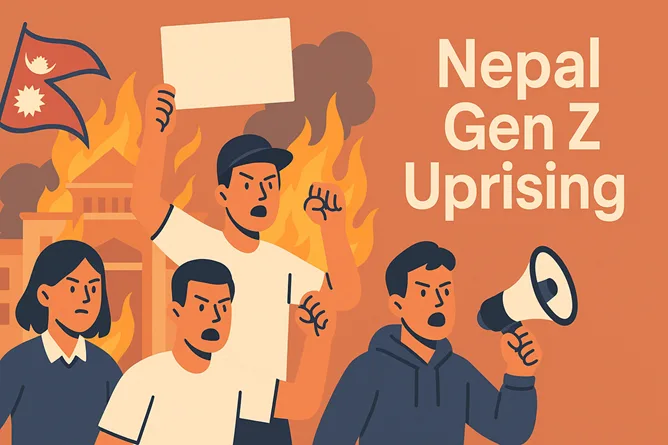
In an unprecedented turn of events, Nepal witnessed a furious eruption of youth anger in early September 2025. Gen Z protesters, enraged by the repressive actions of the K P Sharma Oli regime, took to the streets in a movement that quickly spiraled from peaceful demonstrations into a violent confrontation with the state. The boiling point was reached on September 9, when demonstrators, channeling years of frustration, set fire to government buildings, offices of major political parties, and the homes of top political functionaries, including several former Prime Ministers. This was not merely a reaction to a single government policy but a powerful and fiery rejection of a political system widely seen as corrupt, nepotistic, and completely disconnected from the aspirations of its younger generation.
What Are the Defining Features of This Protest?
- A Youth-Dominated Movement
- The protests are overwhelmingly driven by young people, particularly those belonging to Generation Z, which generally includes individuals born between the mid-1990s and the early 2010s.
- A significant number of the participants are high school and college students, with many seen protesting in their school or college uniforms, symbolizing a generation demanding a future different from the present.
- Leaderless and Decentralized Nature
- Unlike traditional political movements in Nepal, which are often organized by established political parties or unions, this protest notably lacks a single, identifiable leader or a formal hierarchical structure.
- It is a more spontaneous and organic uprising, reflecting a grassroots mobilization of citizens.
- Coordination and communication have been heavily reliant on modern technology.
- Digital platforms like Discord were used as virtual ‘control rooms’ to organize and direct protest activities, making it a truly networked movement that was difficult for authorities to decapitate by arresting leaders.
- Initial Trigger and Deeper Causes
- The immediate catalyst was the government’s decision to implement a nationwide ban on 26 popular social media platforms, including Facebook, X (formerly Twitter), and YouTube. This was perceived by the youth as a direct attack on their freedom of speech and a crude attempt to silence growing online dissent.
- However, this trigger was merely the spark that ignited a much larger fire fueled by deep-seated grievances.
- Protesters chanted slogans like “stop corruption not social media,” highlighting that the core issues were widespread political corruption and a culture of impunity.
- A viral social media trend using the hashtag #NepoKids exposed the perceived lavish and unearned lifestyles of the children and relatives of powerful politicians, adding a strong element of class anger and resentment against nepotism.
- Underlying these issues were high rates of youth unemployment and a general sense of economic hopelessness, creating a generation with little to lose and much to gain from radical change.
- Escalation from Peaceful to Violent
- The demonstrations began peacefully, with participants using creative slogans and waving the national flag to emphasize their patriotic intentions.
- The situation escalated dramatically when security forces responded with a heavy hand, deploying tear gas, water cannons, and eventually opening fire on the crowds, leading to the deaths of at least 19 people on the first day of major clashes.
- This violent state response radicalized the movement. In retaliation, enraged protesters stormed and set ablaze numerous high-profile buildings, including the Parliament complex, the Singha Durbar government offices, and the private homes of senior leaders like K.P. Sharma Oli, Sher Bahadur Deuba, and Pushpa Kamal Dahal.
Why Did the Youth Protests Erupt So Violently?
- Accumulated Public Frustration
- The violence was not a sudden occurrence but an explosion of years of pent-up anger. Since Nepal became a democratic republic, there has been a persistent feeling among citizens, especially the youth, that the political class has consistently failed to deliver on promises of good governance, development, and economic prosperity.
- Precedent of Youth Activism
- The groundwork for this uprising was laid by earlier movements. The “Enough is Enough” campaign in 2020, also a youth-led initiative, mobilized thousands against government incompetence and lack of transparency during the COVID-19 pandemic. This earlier movement demonstrated that non-partisan youth activism could effectively challenge the state.
- Perceived State Arrogance and Repression
- The government’s decision to ban social media was viewed as the ultimate act of arrogance and a sign that the state was unwilling to listen to its citizens. It was seen as an attempt to create a censored environment rather than address legitimate public concerns.
- The subsequent deadly crackdown by police forces acted as a major turning point. The use of lethal force against demonstrators was seen as an unforgivable betrayal, transforming grief and fear into rage and a desire for retribution. Reports indicated at least 19 deaths, which fueled the protesters’ fury.
- Socio-Economic Desperation
- Nepal’s struggling economy, characterized by a lack of industrial growth and high unemployment, has created a bleak outlook for educated youth. With limited opportunities at home, many feel that the current system offers them no stake in the future, making the prospect of radical, disruptive change seem like the only viable path forward.
What Does the Recent News on Protests Reveal?
- Forced Resignations of Top Officials
- The sheer scale and intensity of the protests forced a major political shake-up. On September 9, 2025, Prime Minister K. P. Sharma Oli was forced to resign from his position.
- His resignation followed that of the Home Minister, who stepped down taking “moral responsibility” for the bloodshed during the crackdown on protesters.
- Systemic Demands for a New Political Order
- The movement quickly evolved beyond its initial demands. After forcing the government to lift the social media ban, the protesters issued a public declaration calling for fundamental political reforms. Their key demands included:
- Immediate dissolution of the current House of Representatives.
- The rewriting of the constitution with active participation from citizens and youth.
- The holding of fresh and fair elections after an interim period.
- A constitutional shift towards a directly elected executive leader to ensure greater accountability.
- Investigation and seizure of illegally acquired property from politicians over the past 30 years.
- The movement quickly evolved beyond its initial demands. After forcing the government to lift the social media ban, the protesters issued a public declaration calling for fundamental political reforms. Their key demands included:
- Deployment of the Army and Curfews
- As civilian police forces were unable to contain the unrest and government buildings burned, the situation was deemed out of control.
- The Nepal Army was deployed across Kathmandu to restore order, setting up checkpoints and enforcing curfews.
- Indefinite curfews were imposed in several districts, including the three districts of the Kathmandu Valley, barring all public gatherings and movements to quell the violence.
What Is the Broader Significance for Nepali Politics?
- A Major Generational Shift
- The protests signal a profound generational shift in Nepali politics. They demonstrate that the youth are no longer willing to be passive observers but are a potent political force demanding a central role in shaping the nation’s destiny.
- A Direct Challenge to the Entire Political Establishment
- This is not a protest against a single party but a wholesale rejection of the entire political class that has governed Nepal for decades. The burning of offices of both ruling and opposition parties shows a deep mistrust across the political spectrum.
- Demonstration of Digital Power
- The events are a stark illustration of the power of social media and digital tools in modern political mobilization. It shows how decentralized, networked movements can challenge even entrenched authoritarian tendencies.
- Potential for Sweeping Systemic Change
- While the future remains uncertain, the protests have irrevocably placed the issues of systemic reform, anti-corruption, and youth empowerment at the heart of the national conversation. They have created a critical juncture that could lead to significant and lasting changes in Nepal’s governance.
How Does This Protest Compare with Other Movements?
| Feature | Nepal Gen Z Protest (2025) | “Enough is Enough” (Nepal, 2020) | India Against Corruption (2011) |
|---|---|---|---|
| Primary Drivers | Social media ban, systemic corruption, nepotism (#NepoKids), unemployment. | Government’s poor handling of the COVID-19 pandemic, lack of transparency, demand for PCR tests. | Major corruption scandals (e.g., 2G spectrum), demand for a strong Jan Lokpal (Ombudsman) Bill. |
| Leadership | Leaderless and decentralized, organized organically via social media. | Largely faceless and youth-led, with some prominent activists emerging later. | Led by prominent civil society figures like Anna Hazare and Arvind Kejriwal. |
| Key Participants | Generation Z students and youth, many in school uniforms. | Youth activists, urban professionals, and the middle class. | Urban middle class, students, civil society organizations, and a broad public coalition. |
| Methods | Digital mobilization, street protests, evolving from peaceful to violent arson attacks. | Peaceful protests, social media campaigns, and hunger strikes. | Mass rallies, peaceful protests, civil disobedience, and hunger strikes. |
| Immediate Outcome | Resignation of the Prime Minister, reversal of the social media ban, ongoing political crisis. | The government signed an agreement to meet some demands, though implementation was contested. | Parliament passed a Lokpal Bill; led to the formation of the Aam Aadmi Party. |
What Is the Relevance of These Events for India?
- Geopolitical and Security Concerns
- As a large and immediate neighbor with a long, open border, India has a vital stake in Nepal’s stability. Protracted political instability or chaos in Nepal could have significant spillover effects, including security challenges and refugee flows across the border states of Uttar Pradesh, Bihar, and West Bengal.
- Indian intelligence agencies are on high alert following the unrest, monitoring the situation closely due to the strategic importance of Nepal in the region, especially concerning China’s influence.
- Echoes of Shared Socio-Economic Challenges
- The core issues fueling the protests in Nepal—such as high youth unemployment, widespread corruption, political disillusionment, and a widening gap between the elite and the masses—are challenges that resonate strongly within India as well. The events in Nepal serve as a potent case study and a potential warning for the entire South Asian region about the consequences of ignoring youth aspirations.
- Inspiration for Youth Movements
- The apparent success of Nepal’s Gen Z in forcing the resignation of a Prime Minister and shaking the political establishment could serve as an inspiration for youth-led movements elsewhere in South Asia. The template of a decentralized, digitally-driven protest could be replicated.
- A Call for a Nuanced Foreign Policy
- India must navigate the situation with a careful and nuanced foreign policy. It is crucial to publicly support the democratic process and the aspirations of the Nepali people while avoiding any actions that could be perceived as interference in Nepal’s sovereign internal affairs. The goal should be to encourage a peaceful resolution that leads to a stable and democratic Nepal.
What Is the Path Ahead for the Movement?
- Immediate De-escalation and Dialogue
- The most crucial first step for all parties involved is to de-escalate the situation and restore a sense of calm. This means an immediate cessation of violence from both sides, the protesters and the security forces.
- There is an urgent need for the newly formed interim government, or any future leadership, to initiate genuine dialogue with the representatives of the protest movement. This dialogue should not be tokenistic but aimed at truly understanding and addressing the core grievances.
- Accountability and Justice for Casualties
- To rebuild trust, an independent and transparent investigation into the use of lethal force by the police and security forces must be launched.
- Those responsible for the deaths and injuries of protesters must be identified and held accountable through due process. Providing justice for the victims is paramount to healing the nation’s wounds and preventing future cycles of violence.
- Addressing Root Causes Through Systemic Reforms
- The protests are a symptom of deeper, systemic problems. Therefore, any viable way forward must involve a commitment to fundamental political and economic reforms.
- This includes strengthening Nepal’s democratic institutions, making them more transparent and accountable to the public. For instance, measures could be introduced to streamline bureaucratic processes, reducing opportunities for corruption, as seen with India’s efforts to digitize government services to enhance transparency and reduce red tape.
- A concerted effort to tackle rampant corruption is essential. This might involve establishing truly independent anti-corruption bodies with investigative and punitive powers, similar to India’s Lokpal and Lokayuktas, though ensuring their effective functioning is key.
- Perhaps most critically for the youth, there must be concrete plans to create more economic opportunities and reduce youth unemployment. This could involve promoting entrepreneurship, investing in vocational training, and attracting foreign direct investment, drawing lessons from India’s skill development initiatives like the Pradhan Mantri Kaushal Vikas Yojana.
- Constitutional Review and Political Inclusivity
- The call for a constitutional review and a shift to a directly elected executive by the protesters indicates a desire for a more stable and accountable political system.
- The political class must engage with these proposals seriously, perhaps through a national dialogue or constituent assembly, to ensure that future governance structures are more representative and less prone to political instability and corruption.
- Rebuilding Trust and National Unity
- Beyond immediate political fixes, the country needs a long-term strategy for national reconciliation and rebuilding trust between the state and its citizens, especially the youth.
- This includes fostering civic education that promotes democratic values and responsible citizenship, alongside efforts to bridge the generational divide and integrate youth voices into formal policymaking processes.
Conclusion
The Gen Z uprising in Nepal is a historic and defining moment for the Himalayan nation. It represents the powerful cry of a new generation that is educated, digitally connected, and unwilling to tolerate the failures and corruption of the old political guard. The fiery images of burning government buildings are a symbol of a system being judged and condemned by its own youth. While the path forward is filled with uncertainty and the risks of instability are real, one thing is certain: the young people of Nepal have emphatically declared their presence and power. They have shattered the political apathy of the past and ignited a fierce debate about the very soul of their nation. The events in Nepal hold profound lessons for all of South Asia, highlighting the explosive and transformative potential of youth discontent in an era of deepening inequality and instant communication. The future of Nepal now hinges on whether its political class can heed this desperate call for fundamental change.
Q. How can leaderless, youth-led digital protests be channeled towards sustainable institutional reform? (250 words)

Related Posts
If you like this post, please share your feedback in the comments section below so that we will upload more posts like this.

Responses