
Offshore Aquifers: Earth’s Hidden Freshwater Reserves

From Current Affairs Notes for UPSC » Editorials & In-depths » This topic
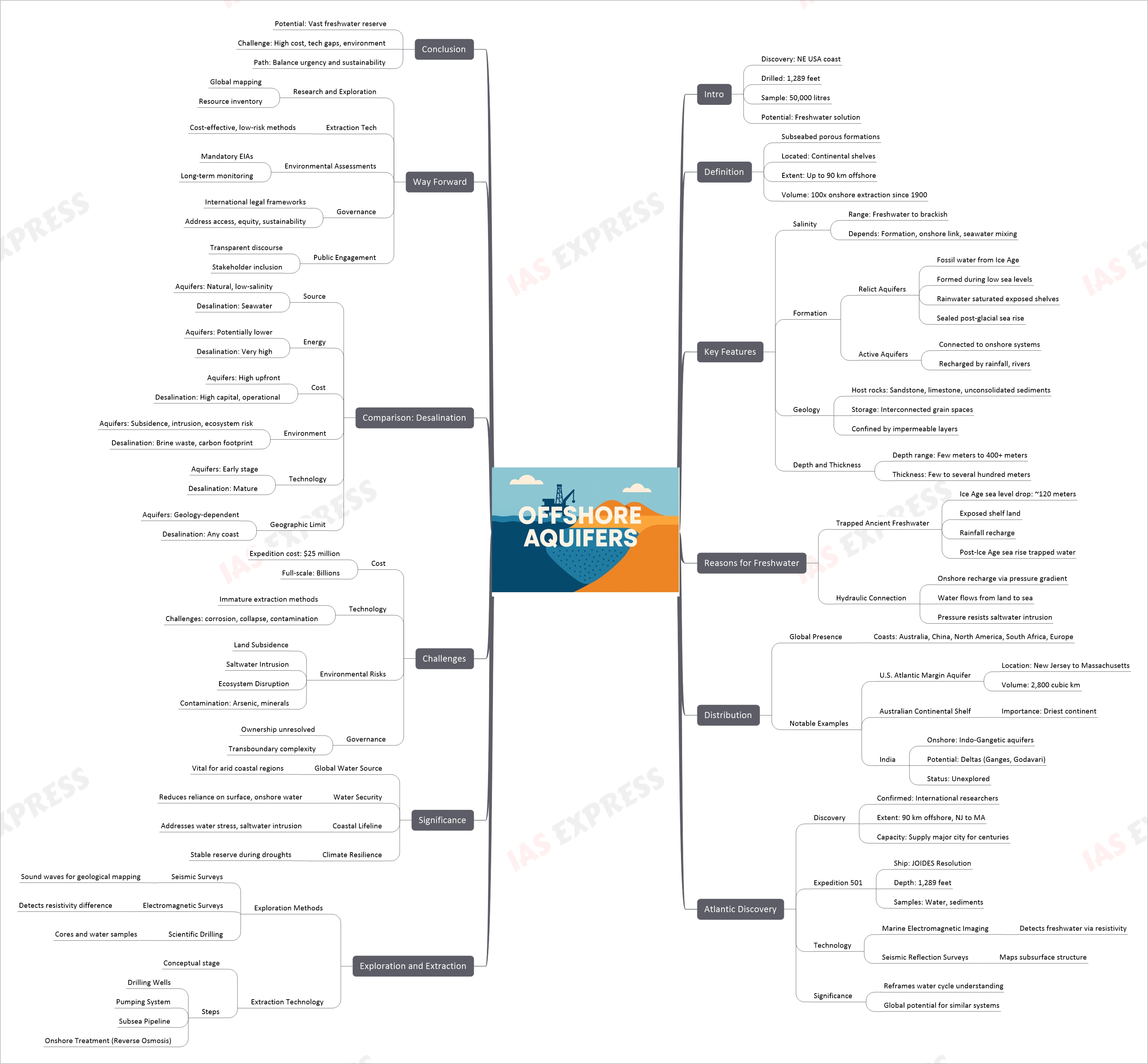
Nearly 50 years ago, a US government ship, which was originally looking for minerals and hydrocarbons, unexpectedly stumbled upon freshwater while drilling into the sea floor off the country’s northeastern coast. Now, a group of international scientists have followed up on the surprise discovery and confirmed the existence of a large aquifer — a body of porous rock or sediment saturated with freshwater — under the Atlantic Ocean, stretching from New Jersey to Maine. The scientists drilled for freshwater under the sea by as many as 1,289 feet and collected nearly 50,000 litres of it for analysis. This groundbreaking discovery has brought offshore aquifers into the limelight as a potential solution to the world’s growing water crisis, but their exploration and exploitation are fraught with challenges. This article delves into the world of these hidden freshwater reserves, exploring their nature, significance, and the future they hold for humanity.
What Exactly Are Offshore Aquifers and Their Key Features?
- Offshore aquifers are vast, underground layers of water-holding permeable rock, fractured rock, or unconsolidated materials like gravel, sand, or silt that are located deep beneath the seabed on continental shelves.
- Think of them as underground sponges, extending from the coastline far out under the ocean.
- These formations are not small; some can stretch for immense distances, with confirmed systems extending up to 90 kilometers from the coast.
- The global volume of water held in these aquifers is estimated to be enormous, potentially holding 100 times the amount of water that has been extracted from all onshore aquifers since 1900.
- These unique geological formations have several key features:
- Salinity: The water quality within offshore aquifers varies significantly.
- It is generally defined as “freshened,” meaning it has a lower salt content than seawater. The water can range from nearly pure freshwater to brackish water that is less salty than the ocean.
- This variation in salinity depends on how the aquifer was formed, its connection to onshore freshwater systems, and how much mixing has occurred with the surrounding seawater over millennia.
- Formation: Geologists believe these massive underwater reservoirs were created through two primary mechanisms.
- Relict Aquifers: These are the most common type and are essentially “fossil water” reserves.
- They formed thousands of years ago during past ice ages when global sea levels were much lower.
- Vast areas of the continental shelf were exposed as dry land, and rainfall seeped into the ground, saturating porous rock layers.
- When the ice age ended and glaciers melted, rising sea levels submerged these land areas, trapping the ancient freshwater beneath layers of sediment and the ocean itself.
- Active Aquifers: Some offshore aquifers are still connected to their onshore counterparts.
- They function as extensions of land-based groundwater systems and are actively replenished by rainfall and rivers that feed the onshore aquifers.
- Relict Aquifers: These are the most common type and are essentially “fossil water” reserves.
- Geology: The structure of these aquifers is crucial for their ability to hold water.
- They are typically found in porous and permeable sedimentary rocks such as sandstone, limestone, and other unconsolidated sediments.
- These rock types have interconnected spaces between their grains, allowing them to store and transmit large quantities of water. Many are confined by overlying layers of less permeable material like clay, which acts as a protective cap.
- Depth and Thickness: The scale of these systems is impressive.
- Offshore aquifers can be found at a wide range of depths, from just a few dozen meters to over 400 meters below the seafloor.
- The thickness of the water-bearing layer itself can also vary dramatically, from a few meters to several hundred meters thick, indicating a substantial volume of stored water.
- Salinity: The water quality within offshore aquifers varies significantly.
Why Do These Undersea Aquifers Contain Fresh Water?
- Trapped Ancient Freshwater:
- The primary reason is historical geology. Many offshore aquifers are holders of ancient, or “fossil,” water that is tens of thousands of years old.
- During the last major ice age, a significant portion of Earth’s water was frozen in massive glaciers. This caused the global sea level to drop by approximately 120 meters compared to today.
- This dramatic drop exposed vast tracts of the continental shelf, turning them into exposed land.
- Rain fell on these exposed plains, and this freshwater percolated deep into the ground, filling up the porous rock formations and creating enormous aquifers.
- As the ice age concluded, the glaciers melted, and sea levels rose again. The ocean gradually submerged these freshwater-filled aquifers, and layers of marine sediment deposited on top acted as a seal, trapping the freshwater beneath the salty ocean above.
- The primary reason is historical geology. Many offshore aquifers are holders of ancient, or “fossil,” water that is tens of thousands of years old.
- Hydraulic Connection to Onshore Systems:
- Not all offshore aquifers are isolated relics of the past; some are dynamic, active systems.
- These aquifers remain hydrologically connected to freshwater sources on land.
- They are constantly, albeit slowly, recharged by rainfall and river water that seeps into the ground onshore.
- This freshwater then migrates underground, flowing from the higher-pressure onshore areas towards the lower-pressure offshore environment, extending the freshwater lens out beneath the sea.
- A continuous pressure gradient from the landward side helps to push back against the denser seawater, preventing it from intruding and contaminating the freshwater within the aquifer.
- Not all offshore aquifers are isolated relics of the past; some are dynamic, active systems.
Where In The World Have Offshore Aquifers Been Found?
- Global Distribution:
- The discovery of offshore aquifers is a global phenomenon, indicating they are a widespread feature of continental shelves around the world. They have been documented off the coasts of:
- Australia
- China
- North America
- South Africa
- Parts of Europe
- The discovery of offshore aquifers is a global phenomenon, indicating they are a widespread feature of continental shelves around the world. They have been documented off the coasts of:
- Notable International Examples:
- The U.S. Atlantic Margin Aquifer: This is the most recently and comprehensively studied example.
- Confirmed by a major drilling expedition, this massive aquifer system stretches from New Jersey up to Massachusetts.
- It is estimated to hold at least 2,800 cubic kilometers of low-salinity water, making it a globally significant freshwater reserve comparable in volume to the famous Ogallala Aquifer on land.
- Australian Continental Shelf: As the driest inhabited continent, Australia has a profound interest in these resources.
- Geophysical studies have suggested the presence of immense offshore freshwater systems that could be critical for the future water security of its coastal population centers.
- The U.S. Atlantic Margin Aquifer: This is the most recently and comprehensively studied example.
- Potential for Offshore Aquifers in India:
- India is known for its extensive onshore aquifer systems, such as the vast alluvial aquifers of the Indo-Gangetic Plain, which are a lifeline for agriculture and drinking water.
- However, there is very little publicly available information regarding specific exploration for offshore aquifers along India’s extensive 7,500-kilometer coastline.
- Given the geology of India’s continental shelves, particularly near large river deltas like the Ganges-Brahmaputra and Godavari, the potential for such aquifers to exist is theoretically high and presents a significant area for future scientific investigation.
What Is the Story Behind the Recent Atlantic Aquifer Discovery?
- The Groundbreaking Discovery:
- In what is being called a landmark scientific achievement, a team of international researchers confirmed the existence of a truly colossal aquifer system beneath the Atlantic Ocean.
- This system is not just a small pocket but a continuous formation extending approximately 90 kilometers out from the coastline and running from New Jersey to Massachusetts.
- Initial estimates suggest the aquifer holds enough low-salinity water to potentially supply a major metropolis like New York City for several centuries.
- The Scientific Expedition:
- The confirmation was the primary goal of a dedicated scientific mission known as Expedition 501.
- Using the advanced research vessel JOIDES Resolution, scientists drilled multiple cores into the seabed at various locations across the suspected aquifer zone.
- They penetrated the earth below the sea by as much as 1,289 feet and successfully extracted thousands of water and sediment samples for detailed onboard and shoreside analysis, which confirmed the presence and low salinity of the water.
- The Technology That Made It Possible:
- This discovery was heavily reliant on cutting-edge geophysical methods.
- Marine Electromagnetic Imaging: This was a key technology. It works by towing a sensor array along the seafloor that emits an electromagnetic field and measures the electrical resistivity of the subsurface. Because freshwater is far less electrically conductive than saltwater, the aquifer shows up as a clear, high-resistivity anomaly.
- Seismic Reflection Surveys: Complementing the electromagnetic data, seismic surveys were used to map the geological architecture of the seabed. By sending sound waves into the earth and reading the echoes, scientists could visualize the layers of sediment and rock, identifying the porous formations likely to contain water.
- This discovery was heavily reliant on cutting-edge geophysical methods.
- The Wider Significance of This Finding:
- This discovery fundamentally changes our understanding of the global water cycle and opens up a new frontier in the search for freshwater.
- It provides strong evidence that similar large-scale offshore aquifers may exist off the coasts of other continents, offering a potential new resource for water-stressed regions worldwide.
How Can We Explore and Extract This Underwater Resource?
- Methods of Exploration:
- Seismic Surveys:
- This is a foundational technique borrowed from the oil and gas industry. It uses compressed air to create powerful sound waves that travel through the water and into the seabed.
- Sensors capture the reflected waves, which are then processed by computers to create a detailed 2D or 3D map of the subsurface geological layers, revealing structures that could host an aquifer.
- Electromagnetic (EM) Surveys:
- This method is particularly powerful for directly detecting freshwater. It measures the electrical resistance of the sub-seafloor materials.
- Since saltwater is a very good conductor of electricity (low resistance) and freshwater is a poor conductor (high resistance), EM surveys can effectively map the size and shape of a low-salinity aquifer.
- Scientific Drilling and Sampling:
- While geophysical surveys can indicate the presence of an aquifer, the only way to be certain and to test the water quality is through direct drilling.
- This involves using specialized ships to drill deep into the seabed to collect physical cores of sediment and samples of the water itself. However, offshore drilling is a logistically complex and very expensive process.
- Seismic Surveys:
- Potential Extraction Technology:
- The technology for drawing water from offshore aquifers is still largely conceptual and has not been implemented on a commercial scale. However, it would likely adapt technology from the offshore oil and gas industry.
- A plausible scenario would involve several key steps:
- Drilling Wells: An offshore platform or a specialized barge would be used to drill a production well directly into the aquifer.
- Pumping System: Submersible pumps would be installed within the well to lift the water to the seafloor infrastructure.
- Subsea Pipeline: A pipeline would be laid on the seafloor to transport the extracted water from the wellhead to a processing facility on the coast.
- Onshore Treatment: Before the water could be used, it would need to be treated. Even low-salinity water might require some level of desalination through processes like reverse osmosis to meet drinking water standards.
What Is the Significance of Offshore Aquifers for Humanity?
- A Potential New Global Water Source:
- As the world’s population continues to grow and climate change puts increasing pressure on traditional freshwater supplies, offshore aquifers represent a vast, untapped resource.
- They could prove to be especially vital for arid and semi-arid coastal regions, such as those in the Middle East, Australia, and parts of Africa and the Americas, that are already facing extreme water stress.
- Boosting Water Security and Resilience:
- Diversifying water sources is a key principle of modern water management. By adding offshore aquifers to the mix, nations can reduce their over-reliance on surface water (rivers, lakes) and onshore groundwater, which are often over-exploited and vulnerable to drought.
- A Lifeline for Coastal Populations:
- A significant portion of the global population lives in coastal zones. These communities are on the front lines of water scarcity and saltwater intrusion into their existing wells. Offshore aquifers could offer a nearby, reliable, and long-term water supply.
- A Buffer Against Climate Change Impacts:
- Unlike rivers and reservoirs that are directly affected by seasonal rainfall and drought, large offshore aquifers are insulated from short-term climatic shifts. They could serve as a strategic reserve, providing a stable water supply during prolonged periods of drought.
What Are the Major Limitations and Challenges Involved?
- Prohibitively High Costs:
- The financial barrier is immense. Both exploration and extraction are exceptionally expensive endeavors.
- For example, the recent scientific expedition to drill into the Atlantic aquifer cost around $25 million. A full-scale production project, including platforms, pipelines, and treatment plants, would cost billions.
- Significant Technological Hurdles:
- The technology for safe and efficient extraction is still in its infancy.
- Engineers face numerous challenges, such as designing robust wells and pumps that can operate for decades in a corrosive deep-sea environment and ensuring that pumping does not cause the aquifer to collapse or become contaminated.
- Serious Environmental Risks:
- Exploiting these aquifers is not without environmental consequences.
- Land Subsidence: Large-scale withdrawal of underground water can cause the overlying land and seabed to compact and sink.
- Saltwater Intrusion: Over-pumping could lower the pressure within the aquifer, allowing surrounding saltwater to seep in and contaminate the remaining freshwater, potentially rendering the entire resource unusable.
- Ecosystem Disruption: Many marine ecosystems may rely on the slow, natural seepage of nutrients and freshwater from these aquifers into the ocean. Disrupting this flow could have unforeseen negative impacts on marine life and local fisheries.
- Contamination Risk: The water may contain minerals or elements like arsenic that are detrimental to human health, having percolated through various rock layers.
- Exploiting these aquifers is not without environmental consequences.
- Complex Ownership and Governance Issues:
- A major unresolved question is: who owns these underwater resources?
- Offshore aquifers can extend across state or even international boundaries, creating a complex web of legal and political challenges regarding rights, access, regulation, and sustainable management.
How Do Offshore Aquifers Compare to Desalination?
| Feature | Offshore Aquifers | Desalination |
|---|---|---|
| Source of Water | Naturally stored, low-salinity or freshwater from underground reservoirs. | Unlimited supply of high-salinity seawater from the open ocean. |
| Energy Consumption | Potentially lower. Energy is needed for pumping, but less may be needed for purification if the water is fresh. | Very high. The process of reverse osmosis to remove salt from seawater is extremely energy-intensive. |
| Overall Cost | High upfront cost for exploration and drilling, but potentially lower operational cost than full desalination. | High capital cost for plants and very high operational costs due to energy consumption. |
| Environmental Impact | Risks include seabed subsidence, saltwater contamination of the aquifer, and disruption of marine ecosystems. | Main impacts are the disposal of highly concentrated brine waste, which harms marine life, and high carbon footprint from energy use. |
| Technology Status | Still in the early developmental and conceptual stages. | A mature, widely deployed, and well-understood technology. |
| Geographic Limit | Resource is only available in specific geological locations where such aquifers exist. | Can be implemented along any coastline with access to seawater and energy. |
What Is the Recommended Way Forward for This Field?
- Invest in Further Research and Exploration:
- A global effort is needed to map the world’s continental shelves using advanced geophysical techniques to identify and quantify offshore aquifers.
- This would create a global inventory of these potential resources.
- Advance Extraction Technology:
- Research and development should focus on creating cost-effective, energy-efficient, and environmentally benign technologies for water extraction.
- Innovation is needed to minimize the risks of subsidence and contamination.
- Mandate Thorough Environmental Impact Assessments (EIAs):
- Before any large-scale extraction project is approved, a comprehensive EIA must be conducted to understand the potential impacts on the marine environment and the aquifer itself.
- This must include long-term monitoring plans.
- Establish International Cooperation and Governance Frameworks:
- The international community must work together to develop clear legal frameworks and treaties for managing transboundary offshore aquifers.
- These frameworks should address issues of ownership, equitable access, benefit-sharing, and long-term sustainability to prevent a “race to the bottom.”
- Promote Public Awareness and Stakeholder Engagement:
- It is crucial to have an open and transparent public discourse about the potential benefits and inherent risks of exploiting offshore aquifers.
- Local communities, environmental groups, and industries must be included in the decision-making process to ensure that any development is responsible and equitable.
Conclusion
Offshore aquifers represent a vast and largely unexplored frontier in our global search for freshwater. The stunning discovery of the massive aquifer under the Atlantic Ocean has ignited immense excitement and hope for a future with greater water security. However, the journey from discovery to consumption is long and fraught with formidable challenges, including prohibitive costs, unsolved technological puzzles, and serious environmental risks. While the promise of tapping into these hidden oceans of freshwater is undeniably alluring, we must proceed with extreme caution and foresight. The future of these resources hinges on our collective ability to balance the urgent need for water with the profound responsibility to protect our planet’s fragile marine ecosystems and ensure these resources are managed sustainably for generations to come.
Q. Critically analyze the potential of offshore aquifers as a sustainable solution to India’s water crisis, considering the economic, environmental, and geopolitical challenges involved. (250 words)
Related Posts

If you like this post, please share your feedback in the comments section below so that we will upload more posts like this.

Responses