
In the aftermath of World War II, a transformative shift unfolded in global politics. As former colonies in Asia, Africa, and elsewhere gained independence, they sought an independent path amidst the Cold War rivalry between superpowers. This gave rise to the concept of a Third World – nations neither aligned with the Western bloc nor the Soviet bloc – and the policy of Non-Alignment. The Non-Aligned Movement (NAM) emerged as a collective voice for these countries, championing sovereignty, equality, and development. This long-form exploration examines the world after WWII by tracing the emergence of the Third World, the founding of NAM, its principles, challenges, achievements, and enduring legacy.

Post-WWII Geopolitical Landscape
- Bipolar World Order: In the late 1940s, the global power structure coalesced around two rival superpowers:
- The United States led the capitalist First World, forming alliances like NATO and promoting democracy and free-market economics.
- The Soviet Union led the communist Second World, creating the Warsaw Pact and spreading socialist ideology.
- These two blocs engaged in an intense Cold War competition for global influence, dividing Europe and extending rivalries into other regions.
- Decolonization Pressures: Simultaneously, European colonial empires weakened:
- World War II had drained European powers (Britain, France, etc.), undermining their capacity to hold colonies.
- Colonial subjects, many of whom fought in the war, grew more conscious of ideals of freedom and self-rule.
- An upsurge in anti-colonial movements across Asia and Africa signaled that the era of colonialism was ending.
- Ideological Battlegrounds: Newly independent regions became strategic battlegrounds:
- Both superpowers sought allies in Asia, Africa, Latin America, offering economic aid or military support to win governments to their side.
- The Cold War turned global, as conflicts in Korea, Vietnam, Middle East, and Africa were fueled by superpower proxy interventions.
- For emerging nations, aligning with one bloc risked loss of autonomy, yet remaining neutral was challenging amid external pressures.
- United Nations and Global Governance: The United Nations (established 1945) provided a new international forum:
- Initially dominated by the victors of WWII and colonial powers, the UN’s character began to change as more independent states joined.
- The UN became a platform where smaller nations could voice concerns about colonialism, racial equality (e.g., apartheid in South Africa), and global peace.
- Global institutions like the UN, World Bank, and IMF were largely influenced by First World interests, prompting calls for reforms by new entrants.
- Nuclear Arms and Non-Great Powers: The dawn of the nuclear age (U.S. atomic bomb in 1945, Soviet bomb in 1949) raised existential threats:
- Superpower arms race and brinkmanship (e.g., Cuban Missile Crisis) worried other countries, which feared being pawns or battlefields in a nuclear showdown.
- Many emerging nations advocated for disarmament and peace, laying groundwork for later Third World solidarity against nuclear proliferation.
- Diverging Development Paths: The First and Second Worlds focused on their rivalry and rebuilding:
- The First World experienced post-war economic booms (e.g., the Marshall Plan rebuilt Western Europe, Japan’s rapid growth), leading to unprecedented prosperity and technological advancement.
- The Second World saw rapid industrialization in the Soviet Union and Eastern Europe under state socialism, albeit at high human and economic costs.
- In contrast, much of the rest of the world faced underdevelopment, poverty, and the task of building nations from the ground up, setting the stage for a distinct Third World identity.
Decolonization and the Birth of New Nations
- Collapse of Colonial Empires: Between 1945 and the 1960s, dozens of colonies gained independence:
- Asia: India and Pakistan’s independence in 1947 signaled the end of British rule in South Asia; by the mid-1950s, nations like Indonesia (from the Dutch, 1949), Vietnam (from the French, 1954) and Malaysia (1963) emerged.
- Middle East: Former mandates like Syria (1946), Jordan (1946), and Israel (1948) became independent states as European influence receded.
- Africa: A dramatic wave of decolonization occurred, especially around 1960 – often called “The Year of Africa,” when 17 African countries declared independence (from former British, French, and Belgian rule). By the mid-1960s, Ghana, Nigeria, Senegal, Kenya, and many others had shed colonial rule.
- Caribbean & Oceania: European colonies in the Caribbean (Jamaica, Trinidad in 1962) and Pacific (Fiji in 1970, others later) also attained nationhood in this period.
- Nationalist Movements: Liberation was driven by strong nationalist and anti-imperialist movements:
- Indigenous leaders such as Kwame Nkrumah in Ghana, Sukarno in Indonesia, Ho Chi Minh in Vietnam, Gamal Abdel Nasser in Egypt, and others mobilized mass support for independence.
- These movements were often inspired by principles of self-determination and were fueled by war-weary populations unwilling to return to colonial subjugation.
- Colonial powers, exhausted from WWII, often lacked the will or resources to fight protracted colonial wars (though some attempted – e.g., France in Indochina and Algeria – but ultimately conceded defeat).
- Emergence of New States: The world map was redrawn as new states proliferated:
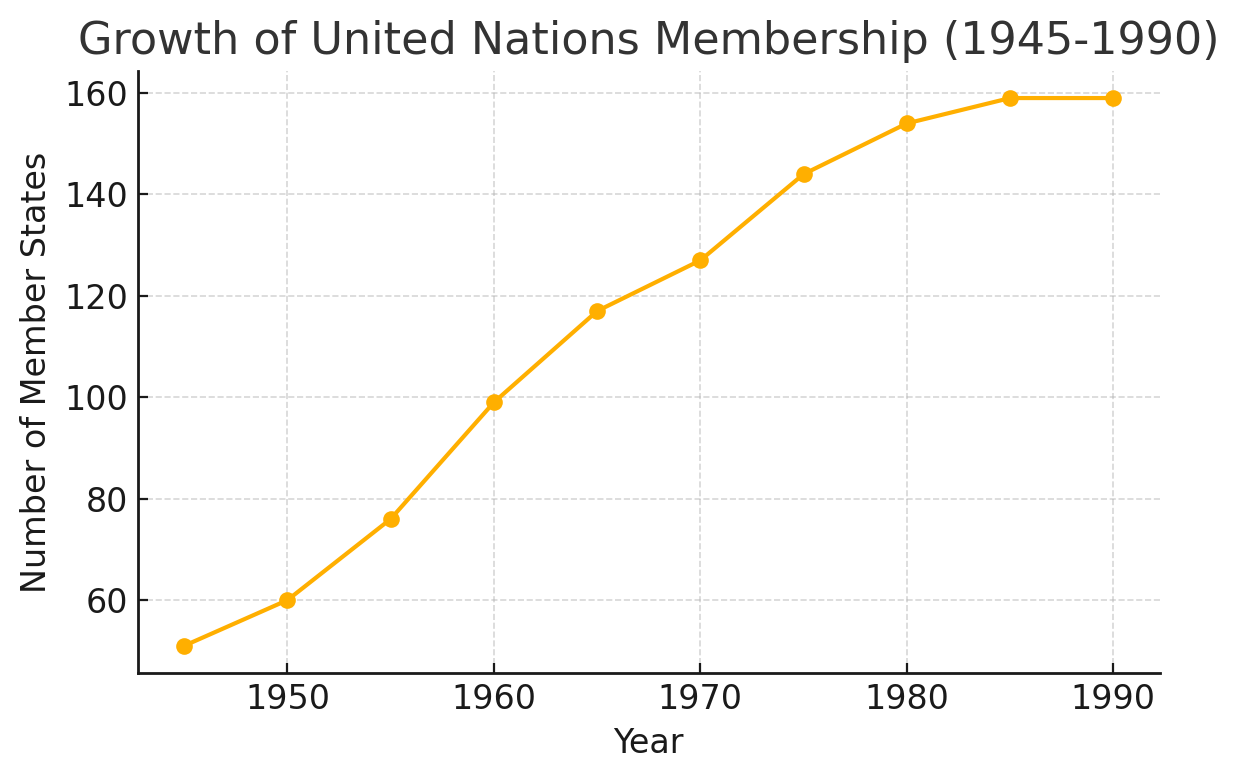
- United Nations Growth: The number of UN member states expanded rapidly, reflecting newly sovereign countries joining the international community.
- Immediate Challenges: Newly independent states faced enormous challenges – from drawing national boundaries and establishing governance structures to economic underdevelopment and illiteracy left by colonial neglect.
- Many had to craft constitutions, hold elections, and manage ethnic or religious diversity often arbitrarily grouped under colonial boundaries.
- Superpower Reactions: The US and USSR viewed decolonization through the prism of the Cold War:
- The United States often supported decolonization rhetorically (positioning itself as anti-imperial, given its own history) but was wary of movements perceived as communist-inspired.
- The Soviet Union framed anti-colonial struggles as part of a global proletarian revolution, offering support to left-leaning liberation movements and newly socialist states.
- Both tried to win influence: e.g., the US via economic aid (Point Four Program, later USAID), the USSR via military aid or ideological training for revolutionary leaders.
- Non-Colonized but Newly Free: A few countries not colonized in the classical sense also aligned with Third World aspirations:
- China, though not a European colony (except parts like Hong Kong/Macau), emerged from Japanese occupation and civil war in 1949 as the People’s Republic of China. It saw itself as part of the anti-imperialist camp, championing Third World unity despite not joining NAM.
- Ethiopia and Thailand, never fully colonized, and Iran, Turkey (former imperial states themselves), identified with the developing world’s struggles in certain contexts.
- Regional Blocs: Newly independent nations sometimes grouped regionally:
- In Africa, the formation of the Organisation of African Unity (OAU) in 1963 aimed to foster solidarity among African states, assist liberation of remaining colonies (like Rhodesia, Angola, Mozambique), and resist neo-colonial interference.
- In the Arab world, Pan-Arabism promoted by leaders like Nasser sought unity and a bloc that could resist both Western and Soviet meddling, culminating in experiments like the short-lived United Arab Republic (Egypt-Syria union, 1958-61).
- In Southeast Asia, initiatives like the Association of Southeast Asia (ASA) and later ASEAN (1967) were driven partly by the desire for collective self-reliance and neutrality in the Cold War context.
- Initial Third World Solidarity: Even before formal movement, newly independent countries showed solidarity:
- They often supported each other’s admission to the UN and defended fellow ex-colonies’ rights in international forums.
- For example, Asian and Arab states strongly backed African independence movements in the UN General Assembly, contributing to diplomatic pressure on colonial powers.
- Diplomatic Recognition: Third World countries recognized revolutionary governments (like the FLN in Algeria before France relinquished control) to lend legitimacy to anti-colonial causes.
The Three Worlds Concept: First, Second, and Third World
- Origin of the Term “Third World”: The phrase “Third World” (Tier Monde) was coined in the 1950s by French demographer Alfred Sauvy:
- It drew an analogy to the “Third Estate” of the French Revolution – representing the commoners – suggesting that just as the Third Estate opposed aristocratic privilege, the Third World stood apart from the two superpower “estates” of the East and West.
- Initially, “Third World” denoted countries not aligned with either the First World (U.S.-led capitalist bloc) or the Second World (Soviet-led communist bloc).
- Over time, it also came to imply nations that were mostly poor, agrarian, and developing, as opposed to the industrialized wealth of the First World or the industrial-socialist Second World.
- Characteristics of Third World Countries: Common features that grouped these nations:
- Colonial Legacy: Most had been subject to colonial rule or domination, emerging with artificial borders, economic structures geared towards export of raw materials, and social inequalities rooted in colonial policies.
- Economic Underdevelopment: They generally faced low per capita income, high levels of poverty and illiteracy, and reliance on agriculture or extraction. Industrialization was minimal or just beginning.
- Rapid Population Growth: Many Third World societies experienced high birth rates and growing populations, putting pressure on resources and development (e.g., India’s population soared past 350 million by 1950 and continued rising rapidly).
- Political Instability: With nascent political institutions, several faced internal ethnic or sectarian divisions and frequent changes of government (through coups or civil wars) in the initial decades of independence.
- Non-Alignment in Foreign Policy: Many preferred not to join formal military alliances of the superpowers, aiming to chart independent international courses and mediate East-West tensions.
- First World vs Second World vs Third World: The “Three Worlds” classification during the Cold War:
- First World: The wealthy, industrialized, capitalist countries – including Western Europe, North America, Japan, Australia/New Zealand – characterized by multi-party democracies (in most cases) and market economies.
- Second World: The communist states – the Soviet Union, Eastern European satellites, China (at least until the Sino-Soviet split put China somewhat outside the main Soviet bloc), North Korea, North Vietnam, Cuba, etc. – with state-controlled economies and single-party regimes.
- Third World: The remaining countries, primarily in Asia, Africa, Latin America, and the Middle East, many of which were newly independent. This group was not monolithic – it included varying political systems (democracies like India, monarchies like Ethiopia or Saudi Arabia, military regimes, socialist experiments like Tanzania’s ujamaa, etc.) – but they shared a relative lack of economic development and a desire to avoid domination by the superpower blocs.
- Notably, Latin American countries (mostly independent since the 19th century) were often included in Third World due to similar economic challenges and their stance against colonialism and neo-colonial influence, even though some (like Brazil, Mexico) were more economically advanced than newly decolonized African nations.
- Neutralism vs Alignment: Third World countries had to decide their foreign alignment:
- Some embraced neutralism, refusing to formally side with either bloc, while maintaining diplomatic and economic relations with both.
- Others leaned toward one camp while still claiming non-alignment – for instance, Egypt under Nasser received Soviet arms but did not join the Warsaw Pact, maintaining an independent stance; Pakistan initially joined U.S.-led alliances (SEATO, CENTO) and thus wasn’t non-aligned until later shifting stance.
- True Alignment: A minority of Third World states fully joined one camp (e.g., South Korea and Taiwan allied with the U.S., Cuba aligned with USSR after 1960). Such countries, despite being developing, weren’t considered non-aligned, though they were still part of the “Third World” in economic terms.
- Shared Aspirations: Despite diversity, Third World nations often identified common goals:
- Protecting sovereignty and newly gained political independence against any new form of domination.
- Pursuing economic development to close the gap with rich nations and overcome centuries of exploitation.
- Demanding racial equality and an end to policies like apartheid, given many Third World peoples had suffered racial discrimination under colonialism.
- Advocating for cultural respect and revival of indigenous identities that colonial powers had suppressed.
- Reforming the international system to be more equitable (e.g., fair trade terms, more aid and technology transfer to poor countries, more representation in global institutions).
- Numerical Dominance vs Economic Weakness: By sheer numbers, the Third World constituted the majority of humanity and states:
- Population: These countries collectively contained a large majority of the world’s population (over 60% by the 1970s). For example, populous nations like India, China, Indonesia, Brazil, Nigeria, and Bangladesh were all part of this demographic weight.
- Economic Share: In contrast, they produced only a small fraction of global economic output. The bulk of world GDP was concentrated in the industrialized First World (and to a lesser extent, the Second World).
- The imbalance was stark: many Third World nations exported raw commodities (cash crops, minerals) and imported expensive manufactured goods, perpetuating trade deficits and debt.

- Solidarity in Numbers: The demographic and political weight of the Third World began to translate into a force in international forums:
- Voting Power in UN: As their numbers grew, developing countries formed a majority in the UN General Assembly. They often voted together on issues like condemning colonialism, apartheid, or calling for economic changes, creating a “Third World bloc” that could pass resolutions despite opposition from Western nations (though Security Council vetoes could block enforcement).
- Collective Identity: Being labeled Third World became a badge of shared identity in the 1950s-60s, fostering unity across continents (e.g., an African country might feel closer ties with an Asian or Latin American Third World nation than with its former European ruler).
- Emergence of the Global South: Over time, terms like “Global South” or “developing world” also came into use, emphasizing the socio-economic commonalities of these countries. But during the Cold War, “Third World” remained the prevalent term framing their unique position in world affairs.
Early Steps Toward Non-Alignment (Bandung Conference, 1955)
- Asian-African Solidarity: Even before the formal creation of the Non-Aligned Movement, newly independent countries sought to cooperate:
- Leaders like Jawaharlal Nehru of India and Sukarno of Indonesia championed the idea of an alliance of independent nations that would stay clear of Cold War entanglements.
- There was a recognition that unity among post-colonial states could amplify their voices on the world stage and help resist pressures from both East and West.
- Bandung Conference (1955): A milestone in Third World cooperation occurred in April 1955 in Bandung, Indonesia:
- Participants: Delegations from 29 Asian and African countries (representing over half the world’s population at the time) attended. Key figures included Nehru (India), Sukarno (Indonesia), Nasser (Egypt), Zhou Enlai (China), U Nu (Burma), Prince Sihanouk (Cambodia), among others.
- Notably, China (though a communist power) participated, aligning with the conference’s anti-colonial spirit. Many Arab and African countries under colonial rule were not present but were discussed in spirit.
- Goals: The conference aimed to promote economic and cultural cooperation between Africa and Asia, oppose colonialism in any form, and assert the right of nations to not align with great power blocs.
- Spirit of Bandung: President Sukarno opened the conference by highlighting the common fight against colonialism and racism. The atmosphere was one of Afro-Asian unity and enthusiasm for shaping a new world order free from imperialism.
- Ten Principles of Bandung: The conference concluded with a communiqué outlining guiding principles for relations among Asian-African nations, which became foundational to the later NAM ethos. These principles (closely aligned with Panchsheel or “Five Principles of Peaceful Coexistence” earlier agreed by India and China in 1954) included:
- Respect for fundamental human rights and for the purposes and principles of the UN Charter.
- Respect for sovereignty and territorial integrity of all nations.
- Recognition of the equality of all races and nations, large and small.
- Abstention from intervention or interference in the internal affairs of other countries.
- Respect for each nation’s right to defend itself (individually or collectively, consistent with the UN Charter).
- Refraining from acts or threats of aggression or use of force against another state’s territorial integrity or political independence.
- Peaceful settlement of disputes through dialogue and international law.
- Promotion of mutual interests and cooperation among nations.
- Respect for justice and international obligations.
- (Additionally, consensus against colonial domination and racial segregation was strongly affirmed, even if not each spelled as a “principle,” it underpinned the spirit).
- Outcomes of Bandung:
- The conference showcased that countries of the “Global South” could come together across continental lines and share a common agenda, independent of Western or Soviet directions.
- It planted seeds for formal political cooperation: the idea emerged of holding regular conferences, which eventually led to the Non-Aligned Movement’s formation.
- Though no formal organization was created at Bandung, it set the stage by forging personal relationships between leaders and a sense of solidarity. For instance, Nehru, Nasser, Tito (who wasn’t at Bandung but engaged closely with Nehru afterward) began corresponding about a follow-up at a global level.
- Afro-Asian identity: Bandung inspired similar regional meetings (e.g., Afro-Asian People’s Solidarity Conference in Cairo, 1957) and gave confidence to colonies still under rule (like those in Africa) that they had international support.
- Neutralism vs Solidarity: The conference displayed nuances in approaches:
- Some nations like India and Indonesia were firmly neutralist, preaching complete non-alignment.
- Others like Egypt and Syria leaned toward the Soviet bloc in some matters (Egypt was buying arms from Czechoslovakia by 1955, breaking Western monopoly, while Syria had socialist ties), yet they subscribed to the principles of sovereign non-interference.
- China’s presence: Zhou Enlai reassured others that China did not seek to dominate smaller countries, easing fears of Chinese intentions. China’s inclusion showed that even a major communist power could find common cause with neutral nations in opposing Western imperialism.
- Impact on Superpowers: Bandung signaled to Washington and Moscow that a third force was rising:
- Western powers were concerned this might become an anti-Western coalition (some American officials saw it as a “communist influenced” gathering since China attended and many participants criticized Western colonialism).
- The Soviet Union officially welcomed anti-colonialism but was cautious of the group’s refusal to side with either bloc; however, Soviet media lauded the conference’s stand against imperialism.
- The non-aligned sentiment meant neither superpower could take the developing world’s allegiance for granted; they might have to compete by offering more favorable partnerships or risk pushing these countries further away.
- Role of Yugoslavia: A unique participant in early non-aligned initiatives was Yugoslavia (in Europe, but a socialist country outside the Soviet bloc after Tito’s split with Stalin in 1948):
- Marshal Josip Broz Tito, Yugoslavia’s president, found common cause with leaders of Asia and Africa, as his country too wanted to assert independence from the two power centers.
- Though not at Bandung (which was Afro-Asian), Yugoslavia became a bridge between Europe and the Third World, and Tito soon emerged as a key figure advocating for a formal Non-Aligned Movement alongside leaders like Nehru and Nasser.
- From Bandung to NAM: After Bandung, discussions intensified on creating a permanent forum:
- Bilateral meetings among Nehru, Tito, and Nasser in the late 1950s (e.g., the Brioni Meeting in Yugoslavia, 1956) further refined the concept of a Non-Aligned grouping.
- They agreed to convene a larger conference of heads of state from neutral and newly independent countries. This culminated in plans for the Belgrade summit of 1961, essentially the first Non-Aligned Movement conference.
Formation of the Non-Aligned Movement (1961)
- Belgrade Conference, 1961: The first official Conference of Heads of State or Government of Non-Aligned Countries took place in Belgrade, Yugoslavia from September 1-6, 1961:
- Founding Leaders: The initiative was spearheaded by five key figures often called the founding fathers of NAM:
- Josip Broz Tito – President of Yugoslavia (host).
- Jawaharlal Nehru – Prime Minister of India.
- Gamal Abdel Nasser – President of Egypt (then the United Arab Republic).
- Kwame Nkrumah – President of Ghana.
- Sukarno – President of Indonesia.
- These leaders, representing Europe (Yugoslavia), South Asia, the Arab world, Africa, and Southeast Asia respectively, symbolized the broad geographic coalition of the movement.
- Attendance: 25 countries participated as full members at Belgrade, with observers from several others. Notable attendees included heads of state like Haile Selassie of Ethiopia, Prince Abdallah of Morocco, and representatives from regions across the developing world.
- Latin America had minimal presence at the first summit (as many Latin nations were either aligned with the US or hesitant), but Cuba attended as an observer in 1961 and would fully join later.
- Criteria for Membership: Though not formally written as strict rules, informal criteria emerged such as:
- The country should follow an independent policy based on co-existence of states with different systems (i.e., tolerance of capitalism vs socialism).
- It should support national liberation movements (anti-colonial struggles) and not be a member of a multilateral military alliance linked to a superpower (this allowed members to have bilateral alliances or security arrangements, as long as they weren’t formally part of Cold War blocs like NATO or Warsaw Pact).
- In practice, some flexibility existed: for example, Cuba joined in 1961-64 period despite a tight relationship with the Soviet bloc, because it claimed non-alignment in principle.
- Founding Leaders: The initiative was spearheaded by five key figures often called the founding fathers of NAM:
- Objectives Declared at Belgrade:
- The delegates agreed that world peace could best be preserved by countries not aligning with either nuclear armed camp and instead urging negotiation and disarmament.
- They emphasized the sovereign equality of all nations and the right of peoples to self-determination (giving moral support to still-colonized places or those under foreign domination like Angola, Mozambique, Palestine, etc.).
- They voiced concern over neo-colonialism – control through economic or political means after political independence – warning that old colonial powers must not be allowed to retain undue influence.
- Socio-economic development was highlighted: the new movement recognized that political independence is incomplete without closing the gap in living standards; thus, cooperation among developing countries to share technical knowledge, trade, and aid each other was encouraged.
- It was agreed that regular meetings would continue to strengthen solidarity and coordinate positions on international issues.
- Cold War Response: The formation of NAM sent ripples through Cold War dynamics:
- Western skepticism: Many Western commentators were cynical, labeling NAM as pro-Soviet in disguise since it included socialist-leaning states and criticized Western imperialism. Western powers worried NAM could act as a large voting bloc against them in the UN and other forums.
- Soviet reaction: The USSR officially endorsed the aims of anti-colonialism and peace, seeing NAM as a buffer constraining Western actions. However, privately, Soviets were cautious because these countries refused to endorse Soviet leadership of the “progressive” camp and often condemned great-power actions on both sides (e.g., the Soviets were criticized by NAM for events like the invasion of Hungary in 1956 or later Czechoslovakia 1968, just as the U.S. was for interventions in Cuba 1961, Vietnam, etc.).
- US approach: The Kennedy administration, then in office, attempted outreach to newly independent states via aid and diplomacy (Alliances for Progress in Latin America, Peace Corps, etc.) to counter communist appeal, and tried to convince non-aligned nations that the U.S. supported their independence and development. The U.S. realized overt hostility to NAM could backfire, so it took a nuanced approach, engaging with key NAM leaders like Nehru on issues of common interest (like preventing war).
- Initial Impact: With NAM’s birth:
- The Third World now had an institutionalized forum to articulate common positions. This increased their bargaining power on global issues, since they could declare a stance as a collective representing a significant portion of humanity.
- Disarmament and Peace Initiatives: NAM became a vocal proponent of nuclear disarmament. In the 1960s, non-aligned voices were influential in pushing for treaties like the Partial Test Ban Treaty (1963) and later the Nuclear Non-Proliferation Treaty (1968) – although some NAM members (like India) had reservations about the NPT’s fairness, the general NAM stance was to prevent nuclear war and free the world of nuclear weapons.
- Decolonization support: NAM consistently put the remaining colonial issues at the forefront. For example, it condemned the apartheid regime in South Africa and the continued rule of Portugal in Angola and Mozambique, mobilizing international opinion and isolation of those regimes. At the UN, NAM countries were pivotal in expelling South Africa from the General Assembly in 1974 (symbolically, as a pressure tactic) and in recognizing the legitimacy of liberation movements.
- Institutional Development:
- NAM established the practice of Summit Conferences every few years (typically every 3 years in later decades). After Belgrade (1961), the next summits were Cairo (1964), Lusaka (Zambia, 1970), Algiers (1973), etc. These summits rotated among different continents, giving each region’s issues spotlight in turn.
- A Coordinating Bureau was set up at the UN in New York, so NAM members could consult each other regularly and present unified proposals in the UN framework.
- Decisions in NAM were made by consensus rather than voting, to maintain unity. The movement had (and still has) no formal constitution or permanent secretariat, making it a flexible, loose coalition rather than a rigid organization.
- Notable Early Members: Countries across various regions joined NAM during the 1960s:
- Asia: India, Burma (Myanmar), Ceylon (Sri Lanka), Indonesia, Cambodia, Afghanistan, Nepal, etc.
- Middle East: Egypt, Syria, Iraq (after 1958 revolution), Yemen.
- Africa: Ghana, Guinea, Mali, Ethiopia, Morocco, Sudan, and others by mid-60s.
- Europe: Yugoslavia (unique case as a European communist nation in NAM).
- Latin America: Cuba became the first Latin American NAM member (formally joining by the late 1960s; it hosted the 1979 summit later). Others in Latin America were slower to join; many Latin nations started participating in NAM more in the 1970s as the movement’s focus broadened to economic issues relevant to them.
- Membership Growth: The appeal of NAM grew as more nations attained independence or reconsidered their alignments:
- By the early 1970s, membership had more than doubled from the founding meeting, making NAM a sizeable coalition in global diplomacy.
- Some aligned countries even moved towards non-alignment: e.g., Pakistan left SEATO in 1972 and became active in NAM, seeking a more balanced foreign policy after earlier alliances didn’t fully serve its interests.
- Newly decolonized states from the Portuguese empire (Angola, Mozambique, etc. mid-1970s) and others like Bangladesh (1971) promptly joined NAM to assert their neutral stance.
- The growing numbers made NAM meetings almost parallel the UN General Assembly in representation, minus the Western and Soviet bloc countries.
Principles and Objectives of Non-Alignment
- Core Philosophy: Non-Alignment was not simply passive neutrality; it was an active stance:
- Independence in Decision-Making: The primary principle was that each nation should make its foreign policy decisions independently, based on its own national interest and moral principles, not dictated by Cold War loyalties.
- Peaceful Coexistence: NAM embraced the idea that countries of different ideologies and systems (capitalist, socialist, mixed economies, monarchies, etc.) could coexist peacefully. This was derived from Panchsheel (Five Principles) agreed by India and China in 1954: mutual respect for sovereignty, non-aggression, non-interference, equality and mutual benefit, and peaceful coexistence.
- Anti-Colonialism and Anti-Imperialism: A foundational objective was the complete eradication of colonial rule and opposition to new forms of imperialism. NAM countries pledged support to liberation movements still fighting for independence (e.g., in Southern Africa) and condemned imperialist military interventions (whether by Western powers in Vietnam and the Middle East or Soviet interventions in places like Hungary).
- National Sovereignty and Territorial Integrity: They affirmed that no bloc or big power should violate the sovereignty of another state. This extended to opposing foreign military bases on their soil (unless the host country freely consented without outside pressure).
- Struggle against Racism and Apartheid: Many Third World nations had populations of color who suffered under colonial racism. NAM took a strong moral stance against institutional racism, most prominently apartheid in South Africa and racial segregation elsewhere, calling for global action to isolate regimes practicing such policies.
- Social and Economic Justice: While NAM was a political movement, it recognized that political equality must be accompanied by efforts to reduce the huge economic disparities. The movement advocated for a New International Economic Order (NIEO) that would give developing countries a fairer share of global prosperity (more on this in later sections).
- Non-Alignment vs Neutrality:
- Neutrality traditionally meant not taking sides in a war (like Switzerland’s stance). Non-Alignment was broader – it applied in peace time as a guiding principle, not just in conflict. Non-aligned countries often engaged in international issues actively (mediating conflicts, offering troops to UN peacekeeping, etc.), rather than staying completely aloof.
- Non-alignment allowed moral positions: NAM members frequently criticized superpower actions they felt were wrong. For example, they could condemn colonial wars or invasions (like the U.S. war in Vietnam or the Soviet invasion of Afghanistan in 1979) – something a strictly “neutral” country might avoid doing. Thus, non-alignment was “active neutrality with principles.”
- Five Pillars (Panchsheel) Influence: The spirit of Panchsheel was reflected in NAM’s code:
- Respect for each country’s sovereignty and territorial integrity.
- Non-aggression pact: Countries should not attack each other.
- Non-interference in internal affairs: No attempts to destabilize or undermine other governments.
- Equality and mutual benefit: All nations, big or small, are equal; cooperation should be fair and advantageous to both sides.
- Peaceful coexistence: Ideological differences (capitalism vs socialism, democracy vs one-party rule, etc.) should not preclude states from having friendly relations.
- Ten Principles of Bandung reiterated: The Ten Principles agreed at Bandung (as listed in the previous section) were essentially adopted as guiding values for NAM. These became a moral compass for non-aligned states in international relations.
- Fidel Castro’s Formulation: At the 1979 NAM Summit in Havana, Cuba’s leader Fidel Castro summarized the purpose of NAM eloquently (often quoted since):
- He described it as ensuring “the national independence, sovereignty, territorial integrity and security of non-aligned countries” in their struggle against “imperialism, colonialism, neo-colonialism, racism, and all forms of foreign aggression, occupation, domination, interference or hegemony, as well as against great power and bloc politics.”
- This encapsulates NAM’s comprehensive anti-hegemonic agenda – opposing domination whether political, military, or economic.
- Positive Neutralism: Another term used by some NAM leaders (like Nehru) was “positive neutralism” or “dynamic neutralism”:
- “Positive” in the sense that these nations were not just passively standing aside, but actively engaging to reduce tensions and promote an alternative vision of world order based on justice and peace.
- Examples include offering mediation: India, for instance, mediated between the U.S. and China to defuse crises in the 1950s and 60s, and Ghana attempted to mediate in the Vietnam conflict early on.
- Collective Self-Reliance: NAM promoted the idea of Third World countries helping each other to reduce dependence on the superpowers:
- This meant sharing technical expertise, trading among themselves on favorable terms (often called South-South cooperation today), and even pooling resources for development projects.
- There were calls to create institutions like a common bank for developing countries or joint ventures that bypass First World dominance. (The success of these ideas was limited, but it set a precedent for later initiatives like the BRICS Bank much later).
- Cultural Non-Alignment: Beyond politics and economics, NAM implicitly encouraged cultural independence:
- Newly independent societies sought to reclaim their cultural heritage, languages, and traditions that colonial powers had often repressed. There was a renaissance of traditional art, literature, and values in many Third World countries during the 1960s-70s.
- The concept of non-alignment extended to resisting cultural imperialism – for instance, promoting education systems and media that reflected indigenous perspectives rather than just Western curricula.
- No Formal Alliance: Importantly, NAM itself was not a military alliance or even a binding treaty-based group:
- There were no collective defense commitments (unlike NATO or Warsaw Pact). If a NAM country was attacked, others had sympathy but no treaty obligation to defend it.
- This was intentional to keep the movement flexible and inclusive (countries with very different security policies could all join as long as they weren’t in a superpower bloc).
- It did, however, mean that NAM’s strength was moral and diplomatic rather than military – the movement wielded influence through numbers and persuasion, not through an army or hard power.
- Permanent Interests, Not Permanent Enemies: Non-alignment allowed countries to pursue pragmatic interests without permanent enmity:
- NAM members often emphasized they were “friends to all, enemies to none.” For example, India maintained cordial relations with both the US and USSR; Egypt under Nasser took aid from both sides at different times (World Bank funds for the Aswan Dam initially, then Soviet assistance after the West pulled out).
- Non-alignment meant freedom to trade and interact globally – many NAM nations gladly accepted development loans or infrastructure projects from the West, the East, or any source as long as it didn’t force a compromise in their political independence.
- However, they stayed vigilant against strings-attached aid that could become a lever of control, hence preferring diversification of partnerships.
- Principle of Universality: NAM espoused that peace and progress were indivisible:
- They often declared that world peace was not secure until all regions were free of conflict and all peoples free of subjugation. This connected struggles worldwide; for instance, NAM leaders argued that as long as apartheid or colonialism existed anywhere, justice everywhere was at risk.
- It reinforced the idea that Third World issues (like poverty or regional wars) were of global concern, not to be dismissed as peripheral by superpowers.
- Independence in Group: Interestingly, even within the movement, members maintained independence:
- NAM had no binding vote, so if consensus could not be reached on an issue, it would avoid taking a position rather than force members. Each nation’s sovereign decision was respected.
- This allowed countries with opposing views (e.g., India and Pakistan, or Iran and Iraq) to both be NAM members despite bilateral conflicts, because NAM would not intervene in disputes between members except to urge peaceful resolution.
The Third World in Cold War Politics
- Navigating Superpower Rivalry: Third World nations became arenas of competition as well as significant actors in their own right during the Cold War:
- Aid as Influence: The US and USSR each tried to win friends by offering economic aid, military equipment, or trade deals. Third World leaders often played this to their advantage:
- Some like Nehru’s India or Nasser’s Egypt skillfully got assistance from both sides without committing to either, essentially leveraging competition (India received American food aid under PL-480 during 1950s famine relief, and also Soviet help in building steel plants).
- Others tilted strongly after initial courting – e.g., Cuba received Soviet military and economic support extensively after the US imposed sanctions post-1959 revolution.
- Military Alignments and Base Rights: While NAM countries refused formal alliance, some did allow limited military cooperation:
- The US established bases or access in some third world nations (e.g., Philippines, an aligned country hosting US bases; Ethiopia under Emperor Haile Selassie hosted a US communications base until the late 1970s despite Ethiopia being in NAM).
- The Soviets acquired naval access in places like Egypt (until 1972) and later in South Yemen, also sending Cuban troops (a NAM member) to support allied regimes like Angola’s MPLA government in 1975.
- Such activities often put NAM principles to test, raising debates within NAM about how far members could go without being considered “aligned.”
- Aid as Influence: The US and USSR each tried to win friends by offering economic aid, military equipment, or trade deals. Third World leaders often played this to their advantage:
- Proxy Wars in the Third World: Many Cold War conflicts were fought on Third World soil:
- Korean War (1950-53): Though before NAM’s creation, it set the tone – a war in Asia involving US-led UN forces and Chinese/communist forces in the Korean peninsula. It underscored the danger many Asian countries felt of superpower wars spilling into their lands.
- Vietnam War: A major Cold War proxy war in Asia (1960s-1975) – North Vietnam (backed by USSR/China) vs South Vietnam (backed by US). While Vietnam was not non-aligned (North was aligned with communist bloc, South with US), the war deeply impacted neighboring non-aligned countries:
- Cambodia and Laos, both NAM members, got drawn in and suffered internal conflicts as spillover.
- NAM as a whole opposed foreign intervention in Vietnam. Resolutions at NAM conferences called for peaceful settlement and criticized US bombing of North Vietnam.
- Arab-Israeli Wars: The Middle East saw repeated wars (1956 Suez Crisis, 1967 Six-Day War, 1973 Yom Kippur War) with superpower involvement:
- Egypt, Syria and other Arab states (mostly NAM members) fought Israel (supported by the US). The Soviets provided arms to Arabs, the US to Israel, making it a proxy confrontation.
- NAM’s stance generally supported Arab states’ position of ending Israeli occupation of Arab lands and advocated Palestinian self-determination. NAM condemned Western support for Israel, framing it partly as a legacy of colonial intrusion in the Middle East.
- However, NAM also maintained it desired a peaceful resolution and often called for international conferences under UN auspices to solve the conflict.
- African Conflicts: Many newly independent African countries became Cold War battlefields:
- Congo Crisis (1960-65): After Congo’s independence from Belgium, superpower-fueled chaos ensued – the elected leader Patrice Lumumba (non-aligned but leaning toward USSR for help) was assassinated with Western implication, leading to civil strife. The UN (with many NAM countries contributing peacekeepers) intervened to stabilize Congo. This episode showed third world countries caught in superpower proxy fights and the NAM members’ interest in neutralizing such conflicts.
- Angola (1975-2002): Upon independence from Portugal, rival factions turned civil war into a proxy fight – MPLA (Marxist, backed by Soviet/Cuba) vs UNITA (backed by US/South Africa). Angola was a NAM member with MPLA in power; Cuba (NAM member) sent troops at the MPLA’s request. This was controversial within NAM since it blurred non-alignment, but Cuba justified it as anti-imperialist solidarity. The war exemplified how Cold War rivalries could override NAM ideals on the ground.
- Ethiopia-Somalia (1977-78): A war between two NAM members where ideological alignments flipped – Somalia had Soviet support then expelled it and sought US aid, while Ethiopia went from US ally to Soviet ally. NAM tried to mediate but the Horn of Africa became another arena of superpower chess.
- Latin America: Many Latin American countries were in the US sphere, but Cuba’s communist revolution (1959) was a turning point. As a NAM member (joined in 1961), Cuba tried to export revolution in Latin America, which the US forcefully opposed:
- The Cuban Missile Crisis (1962) brought the world to nuclear brink when USSR placed nuclear missiles in Cuba. Cuba, though NAM, had allowed the Soviets in for its defense. After this crisis, Cuba remained aligned with USSR but still participated in NAM claiming the two were not incompatible since Cuba said it was not a pawn but an ally by choice.
- Several NAM summits underlined the principle that Latin America and other regions should be free of nuclear weapons (leading to treaties like the Treaty of Tlatelolco, 1967, making Latin America a nuclear-weapon-free zone – an idea NAM staunchly supported for all regions).
- Diplomatic Balancing Acts: Non-aligned nations found themselves mediating and moderating:
- India-Pakistan Conflicts: Both countries joined NAM (India from start, Pakistan in 1979). They fought wars in 1965 and 1971 despite both advocating non-alignment. NAM did not collectively intervene, but other non-aligned countries urged peaceful resolution. The 1971 war (Bangladesh’s independence) was awkward as India leaned on Soviet support, and several NAM nations diplomatically supported one side or the other. This highlighted how national interests could override NAM solidarity at times.
- Arab mediation: During Indo-Pak conflicts, countries like Egypt and Yugoslavia attempted to mediate or at least reduce the war of words, showing how NAM relationships created channels for dialogue.
- Middle East mediation: India and Yugoslavia, for instance, maintained good relations with both Arab countries and Israel initially, hoping to facilitate dialogue. However, after 1973, NAM took a more uniformly pro-Palestinian line as part of anti-imperialism.
- Global Issues: NAM collectively took stands in broader Cold War disputes – e.g., calling for a halt to the arms race, supporting the Helsinki Accords (1975) which advocated respect for borders and human rights (non-aligned Finland hosted it; NAM welcomed East-West détente moves).
- Influence in Multilateral Forums: With their numbers, NAM countries shaped many international agreements:
- Nuclear Non-Proliferation Treaty (NPT) 1968: While NAM pushed for disarmament, they were divided on NPT – some like Egypt, Turkey signed early; others like India refused because it perpetuated a monopoly of nuclear weapons by a few. NAM as a group insisted on the promise of eventual total disarmament and a fair deal on peaceful nuclear technology access, conditions which made many sign on later.
- UNCTAD and Trade: In the UN Conference on Trade and Development (created 1964 under pressure from developing countries), NAM members collectively demanded better terms of trade. They were instrumental in passing resolutions about preferential treatment for developing exports and stabilizing commodity prices.
- Law of the Sea (1982): NAM countries played a big role in negotiations for the UN Convention on the Law of the Sea, ensuring that ocean resources (like deep sea minerals) would be considered the “common heritage of mankind” rather than grabbed by the rich—reflecting the NAM ethos of global equity.
- Apartheid Isolation: NAM led drives to impose sanctions on South Africa and Rhodesia (Zimbabwe under white minority rule) – their lobbying at the UN and in international sports/cultural forums gradually turned world opinion, making those regimes pariahs.
- The China Factor: China, while not a NAM member, influenced Third World dynamics:
- In the 1960s, Sino-Soviet split created a “Three-way Cold War” in the Third World: US vs USSR vs China all courting influence. Some countries aligned or received aid from China as an alternative (e.g., Tanzania got Chinese help to build the Tan-Zam railroad in the 1970s as a statement of South-South cooperation).
- China presented itself as a leader of Third World as well, especially under Mao’s “Three Worlds Theory” (China considered US and USSR as First and Second worlds, itself and other developing nations as Third World). This ideological stance meant China often rhetorically supported NAM goals and sometimes voted with NAM countries in UN (after it took China’s seat in UN in 1971).
- However, China’s conflicts (like with India in 1962, or rivalry with Soviet Union for influence in Africa) at times undercut Third World unity. NAM had to carefully manage these big-power rifts – generally NAM didn’t involve itself in Sino-Soviet issues directly, focusing on decolonization and development instead.
- Maintaining Unity: Throughout Cold War crises, NAM tried to maintain an image of unity and relevance:
- They frequently reaffirmed that non-alignment was more needed than ever whenever a major world crisis occurred (like after the Soviet invasion of Afghanistan in 1979, NAM condemned it but also reiterated opposition to all foreign intervention, balancing criticism).
- Internal conflicts among members were kept off the official agenda to avoid fragmenting the movement (e.g., the Iran-Iraq war in the 1980s had both belligerents as NAM members, so NAM offered to mediate but avoided taking sides).
- The movement showed resilience – despite wars and ideological differences, no major member quit NAM out of dissatisfaction (in fact, membership kept growing). This suggested that even if NAM couldn’t prevent all conflicts, countries still valued the platform it provided.
Challenges Faced by Third World Nations
- Economic Underdevelopment: Perhaps the most fundamental challenge for Third World countries was to overcome poverty and build modern economies:
- Low Income and Poverty: At independence, most had very low per capita incomes (often under a few hundred USD per year in 1960s terms). A large percentage of their populations lived in rural areas, practicing subsistence agriculture. For example, in the 1960s, over 70% of Indians and Nigerians lived in villages with limited access to electricity, clean water, or healthcare.
- Lack of Industrialization: Colonial economies were geared toward exporting raw materials (minerals, cash crops like cocoa, coffee, cotton) and importing finished goods. After independence, these countries struggled to industrialize due to lack of capital, technology, and infrastructure. They often had to import machinery and expertise at great cost.
- Trade Disadvantages: Prices of primary commodities they exported were volatile and tended to decline relative to prices of manufactured goods they needed to import (the “declining terms of trade” problem). This meant they had to export increasing volumes just to afford the same imports, a vicious cycle keeping them poor.
- Debt Burdens: To finance development, many new states borrowed from international lenders. By the 1970s, debt burdens grew heavy, and servicing those debts took a large share of export earnings (some fell into debt crises by the 1980s, requiring painful adjustments).
- Population Pressure: Rapid population growth (often 2-3% per year) meant whatever economic growth occurred got partly offset by more mouths to feed. Governments had to spend scarce resources on basic services for a growing populace, making it hard to invest heavily in modernizing the economy.
- Political Instability and Governance Issues:
- New Institutions: Creating stable political institutions was difficult. Colonial powers had not prepared successor governments in many cases (or the structures left behind were weak and served colonial interests). New leaders had to establish constitutions, parliaments, and civil services often from scratch or with minimal trained personnel.
- Ethnic and Sectarian Divisions: Colonially drawn borders often grouped diverse ethnic or religious communities without regard for historical animosities or differences. Upon independence, these differences sometimes flared into conflict (e.g., the Nigerian Civil War 1967-70 between the federal government and the Igbo secessionists of Biafra; or constant coups in countries with divided societies).
- Civil Wars and Coups: Many Third World nations experienced coups d’état and military dictatorships, especially in the 1960s-1980s:
- Example: Coup Culture in Africa – By late 1970s, over half of African countries had experienced military coups. Leaders like Nkrumah (Ghana) and Nyerere (Tanzania) warned that neocolonial forces or internal power struggles could derail democracy.
- Latin America saw authoritarian regimes (often military juntas) take power in numerous countries (e.g., 1973 coup in Chile, various Central American conflicts), sometimes with superpower involvement.
- One-Party States: Some leaders instituted one-party rule or became “presidents for life,” arguing that unity and strong leadership were needed for development (e.g., Nkrumah in Ghana, Sukarno’s guided democracy in Indonesia, later Mobutu in Zaire). While this provided short-term stability, it also led to abuses of power and less accountability, fueling dissent in the long run.
- External Interference – Neo-Colonialism: Even after official independence, Third World countries often felt their sovereignty compromised by external economic or political interference:
- Economic Dependence: Former colonial powers retained control of key economic sectors in some countries through multinational corporations (for example, mining companies in copper-rich Zambia remained foreign-owned, repatriating profits abroad). This limited the benefits locals got from their own resources.
- Political Sway: Superpowers and former colonial nations sometimes influenced elections or backed certain politicians to safeguard their interests (such as the CIA’s involvement in the overthrow of Iran’s Premier Mossadegh in 1953 or in Congo’s politics in the 60s).
- Military Interventions: Some Third World regions faced direct military intervention by outside powers, violating their sovereignty:
- The Suez Crisis (1956) saw Britain and France militarily attack Egypt (with Israel’s help) to try to retake the Suez Canal after Nasser nationalized it – an act of old imperial gunboat policy that was thwarted by UN and superpower pressure. It nevertheless showed the readiness of colonial powers to use force even in the 1950s.
- Soviet interventions in Hungary (1956), Czechoslovakia (1968), and Afghanistan (1979) were denounced by NAM as great-power interference (though Hungary and Czechoslovakia were not third world countries, Afghanistan was).
- US interventions and coups, such as in Guatemala (1954), the Bay of Pigs invasion of Cuba (1961), or later interventions in the Dominican Republic (1965) and Grenada (1983), underscored to NAM countries the threat of superpower violation of sovereignty in the name of anti-communism.
- Proxy Pressure: Some conflicts in Third World nations were stoked or prolonged by the rival blocs supplying arms (e.g., the prolonged civil war in Mozambique where apartheid South Africa backed rebels against the Marxist government that was supported by Soviet bloc).
- NAM constantly highlighted neo-colonial patterns, coining terms like “puppet regimes” for governments seen as installed by foreign powers and urging respect for true independence.
- Social Challenges:
- Education and Literacy: Colonial regimes often invested little in mass education for the native population. At independence, many countries had literacy rates below 20-30%. Building school systems and universities was an urgent but slow task. Lack of skilled workforce hampered state-building and development.
- Healthcare: High infant mortality, diseases like malaria, and low life expectancy plagued Third World populations. Governments needed aid and new policies to combat public health crises. For instance, sub-Saharan African nations, in their first decades, relied on foreign assistance to train doctors and fight endemic diseases.
- Unity in Diversity: Nation-building required forging a common national identity out of plural societies. Leaders like Julius Nyerere (Tanzania) emphasized national language (Swahili) to unify, while others like Nigeria had to alternate power between regions to keep balance. These internal nationhood projects were tough and made more complex by Cold War as internal dissent could be exploited by one bloc or the other.
- Environmental and Resource Issues: Though less highlighted at the time compared to today, many Third World countries faced resource exploitation and environmental degradation:
- Desertification, droughts (e.g., the Sahel drought in the 1970s caused famines in Mali, Niger, etc.), and floods could set back economies and create humanitarian crises. These countries had few resources to invest in mitigation or infrastructure to handle disasters.
- Some also faced depletion of valuable resources by foreign companies, leaving ecological damage (e.g., oil extraction in the Niger Delta causing pollution with little benefit to local communities).
- These concerns later fed into global discussions (like at the 1972 Stockholm Conference on the environment, where developing countries insisted that environmental action must coincide with development support).
- Security and Defense Dilemmas:
- Many new states inherited weak security apparatuses. They often had small armies and limited control over borders, making them susceptible to foreign incursions or internal rebellions.
- Acquiring modern weapons meant turning to superpowers or arms exporters, which sometimes dragged them into dependency. For example, buying Soviet tanks or American jets could come with political strings or at least large debts.
- Some NAM countries attempted to diversify arms sources (India famously mixed Soviet, British, French weaponry to avoid over-reliance on one supplier). Others started indigenous arms production on limited scales.
- The absence of a collective defense pact among Third World nations meant each was on its own to face aggression. Some regional defense attempts occurred (like the Arab coalition against Israel, or African mutual defense treaties) but these were often not effective or unified enough.
- Balancing Development and Defense: Third World governments faced a tough choice between spending on military vs development:
- External threats (neighbors’ disputes, internal insurgencies, or fear of regime change plots) compelled some to allocate large budgets to defense. For instance, countries like Pakistan and India, despite poverty, spent significant portions of their budget on military due to mutual conflict and security needs.
- This was a double-edged sword – while addressing immediate security, it diverted funds from schools, roads, and industry. NAM discussions frequently lamented the waste of resources on the arms race and called for disarmament precisely so that money could be redirected to development (“guns vs butter” debate).
- Ideological and External Political Pressures:
- Capitalism vs Socialism: Newly independent nations had to choose economic models. Some, like India, adopted a mixed-economy with five-year plans (influenced by socialist planning but retaining private sector) aiming to chart a middle path. Others like Cuba, Vietnam or Tanzania pursued socialist models of varying kinds (Cuba a Soviet-style command economy, Tanzania a unique African socialism). On the other hand, countries like Ivory Coast or Malaysia stuck closer to capitalist market frameworks.
- These choices often attracted or repelled foreign aid – the US was more generous to capitalist-oriented states, the USSR and China aided socialist experiments. But each model had pitfalls and none offered a quick fix to underdevelopment.
- Non-Aligned Unity vs Ideological Differences: There was diversity – at NAM summits, you had kings standing next to Marxist revolutionaries, liberal democrats alongside military rulers. Reconciling these internal differences was a challenge for coherence. The only way was keeping focus on common goals (anti-colonialism, development) rather than how each ran its domestic affairs.
Economic Solidarity and the Quest for Development
- UNCTAD and Group of 77: Frustrated by what they saw as unfair global trading conditions, developing countries banded together economically:
- In 1964, the United Nations Conference on Trade and Development (UNCTAD) was established largely due to pressure from Third World leaders like Raúl Prebisch (an Argentine economist). It was the first global forum to focus on North-South economic issues rather than East-West.
- That same year, Group of 77 (G-77) was formed at UNCTAD by 77 developing nations signing a joint statement. The G-77 became a coalition that would negotiate as one on economic matters in the UN, pressing for better terms of trade, more aid, and a say in international financial decisions. (Though called G-77, membership grew to over 120 countries later, overlapping heavily with NAM membership).
- Demands included stable and remunerative prices for commodity exports, preferential access for their goods to rich country markets, and regulation on activities of multinational corporations.
- New International Economic Order (NIEO): In the 1970s, buoyed by a more confident Third World (especially after some economic wins like the rise in oil prices), NAM countries collectively called for a sweeping restructuring of the global economy:
- At the 1973 Algiers NAM summit and 1974 UN General Assembly special session, developing countries pushed the concept of a NIEO.
- The NIEO declaration (1974) in the UNGA (passed by an overwhelming majority of developing states) outlined principles:
- Greater sovereign control over natural resources (including the right to nationalize foreign property with fair compensation).
- Better terms of trade and stabilizing commodity prices.
- More development assistance from wealthy nations, including technology transfer and debt relief.
- Reform of international financial institutions (like giving developing countries more voice in the IMF and World Bank, and possibly new institutions geared to their needs).
- It also implicitly encouraged South-South cooperation (trade among developing countries) to reduce reliance on the North.
- While the NIEO was more a statement of aspiration and did not fully materialize, it marked the high point of Third World economic solidarity and set a tone for North-South dialogue in that decade.
- OPEC and Resource Power: A striking example of Third World countries leveraging collective power was OPEC (Organization of Petroleum Exporting Countries):
- Though not a NAM initiative per se, OPEC’s membership included many NAM or developing nations (Middle Eastern and Latin American oil producers).
- In 1973, OPEC’s Arab members used the “oil weapon” during the Yom Kippur War by imposing an oil embargo on Western supporters of Israel, causing oil prices to quadruple. Later in the decade, another price spike occurred in 1979.
- The oil crisis gave some clout to resource-rich Third World nations and vastly increased revenues for countries like Saudi Arabia, Iraq, Venezuela, Nigeria, etc.
- NAM as a whole cautiously welcomed this shift, seeing it as a lesson that control of raw materials could shift the balance of economic power. However, oil price hikes also hurt many non-oil developing countries who faced higher import bills, which led NAM to call for global mechanisms to help those adversely affected.
- South-South Cooperation Initiatives: Various efforts were made to enhance direct cooperation among developing countries:
- Trade Agreements: Some regional economic groupings formed among Third World countries (e.g., ECOWAS in West Africa, ASEAN in Southeast Asia initially had economic coordination aims, LAFTA/LAIA in Latin America for trade integration). These often aimed to create larger markets and reduce tariffs amongst themselves, hoping to foster industrial growth internally.
- Joint Projects: Countries sometimes pooled funds for common enterprises. For example, the idea of a Pan-African telecommunications network or shared transportation links (like the aforementioned Tan-Zam Railway financed by China for Tanzania and Zambia) to reduce dependence on former colonial powers.
- Development Banks: The establishment of regional development banks (African Development Bank in 1964, Asian Development Bank in 1966, Inter-American Development Bank earlier in 1959) provided sources of finance more attuned to regional priorities.
- Technical Exchange: Under the banner of “Technical Cooperation among Developing Countries” (TCDC), NAM conferences encouraged sharing expertise – e.g., Indian agricultural experts advising African countries on Green Revolution techniques, or Egyptian doctors helping set up hospitals in Yemen, etc. Though modest, these symbolized a break from always seeking Western experts.
- Aid and Assistance Flows: NAM countries advocated for increased foreign aid from rich nations:
- They pushed the UN resolution setting a target for developed countries to give 0.7% of their GNP as aid to developing countries. This became an oft-repeated goal (though few nations met it consistently, with some Scandinavian countries being exceptions).
- Aid, however, often came with conditions or political ties. Western aid sometimes was tied to purchasing goods from donor countries or aligning with certain policies. Soviet aid was usually tied to buying their machinery or arms.
- Some NAM members, like India and Egypt, diversified aid sources to avoid political strings – taking aid from the US, USSR, World Bank, and others simultaneously.
- Oil-rich countries in OPEC themselves began providing aid or soft loans to poorer NAM countries post-1973 through funds like the OPEC Special Fund (later the OFID).
- Striving for Industrialization: Many Third World regimes pursued state-led development strategies:
- Five-Year Plans and central planning were adopted in various forms (India, Egypt, Ghana, etc.), inspired by both Soviet planning and the exigency to direct limited resources into priority sectors.
- Import Substitution Industrialization (ISI): A common strategy where countries tried to reduce imports by building domestic industries behind tariff barriers. For example, Latin American countries and India manufactured things like steel, machinery, or chemicals domestically by nurturing infant industries. This had mixed success – it created some industrial base (India built a heavy industrial sector, Brazil developed an auto industry), but often the products were not globally competitive and the protected industries became inefficient.
- Agricultural Reforms: To feed growing populations, many attempted land reforms or “Green Revolution” techniques:
- India’s Green Revolution in the late 1960s (high-yield variety seeds, fertilizers, irrigation) led to leaps in wheat and rice production, achieving food self-sufficiency by the 1970s. Similar efforts were tried in Southeast Asia and parts of Latin America.
- However, poorer African countries struggled with such agricultural transformations, lacking infrastructure and facing different climate challenges. By the 1980s, some areas (like the Sahel) saw worsening food security.
- Nationalization: Taking control of foreign-owned assets was popular in the 1960s-70s. Many NAM countries nationalized industries such as oil (e.g., Algeria and Iraq nationalized French and US/British oil companies in the early 70s), mines (Zambia nationalized copper mines), and banks. This aligned with the push for economic sovereignty, though the outcomes varied – some national companies flourished, others became inefficient without foreign capital/skills.
- Diverse Outcomes: The economic trajectory of Third World countries was not uniform:
- Success Stories: A few developing countries managed high growth and diversification. The “Asian Tigers” – South Korea, Taiwan, Singapore, Hong Kong – achieved rapid industrialization and export-led growth by the 1980s (though they were not all NAM members, and often had security ties with the US, they were part of the broader developing world narrative). Their success created debates in NAM circles on whether export capitalism might work better than state socialism or ISI.
- Oil Exporters: Middle Eastern Gulf states and some others (Libya, Brunei) got rich on oil money, achieving high per capita incomes, though often with small citizen populations and guest workers. They formed a unique subset of Third World – wealthy but still aligned with Third World politics on many issues (for instance, Kuwait and others funded a lot of Arab development aid).
- Stagnation and Crisis: Many African and some South Asian/Latin states saw little economic headway. By the early 1980s, global recessions and high interest rates led to a debt crisis: countries like Mexico, Brazil, Nigeria, and others could not repay loans, requiring international bailouts and austerity measures (often under IMF programs). This caused social hardships and slowed growth, leading to what was called the “lost decade” for development in the 1980s for many.
- NAM as a collective felt these setbacks; they continued to argue that unequal global economic structures were to blame, though critics also pointed to domestic mismanagement and corruption in some Third World governments as contributing factors.
- North-South Dialogue: In the 1970s, formal dialogues between representatives of NAM/G-77 and the developed nations (G-7 etc.) took place:
- Conferences in Paris and other venues (the “Conference on International Economic Cooperation”) were held to address demands of the NIEO. While they achieved only modest concessions (some aid increases, creation of special funds like IFAD for agriculture), the very fact of a negotiation between two “sides” showed the recognition of a North-South divide in global politics.
- Developed countries agreed to some measures like Generalized System of Preferences (GSP) – reducing tariffs on imports from developing countries to help their trade – and more representation for developing nations in certain UN agencies. But they resisted radical restructuring of world finance or trade rules that would harm their interests.
- Technology and the Digital Divide: Even as early as the 1970s-80s, NAM countries discussed the technological gap:
- The world was seeing rapid advancements in science, computing, and communications, but much of the Third World was left behind. Basic industries were priority, so high-tech was often a luxury.
- NAM called for technology transfer – urging Western nations to make technologies available at affordable costs, and not to use intellectual property rights to keep developing countries dependent.
- Initiatives like the Indian Space Research Organisation (ISRO) or the nuclear programs of India, Pakistan, etc., showed some Third World countries investing in advanced fields to catch up, sometimes with external help (or in India’s case, with a largely self-reliant approach).
- Education in science and engineering was ramped up in places like India, Egypt, and Brazil in hopes of nurturing homegrown innovation.
- Critiques of the Global Economic Order: Third World leaders and intellectuals often critiqued capitalism’s international workings:
- The concept of “Dependency Theory” emerged from Latin American thinkers (e.g., André Gunder Frank, Cardoso) which argued that global capitalism structurally trapped peripheral (Third World) economies into dependency on the core (First World), draining wealth outward. This theory influenced NAM’s stance that without systemic change, aid or trade tweaks wouldn’t suffice.
- They highlighted how multinational corporations could exert undue influence and repatriate profits. Some NAM countries thus restricted foreign investment or imposed conditions to ensure joint ventures with local equity.
- The call for a “Trade not Aid” approach emphasized that gaining fair access to markets and fair prices would ultimately allow self-sufficiency more than perpetual aid which could foster dependency or humiliating donor-donee dynamics.
- Cultural and Information Sphere (NIC and NWICO): Another economic-adjacent solidarity emerged in media and culture:
- NAM countries in the 1970s pushed for a “New International Information and Communication Order (NWICO)” at UNESCO, arguing that global news and information flow was dominated by Western agencies, portraying the Third World negatively or through a colonial lens.
- They sought to build their own news agencies (like NON-ALIGNED News Agencies Pool), strengthen local media, and have rules to ensure more balanced information dissemination. This was part of asserting economic and cultural independence.
- Though NWICO fizzled out amid Western opposition (and the US/UK withdrawing from UNESCO for a time), it foreshadowed modern debates on global media representation and digital divides.
Major Achievements of Non-Alignment and Third World Unity
- Voice for the Voiceless: One of NAM’s greatest achievements was amplifying the voice of developing nations in world affairs:
- At the UN and other forums, issues that might have been ignored – colonial atrocities, apartheid, poverty – were brought to the forefront by coordinated action. For instance, by sheer persistence, NAM got the UN to recognize apartheid as a crime against humanity and establish committees against it.
- The movement provided moral and diplomatic support that boosted many national liberation movements (e.g., those in Angola, Mozambique, Guinea-Bissau gained momentum knowing they had international recognition from NAM states even before independence).
- Global Awareness: Terms like “Third World”, “North-South divide”, and “development gap” became common parlance globally, indicating a widespread acknowledgment of these nations’ collective identity and issues, largely thanks to NAM’s advocacy.
- Decolonization Completed: During the era of NAM’s prominence, nearly all remaining colonies gained independence:
- NAM consistently pressed the UN to act on decolonization. By the mid-1970s, Portuguese colonies in Africa were free, largely aided by NAM solidarity (Zambia, Tanzania, and others had sheltered and supported these colonies’ liberation fighters).
- Zimbabwe (1980) and Namibia (1990): NAM countries were pivotal in supporting guerrilla movements in these last African colonies. Frontline states with NAM backing forced negotiations that ended white minority rule.
- End of Apartheid (1990s): NAM’s decades-long campaign against South African apartheid (through sanctions, boycotts, and diplomatic isolation) contributed to the international pressure that led to apartheid’s demise and the birth of a democratic South Africa in 1994.
- Preventing Bloc Polarization: NAM arguably helped prevent the Cold War from becoming an even more all-encompassing global conflict:
- By refusing to enlist in military blocs, NAM countries denied both superpowers some legitimacy and bases they sought. For example, if Egypt or Indonesia had joined a superpower alliance, it could have escalated regional arms buildups. Instead, their non-alignment kept certain regions from being formally split militarily.
- NAM members often acted as intermediaries and channels of communication between East and West, reducing misunderstandings. The fact that American and Soviet leaders maintained relations with prominent NAM leaders (like Nehru, Tito, Nasser) allowed backdoor communications during crises.
- Cooling Conflicts: In some instances, NAM interventions helped cool down crises. For instance, during the 1973 Arab-Israeli War, NAM countries pushed at the UN for a ceasefire and peacekeeping, which helped bring that war to an earlier close.
- International Treaties and Norms: Through their collective influence, NAM countries contributed to shaping international norms:
- No Colonialism Norm: It became universally accepted that colonialism was illegitimate. After the 1960 UN Declaration on Granting Independence to Colonial Countries (pushed by NAM), colonial powers found themselves with almost no international support to hold colonies. This normative change, from colonialism being “normal” pre-WWII to being anathema by the 1960s, is a huge shift to which NAM contributed.
- Human Rights and Racial Equality: NAM’s stance against racism helped bolster global human rights discourse. By the 1980s, even the major powers had to publicly condemn apartheid and distance themselves from any racist policies.
- Nuclear Weapon Free Zones: NAM proposals led to treaties creating nuclear-weapons-free zones in several regions (Latin America 1967, South Pacific 1985, later Africa 1996). These zones helped prevent proliferation in those areas and set precedents for regional arms control.
- Law of the Sea: As mentioned, NAM input in Law of the Sea negotiations ensured that seabed resources beyond national jurisdictions would be managed for the benefit of mankind, not just whoever could exploit them. They succeeded in establishing the International Seabed Authority, headquartered in a NAM country (Jamaica), to oversee this – a win for equitable resource sharing principle.
- Unity Despite Diversity: The fact that NAM held together a coalition of now over 100 countries through the Cold War was itself an achievement:
- Summits continued regularly, and even contentious issues were managed via diplomatic finesse, showing a level of statesmanship among Third World leaders.
- Cuban Chairmanship (1979): When Fidel Castro became chair of NAM (1979-83) after hosting the Havana Summit, some feared NAM would tilt too far left given Cuba’s hardline stance. However, Castro in his NAM role moderated some rhetoric to keep consensus. The movement thus could accommodate even a Soviet ally in leadership without splintering – indicating a commitment to broader unity over ideological purity.
- Inclusivity: NAM eventually welcomed almost all developing nations, even ones that had been on opposite sides in wars (Iran and Iraq both active during their war, India and Pakistan, etc.). This inclusive umbrella prevented the Third World from splitting into sub-blocs permanently; at NAM meetings, they had to sit and talk in the same halls, maintaining dialogue.
- Cultural Confidence: NAM and Third World discourse fostered a sense of pride and confidence among peoples long subjugated:
- Celebrations of African, Asian, and Latin American identity surged. Festivals, cultural exchanges, and scholarly work from a Third World perspective flourished (e.g., histories of colonization written by colonized people themselves, like Frantz Fanon’s works or Ali Mazrui’s perspectives).
- Many countries established new universities and research centers focusing on development studies, international relations from a non-aligned perspective, etc., building an intellectual infrastructure that supported NAM’s worldview.
- The idea that “nations of the South can solve their own problems best” gained currency, emboldening domestic policies that were tailor-made rather than copied from Western templates.
- Some Development Gains: While the overall economic picture had many problems, there were notable advancements:
- Health improvements: By the 1980s, life expectancy in most Third World countries had increased significantly from the 1950s due to better healthcare, immunization (global campaigns for diseases like smallpox, which was eradicated in 1977, saw strong support from developing nations), and improved sanitation. Child mortality fell in many places.
- Education: Literacy rates climbed as mass education campaigns took root. For instance, India’s literacy improved from ~18% at independence to around 50% by the 1990s; in some smaller countries literacy jumped even more rapidly (many post-colonial states made primary education free and expanded schooling).
- Infrastructure: Critical infrastructure like roads, railways, dams, and power plants were built across the Third World often with solidarity assistance. For example, India helped build parliament buildings or industries in some African countries; Egypt sent engineers to aid African dam projects, etc.
- A handful of developing countries moved from low-income to middle-income status, diversifying their economies (Malaysia and Thailand by 1990 were industrializing, Brazil had established significant manufacturing base, etc.).
- Global South Institutions: NAM set the precedent for later groupings of the Global South:
- It influenced the creation of the South Commission in the late 1980s (led by Julius Nyerere) to find South-led solutions to problems.
- It also laid groundwork for dialogues like the G15 (a forum of some leading developing countries formed in 1989) and others focusing on South-South cooperation beyond just political non-alignment.
- Today’s discourse of “South-South cooperation” and “South solidarity” owes much to the NAM pioneers who first institutionalized the idea that developing countries have a common agenda.
- Peaceful Coexistence as Norm: NAM championed peaceful coexistence, and arguably helped reduce direct conflicts between major powers in the Third World:
- While proxy wars happened, the superpowers never fought each other directly, and after the Cuban Missile Crisis, they became more cautious partly due to the non-aligned and global public opinion warning of the catastrophic consequences.
- Some credit NAM’s constant peace advocacy as one factor that pressured leaders to pursue détente in the 1970s (e.g., SALT agreements, Helsinki Accords).
- Conflict Resolution: NAM also stepped in as a group or through notable individuals to resolve conflicts: The 1988 accord ending the Soviet occupation of Afghanistan had involvement from NAM nations like Algeria as mediators; likewise, NAM countries played roles in mediating Cambodia’s peace talks in the late 80s (Indonesia helped bring warring Cambodian factions to negotiation, working with France).
- Assertion of Sovereign Rights: Third World unity emboldened countries to assert rights that are now taken for granted:
- For example, the permanent sovereignty over natural resources – a principle NAM pushed which is now enshrined in international law – legitimized actions like nationalizations and production sharing agreements that allowed countries to reap more benefit from their own oil/minerals.
- The idea that every nation has the right to choose its social, economic, and political system without external dictation was championed by NAM and is embedded in UN resolutions. This served as a shield for countries to try different paths (whether socialist, capitalist, or mixed) free from direct external coercion, at least normatively.
- Survival of a Movement: Through the vicissitudes of global politics, NAM not only achieved specific goals but survived as a movement:
- By 1989, at the end of the Cold War, NAM had held 10 summits, grown to include nearly all eligible countries, and persisted while many doubted it would. It adapted to changing leadership (from Nehru and Nasser in the 60s to leaders like Suharto or Mahathir Mohamad by the late 80s) and different global contexts.
- This durability was itself an achievement reflecting that the issues it addressed were not fleeting but deeply rooted in global inequities that outlasted the Cold War.
Criticisms and Limitations of the NAM
- Diverse Members, Divergent Interests: A core criticism was that NAM included too broad a range of countries with conflicting agendas:
- While united against colonialism, members had their own rivalries – e.g., India and Pakistan fought wars; Iran and Iraq engaged in a brutal war in the 1980s; China and India had a border war in 1962 (China not NAM, but a Third World rivalry affecting NAM unity).
- Such disputes meant NAM could not take strong stands or collective action in many conflicts involving members. It often resorted to general calls for peace without directly resolving the issue, showing the limits of solidarity when national interests clashed.
- Some critics dubbed NAM “No-Action Movement” or “Never-Act Movement” jokingly, pointing to its inability to enforce solutions or prevent wars between members.
- Alignment in Disguise: Especially from Western analysts, there was skepticism that many NAM members were actually aligned:
- Pro-Soviet tilt: Some NAM countries consistently sided with the Soviet positions in international fora – for example, Cuba, Vietnam (joined NAM in 1976 after unification, but as a close Soviet ally), and others. This led to arguments that NAM was hypocritical, condemning Western imperialism but mute on Soviet imperial actions.
- Pro-Western members: Conversely, some NAM members were quite pro-Western in orientation (like Saudi Arabia or Morocco, who aligned closely with the US on many issues, or Zaire’s Mobutu who was a US ally). Yet they stayed in NAM for diplomatic benefits. This raised questions about how “non-aligned” they truly were.
- Cuba’s Role: Cuba hosting NAM in 1979 as a Warsaw Pact ally was often cited by critics as incongruous. However, Cuba argued it was independent in foreign policy and joined Warsaw Pact only after NAM chairmanship ended. Still, Western critics saw this as evidence NAM was anti-West more than truly neutral.
- Limited Economic Impact: Despite grand plans like NIEO, the actual economic order saw little fundamental change:
- The NIEO proposals largely stagnated by the early 1980s. Developed nations did not concede major reforms in IMF/World Bank governance or trade practices. Global capitalism continued mostly on terms set by the industrialized countries.
- Many Third World economies remained primary commodity exporters and aid dependents; some fell further into debt and poverty. Thus, critics say NAM’s collective economic bargaining failed to deliver concrete improvements to the poorest nations.
- Internal Economic Policies: Some faulted the development strategies pushed by certain NAM leaders (like heavy state control, big public sectors, or isolation from world markets) as contributing to inefficiency and slow growth. As such, NAM was seen by free-market advocates as clinging to outdated economic ideas.
- Authoritarianism and Human Rights Issues: NAM tended to avoid criticizing its own members’ governance, focusing only on external issues:
- This meant repressive regimes among NAM (of which there were many) weren’t held to account within the movement. For instance, Idi Amin’s brutal rule in Uganda in the 1970s did not result in NAM expelling or publicly censuring Uganda – Amin even hosted the 1975 OAU summit.
- Similarly, the Khmer Rouge’s Cambodia (Democratic Kampuchea), despite genocide, was supported by many NAM members diplomatically in the UN in late 1970s because of Cold War alignments (they opposed the Vietnam-backed regime that ousted Khmer Rouge). This realpolitik contradicted NAM’s stated principles of human rights and justice.
- Hence, observers criticized that NAM practiced double standards – very vocal about Western or Israeli violations, but silent on atrocities by fellow NAM governments or allies (like Soviet or Chinese-backed regimes).
- Ineffectiveness in Wars Involving Great Powers: NAM could do little in conflicts where superpowers were deeply involved:
- Afghanistan 1979: When the Soviet Union invaded Afghanistan (a NAM observer nation) in 1979, NAM condemned it in general terms but couldn’t compel Soviet withdrawal. Some NAM members more aligned to USSR even downplayed the invasion. Afghanistan remained occupied through the 1980s, illustrating NAM’s impotence against a superpower’s direct action.
- Middle East Peace: Despite calls for solutions, NAM by itself didn’t bring about Israeli-Palestinian peace or end the civil war in Lebanon, etc. Those needed superpower and regional power negotiations beyond NAM’s reach.
- Nuclear Proliferation: NAM’s push for nuclear disarmament yielded only partial measures. Nuclear stockpiles grew massively during most of the Cold War. Non-aligned advocacy alone could not force the U.S. or USSR to disarm significantly until their own bilateral treaties in the late 80s.
- Perception of Anti-West Bias: NAM’s critique of Western policies was interpreted by some as a general anti-Western stance:
- Western politicians often felt NAM was basically aligned against NATO interests, pointing to how NAM conferences routinely criticized “imperialism” (understood as mainly Western colonial or neo-colonial behavior) while often not mentioning Soviet transgressions with equal vigor.
- This perception sometimes reduced NAM’s ability to influence Western public opinion – in the West, NAM demands could be dismissed as coming from a hostile bloc rather than neutral parties (for instance, appeals on disarmament may have been taken less seriously in Washington or London if seen as propaganda).
- Fragmentation in the 1980s Debt Crisis: Economic crises in the 1980s made unified action harder:
- Some countries, like those in Latin America, engaged in separate negotiations with Western banks (“Brady plan”, IMF programs), which drew them closer economically to Western institutions, while others like Cuba or North Korea remained outside those processes.
- A solidarity move like a collective debtors’ cartel (some talked of forming one to bargain with creditors) never materialized because each country’s situation differed and they feared consequences of default.
- Thus, when faced with economic exigencies, national interest overrode collective bargaining.
- End of the Cold War and Relevance Question: As the Cold War wound down, critics argued NAM had lost its primary rationale:
- With no Soviet Union and a unipolar world emerging in the 1990s under U.S. dominance, some thought NAM would fade away as it was built for a bipolar context.
- Already in the late 1980s, some NAM members were quietly aligning more with the West economically, adopting liberalization (India’s big economic reforms came in 1991, for example, partly due to IMF pressure).
- Unity in doubt: A new generation of leaders in the 1990s had different priorities – many focused on globalization and attracting foreign investment, not ideological battles. Countries like Egypt or India sought closer ties with the U.S. in the new environment, raising the question whether they still adhered to “non-alignment” or if that term was now just historical.
- Bureaucracy and Summits: Detractors also noted that NAM summits sometimes devolved into speech-making marathons with little follow-up action:
- Lengthy declarations were issued at each summit, reiterating principles but often without concrete implementation mechanisms. The sheer breadth of subjects (from nuclear war to cultural cooperation) made it hard to produce actionable programs.
- Without a permanent executive structure or enforcement mechanism (since NAM was consensus-based and not treaty-bound), follow-through depended on individual states. This loose setup limited what NAM could tangibly achieve between conferences.
- Regional Subgroupings vs Global NAM: Some effectiveness shifted to regional bodies:
- The African Union (formerly OAU) or Arab League at times took lead on issues in their regions (with mixed success). ASEAN managed to keep peace among Southeast Asian nations fairly well by their own arrangements. These sometimes overshadowed NAM’s contributions on local conflicts.
- Countries increasingly engaged through regional trade deals or security understandings that were outside NAM’s framework, suggesting that more concrete cooperation was happening in smaller groupings than in the mega coalition of NAM.
- Case of Non-Adherence: A few notable countries of the developing world never joined NAM or were on the sidelines:
- China never joined (though sympathetic), and with its growing power, it often acted independently. Some wonder if China’s absence (due to being a superpower in its own right or differences with India earlier) meant NAM lacked one of the biggest voices of the Third World, potentially weakening the movement.
- Mexico largely stayed out of NAM formalities (joined as observer late) due to its focus on relations with US and policy of hemispheric non-entanglement. Other Latin dictatorships shunned NAM in the Cold War height (Chile under Pinochet, etc.), meaning the Western Hemisphere Third World was split.
- Post-Cold War entrants: After the breakup of Yugoslavia and USSR, many new countries joined NAM in the 1990s (like former Soviet republics in Central Asia, or Bosnia) but often just as a diplomatic formality. Their commitment to NAM principles was not deeply rooted like the founding members’, raising questions of how cohesive the group could remain.
- Critique by Scholars: Some scholars argued that the idea of the Third World itself was flawed:
- They said it lumped together very different countries and often was used paternalistically. As some “Third World” states became relatively rich (like Gulf oil states) and some remained extremely poor (like least developed countries in sub-Saharan Africa), the commonality eroded.
- Additionally, by the late 20th century, the global economy saw some developing nations integrate successfully, while others failed – a divergence that “Third World” as a single category couldn’t capture. The uniform strategy of non-alignment might not suit all in an era where engaging with the global market was key.
- Critics from within (like Mahathir Mohamad of Malaysia) argued NAM had to evolve from just political rhetoric to economic collaboration and that it risked irrelevance if seen as a Cold War relic.
Legacy of the Non-Aligned Movement and Third World
- The Post-Cold War Global South: After 1991, the world’s political landscape changed, but the legacy of Third World solidarity persisted in new forms:
- The term “Third World” gradually fell out of favor, replaced by “developing countries”, “Global South”, or classifications like “Low and Middle Income countries”. This shift acknowledged that the strict three-world division was over, but also that the core issues of development and inequality remained.
- Many former Third World countries began to reposition themselves in a unipolar world. Without two superpowers to balance, non-alignment became trickier. For some, it morphed into a concept of “strategic autonomy” – engaging with all major powers but not being overly dependent on any one.
- Continuity of NAM: The Non-Aligned Movement did not dissolve with the Cold War’s end:
- It continues to hold summits (e.g., the 17th NAM Summit in 2016 in Venezuela, 18th in 2019 in Azerbaijan, etc.), with 120 member states as of the 21st century. This makes it the second largest international grouping after the UN itself.
- The focus of NAM shifted toward new themes: development, South-South cooperation, global governance reform, climate change, and resisting unilateralism.
- NAM countries in the 1990s and 2000s spoke against what they saw as a new threat: unipolar domination or western interventionism (for example, NAM opposed the 2003 Iraq War, calling for respect of UN and international law).
- However, without the binary Cold War context, NAM struggled for visibility; critics often questioned if it was still relevant or just a historical club. Yet, its members maintained that as long as global inequalities and power imbalances exist, NAM’s role is still important as a voice of the developing world majority.
- India’s Foreign Policy Evolution: As a founding leader of NAM, India’s path reflects the legacy:
- During the Cold War, India was a champion of non-alignment, though leaning Soviet in some periods due to security needs. Post-1991, India began liberalizing its economy and improving ties with the West, especially the US. Some observers said India had effectively “abandoned” non-alignment.
- Indian strategists responded by rebranding non-alignment for a new era as “strategic autonomy”, meaning India would still not enter formal alliances but would engage in multi-alignment (e.g., being part of US-led Quad grouping in Asia, yet also in BRICS with Russia/China, and still a NAM member).
- India’s continued participation in NAM (e.g., hosting NAM Summit in 1983, active till early 2000s though at times sending lower-level representation later) shows the legacy’s hold on its diplomatic ethos of independence.
- Global South Cooperation Grows: The spirit of Third World solidarity lives on in various international coalitions:
- G-77 is still active at the UN, often issuing joint statements representing developing nations’ interests in climate talks, trade negotiations, etc. It has even expanded (though still called 77).
- Newer groups like BRICS (Brazil, Russia, India, China, South Africa) have emerged, showing major developing economies coordinating positions on global economic issues – a kind of updated solidarity focusing on economic power.
- South-South Summits and forums (like India-Africa Forum, China-Africa Cooperation Forum, Latin America-Africa summit) echo the Bandung era by trying to forge direct connections and reduce reliance on Western markets/technology.
- Initiatives like the Belt and Road (led by China investing in dozens of developing countries infrastructure) can be seen as a continuation of the idea that development can be fostered through cooperation among Asian, African, and Latin American partners (though China is much wealthier now, it portrays the BRI as mutually beneficial South-South development).
- Influence on Global Governance: Developing countries today have a bigger say in international institutions, a legacy partly traceable to NAM’s demands:
- For instance, leadership of agencies like UNCTAD, UNESCO, even the UN General Assembly presidency often goes to candidates from developing nations, reflecting the principle that was fought for in the 60s – inclusive representation.
- There are ongoing campaigns to reform the UN Security Council to include permanent representation from Africa, Asia, Latin America – an unfinished agenda of giving the Global South a voice in the highest decision-making circles.
- The WTO (World Trade Organization) sees developing countries negotiating hard as a bloc (like in the Doha Development Round) – a scene that would have been unlikely without the precedent of collective bargaining set by NAM and G-77.
- Non-Alignment 2.0?: With new geopolitical shifts (e.g., a rising China and a more assertive Russia in the 21st century vs Western powers), some analysts talk of a potential revival of non-alignment:
- Countries in Asia or Africa might again find themselves pressured to choose sides in great power rivalries (such as US vs China competition). Many are responding by avoiding taking sides – essentially a return to a non-aligned mindset.
- For example, in UN votes regarding big power conflicts (like Russia-Ukraine issues, or South China Sea disputes), a number of developing countries try to maintain a balanced stance, recalling the old NAM approach.
- Modern non-alignment might focus on maintaining trade and diplomatic ties with all, refusing military alliances, and emphasizing a multipolar world order where no single country or bloc dominates.
- Critique and Affirmation of Legacy: The legacy of the Third World and NAM is viewed in mixed light:
- On the affirmative side: Many of the freedoms and rights in today’s international norms (freedom from colonial rule, racial equality, economic development as a global concern) are results of the Third World’s advocacy. The fact that terms like Global South are mainstream is due to the consciousness that these countries created about their shared condition and rights.
- The NAM legacy also lives in the confidence of developing countries negotiating deals on largely equal terms now – e.g., India negotiating nuclear agreements with superpowers while not signing NPT, or African nations demanding better terms from Chinese investors – these assertive stances owe to the mindset change NAM instilled that they can and should negotiate without inferiority.
- On the critical side: Some argue the Third World project failed to deliver true economic liberation and that internal problems (corruption, authoritarianism) in developing countries also held them back. They contend that by blaming external imperialism for too long, some leaders avoided accountability for domestic misrule. This is a continuing debate in post-colonial studies.
- Also, with huge divergence now (some ex-Third World like South Korea are OECD members, while others like Haiti remain very poor), the idea of one Third World is more complex. The challenge for NAM’s legacy is addressing this diversity – ensuring the least developed aren’t left behind by the more advanced developing countries.
- NAM in 21st Century Issues: NAM countries attempt to address modern transnational issues collectively:
- Climate Change: As many Global South countries are most affected by climate change, NAM has lobbied for equity in climate agreements (common but differentiated responsibility principle – i.e., rich nations should cut emissions more and help finance poorer nations’ adaptation).
- Global Health: During pandemics (like COVID-19), developing nations via NAM/G77 pushed for vaccine equity and waivers on intellectual property for vaccines, echoing the old calls for technology sharing.
- Economic Justice: Calls for reforming international tax rules or cracking down on illicit financial flows (which drain wealth from poor countries) are being raised by NAM members, continuing the fight for a fair economic order in new arenas.
- Enduring Vision: Ultimately, the enduring legacy is the vision of a world where international relations are not dictated by might nor divided into competing armed camps, but guided by principles of sovereign equality, justice, and cooperation:
- That vision, articulated by the leaders of the Third World, remains a reference point whenever global tensions rise. For instance, when talking of avoiding a new Cold War, commentators often invoke the need for a “new non-alignment” so countries don’t become pawns again.
- The concept of “multi-polarity” widely discussed today – a world with multiple centers of power and no single hegemon – is philosophically aligned with what NAM advocated: pluralism in power structures.
- The quest for development with dignity continues, and the experience shared among nations of the Global South over the past decades informs their collaborations today. The pride in independence and sovereignty championed by the Third World movements still resonates as nations guard their rights in an interconnected but unequal world.
Conclusion
The emergence of the Third World and the ethos of non-alignment profoundly shaped the world order in the decades after World War II. Newly independent nations refused to be mere pawns in the Cold War and instead forged a collective identity and agenda through the Non-Aligned Movement. They championed anti-colonialism, sovereignty, and a more equitable global system. While facing immense challenges of poverty, instability, and external pressures, Third World countries achieved significant political victories – the end of colonial empires, the delegitimization of racial oppression, and a greater voice in international affairs. The NAM’s legacy endures in ongoing efforts to create a fair multipolar world and in the principle that even the weakest nations have the right to chart their own destiny free from domination. History shows that the solidarity of developing nations transformed international norms, and its relevance is still apparent as the Global South navigates new power dynamics in the 21st century.
- Analyze the circumstances that led to the emergence of the Non-Aligned Movement after World War II. (250 words)
- Discuss the economic and political challenges faced by Third World nations during the Cold War era. (250 words)
- Assess the relevance of the Non-Aligned Movement and Third World solidarity in the contemporary era. (250 words)
Responses