
Digital Literacy in India: Key Lessons from Kerala


From Current Affairs Notes for UPSC » Editorials & In-depths » This topic
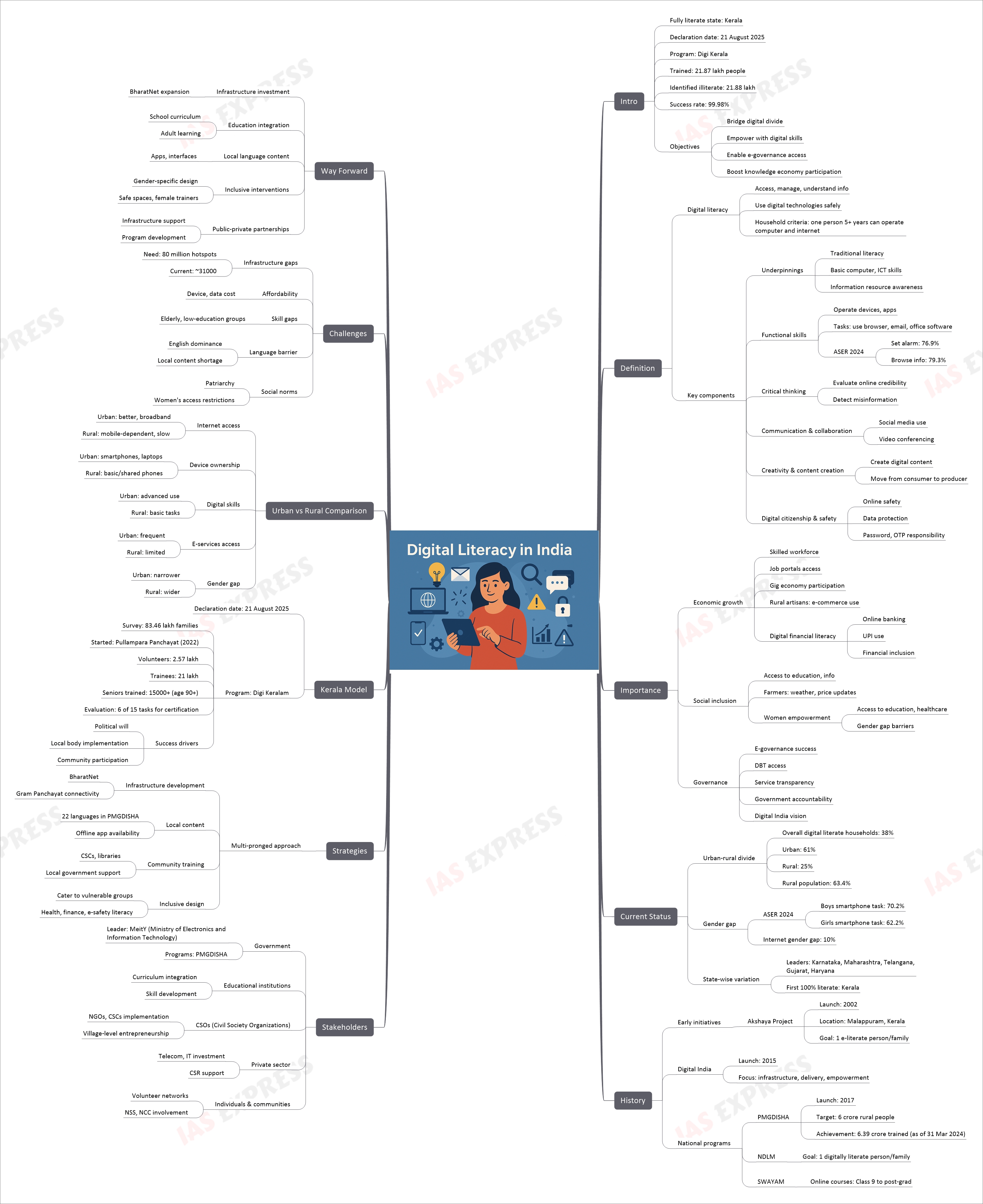
In a landmark achievement for India’s digital journey, Kerala was declared the nation’s first fully digitally literate state on August 21, 2025. Chief Minister Pinarayi Vijayan announced the successful completion of the initial phase of the ‘Digi Kerala’ programme. This grassroots initiative, implemented across all local self-government bodies, aimed to bridge the digital divide by training citizens and empowering them with essential skills. A ground-level survey identified 21.88 lakh “digitally illiterate” individuals, out of which an impressive 21.87 lakh, or 99.98% of participants, successfully completed the training and evaluation. This accomplishment, built upon earlier pioneering initiatives, showcases a scalable model for empowering citizens to navigate the digital world, access e-governance services, and participate fully in the knowledge economy, setting a powerful precedent for other states to follow.
What is the Real Meaning of Digital Literacy?
- Core Definition: Digital literacy is not merely about knowing how to use a computer or a smartphone. It is a comprehensive ability to access, manage, understand, integrate, communicate, evaluate, and create information safely and appropriately through digital technologies. It encompasses a collection of skills that are essential for full participation in a society where communication and access to information are increasingly channeled through digital platforms. A digitally literate household is one where at least one person over the age of five can operate a computer and use the internet.
- Key Components and Frameworks:
- Underpinnings and Background Knowledge: This foundational layer includes traditional literacy and basic computer/ICT skills. It also involves understanding the nature of information resources available in the digital space.
- Functional Skills (Central Competences): This is the practical level, involving the technical know-how to use digital devices, software, and applications.
- This includes fundamental tasks like operating a computer or smartphone, using a web browser, sending an email, and using office software.
- The ASER 2024 report found that among rural youth who could use a smartphone, 76.9% could set an alarm and 79.3% could browse for information.
- Critical Thinking and Evaluation: This advanced skill involves the ability to critically analyze, evaluate, and question the credibility and reliability of online information. In an era rife with misinformation and disinformation, this ability to discern fact from fiction is a crucial aspect of digital literacy.
- Communication and Collaboration: This refers to using digital tools to communicate and collaborate with others. It includes using social media, video conferencing, and other collaborative platforms effectively and responsibly.
- Creativity and Content Creation: This is the ability to create new content and express oneself through digital media. It represents a higher level of digital competence, moving from a consumer of information to a producer.
- Digital Citizenship and Safety: This involves understanding the rights, responsibilities, and ethics of being a member of the online community.
- It covers critical topics like online safety, protecting personal data, understanding privacy policies, and avoiding online fraud.
- It includes the responsible use of passwords and being aware of not sharing OTPs with anyone.
Why is Digital Literacy so Crucial for India?
- Economic Growth and Empowerment:
- Digital literacy is a key catalyst for economic growth and is increasingly seen as essential for India’s economic progress. A digitally skilled workforce is vital for the growth of the IT sector and the wider knowledge economy.
- It empowers individuals by enabling them to access online job portals, participate in the gig economy, and start their own online businesses. For instance, digital literacy allows rural artisans to use e-commerce platforms to sell their products to a global audience, improving their livelihoods.
- Digital financial literacy, a critical subset, enables people to use online banking, and digital payment systems like UPI, which promotes financial inclusion, transparency, and economic participation.
- Social Inclusion and Equity:
- Digital literacy is a powerful tool for bridging social and economic divides. It provides marginalized communities with access to information, education, and opportunities that were previously out of reach.
- For example, farmers can use mobile apps and platforms like Kisan Call Centres to get real-time information on weather, market prices, and modern farming techniques, which can significantly improve their yields and income.
- It can also empower women by providing them with access to education, healthcare information, and a platform to voice their opinions, fostering agency and empowerment. However, cultural norms and economic disparity often widen the gender gap, limiting women’s participation.
- Enhanced Governance and Citizen Services:
- The success of e-governance initiatives is fundamentally dependent on the digital literacy of citizens. Digital literacy enables people to access a wide range of government services online, such as applying for documents, paying bills, and accessing welfare schemes through Direct Benefit Transfer (DBT).
- This not only improves the efficiency and transparency of public service delivery but also reduces corruption and empowers citizens to hold the government accountable. The overarching Digital India program, with its vision of a connected nation, can only realize its full potential with a digitally literate populace.
Where Does India Stand in Digital Literacy?
- The Urban-Rural Divide: A significant chasm exists in digital literacy rates between urban and rural India. While urban areas generally benefit from better access to digital infrastructure and educational opportunities, rural areas lag considerably.
- Only 38% of all households in India are considered digitally literate. This figure masks a stark contrast: 61% in urban areas compared to just 25% in rural areas.
- As of early 2024, India’s population was 63.4% rural, highlighting the vast number of people who remain on the other side of the digital divide.
- The Gender Gap: The digital divide is also deeply gendered. Women, particularly in rural settings, have lower levels of digital literacy compared to men due to a combination of socio-cultural norms, economic disparity, and lower access to devices.
- The ASER 2024 survey revealed that in rural India, while a high percentage of youth have smartphones at home, boys consistently outpace girls in access, personal ownership, and usage. For instance, 70.2% of males could bring a smartphone for tasks, compared to only 62.2% of females.
- India’s overall gender gap in internet connectivity stands at 10%, which is higher than the world average of 9%.
- State-wise Variations: Digital literacy rates and digital infrastructure development are not uniform across India. Richer states tend to be more digitalized.
- States like Karnataka, Maharashtra, Telangana, Gujarat, and Haryana lead in digitalization scores, while others lag.
- Kerala recently became the first state to achieve 100% digital literacy, showcasing a successful model of state-led effort.
When Did India’s Digital Literacy Journey Begin?
- Early Initiatives: The journey towards digital literacy in India began with pioneering state-level initiatives in the early 2000s.
- The Akshaya project, launched in Kerala’s Malappuram district in 2002, was a groundbreaking effort to make one person in every family e-literate, laying the foundation for the state’s future success.
- The Digital India Push: The launch of the Digital India programme in 2015 was a watershed moment, giving a massive, nationwide impetus to the digital literacy movement. This flagship program aims to transform India into a digitally empowered society and knowledge economy by focusing on digital infrastructure, digital service delivery, and digital empowerment of citizens.
- Targeted National Programs: The government has launched several large-scale programs specifically to promote digital literacy.
- Pradhan Mantri Gramin Digital Saksharta Abhiyan (PMGDISHA): Launched in 2017, this is one of the world’s largest digital literacy programs. It was designed to make 6 crore people in rural households digitally literate, targeting one person per eligible household. As of March 31, 2024, the scheme had successfully trained 6.39 crore individuals, exceeding its ambitious target.
- National Digital Literacy Mission (NDLM): This mission, along with PMGDISHA, aims to ensure at least one person in every Indian family is digitally literate, focusing on imparting basic digital skills.
- SWAYAM (Study Webs of Active Learning for Young Aspiring Minds): An initiative by the MHRD to provide online courses from class nine to post-graduation, promoting digital education across various disciplines.
Who are the Key Stakeholders in this Mission?
- The Government: The central and state governments are the primary drivers of the digital literacy mission. The Ministry of Electronics and Information Technology (MeitY) leads these efforts, formulating policies, launching programs like PMGDISHA, and creating the necessary digital infrastructure.
- Educational Institutions: Schools, colleges, and universities have a crucial role in integrating digital literacy into the curriculum from an early age and equipping students with the necessary future-ready skills.
- Civil Society Organizations (CSOs): NGOs and community-based organizations play a vital role in last-mile implementation. Common Service Centres (CSCs), operated by village-level entrepreneurs, have been instrumental in delivering PMGDISHA training across the country.
- The Private Sector: Telecom companies, IT firms, and other private sector players contribute by investing in digital infrastructure, developing affordable technologies, and supporting digital literacy initiatives as part of their corporate social responsibility.
- Individuals and Communities: Ultimately, the success of the digital literacy mission depends on the active participation and willingness of individuals and communities to embrace digital change. Youth organizations like NSS and NCC are also encouraged to participate as volunteers.
How Can Digital Literacy Be Achieved Across India?
- A Multi-pronged Approach: Achieving universal digital literacy in a vast and diverse country like India requires a comprehensive, multi-pronged approach that addresses access, skills, and inclusion simultaneously.
- Infrastructure Development: Expanding access to affordable and reliable internet connectivity, especially in rural and remote areas, is a non-negotiable prerequisite. Initiatives like the National Optical Fiber Network (now BharatNet) aim to connect all Gram Panchayats with high-speed internet.
- Accessible and Localized Content: Developing digital literacy content in local languages is critical for ensuring comprehension and engagement.
- The PMGDISHA scheme, for example, aimed to make training content available in all 22 scheduled languages of India, along with a mobile app for offline access.
- Programs must be designed to cater to individuals of all ages and abilities to address existing educational disparities.
- Community-based Training Models: Leveraging community-based platforms like Common Service Centres (CSCs) and local libraries to provide digital literacy training has proven effective in reaching the grassroots level. The ‘Digi Kerala’ model also relied heavily on local self-government bodies and community volunteers.
- Inclusive Program Design: Initiatives must be designed with vulnerable populations in mind, addressing multiple literacies such as health, financial, and e-safety, especially in low-resource settings.
The Landmark Achievement of Kerala
- A Model for the Nation: Kerala’s declaration as India’s first fully digitally literate state on August 21, 2025, is a testament to the power of a concerted, well-planned, and community-driven effort.
- The ‘Digi Keralam’ program, which led to this achievement, began with a massive ground-level survey across 83.46 lakh families to identify digitally illiterate individuals, followed by a targeted training program.
- The program started in the Pullampara panchayat, which became the first fully digitally literate panchayat in 2022, serving as a successful pilot model that was then scaled up across the state.
- It leveraged a large network of 2.57 lakh volunteers, including students, youth, and members of the Kudumbashree network, to provide training to over 21 lakh people, including more than 15,000 seniors over the age of 90.
- The training focused on practical skills. The evaluation required trainees to complete at least six out of 15 essential tasks to be certified as digitally literate, ensuring a minimum standard of competence.
- The success of the program is attributed to strong political will, meticulous implementation by local self-government bodies, and active, widespread community participation.
Comparison Chart: Digital Literacy in Urban vs. Rural India
| Feature | Urban India | Rural India |
|---|---|---|
| Internet Access | Higher penetration, better access to fixed broadband and high-speed mobile internet. | Lower penetration, high reliance on mobile data, and often patchy or slow connectivity. |
| Device Ownership & Cost | Higher ownership of diverse devices like smartphones, laptops, and computers per household. | Lower device ownership, greater reliance on shared or basic-feature phones. High device costs are a major barrier. |
| Digital Skills & Usage | Generally higher levels of digital literacy, including advanced skills for professional and creative use. | Skills are often limited to basic functional tasks like social media use, with gaps in areas like educational or financial services. |
| Access to E-Services | Easier and more frequent access to a wide range of e-commerce, financial, and e-governance services. | Limited access and utilization due to lack of infrastructure, skills, and awareness of available services. |
| Gender Gap | The gender gap in digital access and literacy is present but generally narrower than in rural areas. | The gender gap is significantly wider, with women facing more socio-cultural and economic barriers to accessing and using digital technology. |
What are the Major Challenges and Hurdles?
- Infrastructural Deficits: Despite significant progress, large parts of rural and remote India still lack reliable internet connectivity and consistent electricity supply, which are the most fundamental requirements for digital access. According to one report, India needs over 80 million hotspots to reach global levels, against a current availability of about 31,000.
- Affordability: The high cost of smartphones, computers, and even internet data remains a significant barrier for many low-income households, preventing them from crossing the digital threshold.
- Lack of Digital Skills and Awareness: A large section of the population, especially the elderly and those with low levels of formal education, lack the basic skills and confidence to use digital technologies. This “skills gap” is a key barrier to technology adoption.
- Language and Content Barrier: The dominance of English on the internet and in many digital applications poses a major challenge for a majority of Indians who are not proficient in the language. The lack of relevant, high-quality content in local languages hinders adoption.
- Social and Cultural Norms: In many communities, deeply entrenched patriarchal norms restrict women’s access to and use of mobile phones and the internet, widening the gender digital divide and undermining their autonomy.
What is the Way Forward for a Digitally Literate India?
- Investing in Robust Infrastructure: The government must accelerate investments in expanding digital infrastructure, ensuring last-mile connectivity through programs like BharatNet. The focus should be on providing reliable and affordable internet access to every corner of the country.
- Integrating Digital Education: Digital literacy should be formally integrated into the school curriculum from an early age. Furthermore, continuous learning programs must be available for adults to upskill and adapt to new technologies.
- Creating a Local Language Ecosystem: A concerted effort is needed from both the public and private sectors to develop more digital content, applications, and user interfaces in India’s diverse local languages. This will make the internet more accessible, relevant, and inclusive.
- Targeted Interventions for Inclusion: Specific, targeted interventions are required to bridge the gender divide and include other marginalized groups. This involves providing safe and accessible training spaces for women, promoting female trainers, and designing awareness campaigns that challenge restrictive social norms.
- Fostering Public-Private Partnerships: The government should create a more conducive environment for collaboration with the private sector. This can leverage private sector expertise, innovation, and resources to accelerate the deployment of infrastructure and the development of effective digital literacy programs.
Conclusion
Digital literacy has transitioned from being a desirable skill to a fundamental necessity for meaningful participation in the 21st century. It stands as the cornerstone for unlocking the full potential of India’s digital revolution and for building a more inclusive, equitable, and empowered nation. The journey towards universal digital literacy is undoubtedly long and fraught with challenges, from infrastructural gaps to deep-seated social inequalities. However, the recent remarkable achievement of Kerala in becoming India’s first fully digitally literate state provides not just a ray of hope but a tangible, replicable roadmap. By adopting a multi-pronged strategy that prioritizes robust infrastructure, inclusive education, local language content, and active community participation, India can systematically bridge the digital divide. The success of this national mission is critical for realizing the ambitious goals of sustained economic growth, social progress, and transparent governance for all its citizens.
Q. Critically analyze the role of digital literacy in transforming India into a knowledge economy. (250 words)
Related reading: As more learning moves online, education providers are rethinking how they reach students. See how education businesses can generate more student leads online.
Related Posts

If you like this post, please share your feedback in the comments section below so that we will upload more posts like this.

Responses