
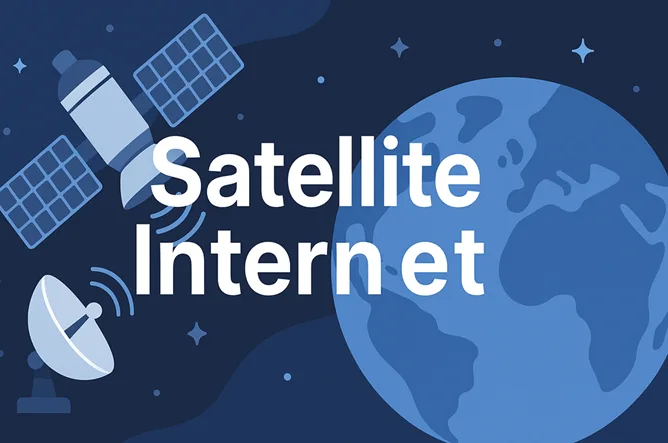
Satellite Internet: Working, Pros, Cons, Challenges

From Current Affairs Notes for UPSC » Editorials & In-depths » This topic
In today’s increasingly digitised world, internet connectivity is an absolute necessity, across both military and civilian domains. With Elon Musk’s Starlink about to make its debut very soon in India, internet infrastructure is going to fundamentally change. This shift is not just about faster speeds; it’s about a new paradigm of connectivity that promises to reach the most remote corners of the nation, overcoming geographical barriers that have long hindered development. This wave of satellite internet technology, led by global and domestic players, holds the potential to bridge the digital divide, empower communities, and bolster India’s strategic capabilities, heralding a truly connected future for all.
What is satellite internet and how does it work?
- Satellite internet is a method of delivering broadband internet access using communication satellites orbiting the Earth. Unlike traditional internet, which relies on underground cables or ground-based mobile towers, this technology beams data from space, making it available almost anywhere on the planet.
- The system operates through a simple, yet technologically advanced, three-part process:
- The Satellites in Space
- Companies launch a network of satellites into orbit. These can be of two main types:
- Geostationary Orbit (GEO) Satellites: These are large satellites located about 36,000 kilometres above the Earth. They match the Earth’s rotation and appear fixed in the sky. This high altitude, however, results in high latency, or delay, in signal transmission.
- Low Earth Orbit (LEO) Satellites: This is the modern approach used by companies like Starlink. They use thousands of smaller satellites in a constellation that orbit much closer to the Earth, typically between 500 to 2,000 kilometres. This proximity significantly reduces latency, making the internet feel much more responsive.
- Companies launch a network of satellites into orbit. These can be of two main types:
- The Ground Infrastructure
- A network of ground stations, also known as gateways, is built on Earth. These stations are connected to the existing global internet backbone with high-speed fiber optic cables. They act as the bridge between the satellites and the internet.
- The User’s Equipment
- The end-user, whether at home or in a business, has a small satellite dish called a user terminal. This dish, which is about the size of a pizza box, is installed with a clear view of the sky.
- The Satellites in Space
- The communication flow is a round trip:
- When you try to visit a website, your computer sends a request to the user terminal.
- The terminal sends this signal up to a LEO satellite passing overhead.
- The satellite relays this signal down to the nearest ground station.
- The ground station fetches the data from the internet and sends it back up to the satellite.
- The satellite then beams this data back down to your user terminal, and you see the website load on your screen. This entire process happens in a fraction of a second.
Why is satellite internet gaining importance?
- Bridging the Digital Divide
- Its most significant advantage is its ability to provide high-speed internet to remote, rural, and geographically challenging areas where it is physically or financially unfeasible to lay fiber optic cables.
- In a country like India, with vast rural populations and difficult terrains like the Himalayas or remote islands such as the Andaman and Nicobar Islands, satellite internet can connect communities that have been left behind by the digital revolution. Many of India’s over 6 lakh villages still lack reliable broadband.
- Ensuring Disaster Resilience
- During natural calamities like floods, earthquakes, or cyclones, terrestrial infrastructure like cell towers and cables are often the first to be destroyed.
- Satellite internet can be rapidly deployed in disaster-stricken areas, providing a crucial communication link for rescue teams, government agencies, and affected populations when all other forms of communication have failed.
- Enabling True Mobility
- It offers seamless connectivity for moving vehicles. This is transforming travel and logistics by providing reliable internet on airplanes, cargo ships, and even long-distance trains and buses.
- Strengthening Military and Strategic Capabilities
- For armed forces, secure and uninterrupted communication is paramount. Satellite internet provides a reliable command and control network for troops deployed in remote border outposts, naval ships patrolling the high seas, and for operating unmanned aerial vehicles (UAVs).
Where can satellite internet be most beneficial?
- Education and Healthcare Sector
- In villages with no reliable internet, students can get access to high-quality online educational resources, bridging the urban-rural knowledge gap.
- It is a game-changer for telemedicine, allowing patients in remote Primary Health Centres to consult with specialist doctors in city hospitals.
- Government and Public Services
- It can connect Gram Panchayats and government offices in the last mile, enabling the effective delivery of e-governance services and social welfare schemes envisioned under the Digital India mission.
- Commerce and Industry
- Businesses that operate in isolated locations, such as mining corporations, oil and gas rigs, and large-scale agricultural farms, can use it to improve operational efficiency and safety.
- It can empower rural artisans and small entrepreneurs to connect to e-commerce platforms and sell their products to a global market.
- Defence and Emergency Services
- It provides a secure and independent communication channel for military operations in forward areas and for coordinating disaster response efforts.
When did satellite internet technology evolve?
- The Early Era (1990s – 2000s)
- The first consumer-grade satellite internet services emerged, primarily relying on large GEO satellites.
- These services were characterized by:
- High Latency: The long distance to the satellites (36,000 km) resulted in significant signal delay (over 600 milliseconds), making activities like video calls or online gaming nearly impossible.
- Slow Speeds: Download speeds were often limited to just a few megabits per second (Mbps).
- High Cost: Both the equipment and the monthly plans were very expensive, limiting their use to wealthy individuals or corporations.
- The LEO Constellation Revolution (Late 2010s – Present)
- This is the current and most transformative phase, driven by private space companies.
- The Rise of LEO
- Companies like SpaceX (Starlink) and OneWeb pioneered the concept of launching thousands of small, relatively inexpensive satellites into Low Earth Orbit.
- This new architecture brought about revolutionary changes:
- Drastically Reduced Latency: With satellites orbiting just 550 km away, latency dropped to 20-40 milliseconds, a level comparable to ground-based fiber and 4G networks.
- Massively Increased Speeds: Users can now experience speeds well over 100 Mbps, sufficient for high-definition streaming, online gaming, and other data-intensive tasks.
- Falling Costs: While still more expensive than terrestrial options, the costs are steadily decreasing due to mass production of satellites and user terminals.
Who are the main players in satellite internet services?
- The Global Pioneers
- SpaceX’s Starlink: Owned by Elon Musk, it is the most prominent player with the largest satellite constellation of over 5,000 active satellites. It is known for its direct-to-consumer model, offering a complete kit for home installation.
- OneWeb: Primarily backed by India’s Bharti Enterprises and the UK Government, OneWeb focuses more on a B2B (Business-to-Business) model, providing connectivity to governments, other telecom operators, and enterprises.
- Amazon’s Project Kuiper: This is Amazon’s ambitious initiative to build its own LEO constellation of over 3,000 satellites. It is expected to become a major competitor to Starlink once operational.
- The Indian Contenders
- Reliance’s Jio SpaceFiber: Jio has partnered with SES, a global satellite operator, to launch its own satellite broadband service. It aims to connect the most remote parts of India and has already demonstrated its capabilities.
- Bharti-backed OneWeb: As a major investor in OneWeb, Bharti Airtel is positioned to integrate satellite services into its existing telecom network, offering hybrid solutions to Indian customers.
- Indian Space Research Organisation (ISRO): While not a direct-to-consumer provider, ISRO’s communication satellites from the GSAT series are the backbone for government, strategic, and broadcasting services in India. Policies are now encouraging collaboration between ISRO and private players.
What recent developments are shaping satellite internet?
- Starlink’s Anticipated Entry into India
- The most significant recent development is the impending approval for Starlink to begin its services in India. This move is expected to ignite intense competition in the broadband market, potentially driving down prices and accelerating the adoption of high-speed internet in unconnected areas.
- The Rise of Domestic Competition
- The launch announcement of Jio SpaceFiber marks a crucial step in building domestic capacity. This ensures that India is not solely reliant on foreign operators for this critical infrastructure, creating a competitive and self-reliant ecosystem.
- Focus on ‘Make in India’ for Space
- The Indian government’s space policy reforms and the creation of bodies like IN-SPACe (Indian National Space Promotion and Authorization Center) are designed to encourage private sector investment. This includes promoting the domestic manufacturing of satellite components and user terminals, aligning with the Make in India initiative.
- Direct-to-Device Technology
- The next technological frontier is connecting standard smartphones directly to satellites. This would initially enable basic SMS and emergency services in areas with zero mobile coverage, a feature that could be life-saving.
How does satellite internet compare to others?
| Feature | Fiber Optic | DSL (Digital Subscriber Line) | Satellite Internet (LEO) |
|---|---|---|---|
| Speed | Very High (100 Mbps – 10 Gbps) | Low to Medium (5 – 100 Mbps) | High (50 – 250 Mbps) |
| Latency | Very Low (< 20 ms) | Medium (25 – 100 ms) | Low (20 – 50 ms) |
| Availability | Very Low (Mainly in dense urban areas) | Medium (Requires phone lines) | Very High (Almost anywhere with a clear sky view) |
| Reliability | Very High (Immune to weather) | High (Stable connection) | Medium (Can be affected by heavy rain or snow – ‘rain fade’) |
| Initial Cost | Low to Medium (Installation fees) | Low (Often uses existing phone jack) | High (Requires purchase of a user terminal/dish) |
| Monthly Cost | Low | Low to Medium | High |
What are the limitations of current satellite internet?
- Weather Interference (Rain Fade)
- The biggest operational limitation is its vulnerability to adverse weather. Heavy rain, dense clouds, or snow can absorb and scatter the satellite’s radio signals, leading to slower speeds or a complete loss of connection. This phenomenon is known as rain fade.
- Requirement for a Clear Line of Sight
- The user terminal dish needs a direct, unobstructed view of the sky to communicate with the satellites. This can be a challenge in densely forested areas, deep valleys, or urban canyons surrounded by tall buildings.
- Data Caps and Fair Use Policies
- Unlike many unlimited fiber plans, most satellite internet services come with a monthly data allowance. Exceeding this cap can result in significantly throttled speeds for the rest of the month, limiting heavy usage.
- Power Requirements
- The user terminal and modem require a constant supply of electricity. This can be a practical challenge in off-grid or power-deficient remote areas, necessitating solutions like solar panels.
What are the major challenges facing satellite internet?
- Affordability and Cost Barrier
- The primary challenge for mass adoption, especially in a price-sensitive market like India, is cost. The upfront cost for the hardware (dish and router), which can be around ₹40,000-₹50,000, and the higher monthly subscription fees compared to fiber, make it unaffordable for a large segment of the rural population.
- Complex Regulatory Environment
- Satellite operators must navigate a complex web of regulations, seeking licenses and spectrum allocation from multiple government bodies like the Department of Telecommunications (DoT) and the Department of Space. This can be a time-consuming process that delays service launches.
- The Threat of Space Debris
- The deployment of mega-constellations involving tens of thousands of satellites has exponentially increased the risk of collisions in orbit. This creates space debris, which can damage or destroy other satellites, potentially leading to a chain reaction known as the Kessler Syndrome that could render LEO unusable.
- Need for Extensive Ground Infrastructure
- While the satellites are in space, the system is critically dependent on a widespread network of ground stations. Building, maintaining, and securing this terrestrial infrastructure across a vast and diverse country like India requires immense capital investment and logistical planning.
What is the way forward for satellite internet technology?
- Technological Innovations for Cost Reduction
- Continued advancements in reusable rocket technology for cheaper launches and mass production of satellites and user terminals are key to driving down the overall cost of the service.
- Development of Inter-Satellite Links
- Advanced satellites are now being equipped with laser links that allow them to communicate directly with each other in space. This creates a mesh network in orbit, reducing the need to relay signals to a ground station every time, which further lowers latency and increases network efficiency.
- Global Cooperation on Space Sustainability
- There is an urgent need for international agreements and robust technical standards for space traffic management and the responsible de-orbiting of defunct satellites to mitigate the growing problem of space debris.
- Creating Hybrid Communication Networks
- The future of connectivity is not about one technology replacing another, but about their integration. Telecom companies will likely create hybrid networks that seamlessly switch a user’s connection between 5G, fiber, and satellite, ensuring the best possible service at all times, regardless of location.
- Policy Support and Subsidies
- Governments can play a crucial role by creating subsidy programs or using universal service obligation funds to make the hardware and monthly plans more affordable for users in economically weaker and remote regions.
Conclusion
Satellite internet is rapidly evolving from a niche, expensive option into a mainstream, transformative technology. For India, it is not merely another way to access the internet; it is a strategic tool with the immense potential to achieve universal connectivity, erasing the last-mile gaps left by terrestrial networks. The imminent arrival of global giants like Starlink, coupled with the ambitious push from domestic players like Jio, is set to create a vibrant and competitive market. This will be instrumental in realizing the vision of a fully Digital India. However, the path forward requires a concerted effort to navigate the challenges of high costs, regulatory complexities, and the critical issue of space sustainability. If managed wisely, this leap in technology will undoubtedly empower millions, drive economic growth, and secure India’s position as a leading digital nation.
Q. Critically analyze the potential of Low Earth Orbit (LEO) satellite internet to bridge India’s digital divide while considering the associated economic and regulatory challenges. (250 words)

Related Posts

If you like this post, please share your feedback in the comments section below so that we will upload more posts like this.

Responses