
Biochar Explained: A Powerful Solution for Climate, Soil, and Rural India

From Current Affairs Notes for UPSC » Editorials & In-depths » This topic
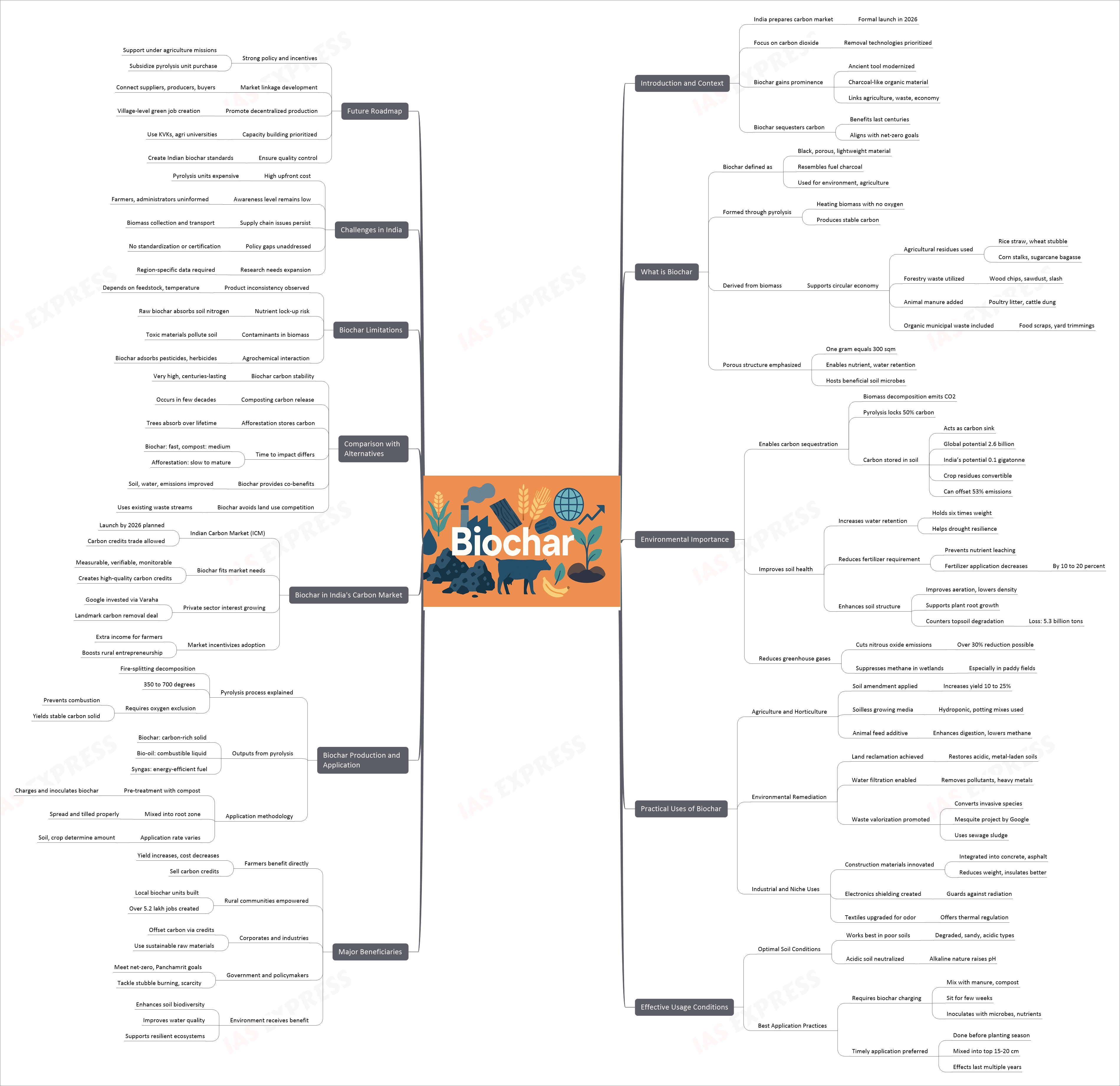
As India positions itself for the launch of its formal carbon market in 2026, the focus on effective carbon dioxide removal (CDR) technologies has intensified. Among the frontrunners is biochar, an ancient innovation finding new relevance in the modern climate crisis. This charcoal-like substance, produced from organic waste, is gaining recognition not just as a tool to pull carbon from the atmosphere but as a multifaceted solution with the potential to revolutionize Indian agriculture, manage waste, and foster rural economic growth. With its ability to sequester carbon for centuries while simultaneously enriching soil, biochar is poised to become a crucial instrument in India’s journey towards its ambitious net-zero targets and sustainable development goals, offering a tangible pathway to link environmental action with farmer prosperity.
What exactly is this substance called biochar?
- Biochar is a black, lightweight, and highly porous material that looks very similar to charcoal. However, unlike charcoal used for fuel, its primary purpose is environmental management and agricultural enhancement.
- It is essentially a form of stable carbon, created by heating organic materials in a controlled manner.
- The raw material used to create biochar is known as biomass.
- This can include a wide variety of organic wastes, making it a key technology for a circular economy.
- Agricultural residues: such as rice straw, wheat stubble, corn stalks, and sugarcane bagasse. This is particularly relevant for India to manage the issue of stubble burning.
- Forestry waste: including wood chips, sawdust, and slash from forest thinning.
- Animal manure: like poultry litter and cattle dung.
- Organic municipal waste: such as food scraps and yard trimmings.
- This can include a wide variety of organic wastes, making it a key technology for a circular economy.
- The defining characteristic of biochar is its incredibly porous structure.
- A single gram of biochar can have a surface area of over 300 square meters, equivalent to the size of a tennis court.
- This vast network of microscopic pores gives it the ability to hold water and nutrients, providing a perfect habitat for beneficial soil microbes.
Why is biochar so important for the environment?
- Its most celebrated environmental benefit is long-term carbon sequestration.
- When biomass decomposes naturally or is burned, its carbon is released back into the atmosphere as carbon dioxide (CO2).
- The process of making biochar locks about 50% of the original carbon into a highly stable form that resists decomposition for hundreds or even thousands of years.
- This effectively removes carbon from the active carbon cycle and stores it securely in the soil, acting as a “carbon sink.”
- Globally, biochar has the potential to sequester up to 2.6 billion tons of CO2 per year.
- For India, utilizing just 30-50% of its surplus agricultural waste could produce enough biochar to remove an estimated 0.1 gigatonnes of CO2-equivalent annually. A recent study highlighted that India has the potential to sequester up to 53% of its current emissions by converting crop residues into biochar.
- Biochar significantly improves soil health and fertility.
- It enhances water retention. Its sponge-like structure can hold up to six times its weight in water, making soils more resilient to drought. This is critical for India, where water scarcity is a major concern.
- It reduces the need for chemical fertilizers. Biochar acts like a magnet for nutrients, preventing them from leaching away with rainwater. This means fertilizers remain in the root zone for longer, reducing the required application by 10-20%.
- It improves soil structure by increasing aeration and reducing soil density, making it easier for plant roots to grow. This is vital in combating soil degradation, an issue that leads to the loss of over 5.3 billion tons of topsoil in India annually.
- It helps mitigate other powerful greenhouse gases.
- When applied to agricultural soils, biochar can reduce emissions of nitrous oxide (N2O), a greenhouse gas nearly 300 times more potent than CO2, by over 30%.
- It can also suppress methane (CH4) emissions, particularly from water-logged soils like those found in paddy cultivation.
Where can biochar be practically used?
- Agriculture and Horticulture
- Soil Amendment: This is its primary and most well-known use. Mixing biochar into topsoil can boost crop yields by an average of 10-25% by improving soil structure, water retention, and nutrient availability.
- Soilless Growing Media: It can be used as a component in potting mixes and for hydroponic systems.
- Animal Feed Additive: In some cases, it is added to animal feed to improve digestion and reduce methane emissions from livestock.
- Environmental Remediation and Waste Management
- Land Reclamation: It is used to restore degraded land, such as old mine sites. Biochar can neutralize soil acidity and immobilize heavy metal contaminants, allowing vegetation to grow again.
- Water Filtration: Its porous nature makes it an excellent filter. It can be used in wastewater treatment systems to remove pollutants, heavy metals, and excess nutrients. Some applications even use it to create natural water purifiers.
- Waste Valorization: It provides a sustainable method for managing organic waste. For instance, a major project in India, backed by Google, involves producing biochar from an invasive mesquite species, simultaneously tackling an ecological problem and sequestering carbon. It can also be produced from sewage sludge, turning a disposal challenge into a valuable resource.
- Industrial and Niche Applications
- Construction Materials: Biochar can be incorporated into concrete, asphalt, and building insulation. This not only sequesters carbon within buildings but can also create lighter and better-insulating materials.
- Electronics: Its properties allow it to be used in creating shields against electromagnetic radiation in electronic devices.
- Textiles: It can be integrated into fabrics to provide properties like odor reduction and thermal regulation.
When is biochar most effective to use?
- Optimal Soil Conditions
- Biochar shows the most dramatic benefits in poor-quality soils.
- Degraded or Coarse-Textured Soils: In sandy soils, its ability to hold water and nutrients provides a significant boost to productivity.
- Acidic Soils: Most biochar has an alkaline pH, so it acts as a liming agent, raising the pH of acidic soils to levels more suitable for crop growth.
- Biochar shows the most dramatic benefits in poor-quality soils.
- Best Application Practices
- Inoculation or ‘Charging’ Before Use: Raw, freshly made biochar can sometimes temporarily absorb nutrients from the soil, competing with plants. To prevent this, it is most effective when it is “charged” before application.
- This involves mixing it with compost, manure, or other nutrient-rich organic materials and letting it sit for a few weeks. This process inoculates the biochar with beneficial microbes and saturates it with nutrients, turning it into a slow-release fertilizer from day one.
- Timing of Application: It is best applied during land preparation before the planting season. This allows it to be thoroughly mixed into the top 15-20 cm of soil, where it can interact with plant roots. Since its effects are long-lasting, it does not need to be applied every year.
- Inoculation or ‘Charging’ Before Use: Raw, freshly made biochar can sometimes temporarily absorb nutrients from the soil, competing with plants. To prevent this, it is most effective when it is “charged” before application.
Who are the major beneficiaries of biochar?
- Farmers
- They experience direct economic benefits through increased crop yields and reduced input costs for irrigation and fertilizers.
- With the emergence of carbon markets, farmers can earn additional income by selling carbon credits generated from using biochar, turning a sustainable practice into a new revenue stream.
- Rural Communities
- The promotion of decentralized, village-level biochar production units can create local employment. It is estimated that deploying biochar equipment at scale has the potential to create over 5.2 lakh rural jobs in India.
- Industries and Corporations
- Companies looking to meet their environmental, social, and governance (ESG) goals and offset their carbon footprint can invest in biochar projects or purchase carbon credits.
- The construction and manufacturing industries can use biochar as a sustainable, carbon-negative raw material.
- Government and Policymakers
- Biochar provides a practical tool to help meet national and international climate commitments, such as India’s Panchamrit goals and the target of achieving net-zero by 2070.
- It helps address pressing national issues like air pollution from stubble burning, water scarcity, and food security.
- The Environment
- The ultimate beneficiary is the planet, through climate change mitigation, enhanced biodiversity in soils, improved water quality, and the creation of more resilient ecosystems.
How is biochar actually made and applied?
- The Production Process: Pyrolysis
- Biochar is created through a process called pyrolysis. This term literally means ‘fire-splitting’ (from the Greek words pyr for fire and lysis for splitting).
- It involves heating biomass to high temperatures (typically between 350°C and 700°C) in a container with very little or no oxygen.
- This lack of oxygen is crucial. It prevents the biomass from combusting (burning) and instead causes it to thermally decompose, breaking down into a stable, carbon-rich solid.
- The pyrolysis process yields three main products:
- Biochar: The solid, charcoal-like material, which contains the majority of the stable carbon.
- Bio-oil (or Pyrolysis Oil): A liquid fuel that can be refined and used for energy.
- Syngas (Synthesis Gas): A mixture of combustible gases (like hydrogen and carbon monoxide) that can be captured and used to power the pyrolysis unit itself, making the process energy-efficient and potentially self-sustaining.
- The Application Method
- Pre-treatment: As mentioned, the best practice is to ‘charge’ the biochar by co-composting it with materials like cow dung or compost.
- Incorporation into Soil: The most common method is to spread the biochar on the soil surface and then till or mix it into the top layer of soil (the root zone).
- Application Rate: The amount of biochar applied depends on the soil type, crop, and specific goals, but a one-time application can provide benefits for many years due to its high stability.
What is the news about India’s Carbon Market and Biochar?
- India is on track to operationalize its national Indian Carbon Market (ICM) by 2026. This regulated market will allow industries to trade in carbon credits to meet their emission reduction targets.
- Carbon removal technologies are expected to be a key component of this market, and biochar is being recognized as one of the most promising and shovel-ready pathways.
- Its ability to be easily measured, verified, and monitored makes it an ideal candidate for generating high-quality carbon credits.
- This has sparked significant interest from the private sector. In a landmark deal, Google recently invested in a large-scale biochar project in India through the startup Varaha.
- This represents one of the largest biochar-based carbon removal deals to date and signals strong corporate confidence in biochar’s potential within the Indian market.
- The establishment of the ICM is set to create a powerful financial incentive for adopting biochar.
- This will provide an additional income source for farmers and rural entrepreneurs, directly linking climate action with economic benefit and accelerating the technology’s adoption across the country.
How does biochar compare to other methods?
| Feature | Biochar | Composting | Afforestation |
|---|---|---|---|
| Carbon Stability | Very High: Carbon is locked for centuries to millennia. | Low: Carbon is part of the active cycle and is released back into the atmosphere in a few years to decades. | Moderate to High: Carbon is stored for the lifetime of the tree (decades to centuries), but is vulnerable to fire, disease, and deforestation. |
| Time to Impact | Fast: Carbon sequestration begins immediately upon production and application. Soil benefits can be seen in the first growing season. | Medium: Requires several months for compost to mature. Soil benefits are quick, but carbon storage is short-term. | Slow: Takes many years or decades for trees to mature and sequester significant amounts of carbon. |
| Co-Benefits | Numerous: Improves soil health, water retention, reduces fertilizer need, mitigates N2O and CH4, and manages waste. | Good: Improves soil health, water retention, and provides nutrients. | Numerous: Enhances biodiversity, prevents soil erosion, improves local climate, but can compete for land. |
| Scalability & Land Use | High: Can be produced from waste streams, avoiding competition for land. Can be applied to existing agricultural land. | High: Uses organic waste and is applied to existing land. | Moderate: Requires large tracts of land, which may compete with agriculture or other land uses. |
What are the potential limitations of biochar?
- Product Inconsistency: Biochar is not a standardized product. Its properties (like pH, porosity, and nutrient content) vary significantly depending on the feedstock and the pyrolysis temperature and conditions. This means one type of biochar may be perfect for one soil but less effective for another.
- Risk of Initial Nutrient Lock-up: If raw, uncharged biochar is applied to soil, its highly absorbent nature can cause it to soak up available nutrients like nitrogen, temporarily making them unavailable to plants and potentially stunting initial growth.
- Potential for Contaminants: If the biomass used to make biochar contains heavy metals, plastics, or other toxins (e.g., some types of sewage sludge or industrial waste), these contaminants can become concentrated in the final product and pollute the soil.
- Interaction with Agrochemicals: The high surface area of biochar can adsorb pesticides and herbicides, potentially reducing their effectiveness and requiring adjustments in their application rates.
What challenges does biochar currently face in India?
- High Upfront Costs: The initial investment for pyrolysis units, even small-scale ones, can be prohibitively expensive for individual smallholder farmers in India.
- Lack of Awareness and Knowledge: There is a significant awareness gap among farmers and local administrators about what biochar is, how to use it effectively, and the full range of its benefits.
- Logistics and Supply Chain: Establishing an efficient system for collecting dispersed agricultural residues, transporting them to production units, and then distributing the final biochar back to farms remains a major logistical hurdle.
- Policy and Standardization Gaps: There is an urgent need for clear government policies, robust quality standards, and a transparent certification process for biochar, especially for it to be accepted in the formal carbon market. Without this, ensuring product quality and verifying carbon claims is difficult.
- Research and Development: While the potential is clear, more region-specific research is needed in India to determine the optimal biochar types and application rates for different agro-climatic zones and soil conditions.
What is the way forward for promoting biochar in India?
- Strong Policy Support and Financial Incentives:
- The government can promote biochar through schemes like the National Mission on Sustainable Agriculture.
- Providing subsidies or financial support for the purchase of pyrolysis units can help overcome the initial cost barrier for farmers and entrepreneurs.
- Fostering Market Linkages:
- Creating a robust value chain is crucial. This involves connecting biomass suppliers with biochar producers and linking them to both agricultural consumers and the emerging carbon credit market.
- Decentralized Production Models:
- Encouraging the setup of small-scale, community-owned biochar units at the village or block level can solve logistical challenges, create local green jobs, and empower rural communities.
- Mass Awareness and Capacity Building:
- Launching large-scale awareness campaigns and training programs through Krishi Vigyan Kendras (KVKs) and agricultural universities is essential to educate farmers on the production and application of biochar.
- Standardization and Quality Control:
- Developing an “Indian Biochar Standard” or a quality certification mark would build trust and ensure that farmers receive a high-quality product, while also paving the way for reliable carbon crediting.
In conclusion, biochar represents far more than just a method for improving soil. It stands as a powerful, multi-pronged strategy perfectly aligned with India’s most pressing environmental and economic needs. By transforming agricultural waste into a valuable resource, it offers a pragmatic solution to the menace of stubble burning, enhances agricultural resilience in the face of climate change, and provides a scalable pathway for carbon sequestration. As India prepares to launch its own carbon market, the timing is perfect to elevate biochar from a niche concept to a mainstream agricultural practice. With strategic policy support, targeted investment, and grassroots awareness, biochar can truly become India’s ‘black gold’, enriching its soils, cleaning its air, and paving the way for a sustainable and prosperous future.
Q. Critically examine the potential of biochar as a cornerstone for India’s climate-resilient agriculture and net-zero ambitions. (250 words)
Related Posts
If you like this post, please share your feedback in the comments section below so that we will upload more posts like this.

Responses