
2.2 Land Reforms and land tenure system | The Pre Liberalization Era
The post-independence agrarian landscape of India was shaped by the urgent necessity to dismantle the exploitative colonial land tenure systems that had stifled agricultural productivity and entrenched deep socio-economic inequalities. Guided by the Directive Principles of State Policy, the Indian state embarked on a comprehensive program of land reforms aimed at achieving the twin objectives of social justice and economic efficiency. This report provides an exhaustive analysis of the evolution of land tenure systems, the legislative trajectory of reforms, and their implementation across various states from 1947 to 1990. It scrutinizes the structural changes in land ownership, the efficacy of tenancy regulations, the ceiling on land holdings, and the consolidation of fragmented plots, highlighting the successes in states like Kerala and West Bengal contrasted against the systemic inertia in others.
The Colonial Agrarian Legacy and the Structural Imperative for Reform
The agrarian structure inherited by independent India was a complex mosaic of tenure systems engineered by the British colonial administration to maximize revenue extraction rather than to promote agricultural development. These systems fundamentally altered the traditional relationships between the state, the proprietor, and the actual cultivator, creating a layered hierarchy of interests in land.
The Zamindari System and Permanent Settlement
The Permanent Settlement, introduced by Lord Cornwallis in 1793, fundamentally redefined land rights in Bengal, Bihar, Orissa, and parts of Madras. Under this system, the Zamindars, who were originally revenue collectors, were elevated to the status of proprietors of the land. They were obligated to pay a fixed revenue to the colonial state in perpetuity, regardless of the actual agricultural output or economic conditions. This system covered approximately $\text{19\\%}$ of the total area of British India. The structural consequence of this system was the creation of a long chain of intermediaries between the state and the actual tiller, a phenomenon known as sub-infeudation. As the margin between the fixed revenue paid to the state and the rent collected from the tenants increased due to rising prices and population pressure, Zamindars sublet their revenue collection rights to Patnidars, who in turn sublet to Dar-patnidars, and so on. In some districts of Bengal, as many as 50 layers of intermediaries existed, each extracting a share of the surplus, leaving the actual cultivator with a bare subsistence level of income. This parasitic structure discouraged investment in land improvement, as the Zamindar was assured of rent without effort, and the tenant had no security of tenure or surplus to invest.
The Ryotwari and Mahalwari Systems
In contrast to the Zamindari system, the Ryotwari system was introduced in major portions of the Bombay and Madras Presidencies, as well as in Assam and Berar, covering about $\text{51\\%}$ of the British territories. Here, the state recognized the registered holder of the land, the Ryot, as the proprietor with the direct responsibility to pay land revenue. While theoretically this system avoided intermediaries, in practice, the heavy revenue demand often forced Ryots to borrow from moneylenders (Sahukars), leading to widespread indebtedness and the eventual alienation of land to non-cultivating creditors. Consequently, a new class of absentee landlords emerged even in Ryotwari areas, replicating the exploitation seen in Zamindari regions. The Mahalwari system, covering roughly $\text{30\\%}$ of the area (United Provinces, Punjab, Central Provinces), vested revenue responsibility in the village body or Mahal. In Punjab, the system maintained a facade of peasant proprietorship under the village headman (Lambardar), but in Oudh (Awadh), the Taluqdars emerged as powerful landed magnates similar to Zamindars, controlling vast estates and exercising immense power over the tenantry. The fragmentation of holdings was particularly acute in these regions due to inheritance laws, further reducing the economic viability of cultivation.
The Economic Consequences of Colonial Tenure
The cumulative impact of these systems was a stagnant agrarian economy characterized by low productivity, high inequality, and widespread poverty. The concentration of land ownership was extreme; a small minority of landlords owned a vast majority of the land, while the bulk of the agricultural population consisted of tenants-at-will, sharecroppers, and landless laborers. The rent burden was often extortionate, ranging from $\text{50\\%}$ to $\text{75\\%}$ of the gross produce, leaving the cultivator with little incentive to increase production. Furthermore, the lack of defined property rights for tenants meant they could be evicted arbitrarily, preventing any long-term capital formation in agriculture. The Famine Commission reports of the late 19th century and the Great Bengal Famine of 1943 underscored the lethal consequences of this structural malaise, making land reform an immediate political and economic priority for the post-colonial state.
Constitutional Framework and the Legal Battle for Property Rights
The implementation of land reforms in independent India was not merely an administrative task but a profound legal and constitutional struggle. The Constitution of India, adopted in 1950, placed "Land" under the State List (Entry 18 of the Seventh Schedule), giving state legislatures the primary authority to enact land reform laws. However, the Fundamental Rights enshrined in Part III, particularly the Right to Property (Article 31), initially posed significant hurdles.
The Right to Property vs. Directive Principles
The inherent tension between the Fundamental Right to property and the Directive Principles of State Policy (specifically Article 39(b) and (c), which mandated the distribution of material resources for the common good) became the focal point of judicial intervention. When states like Bihar and Uttar Pradesh enacted Zamindari Abolition Acts, affected landlords challenged them in the High Courts, arguing that the compensation offered was inadequate and that the acts violated their fundamental right to equality (Article 14) and property (Article 31). The Patna High Court struck down the Bihar Land Reforms Act, 1950 as unconstitutional, arguing that it discriminated between rich and poor Zamindars in the determination of compensation rates. This judicial roadblock necessitated the First Amendment to the Constitution in 1951, which introduced Article 31A and Article 31B. Article 31A saved laws providing for the acquisition of estates from being challenged on the grounds of inconsistency with Fundamental Rights. Article 31B created the Ninth Schedule, a constitutional vault where laws placed within it were immune from judicial review.
The Question of Compensation
A central debate in the legal framework was the quantum of compensation payable to dispossessed intermediaries. While the state aimed for nominal compensation to avoid fiscal bankruptcy, landlords demanded market value. The Fourth Amendment (1955) further clarified that the courts could not question the adequacy of compensation. The formula for compensation varied significantly across states but generally employed a sliding scale based on the "Net Assets" or "Net Income" of the estate. Smaller intermediaries were often given a higher multiple of their net income as compensation compared to larger landlords, reflecting a progressive approach.
- Numerical Problem: Compensation Calculation
- Consider a scenario under the Uttar Pradesh Zamindari Abolition and Land Reforms Act, 1950. A Zamindar has a Gross Annual Income ($GI$) of [latex]\text{\$ 50,000}[/latex] from his estate. The statutory cost of management and collection ($CMC$) is fixed at $\text{15\\%}$ of the $GI$. The compensation rate ($R$) is set at $\text{8}$ times the Net Assets ($NA$). Calculate the total compensation ([latex]TC[/latex]).
- Solution:
- Step 1: Calculate the Cost of Management.[latex]CMC = GI \times 0.15[/latex][latex]CMC = 50,000 \times 0.15 = 7,500[/latex]
- Step 2: Calculate Net Assets.[latex]NA = GI – CMC[/latex][latex]NA = 50,000 – 7,500 = 42,500[/latex]
- Step 3: Calculate Total Compensation.[latex]TC = NA \times R[/latex][latex]TC = 42,500 \times 8 = 3,40,000[/latex]
- Answer: The total compensation payable to the Zamindar would be [latex]\text{\$3,40,000}[/latex]. This formula ensured that the compensation was pegged to the actual income potential rather than the speculative market value of the land.
Later Constitutional Developments
The legal battle continued through the Golaknath case (1967), where the Supreme Court ruled that Parliament could not curtail Fundamental Rights, effectively putting land reforms in jeopardy. This was countered by the 24th and 25th Amendments, and eventually, the Kesavananda Bharati judgment (1973) which upheld the basic structure doctrine but allowed Parliament to amend property rights. Finally, the 44th Amendment (1978) removed the Right to Property from the list of Fundamental Rights, making it a legal right under Article 300A, thereby removing the last major constitutional impediment to land reforms.
Abolition of Intermediaries: The First Phase of Reform
The abolition of intermediaries was the most successful component of India's land reform program, largely completed by the end of the Second Five-Year Plan. The primary objective was to establish a direct relationship between the state and the cultivator, eliminating the layer of rent-seeking Zamindars, Jagirdars, and Inamdars.
Legislative Enactments and Implementation
By 1952, almost all states had passed legislation to abolish intermediary tenures. The Uttar Pradesh Zamindari Abolition and Land Reforms Act, 1950 served as a model legislation. It vested the rights of all intermediaries in the State Government and simplified the complex tenure system into two main categories: Bhumidhar (with transferable rights) and Sirdar (with hereditary but non-transferable rights). Similarly, the West Bengal Estates Acquisition Act, 1953 and the Bihar Land Reforms Act, 1950 effectively extinguished the rights of the permanent settlement landlords. The scale of this reform was immense. It is estimated that approximately $\text{20}$ million tenants of former intermediaries were brought into direct contact with the state. This structural change also stripped the feudal lords of their administrative and judicial powers, which they had exercised in their estates, thereby democratizing the rural polity.
The Problem of "Khas" Land and Evasion
Despite the statutory abolition, the implementation was marred by significant loopholes. The definition of "personal cultivation" allowed intermediaries to retain vast tracts of land known as Sir or Khudkasht (home-farm) lands. The law permitted intermediaries to keep these lands for their own cultivation, but the definition of "cultivation" was loose enough to include supervision by family members or even hired labor. Consequently, Zamindars engaged in large-scale eviction of tenants from these lands to prove that they were under "personal cultivation" before the laws came into full force. This led to the paradox where the abolition of intermediaries often resulted in the displacement of the actual tillers, who were downgraded to the status of sharecroppers or agricultural laborers without any recorded rights. In states like Bihar, the Zamindars retained thousands of acres of land, transforming themselves into large capitalist farmers while maintaining their social dominance.
Financial Implications
The fiscal burden of compensation was substantial. The total compensation payable to the intermediaries was estimated at over Rs. 600 crores (in 1950s prices). To finance this, some states introduced provisions like the Bhumidhari rights in UP, where tenants could acquire full ownership rights by paying a multiple of their annual rent (usually 10 times) to the "Zamindari Abolition Fund". This mechanism not only helped finance the compensation but also sterilized a significant portion of rural liquidity. However, the rehabilitation grants provided to smaller intermediaries were crucial in preventing their complete destitution.
Tenancy Reforms: Regulation of Rent
Following the abolition of intermediaries, the focus shifted to tenancy reforms, specifically the regulation of rent and security of tenure. In the Ryotwari areas and the former Sir lands of intermediaries, tenancy remained widespread and exploitative. The Planning Commission, in the First Five-Year Plan, recommended that the maximum rent should not exceed one-fourth or one-fifth of the gross produce.
Statutory Rent Limits
State governments enacted laws to cap the rent payable by tenants. The variations in these limits reflected the political economy of the respective states:
- Rajasthan and Maharashtra: Legislations fixed the maximum rent at $\text{1/6}$ of the gross produce, which was more progressive than the Planning Commission's recommendation.
- Tamil Nadu: The Tamil Nadu Cultivating Tenants (Payment of Fair Rent) Act, 1956 initially fixed the fair rent at $\text{40\\%}$ of the gross produce for wet land and $\text{33.3\\%}$ for dry land. This was later reduced, but remained higher than in many other states.
- Kerala: The Kerala Land Reforms Act, 1963 adopted a nuanced approach to fair rent, determining it based on the class of land and the crop grown, often reducing the effective rent to far below market rates.
The Sharecropping Ratio in West Bengal
In West Bengal, the tenancy reform was centered around the rights of the Bargadars (sharecroppers). Under the West Bengal Land Reforms Act, 1955, the division of produce was statutorily defined to protect the tenant from extortion.
- Numerical Example: Share of Produce
- The Act stipulates the share of the produce based on who contributes the inputs (plough, cattle, manure, seeds).
- Case A: If the landowner supplies the inputs.
- The produce is divided in the ratio of $\text{50:50}$ between the Bargadar and the Landowner.
- Case B: If the Bargadar supplies the inputs (which is the most common scenario).
- The Bargadar is entitled to $\text{75\\%}$ of the produce.
- The Landowner is entitled to $\text{25\\%}$ of the produce.
- This $\text{75:25}$ ratio was revolutionary, as it aimed to shift the terms of trade decisively in favor of the tenant. However, until the launch of Operation Barga in the late 1970s, this legal provision was widely flouted, with landlords continuing to extract $\text{50\\%}$ or more of the crop even when they contributed no inputs.
Tenancy Reforms: Security of Tenure
Regulation of rent was meaningless without security of tenure. If a tenant could be evicted at will, they would be forced to pay higher illegal rents just to retain access to the land. Legislative measures aimed to confer permanent or protected status on tenants who had cultivated land for a continuous period.
Resumption for Personal Cultivation
A major weakness in the tenancy laws was the provision allowing landlords to "resume" land from tenants for personal cultivation. While intended to protect small landholders who might want to return to farming, this provision was abused by large landlords. The definition of "personal cultivation" in many states did not require the owner to perform manual labor; supervision was sufficient.
- Impact: This clause led to a wave of evictions during the 1950s and 60s. In Bombay State alone, the number of protected tenants declined significantly as landlords coerced tenants into "voluntarily" surrendering their land.
- Voluntary Surrenders: Landlords would often force tenants to sign documents stating they were voluntarily giving up the land. Recognizing this malpractice, the Fourth Five-Year Plan recommended that all "voluntary" surrenders should be verified by revenue authorities and the landlord should not be allowed to retain land beyond the ceiling limit even in cases of surrender.
Conferment of Ownership Rights
The ultimate goal of tenancy reform was to convert tenants into owners. This was most effectively pursued in Kerala and West Bengal.
- Kerala: The Kerala Land Reforms Amendment Act, 1969 abolished the landlord-tenant relationship and vested the right, title, and interest of the landlords in the government, which then transferred it to the cultivating tenants. This essentially made the tenant the owner of the land they tilled, subject to the payment of a purchase price.
- Other States: In Gujarat and Maharashtra, the "Tillers' Day" (April 1, 1957) was enacted, declaring that all tenants in possession of land on that day were deemed to have purchased the land. However, the success rate varied, with many tenants failing to pay the purchase price or being pressured to opt-out.
Ceilings on Land Holdings: Legislation and Loopholes
The imposition of ceilings on land holdings was the redistributive core of the land reform agenda. The objective was to limit the amount of land an individual or family could own and to distribute the surplus to the landless.
The First Phase (1950s–1972)
The early ceiling laws were characterized by high limits and numerous exemptions.
- Unit of Application: In the initial phase, the unit of application was often the "individual" rather than the "family." This allowed a landlord to partition his estate among his wife, minor children, and relatives, thereby retaining control over vast areas while technically complying with the law.
- Exemptions: Legislation provided generous exemptions for tea, coffee, and rubber plantations, orchards, sugarcane farms operated by sugar factories, and efficiently managed farms. These exemptions were widely exploited to evade the ceiling.
- Variable Limits: The ceiling limits varied wildly across states, often unrelated to land productivity. For instance, in Andhra Pradesh, the limit ranged up to 324 acres for certain classes of land.
The Second Phase (Post-1972)
Recognizing the failure of the early laws, the Central Land Reforms Committee (1971) and the Chief Ministers' Conference (1972) formulated new National Guidelines.
- Family Unit: The unit of application was standardized as the "Family," defined as husband, wife, and up to three minor children.
- Lowered Limits: The guidelines recommended:
- $\text{10}$ to $\text{18}$ acres for land with assured irrigation for two crops.
- $\text{27}$ acres for land with assured irrigation for one crop.
- $\text{54}$ acres for dry land.
- Retrospective Effect: To counter the benami transfers made in anticipation of the new laws, the legislation was often given retrospective effect (e.g., from January 24, 1971), declaring subsequent transfers null and void.
The Concept of Standard Acre and Ceiling Limits
To ensure equity across regions with varying soil fertility and irrigation facilities, the ceiling laws introduced the concept of the "Standard Acre." A Standard Acre was a notional unit of land that represented a specific productive capacity or revenue assessment.
Calculating the Ceiling Area
The conversion of ordinary acres into standard acres was based on a statutory formula.
- Numerical Problem: Ceiling Calculation in Tamil Nadu
- Context: Under the Tamil Nadu Land Reforms (Fixation of Ceiling on Land) Act, 1961 (as amended), the ceiling area for a family of five members is $\text{15}$ standard acres. For every additional member, an additional $\text{5}$ standard acres are allowed, subject to an overall maximum of $\text{30}$ standard acres.
- Conversion Formula:
- $\text{1}$ Standard Acre = $\text{0.8}$ acres of wet land assessed at Rs. 15 or above.
- $\text{1}$ Standard Acre = $\text{4}$ acres of dry land assessed at Rs. 1.25 to Rs. 2.
- Problem Statement: A joint family consists of $\text{7}$ members. They own $\text{12}$ acres of high-grade wet land (assessed > Rs. 15) and $\text{80}$ acres of dry land (assessed at Rs. 1.50). Calculate the surplus land to be surrendered.
- Solution:
- Step 1: Determine the Permissible Ceiling.
- Base ceiling for 5 members = $\text{15}$ Standard Acres.
- Additional members = $\text{7 – 5 = 2}$.
- Additional allowance = $2 \times 5 = 10$ Standard Acres.
- Total Permissible Ceiling = $\text{15 + 10 = 25}$ Standard Acres.
- Step 2: Convert Holdings into Standard Acres.
- Wet Land Conversion:
- Dry Land Conversion:$$80 \text{ ordinary acres} \times \left( \frac{1 \text{ Std Acre}}{4 \text{ ordinary acres}} \right) = 20 \text{ Standard Acres}$$
- Total Holding = $\text{15 + 20 = 35}$ Standard Acres.
- Wet Land Conversion:
- Step 3: Calculate Surplus Land.$$Surplus = \text{Total Holding} – \text{Permissible Ceiling}$\text{\$\$}$Surplus = 35 – 25 = 10 \text{ Standard Acres}$$
- Step 1: Determine the Permissible Ceiling.
- Answer: The family holds a surplus of $\text{10}$ Standard Acres which must be surrendered to the state.
Consolidation of Holdings: Efficiency vs. Equity
Fragmentation of land holdings was a major impediment to agricultural efficiency. A single farmer often cultivated multiple small plots scattered across the village, making irrigation, mechanization, and supervision difficult.
The Process of Consolidation
Consolidation involved the pooling of all land in a village and redistributing it in compact blocks, ensuring that each farmer received a single consolidated plot of equivalent value to their original scattered holdings.
- Progress by State:
- Punjab and Haryana: These states achieved near-complete consolidation by the 1970s. The success here was driven by the homogeneity of the soil, the urgent need for tube-well irrigation (which requires a consolidated block of land), and strong administrative will. Consolidation laid the physical infrastructure for the Green Revolution.
- Uttar Pradesh: Significant progress was made, particularly in the western districts, covering nearly $\text{45\\%}$ of the cultivated area by the 1980s.
- Failures: In West Bengal, Bihar, and the southern states, consolidation made little headway. In West Bengal, the government consciously stalled consolidation, fearing that it would lead to the eviction of sharecroppers whose rights were attached to specific plots and were not recorded.
- Impact on Small Farmers: While consolidation improved efficiency, it often disadvantaged the poorest farmers. The redistribution process was sometimes manipulated by influential landlords to acquire the best quality land near the village settlement, while small farmers were relegated to inferior, distant plots.
Cooperative Farming: The Unfinished Agenda
The Congress Agrarian Reforms Committee (Kumarappa Committee) in 1949 and subsequent Five-Year Plans envisaged cooperative farming as the ultimate solution to the problem of uneconomic small holdings. The Nagpur Resolution of the Indian National Congress (1959) formally declared that "the future agrarian pattern should be that of cooperative joint farming".
Types of Cooperatives
- Joint Farming Societies: Members pooled their land and cultivated it jointly, sharing the produce in proportion to their land contribution and labor work.
- Collective Farming Societies: Ownership of the land was transferred to the society, and members worked as wage laborers, sharing profits based on work units.
Failure of the Movement
Despite the rhetoric, cooperative farming was a resounding failure in India. By the mid-1960s, while there were nominally over $\text{6,000}$ cooperative farming societies, a government working group found that nearly $\text{50\\%}$ were defunct or not functioning according to cooperative principles.
- Bogus Societies: Many societies were formed by large landlords solely to evade ceiling laws or to access government subsidies and loans allocated for cooperatives. They pooled their family land on paper but continued to cultivate it individually.
- Peasant Resistance: The Indian peasant had a deep psychological attachment to their individual plot of land and viewed cooperative farming as a step towards alienation or state control, similar to the Soviet collectivization which was viewed with suspicion.
- Success in Service Cooperatives: While farming cooperatives failed, "Service Cooperatives" (Credit and Marketing) saw significant growth. Primary Agricultural Credit Societies (PACS) expanded their reach, though they were often captured by the rural elite to siphon off cheap credit.
The Bhoodan and Gramdan Movements
Parallel to the state-led reforms, the Bhoodan (Land Gift) movement initiated by Vinoba Bhave in 1951 attempted a non-violent, voluntary solution to land inequality. Starting in Pochampally, Telangana, amidst a violent peasant uprising, Bhave appealed to the conscience of landlords to donate $\text{1/6}$th of their land to the landless.
Achievements and Limitations
- Collection: The movement collected approximately $\text{4.2}$ million acres of land by the 1960s.
- Distribution: Only about $\text{1.9}$ million acres were distributed.
- Gap Analysis:
- A large proportion of the donated land was uncultivable waste, rocky terrain, or under litigation.
- The transition from Bhoodan to Gramdan (where the entire village land was to be collectively owned) in the late 1950s led to impressive statistics—thousands of villages declared as Gramdan—but in reality, private ownership continued largely undisturbed.
- Significance: While failing to fundamentally alter the land distribution, the movement created a moral climate that legitimized the demand for land redistribution and put pressure on the government to enact ceiling laws.
Records of Rights and Administrative Challenges
A major impediment to land reform was the absence of updated land records. In the Zamindari areas, the records were maintained by the intermediaries and were often incomplete or destroyed upon abolition. In Ryotwari areas, records existed but often failed to reflect the actual cultivation status, especially regarding informal tenancy.
The Patwari System
The village accountant (Patwari or Talati) was the linchpin of land administration. However, the Patwari was often aligned with the village elite. Consequently, the names of sharecroppers and tenants-at-will were rarely recorded, making it impossible for them to claim legal protection.
Operation Barga
West Bengal's Operation Barga (launched in 1978) represented an innovative administrative break from the past. Instead of relying on the passive recording of rights where the tenant had to approach the office (and face landlord retaliation), the state brought the administration to the village.
- Methodology: "Reorientation Camps" were held where bureaucrats met with sharecroppers in the presence of peasant organizations. The burden of proof was effectively shifted; if a person was cultivating the land, they were presumed to be a Bargadar unless the landlord could prove otherwise.
- Result: Over $\text{1.5}$ million sharecroppers were recorded, granting them permanent heritable rights and protection from eviction.
Case Studies: Kerala and West Bengal Models
The experience of Kerala and West Bengal stands out as the most successful examples of land reform in India, driven by strong political will and the mobilization of the peasantry by Left-wing governments.
Kerala
The Kerala Land Reforms Act is widely regarded as the most drastic and successful.
- Total Abolition of Tenancy: Unlike other states that regulated tenancy, Kerala abolished it. Section 72 vested all landlord rights in the government, which then transferred ownership to the cultivating tenants.
- Hutment Dwellers: The Act gave Kudikidappukars (landless laborers living on landlord's land) the right to purchase 3 to 10 cents of land surrounding their hut at a nominal price ($\text{1/8}$th of market value), benefiting roughly $\text{2.7}$ lakh households.
- Gini Coefficient Impact: While land redistribution did not equalize land holdings (since most tenants were small holders), it significantly reduced the incidence of landlessness and severed the feudal dependency relations.
West Bengal
While Kerala abolished tenancy, West Bengal focused on protecting it.
- Politicized Implementation: The reform was implemented through the Panchayats, which were captured by the Left Front, ensuring that the bureaucracy worked in favor of the poor.
- Productivity Gains: Studies (e.g., Banerjee, Gertler, and Ghatak) have shown that Operation Barga explained a significant portion of the growth in agricultural productivity in West Bengal in the 1980s, as secured tenants invested more in the land.
Emerging Trends in Agrarian Structure (1950–1990)
The cumulative impact of these reforms, combined with demographic pressure and inheritance laws, led to a distinct transformation in the agrarian structure by 1990.
Marginalization of Holdings
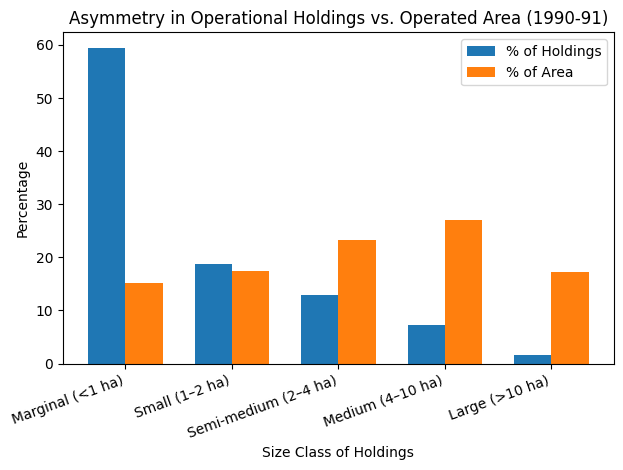
Data from the National Sample Survey Organization (NSSO) reveals a consistent trend towards the proliferation of small and marginal holdings (marginalization).
- Operational Holdings Distribution:
- Marginal Holdings (<1 ha): Increased from roughly
- Large Holdings (>10 ha): Declined significantly in number, from roughly $\text{4.5\\%}$ to $\text{1.6\\%}$ over the same period.
- Marginal Holdings (<1 ha): Increased from roughly
- Area Operated:
- Despite the decline in number, large holdings continued to control a disproportionate share of the land. In 1990-91, the top
- Despite the decline in number, large holdings continued to control a disproportionate share of the land. In 1990-91, the top
- Chart: Disparity in Land Holdings (1990-91)
- The following chart visualizes the disparity between the numerical strength of marginal farmers and the area they control.
Rise of the Middle Peasantry
A sociological outcome of the reforms was the rise of the "Middle Peasantry" (often belonging to Other Backward Classes). The abolition of Zamindars allowed the superior tenants (who were often from intermediate castes) to acquire ownership. This class utilized the Green Revolution technologies of the 1970s and 80s to become the new dominant economic and political force in rural India, shifting the locus of power from the feudal landlords to the rich capitalist farmers.
Comparison Charts
To synthesize the diverse trajectories of land reform, the following tables provide a comparative perspective.
Table 1: Comparative Analysis of Colonial Tenure Systems
| Feature | Zamindari (Permanent Settlement) | Ryotwari | Mahalwari |
| Geographic Focus | Bengal, Bihar, Orissa, Northern Madras | Bombay, Madras, Assam, Sindh | Punjab, UP (Agra), Central Provinces |
| Intermediary | Zamindar recognized as Proprietor | None (Direct state-peasant link) | Village Community (Mahal) / Lambardar |
| Revenue Demand | Fixed in perpetuity (1793) | Variable, revised every 20-40 years | Variable, revised periodically |
| Coverage (approx) | ~19% of British India | ~51% of British India | ~30% of British India |
| Impact on Tenant | High sub-infeudation, rack-renting | Heavy debt, land alienation to moneylenders | Fragmentation, dominance of village headmen |
Table 2: Comparative Ceiling Limits in Selected States (Post-1972)
| State | Family Unit Definition | Ceiling Limit (Irrigated/Best Land) | Ceiling Limit (Dry/Other Land) |
| West Bengal | Family of 5 | 5.00 Standard Hectares (~12.35 acres) | 7.00 Standard Hectares (~17.30 acres) |
| Kerala | Family of 5 | 10 Standard Acres (12-15 ord. acres) | Max 20 acres (regardless of quality) |
| Tamil Nadu | Family of 5 | 15 Standard Acres | Up to 60 acres (depending on conversion) |
| Rajasthan | Family of 5 | 18 Acres | Up to 54 Acres (Desert zones higher) |
| Punjab | Family of 5 | 7 Hectares (First quality) | Up to 21.8 Hectares |
Table 3: Progress of Consolidation of Holdings (up to 1990)
| State | Status of Consolidation | Primary Driver/Barrier |
| Punjab/Haryana | Completed | Green Revolution requirements; Soil homogeneity. |
| Uttar Pradesh | Substantial Progress (Western UP) | Administrative drive; demand for tube-well irrigation. |
| West Bengal | Stalled/Not Implemented | Political decision to protect sharecroppers' unrecorded rights. |
| Tamil Nadu/Kerala | Minimal/Not Implemented | Topographical complexity (undulating terrain); Crop diversity. |
Evaluation of Land Reforms: Success or Failure?
The evaluation of land reforms in India reveals a dichotomy between legislative intent and ground reality.
- Successes:
- Abolition of Intermediaries: This was the most complete success, removing the top layer of the feudal hierarchy and bringing millions into a direct relationship with the state.
- Check on Concentration: Ceiling laws, despite their failure to redistribute massive amounts of land, prevented the further concentration of land in the hands of a few giant corporate-style landlords, checking the growth of Latin American-style latifundia.
- Regional Triumphs: Kerala and West Bengal demonstrated that with political will, structural change was possible, leading to significant improvements in human development indicators and agricultural productivity respectively.
- Failures:
- Land redistribution: The declared surplus was less than $\text{2\\%}$ of the cultivated area, a negligible amount that failed to solve the problem of landlessness.
- Tenancy protection: In many states, tenancy reforms led to the "reverse tenancy" phenomenon or mass evictions, driving tenancy underground into informal, insecure oral leases.
- Inequality: The Gini coefficient of land distribution remained stubbornly high, indicating that the core structure of inequality remained largely intact as India entered the liberalization era.
The land reform agenda, therefore, remained "unfinished business" by 1990, having succeeded in removing the archaic feudal crust but failing to democratize the ownership of the means of production for the vast majority of the rural poor.
- Analyze the extent to which the definition of "Personal Cultivation" in tenancy legislations undermined the objective of "Land to the Tiller" across different states during the 1960s. (250 words)
- "The Green Revolution necessitated land consolidation but marginalized the landless." Critically evaluate this statement in the context of the agrarian structure of Punjab and Haryana between 1970 and 1990. (250 words)
- Compare the efficacy of the "bureaucratic" approach to land reform in Uttar Pradesh with the "politicized" approach of Operation Barga in West Bengal. Which yielded better equity outcomes? (250 words)


Responses