
[Newsbits] 8-11.04.2024: SWAMIH Fund, Igla-S, Health of Nation Report & More

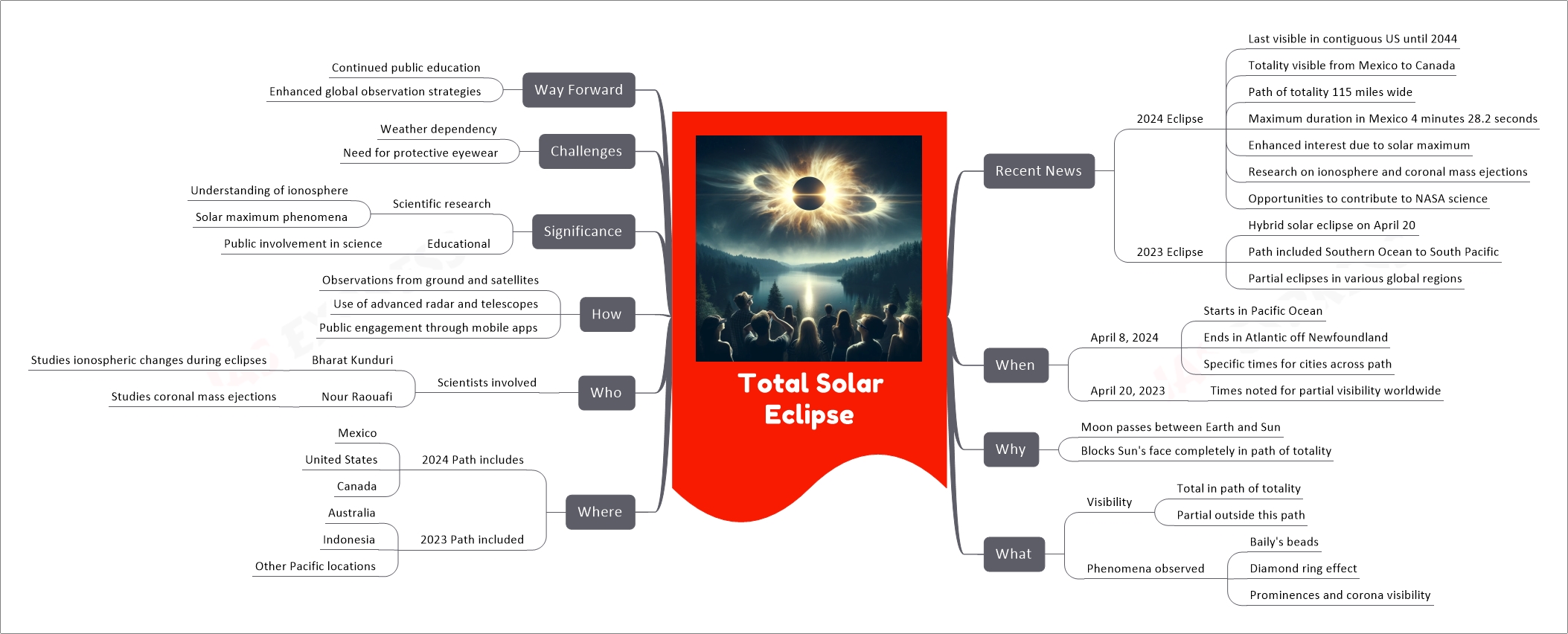
The total solar eclipse on April 8, 2024, is a significant astronomical event where the Moon will completely block the Sun across a path from Mexico through the U.S. and into Canada. This will be the last such eclipse visible from the contiguous U.S. until 2044, making it a unique opportunity for both public viewing and scientific research. Observers in the path of totality will experience a brief period of darkness and have the chance to see the Sun’s corona. This eclipse is particularly important for scientists as it coincides with a period of heightened solar activity, allowing for detailed studies of the Sun’s atmosphere and its effects on Earth’s ionosphere. Opportunities for public engagement and educational activities will enhance understanding and appreciation of solar physics and eclipse phenomena.
NASA is deploying two WB-57 jet planes to chase the total solar eclipse on April 8, 2024, across North America. This mission aims to utilize the extended viewing time and unique vantage point provided by high-altitude flight to gather detailed scientific data on the sun’s corona, coronal mass ejections, and the impact of solar radiation on Earth’s upper atmosphere. The jets, flying in formation and equipped with specialized instruments like spectrometers and high-resolution cameras, will enhance the observation time of totality beyond what is possible from the ground, thus offering a rare opportunity for advancing our understanding of solar phenomena.
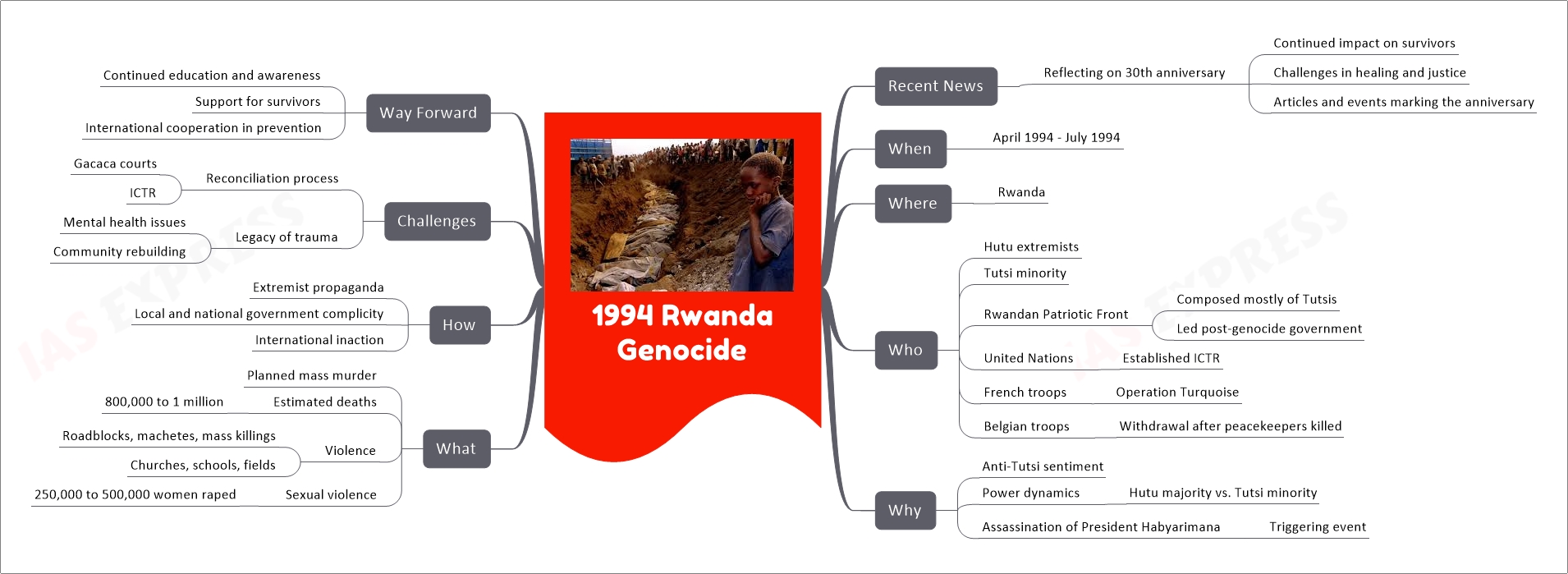
The 1994 Rwanda Genocide was a tragic and brutal mass slaughter that occurred over approximately 100 days, from April to July 1994, in the East African country of Rwanda. The genocide was carried out by the Hutu majority government against the Tutsi minority and moderate Hutus. The violence erupted following the assassination of President Juvénal Habyarimana, an event that led to a devastating cascade of killings orchestrated by Hutu extremists. During this period, an estimated 800,000 to 1 million Tutsis and moderate Hutus were killed. The genocide ended when the Rwandan Patriotic Front (RPF), a Tutsi-led rebel group, took control of the country and established a new government aimed at national unity and reconciliation. Despite the efforts at reconciliation and justice, including the establishment of the International Criminal Tribunal for Rwanda (ICTR) and local Gacaca courts, Rwanda continues to deal with the deep scars left by this atrocity.
The 4th edition of Apollo Hospitals’ Health of the Nation Report, released on World Health Day, delves into the escalating burden of non-communicable diseases (NCDs) in India. It underscores the critical need for preventive healthcare to combat diseases such as diabetes, hypertension, and cancer, which are prevalent across the country. The report advocates for comprehensive health checks from an early age to mitigate these diseases, emphasizes the role of technology and AI in predictive health, and introduces enhanced health programs like ProHealth to tailor preventive care to individual needs.
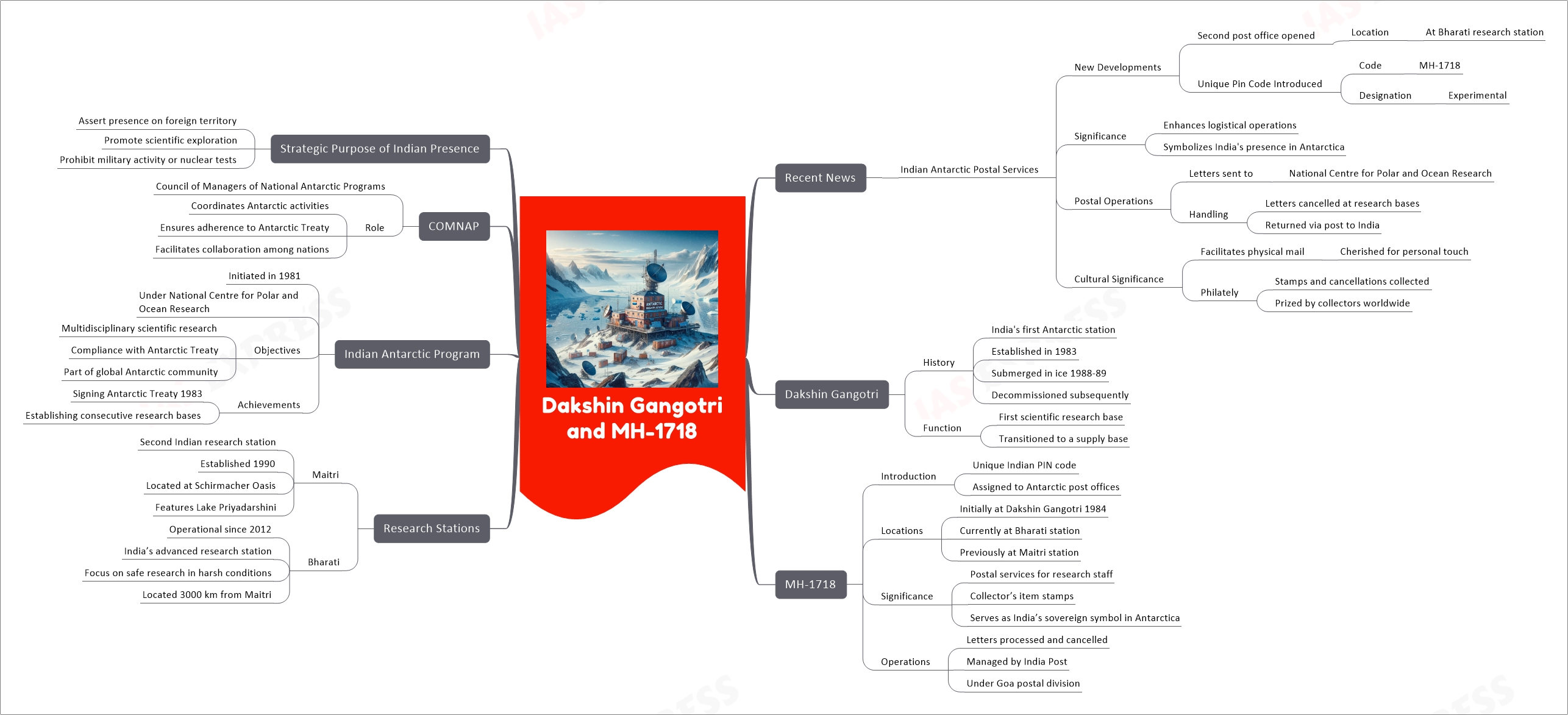
The Indian Antarctic Program, established in 1981, made significant strides by setting up Dakshin Gangotri, India’s first scientific research station in Antarctica. This station was later succeeded by the Maitri and Bharati stations as part of India’s continued presence and research efforts on the continent. The recent introduction of the PIN code MH-1718, uniquely assigned to these remote outposts, facilitates postal services for research personnel, making these stations part of the Goa postal division and symbolizing India’s sovereignty in Antarctica. This initiative not only enhances India’s scientific contributions but also serves a strategic geopolitical purpose under the Antarctic Treaty System. Additionally, a second post office was recently opened at the Bharati research station, and the new PIN code MH-1718 was introduced to streamline operations and communications between India’s Antarctic bases and the mainland. This development underlines the strategic importance of maintaining a robust presence in Antarctica, supported by the National Centre for Polar and Ocean Research in Goa. The post offices serve operational needs and have cultural significance, providing a means for researchers to send physical mail, a practice cherished for its personal touch compared to digital communication.
The Igla-S MANPADS, a highly advanced man portable air defense system, was developed in Russia and introduced in 2004. Designed to engage low-flying aircraft effectively, it features a range of up to 6 kilometers and can operate in all weather conditions. Recently, India has taken significant steps to incorporate this system into its military, focusing on enhancing its short-range air defense capabilities along its northern borders. This move includes a large contract for the procurement and local production of the Igla-S, aiming to modernize its military assets and strengthen its defense infrastructure.
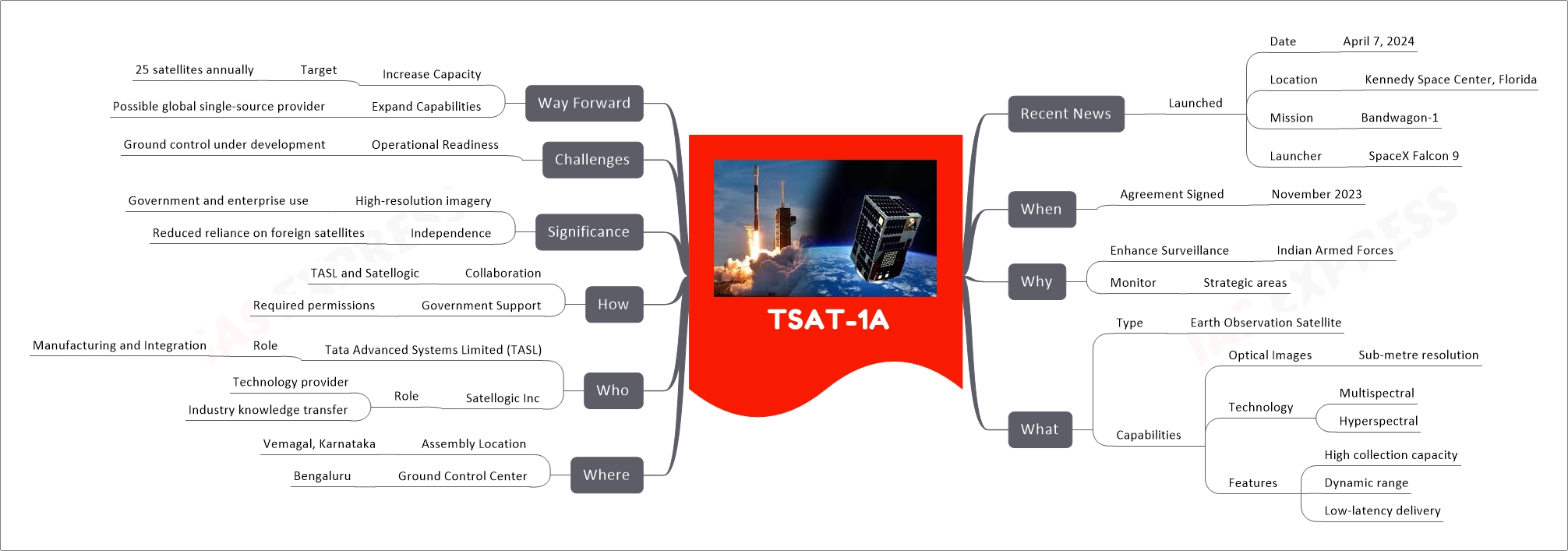
TSAT-1A is India’s first privately built military-grade satellite, developed by Tata Advanced Systems Limited (TASL) in collaboration with Satellogic Inc. Launched on April 7, 2024, aboard SpaceX’s Falcon 9 rocket from Kennedy Space Center, Florida, TSAT-1A is designed for Earth observation with sub-metre resolution optical imaging capabilities. It features advanced multispectral and hyperspectral technologies to provide high-resolution images which can be used for both government and enterprise purposes. The satellite aims to enhance Indian surveillance capabilities and reduce reliance on foreign satellites for critical data.
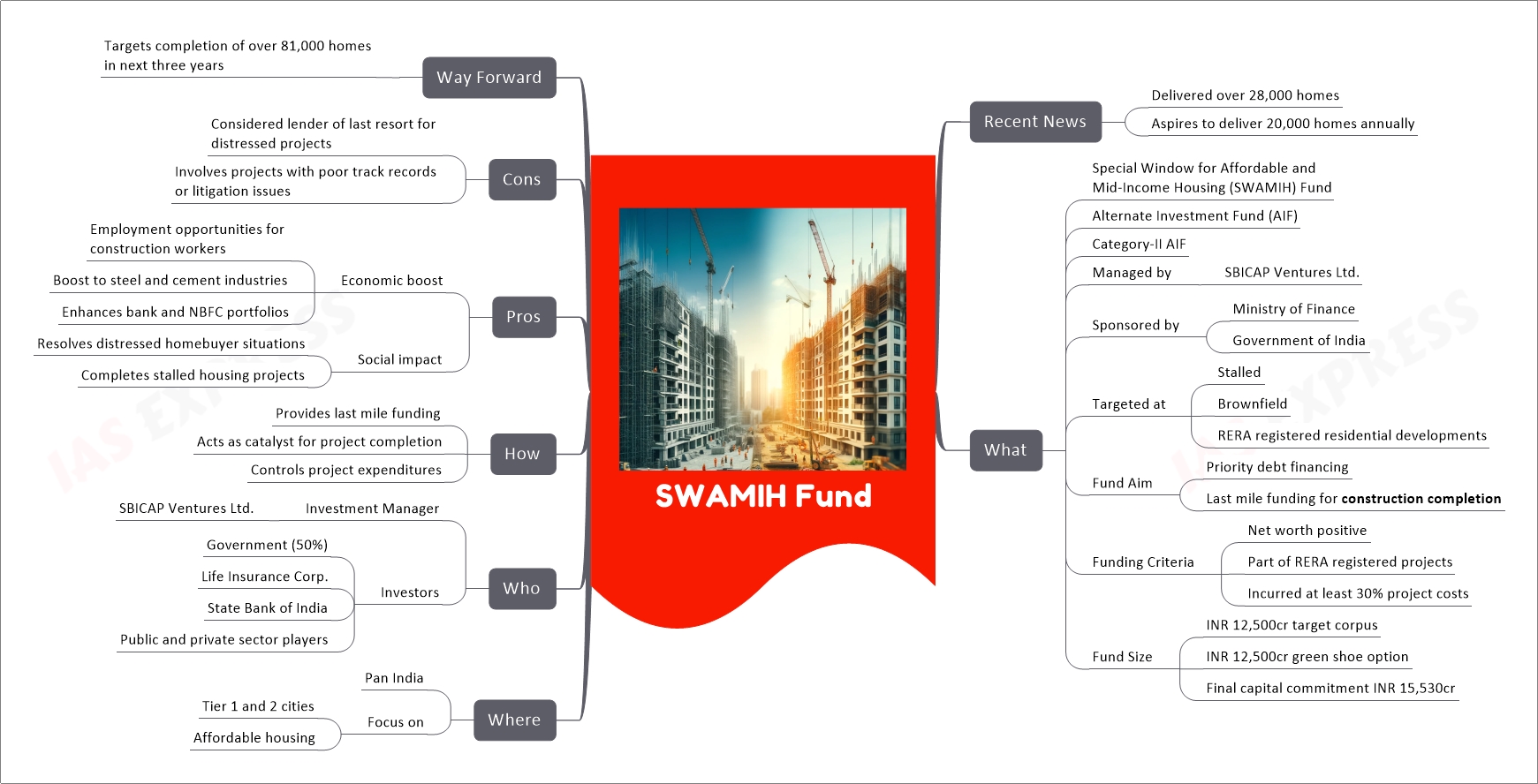
The SWAMIH Fund, managed by SBICAP Ventures and sponsored by India's Ministry of Finance, aims to address the issue of stalled and distressed housing projects across India by providing last-mile funding. It focuses on projects that are net worth positive and RERA registered, requiring funding to complete construction. With a substantial corpus aimed at revitalizing the real estate sector, the fund has already made significant strides, delivering tens of thousands of homes and aiming to continue this trend in the coming years.
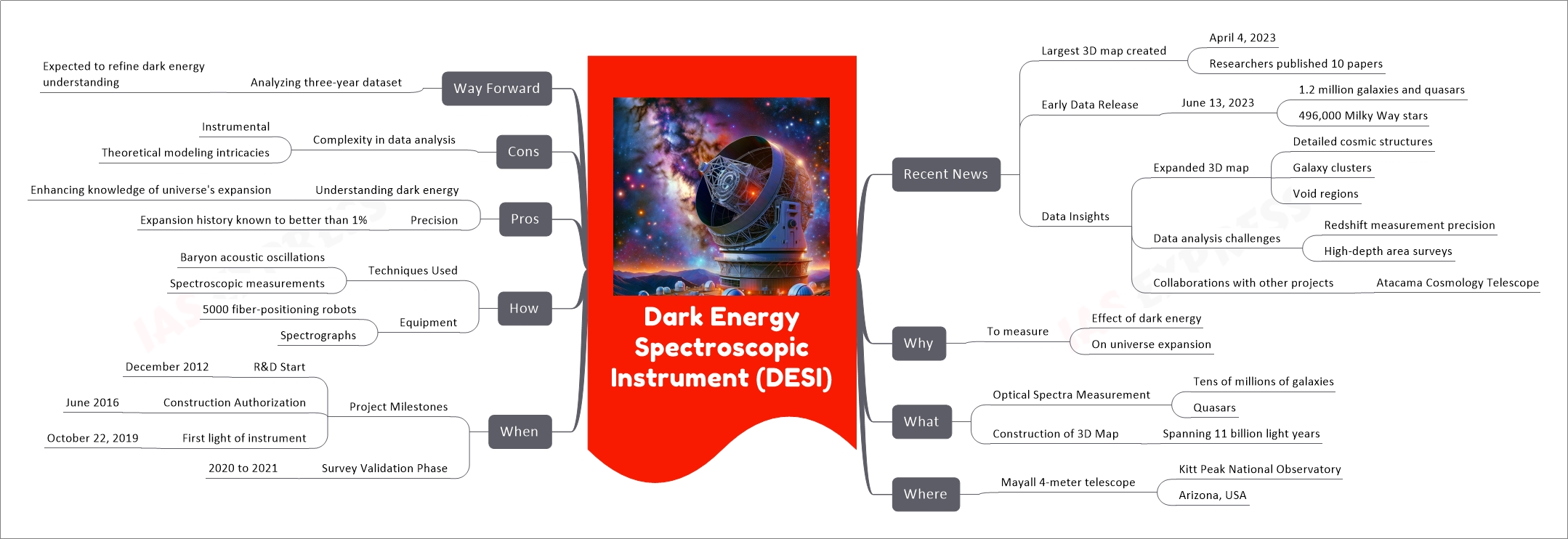
The Dark Energy Spectroscopic Instrument (DESI) is a powerful astronomical tool hosted at the Mayall 4-meter telescope in Arizona’s Kitt Peak National Observatory in United States. It is designed to measure the effects of dark energy on the expansion of the universe by obtaining optical spectra from tens of millions of galaxies and quasars, thus creating the largest 3D map of the universe to date. DESI operates under the guidance of key figures like Michael Levi and involves a complex setup including 5000 fiber-positioning robots and a series of spectrographs. Recent milestones include the release of an early data set in June 2023, which has already enhanced our understanding of the universe’s expansion with remarkable precision.
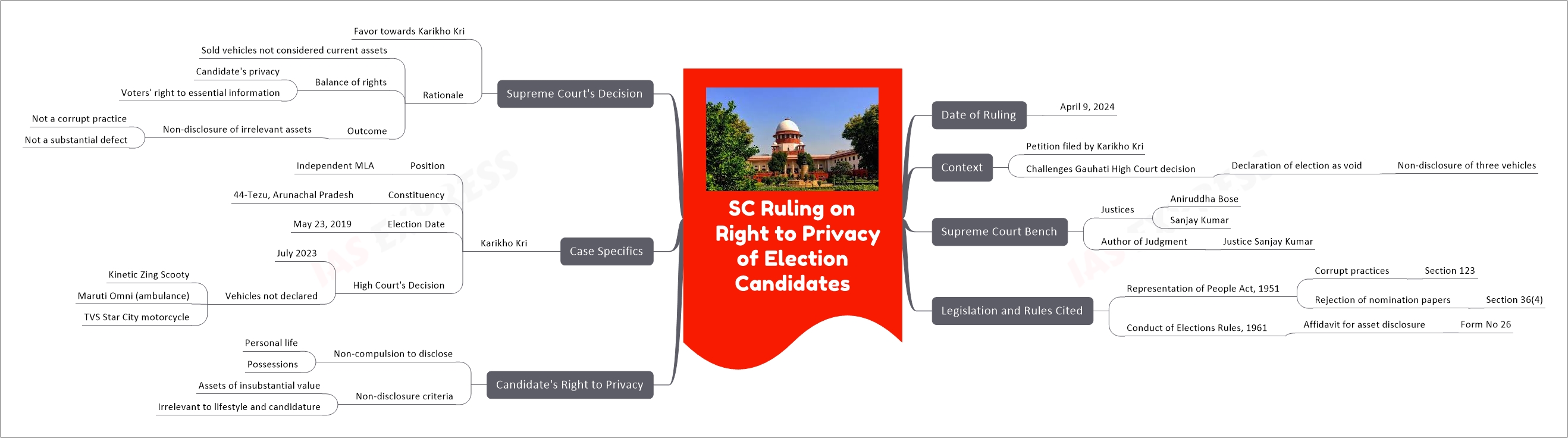
On April 9, 2024, the Supreme Court of India ruled in favor of maintaining a candidate's right to privacy in electoral processes, concerning a petition by Arunachal Pradesh MLA Karikho Kri. The court overturned a previous decision by the Gauhati High Court that had voided Kri's election for failing to declare three vehicles in his affidavit. Justices Aniruddha Bose and Sanjay Kumar clarified that non-disclosure of assets, which are either of insubstantial value or irrelevant to the candidate's lifestyle and public duties, does not constitute a corrupt practice under the Representation of People Act, 1951. This landmark decision underscores the balance between a candidate’s privacy and the voter's right to essential information, shaping future no

If you like this post, please share your feedback in the comments section below so that we will upload more posts like this.



Responses