Self-Regulatory Organisations (SROs) for Regulated Entities

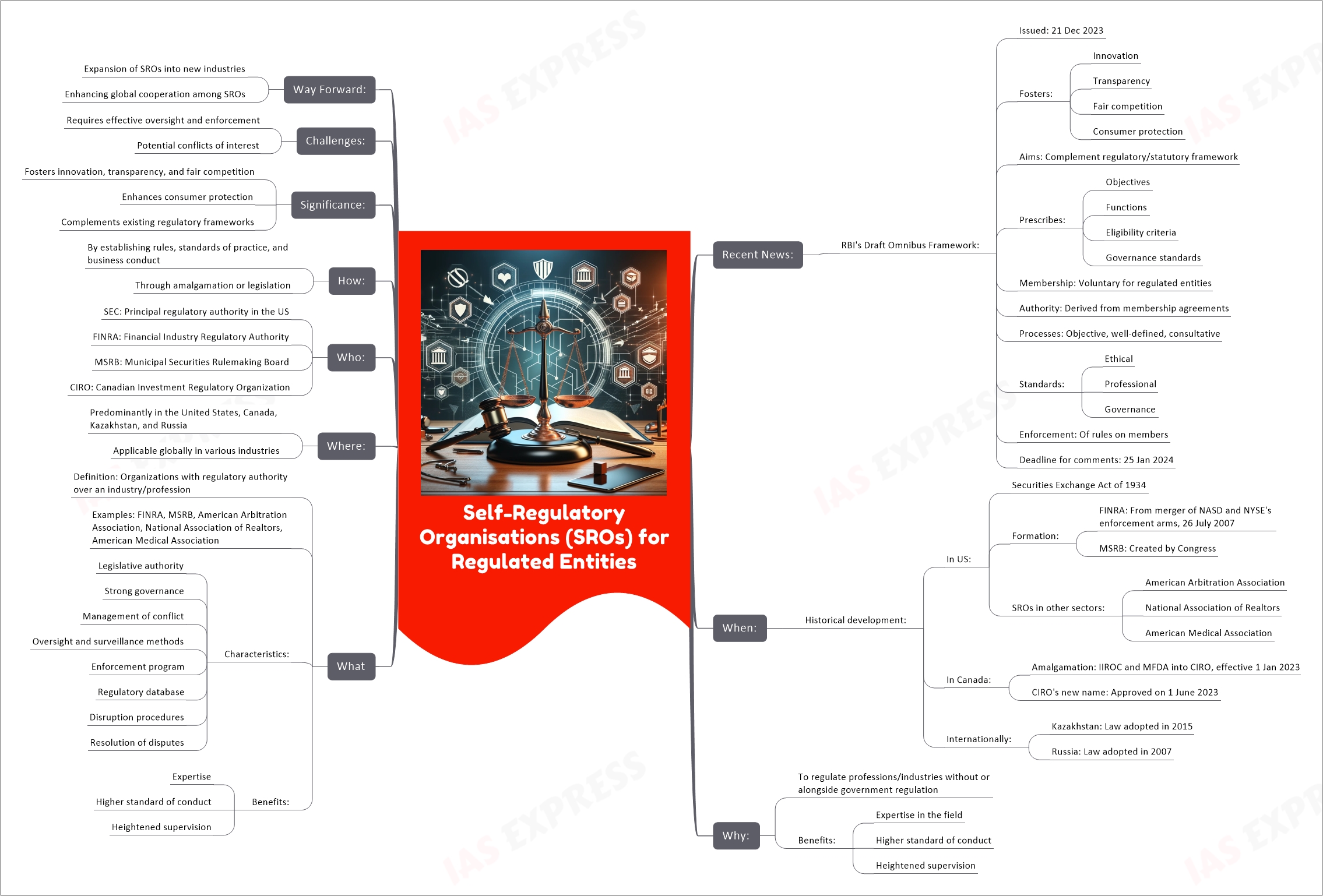
Self-Regulatory Organisations (SROs) for Regulated Entities mind map

  Recent News:
    RBI's Draft Omnibus Framework:
      Issued: 21 Dec 2023
      Fosters:
        Innovation
        Transparency
        Fair competition
        Consumer protection
      Aims: Complement regulatory/statutory framework
      Prescribes:
        Objectives
        Functions
        Eligibility criteria
        Governance standards
      Membership: Voluntary for regulated entities
      Authority: Derived from membership agreements
      Processes: Objective, well-defined, consultative
      Standards:
        Ethical
        Professional
        Governance
      Enforcement: Of rules on members
      Deadline for comments: 25 Jan 2024
  When:
    Historical development:
      In US:
        Securities Exchange Act of 1934
        Formation:
          FINRA: From merger of NASD and NYSE's enforcement arms, 26 July 2007
          MSRB: Created by Congress
        SROs in other sectors:
          American Arbitration Association
          National Association of Realtors
          American Medical Association
      In Canada:
        Amalgamation: IIROC and MFDA into CIRO, effective 1 Jan 2023
        CIRO's new name: Approved on 1 June 2023
      Internationally:
        Kazakhstan: Law adopted in 2015
        Russia: Law adopted in 2007
  Why:
    To regulate professions/industries without or alongside government regulation
    Benefits:
      Expertise in the field
      Higher standard of conduct
      Heightened supervision
  What
    Definition: Organizations with regulatory authority over an industry/profession
    Examples: FINRA, MSRB, American Arbitration Association, National Association of Realtors, American Medical Association
    Characteristics:
      Legislative authority
      Strong governance
      Management of conflict
      Oversight and surveillance methods
      Enforcement program
      Regulatory database
      Disruption procedures
      Resolution of disputes
    Benefits:
      Expertise
      Higher standard of conduct
      Heightened supervision
  Where:
    Predominantly in the United States, Canada, Kazakhstan, and Russia
    Applicable globally in various industries
  Who:
    SEC: Principal regulatory authority in the US
    FINRA: Financial Industry Regulatory Authority
    MSRB: Municipal Securities Rulemaking Board
    CIRO: Canadian Investment Regulatory Organization
  How:
    By establishing rules, standards of practice, and business conduct
    Through amalgamation or legislation
  Significance:
    Fosters innovation, transparency, and fair competition
    Enhances consumer protection
    Complements existing regulatory frameworks
  Challenges:
    Requires effective oversight and enforcement
    Potential conflicts of interest
  Way Forward:
    Expansion of SROs into new industries
    Enhancing global cooperation among SROs

Self-Regulatory Organizations (SROs) for Regulated Entities play a crucial role in regulating professions and industries, either in the absence of or alongside government regulation. They are typically non-governmental organizations responsible for setting and enforcing standards, rules, and conduct within their respective domains. SROs like the Financial Industry Regulatory Authority (FINRA) in the United States or the Canadian Investment Regulatory Organization (CIRO) in Canada, offer numerous benefits including expertise in their fields, maintaining higher standards of conduct, and ensuring heightened supervision without direct government involvement. This approach fosters innovation, transparency, fair competition, and consumer protection, complementing the existing regulatory frameworks.

Related Posts
If you like this post, please share your feedback in the comments section below so that we will upload more posts like this.

Responses

🖍️ Highlight
HomeCoursesPlansAccount