[Newsbits] 2-4.03.2024: International Big Cat Alliance (IBCA), Spaceports in India & More

newsbits mindmap notes
/ Important Days
World Wildlife Day 2024 mind map
  Recent News
    Theme
      Connecting People and Planet
      Exploring Digital Innovation in Wildlife Conservation
    Organized by
      CITES Secretariat
      United Nations Development Programme
      WILDLABS
      Jackson Wild
      International Fund for Animal Welfare
  When
    Date
      March 3, 2024
    UN high-level event
      March 4, 2024
      United Nations Headquarters in New York
      Livestreamed on United Nations WebTV
  Why
    To celebrate and raise awareness
      Of world's wild fauna and flora
    To highlight
      Digital conservation technologies and services
      Sustainable and legal wildlife trade
      Human-wildlife coexistence
  What
    Global digital revolution
      Breaking down barriers
      To people-centered digital governance
      To equal opportunities for digital transformation
    Narrowing digital divide
      Connectivity and Internet access reaching 66% of global population
    Challenges
      2.7 billion people not online
      Only 36% in least developed countries online
      Gaps in Internet access for women and young people
    Technological innovation in conservation
      Research, communication, tracking, DNA analysis
    Critical issues
      Uneven access to new tools
      Environmental pollution
      Unsustainable applications of certain technologies
  Where
    Global event
    Special focus on digital innovation in wildlife conservation
  Who
    CITES Secretariat
      Facilitator for global observance
    United Nations Development Programme (UNDP)
    WILDLABS
    Jackson Wild
      Host of the World Wildlife Day Showcase
    International Fund for Animal Welfare (IFAW)
      Host of the World Wildlife Day Youth Art Contest
  How
    Intergenerational exchange and youth empowerment
      Through art, presentations, conversations
    Exploring digital innovations
      Available now and in the future
    Highlighting
      Latest applications of digital technologies in wildlife conservation and trade
      Impact of digital interventions on ecosystems and communities
  Significance
    Equips people with job-ready digital skills
    Supports indigenous and women-led initiatives
    Expands "financial inclusion"
    Prevents fraud in illegal trade of animals and plants
    Shares information on wildlife populations
  Challenges
    Digital divide
      2.7 billion people not online
      Limited online access in least developed countries
    Gender and youth disparities in Internet use
    Detrimental use of digital technologies
      Illegal sale of protected species on the Internet
  Way Forward
    Mobilize new commitments to policy and funding
      For sustainable adaptation and preservation of nature
    Bridging financial gaps for equitable access to conservation tools
    Strengthening digital capacity-building
    Considering impacts on all communities and ecosystems

World Wildlife Day 2024 focuses on the theme “Connecting People and Planet: Exploring Digital Innovation in Wildlife Conservation.” It aims to highlight the role of digital technologies in wildlife conservation, sustainable trade, and fostering human-wildlife coexistence. Organized by the CITES Secretariat, this year’s event underscores the importance of digital transformation in addressing environmental challenges and ensuring the protection of biodiversity for future generations. The initiative also emphasizes intergenerational exchange, youth empowerment, and bridging the digital divide to ensure equitable access to conservation tools and technologies.
/ Judiciary/Justice
SC seeks to Incentivize Super performer Judges mind map
  Recent News
    Chief Justice DY Chandrachud's statement
    March 2024
    Objective framework development
    Overturned 2018 judgment
      Automatic vacation of stay orders
      Civil and criminal cases
      Five-judge Constitution Bench
        Headed by Chief Justice D Y Chandrachud
      Timeline for case disposal
        Fixed only in exceptional circumstances
  When
    March 2024
  Why
    Motivate trial court judges
    Efficiently clearing case backlogs
    Additional incentives
  What
    Recognize "super performer" judges
    Nationwide
    Objective framework
      Disposal rates
      Backlog reduction metrics
      Judgment quality
        Legal soundness
        Clarity
        Analysis depth
      Courtroom administration
        Timeliness
        Decorum
        Transparency
      Initiative taking
      Work ethic
      Diligence
      Handling complex cases
        Sensitive
        Bold
        Amidst external pressures
    Additional Benefits
      Over regular pay
      Promotions
      Postings
  Where
    Across India
  Who
    Chief Justice of India
      DY Chandrachud
    Trial court judges
    Supreme Court of India
  How
    Developing an objective framework
    Reward frameworks
  Significance
    Motivates efficient case clearing
    Addresses massive case backlog
    Aims to inspire culture of excellence
    Links performance to incentives
  Challenges
    Details pending on parameters
    Equating performance across diverse contexts
  Way Forward
    Implementation of objective framework
    Continuous evaluation and adjustment

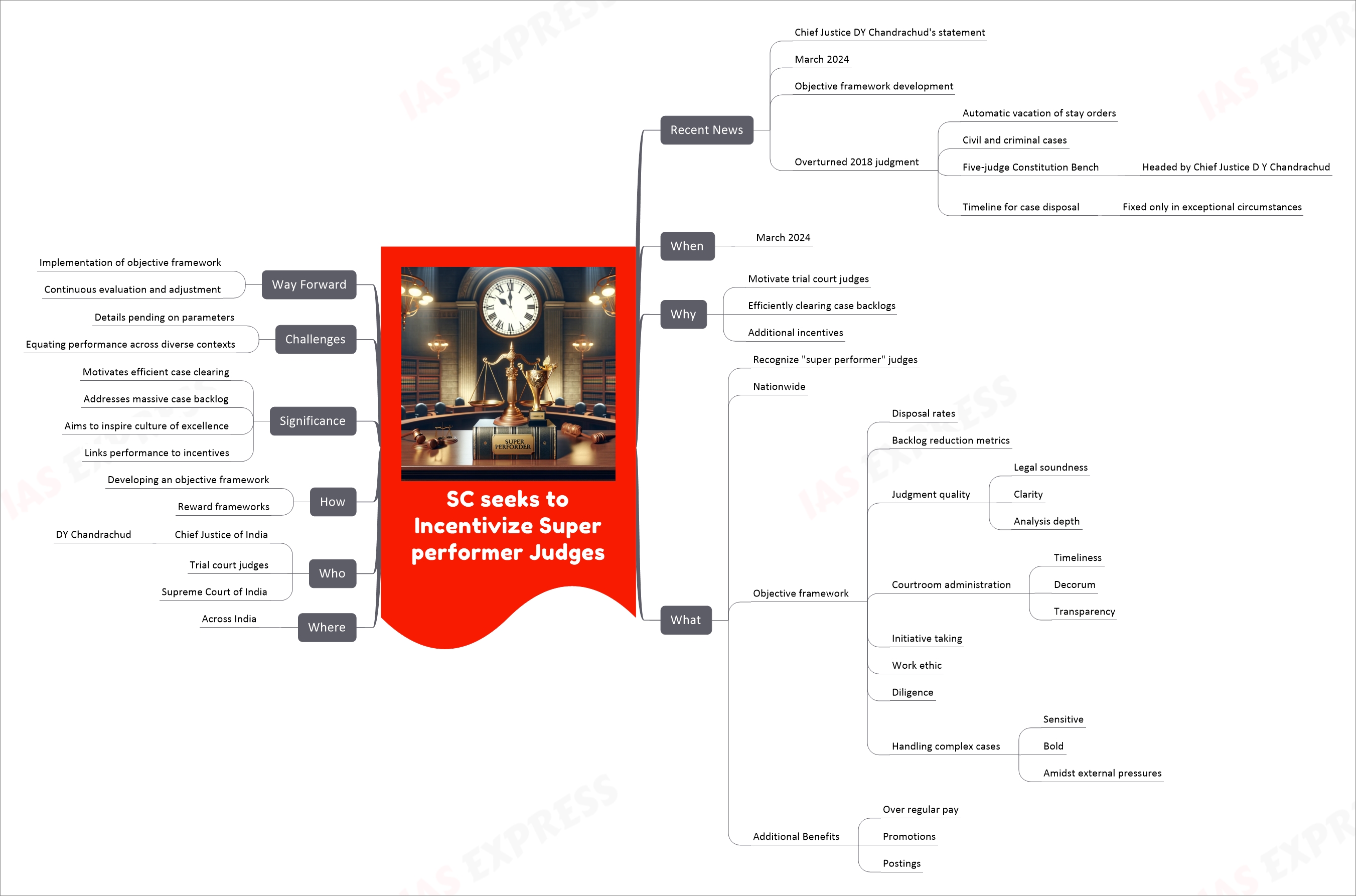
The Supreme Court of India, under the leadership of Chief Justice DY Chandrachud, is planning to introduce an objective framework to identify and incentivize “super performer” judges within the trial courts across India. This initiative, announced in March 2024, aims to address the massive backlog of over 4.5 crore cases by motivating judges to efficiently clear cases through additional incentives. The criteria for recognizing these high performers are expected to include disposal rates, judgment quality, courtroom administration, initiative, work ethic, and the ability to handle complex cases. This move is seen as a significant step towards inspiring a culture of excellence in India’s lower judiciary and linking performance with incentives, providing a higher purpose for judges contributing significantly to backlog reduction.
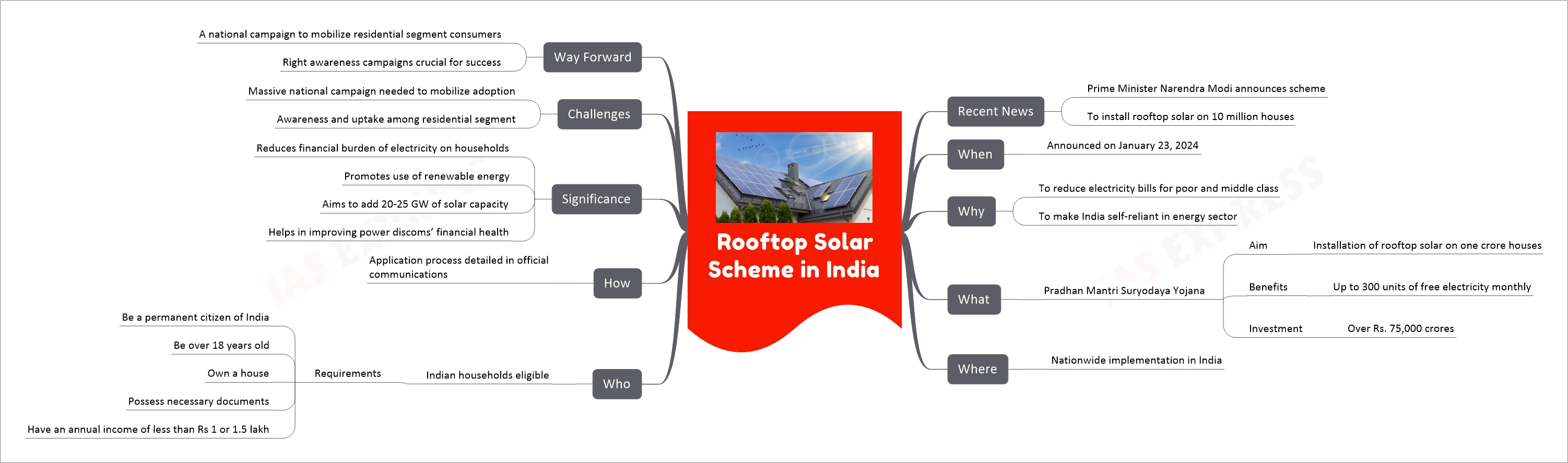
Rooftop Solar Scheme mind map
  Recent News
    Prime Minister Narendra Modi announces scheme
    To install rooftop solar on 10 million houses
  When
    Announced on January 23, 2024
  Why
    To reduce electricity bills for poor and middle class
    To make India self-reliant in energy sector
  What
    Pradhan Mantri Suryodaya Yojana
      Aim
        Installation of rooftop solar on one crore houses
      Benefits
        Up to 300 units of free electricity monthly
      Investment
        Over Rs. 75,000 crores
  Where
    Nationwide implementation in India
  Who
    Indian households eligible
      Requirements
        Be a permanent citizen of India
        Be over 18 years old
        Own a house
        Possess necessary documents
        Have an annual income of less than Rs 1 or 1.5 lakh
  How
    Application process detailed in official communications
  Significance
    Reduces financial burden of electricity on households
    Promotes use of renewable energy
    Aims to add 20-25 GW of solar capacity
    Helps in improving power discoms’ financial health
  Challenges
    Massive national campaign needed to mobilize adoption
    Awareness and uptake among residential segment
  Way Forward
    A national campaign to mobilize residential segment consumers
    Right awareness campaigns crucial for success

The Rooftop Solar Scheme in India, formally known as the Pradhan Mantri Suryodaya Yojana, was launched by Prime Minister Narendra Modi with the aim of installing rooftop solar panels on 10 million households across the country. Announced in January 2024, the scheme targets reducing electricity bills for the poor and middle class while promoting energy self-reliance in India. Beneficiaries are promised up to 300 units of free electricity monthly, with the government investing over Rs. 75,000 crores in this initiative. Eligible households must meet certain criteria, including being permanent citizens of India, over 18 years old, owning a house, possessing necessary documents, and having an annual income below a specified threshold. The scheme represents a significant step towards enhancing the utilization of renewable energy sources within India, aiming to alleviate financial burdens on households and contribute to the country’s energy security​​​​​​​​​​.

/ Space
Spaceports in India mind map
  Recent News:
    Kulasekarapattinam Spaceport:
      Foundation laid by:
        Narendra Modi
      Location:
        Tamil Nadu
      Dedicated to:
        Small Satellite Launch Vehicles (SSLV)
      Construction timeline:
        Two years
      Strategic benefits:
        Fuel savings
        Direct south launch over Indian Ocean
      Investment:
        $119 million (986 crores Indian rupees)
      Launch frequency:
        24 launches per year
    Satish Dhawan Space Centre (SDSC):
      Location:
        Sriharikota, Andhra Pradesh
      Primary spaceport:
        For ISRO
      Launch pads:
        Two functioning
      Director:
        Arumugam Rajarajan
      Features:
        Near equator
        Large uninhabited area
        Coastal length of 27 km
      Launch history:
        First rocket launch in 1971
        SLV and ASLV programs
  When:
    SDSC operational since 1971
    Kulasekarapattinam spaceport construction expected to complete in two years from foundation laying
  Why:
    Kulasekarapattinam:
      To cater to small satellite launches
      Avoid overflying Sri Lanka for polar orbits
    SDSC:
      Primary orbital launch site
      Ideal location near equator
  What
    SDSC:
      Two launch pads
      Supports a wide range of missions
    Kulasekarapattinam:
      Mobile launch structure
      24 launches per year capacity
  Where:
    SDSC:
      Sriharikota, Andhra Pradesh
    Kulasekarapattinam:
      Tamil Nadu
  Who:
    ISRO
    Narendra Modi
    S Somanath
    Arumugam Rajarajan
  How:
    SDSC:
      Utilizing existing infrastructure
      Launches supported by ISRO Range Complex
    Kulasekarapattinam:
      New construction
      Mobile launch structure
  Significance:
    SDSC:
      Proven track record
      Supports major ISRO missions
    Kulasekarapattinam:
      Fuel efficiency
      Increased launch capacity
  Challenges:
    Kulasekarapattinam:
      New infrastructure setup
      Meeting planned launch frequency
  Way Forward:
    Completion of Kulasekarapattinam construction
    Expansion of India's launch capabilities

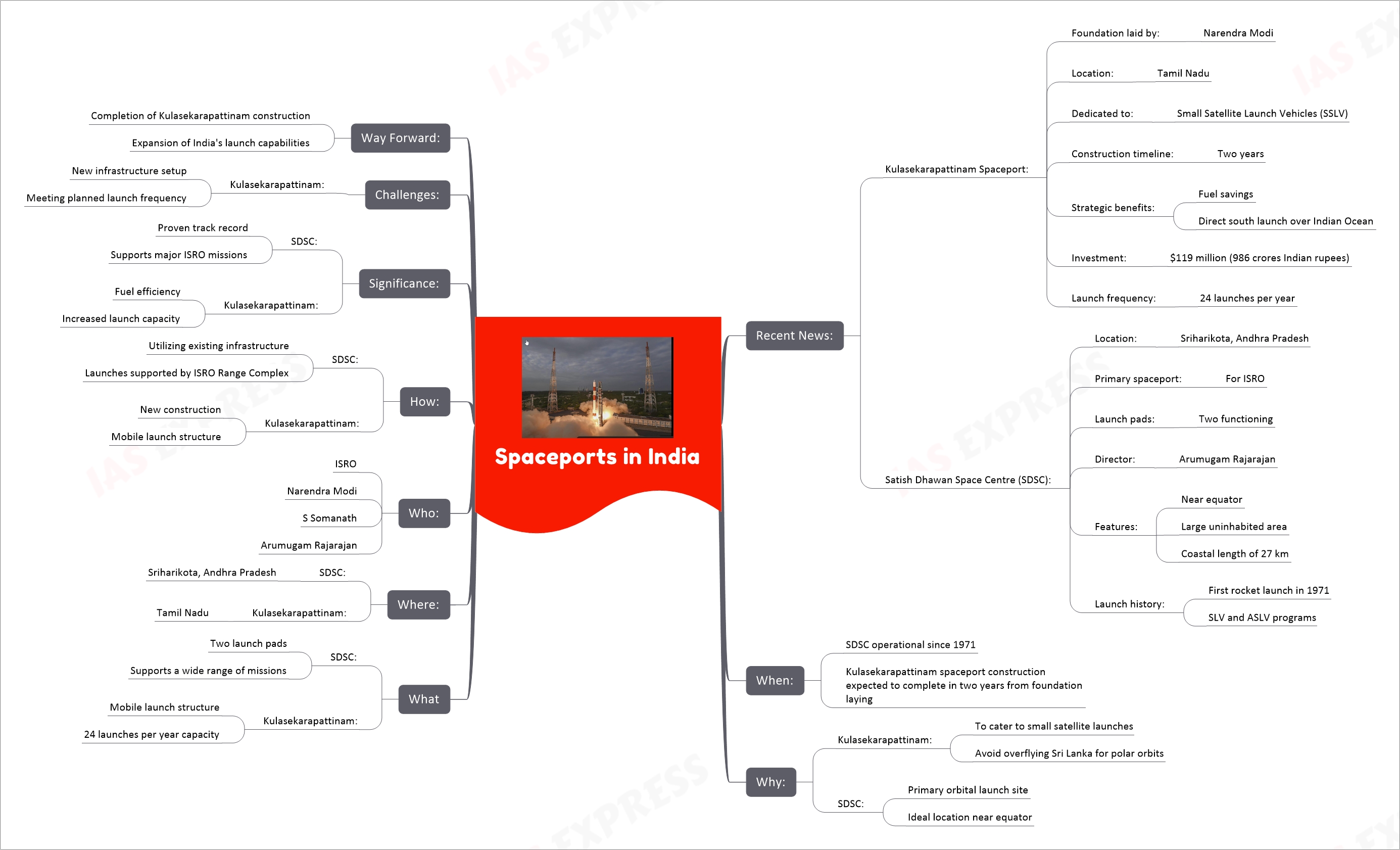
India is enhancing its space launch capabilities with two major spaceports. The Satish Dhawan Space Centre (SDSC) in Sriharikota, Andhra Pradesh, has been operational since 1971, serving as India’s primary orbital launch site. It benefits from its near-equatorial location, which is ideal for launching satellites into space due to the Earth’s rotational speed boost. The centre has two functioning launch pads and has witnessed significant launches, including India’s lunar exploration probes.

On the other hand, India is constructing a new spaceport in Kulasekarapattinam, Tamil Nadu, dedicated to launching smaller launch vehicles with an investment of $119 million. This spaceport aims to conduct 24 launches per year using a mobile launch structure and is expected to be completed in two years. The new facility will cater to the increasing demand for small satellite launches, offering strategic benefits such as fuel savings and the ability to launch directly south over the Indian Ocean. This expansion reflects India’s growing participation in global space developments and its ambition to become a significant player in the space industry​​​​​​​​​​​​.

/ Sri Lanka
India Funds $11M Renewable Energy Project in Sri Lanka mind map
  Recent News
    India inked $11 million grant project
    With Sri Lanka and a private partner
    To install hybrid renewable energy infrastructure
    Across three islands off Jaffna peninsula
  When
    March 2nd
  Why
    For Colombo's energy security
    Economic recovery
  What
    Hybrid renewable energy systems
      Using solar photovoltaics
      Wind turbines
      Supported by battery storage solutions
    To meet baseload power needs of island communities
    Providing 24x7 clean electricity access
    To households, commercial establishments, public institutions
    Project includes
      Installing transmission infrastructure
      Distribution networks
      Setting up 70 charging stations
      Providing solar panels to villages
      Sustainability features
        LED street lighting
        Smart meters
        Microgrids with remote monitoring
    Indian renewable firm U-Solar Clean Energy Solutions
      Signed contract to construct systems
      In Delft (Neduntheevu), Nainativu, Analaitivu islands
    Funding from Indian government
    Local oversight by Sri Lanka Sustainable Energy Authority
  Where
    Three islands off Jaffna peninsula
    Northern Sri Lanka
  Who
    National Thermal Power Corporation
      Spearheading a solar venture in Sampur town
    Adani Group
      Setting up renewable energy projects in Mannar, Pooneryn
    U-Solar Clean Energy Solutions
      Contracted firm for system construction
    Sri Lanka Sustainable Energy Authority
      Providing local oversight
  How
    Through an $11 million grant project
    Collaboration between India, Sri Lanka, and a private partner
  Significance
    Enhances energy security and economic recovery for Sri Lanka
    Supports India's neighborhood first policy
      Spanning humanitarian assistance
      Connectivity infrastructure
      Community development cooperation
    Marks milestone in India-Sri Lanka collaboration
      Across food, fuel, medicines, livelihood packages
    Pushes for greater renewable energy adoption
    Inform sustainable de-centralized electrification roadmaps
  Challenges
    Countering Chinese investments in northern islands
  Way Forward
    Lessons to inform sustainable electrification for remote locations
    Approximates Colombo’s pivot from Chinese dependency
    Towards balanced Indo-Sri Lanka regional dynamic

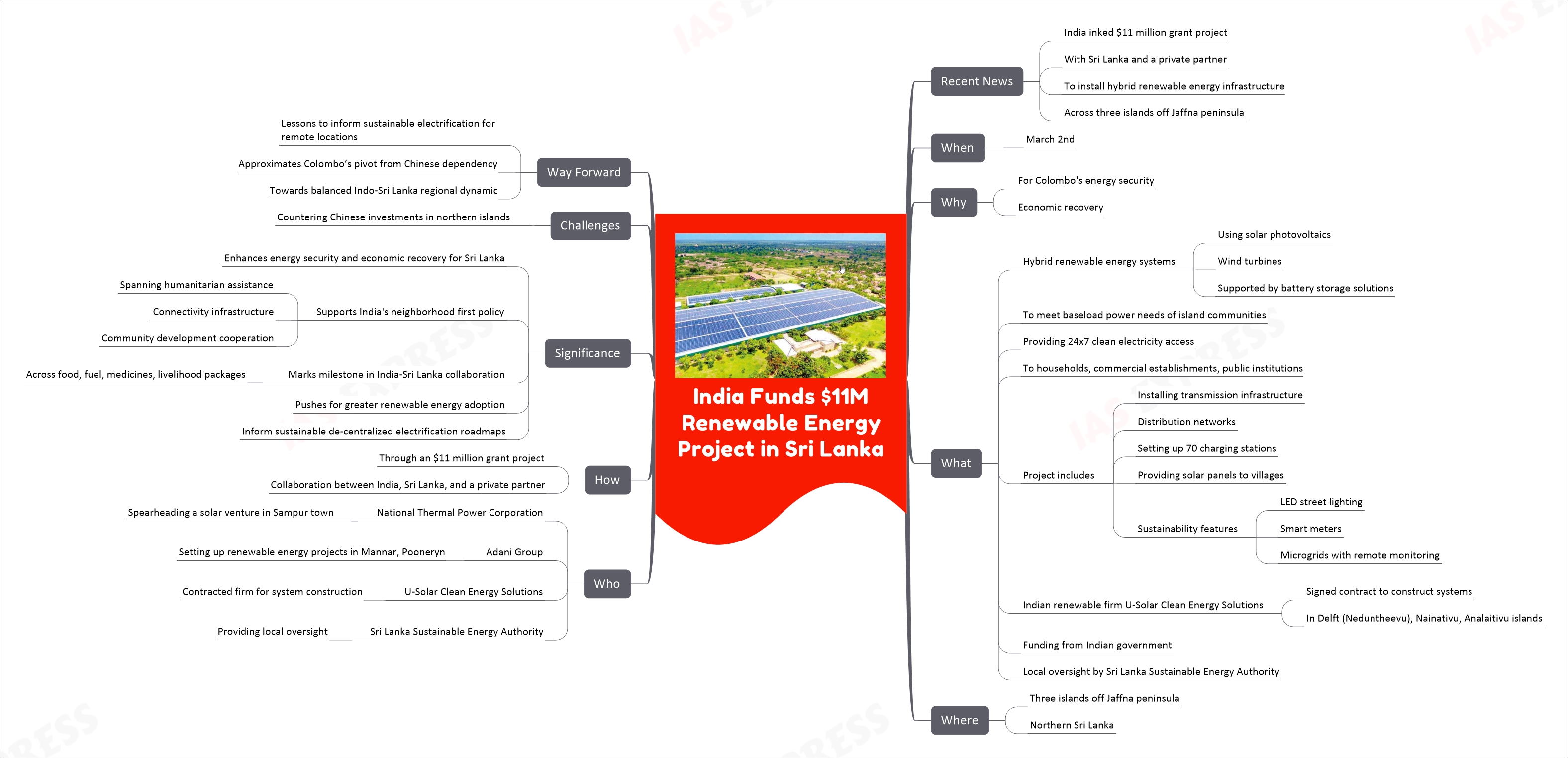
The project involves India granting $11 million to Sri Lanka, in collaboration with a private partner, to install hybrid renewable energy systems across three islands off the Jaffna peninsula in northern Sri Lanka. This initiative aims to bolster Sri Lanka’s energy security and aid in its economic recovery, marking the third India-backed energy project in the region. The effort supports India’s “neighborhood first” policy, emphasizing humanitarian assistance, connectivity, and community development cooperation during Sri Lanka’s challenging transition. By focusing on sustainable energy infrastructure, the project also reflects India’s commitment to promoting renewable energy adoption and could serve as a model for decentralized electrification in remote areas, including within India itself.
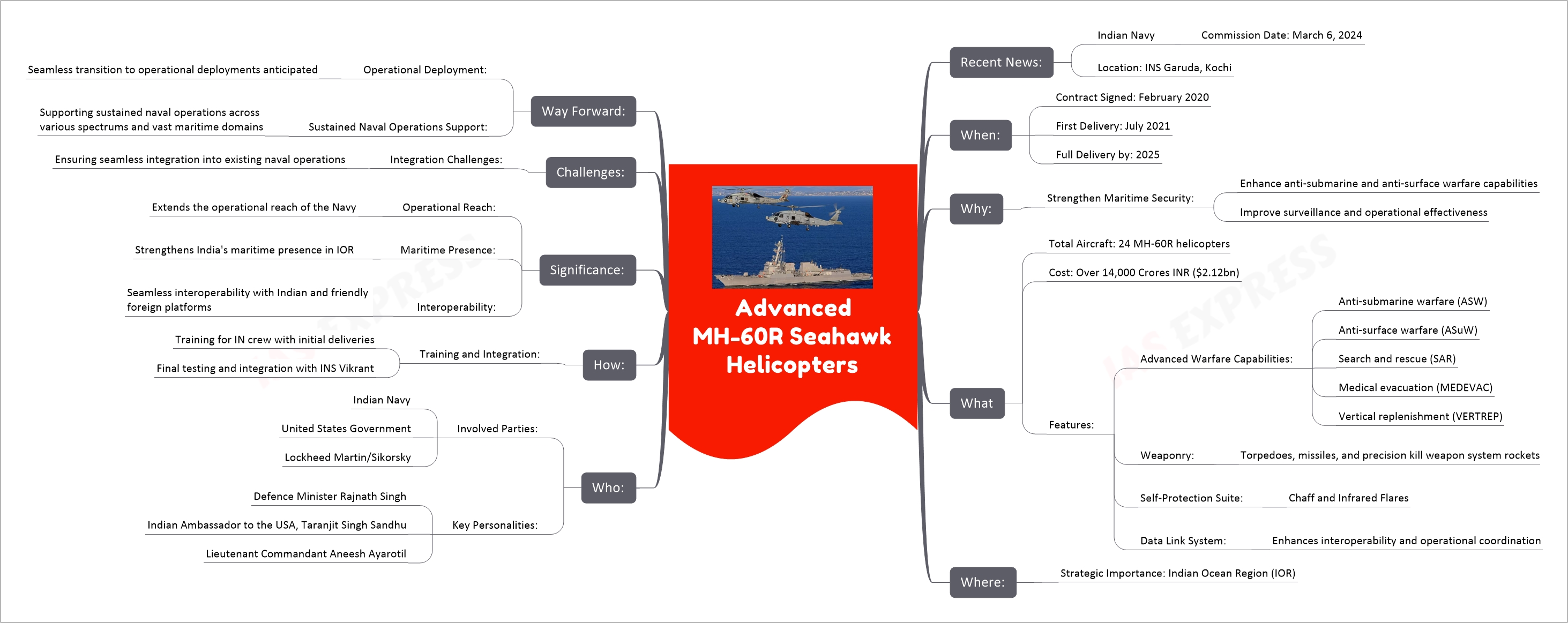
/ etc), Missiles, Submarines
Advanced MH-60R Seahawk Helicopters mind map
  Recent News:
    Indian Navy
      Commission Date: March 6, 2024
    Location: INS Garuda, Kochi
  When:
    Contract Signed: February 2020
    First Delivery: July 2021
    Full Delivery by: 2025
  Why:
    Strengthen Maritime Security:
      Enhance anti-submarine and anti-surface warfare capabilities
      Improve surveillance and operational effectiveness
  What
    Total Aircraft: 24 MH-60R helicopters
    Cost: Over 14,000 Crores INR ($2.12bn)
    Features:
      Advanced Warfare Capabilities:
        Anti-submarine warfare (ASW)
        Anti-surface warfare (ASuW)
        Search and rescue (SAR)
        Medical evacuation (MEDEVAC)
        Vertical replenishment (VERTREP)
      Weaponry:
        Torpedoes, missiles, and precision kill weapon system rockets
      Self-Protection Suite:
        Chaff and Infrared Flares
      Data Link System:
        Enhances interoperability and operational coordination
  Where:
    Strategic Importance: Indian Ocean Region (IOR)
  Who:
    Involved Parties:
      Indian Navy
      United States Government
      Lockheed Martin/Sikorsky
    Key Personalities:
      Defence Minister Rajnath Singh
      Indian Ambassador to the USA, Taranjit Singh Sandhu
      Lieutenant Commandant Aneesh Ayarotil
  How:
    Training and Integration:
      Training for IN crew with initial deliveries
      Final testing and integration with INS Vikrant
  Significance:
    Operational Reach:
      Extends the operational reach of the Navy
    Maritime Presence:
      Strengthens India's maritime presence in IOR
    Interoperability:
      Seamless interoperability with Indian and friendly foreign platforms
  Challenges:
    Integration Challenges:
      Ensuring seamless integration into existing naval operations
  Way Forward:
    Operational Deployment:
      Seamless transition to operational deployments anticipated
    Sustained Naval Operations Support:
      Supporting sustained naval operations across various spectrums and vast maritime domains

The Indian Navy’s commissioning of MH-60R Seahawk helicopters symbolizes a significant enhancement in maritime security capabilities, specifically in anti-submarine warfare and surface warfare, along with improved surveillance, search and rescue, and medical evacuation capabilities. The procurement of 24 advanced helicopters from the US, under a deal worth over 14,000 Crores INR ($2.12 billion), is set to extend the Navy’s operational reach, especially in the strategic Indian Ocean Region. This integration into the Navy’s fleet, with the commissioning scheduled for March 6, 2024, at INS Garuda in Kochi, is a critical part of India’s defense modernization, aiming to bolster its maritime security and ensure seamless interoperability with Indian and international naval forces​​​​​​​​​​.

/ Nuclear Energy
India Initiates Core Loading of First Homegrown Nuclear Reactor mind map
  Recent News
    Core loading in PFBR
    Location
      Kalpakkam, Tamil Nadu
    Witness
      Prime Minister Narendra Modi
    Date
      March 4, 2024
    Significance
      Milestone for India's nuclear power program
      Towards enhanced energy security
  India's Closed Fuel Cycle Strategy
    Stages
      Stage I
        Natural uranium fueled pressurized heavy water reactors
      Stage II
        Fast breeder reactors
        Example
          PFBR
        Characteristics
          Produce more fissile material than consume
      Stage III
        Thorium-based advanced heavy water reactors
  Core Loading
    Core Definition
      Central portion
      Contains fissile fuel assemblies
    First Step
      Loading control and safety rod assemblies
      Regulate reactivity
    Second Step
      Inactive blanket assemblies
      Absorb neutrons for breeding plutonium fuel
    Final Step
      Active fuel assemblies with enriched uranium
      Initiate self-sustaining fission
    Goal
      Attain criticality
      Connect to power grid
    India's Position
      Second country after Russia
      Commercial FBR
  Significance of Closed Fuel Cycle
    Advantages
      Reduces High-Level Nuclear Waste
        Utilizes spent fuel
      Enhances Fuel Security
        Breeds up to 30% more fissile fuel from thorium
      Safer Reactor Design
        Advanced safety systems
        Meltdown prevention features
      Meet Sustainable Goals
        Zero carbon future
        Minimal nuclear waste
  Opposition from Anti-Nuclear Groups
    Criticisms
      Safety concerns
      Local opposition
    Actions
      Urged halt of operations
    Comparison
      US abandoned FBR programs
    Government's Stand
      Advanced safeguards
      Based on feedback from test reactors
    Measures
      Land restrictions around site
    Concerns
      Lack of transparent communication on risks
  Balancing Sustainable Development
    Challenges
      Rising energy demands
      Decarbonize economy
    Solutions
      Maximize zero-emission renewable capacity
      Support clean transitional options
        Nuclear for baseline demands
      Manage community perceptions
        Large industrial projects
    Nuclear's Role
      Provides 3% of India's electricity mix
    Strategic Risks
      Imported fuel dependence
    Indigenous FBRs Benefits
      Mitigate strategic risks
      Ensure waste efficiency
    Importance
      Safety demonstrations
        Reassure on potential threats

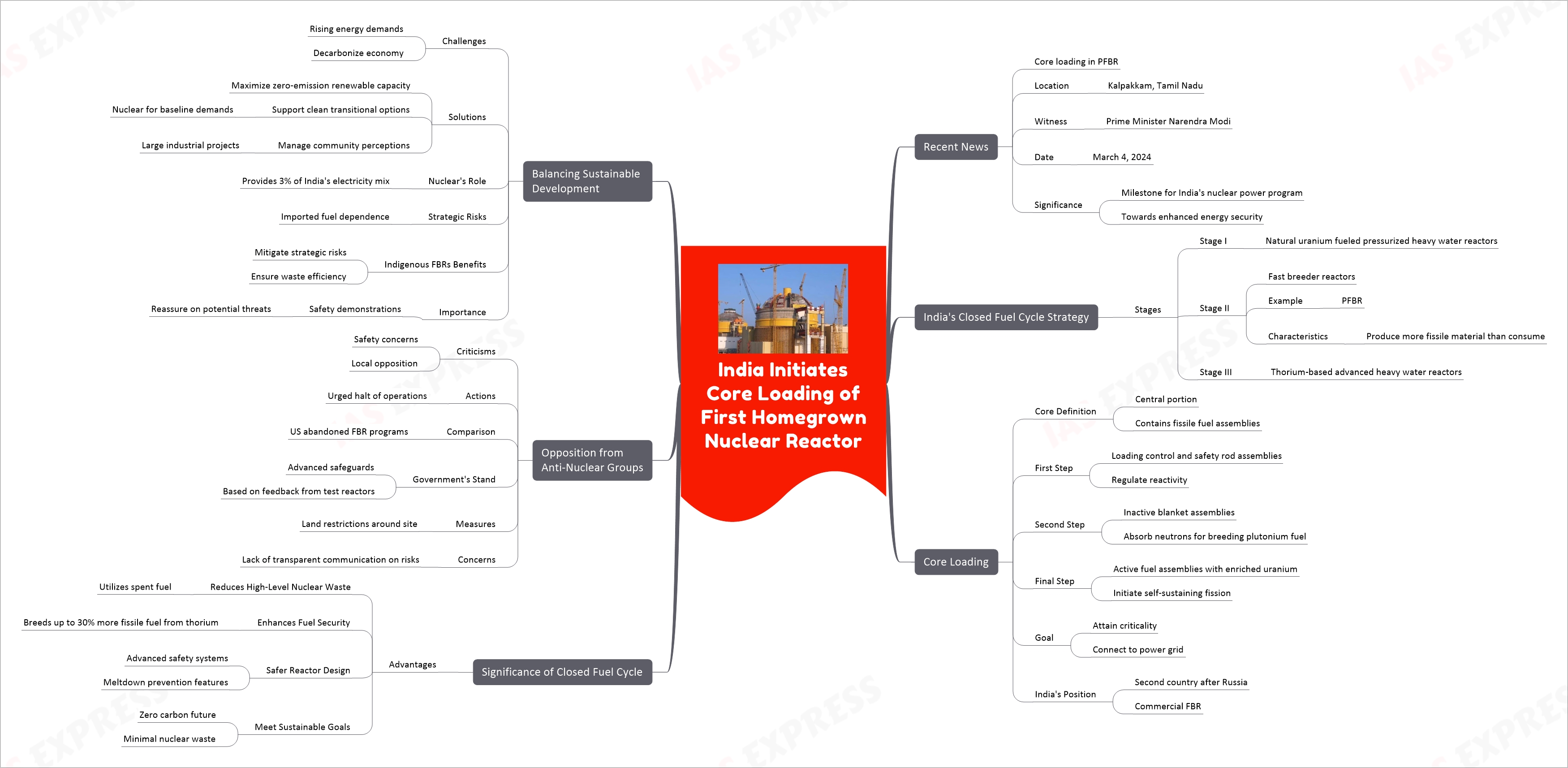
India’s first indigenous Prototype Fast Breeder Reactor (PFBR) in Kalpakkam, Tamil Nadu, marks a significant advancement in the country’s nuclear energy capabilities. With Prime Minister Narendra Modi witnessing the core loading activities, this development is pivotal for India’s three-stage nuclear power program, aimed at enhancing energy security through a closed fuel cycle strategy. This strategy includes utilizing spent fuel to reduce waste, breeding more fissile material, and advancing towards a zero carbon future with minimal nuclear waste, thereby supporting sustainable energy goals. Despite facing opposition over safety concerns, the project underscores India’s commitment to balancing rising energy demands with the need to decarbonize, highlighting the strategic importance of indigenous nuclear technology in ensuring fuel security and environmental sustainability.
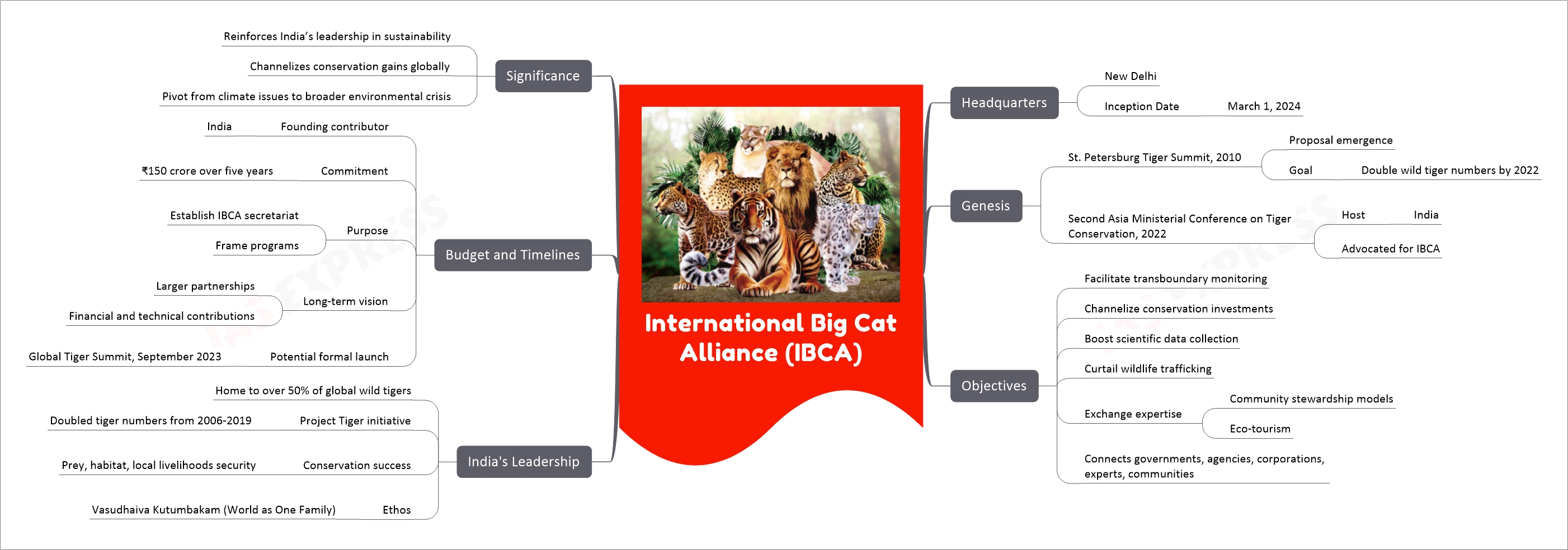
International Big Cat Alliance (IBCA) mind map
  Headquarters
    New Delhi
    Inception Date
      March 1, 2024
  Genesis
    St. Petersburg Tiger Summit, 2010
      Proposal emergence
      Goal
        Double wild tiger numbers by 2022
    Second Asia Ministerial Conference on Tiger Conservation, 2022
      Host
        India
      Advocated for IBCA
  Objectives
    Facilitate transboundary monitoring
    Channelize conservation investments
    Boost scientific data collection
    Curtail wildlife trafficking
    Exchange expertise
      Community stewardship models
      Eco-tourism
    Connects governments, agencies, corporations, experts, communities
  India's Leadership
    Home to over 50% of global wild tigers
    Project Tiger initiative
      Doubled tiger numbers from 2006-2019
    Conservation success
      Prey, habitat, local livelihoods security
    Ethos
      Vasudhaiva Kutumbakam (World as One Family)
  Budget and Timelines
    Founding contributor
      India
    Commitment
      ₹150 crore over five years
    Purpose
      Establish IBCA secretariat
      Frame programs
    Long-term vision
      Larger partnerships
      Financial and technical contributions
    Potential formal launch
      Global Tiger Summit, September 2023
  Significance
    Reinforces India’s leadership in sustainability
    Channelizes conservation gains globally
    Pivot from climate issues to broader environmental crisis

The International Big Cat Alliance (IBCA), initiated by India’s Environment Ministry and approved on March 1, 2024, represents a strategic intergovernmental effort to foster global tiger conservation. Headquartered in New Delhi, the IBCA is inspired by the International Solar Alliance and aims to emulate its success in the realm of wildlife conservation. Emerging from the St. Petersburg Tiger Summit in 2010, the alliance’s core objective is to enhance global collaboration for doubling wild tiger populations by facilitating transboundary monitoring, channeling investments into tiger habitats, boosting scientific data collection, curtailing wildlife trafficking, and exchanging expertise on community stewardship and eco-tourism. India, housing over 50% of the world’s wild tigers, plays a pivotal role through its successful Project Tiger initiative, demonstrating significant conservation achievements. With a commitment of ₹150 crore over five years, the IBCA seeks to establish a secretariat and frame conservation programs, aiming for a larger global partnership to address the broader environmental crisis threatening key ecosystems.

If you like this post, please share your feedback in the comments section below so that we will upload more posts like this.

Responses

🖍️ Highlight
HomeCoursesPlansAccount