International Big Cat Alliance (IBCA)

International Big Cat Alliance (IBCA) mind map

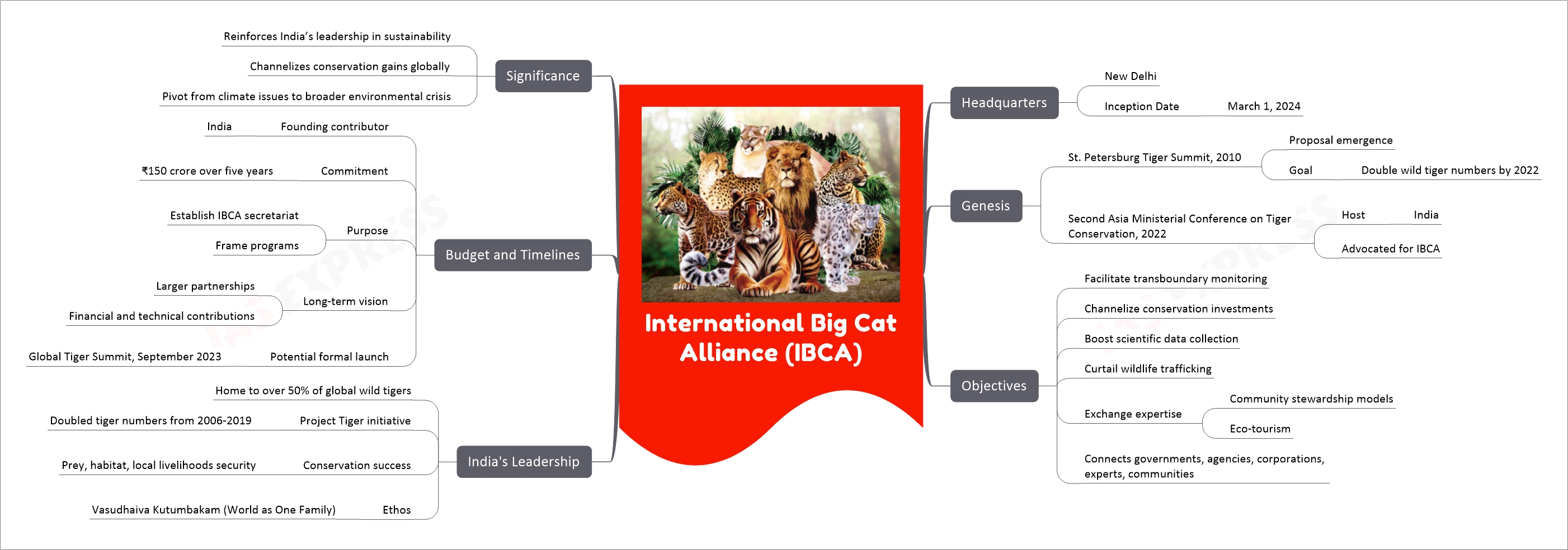
  Headquarters
    New Delhi
    Inception Date
      March 1, 2024
  Genesis
    St. Petersburg Tiger Summit, 2010
      Proposal emergence
      Goal
        Double wild tiger numbers by 2022
    Second Asia Ministerial Conference on Tiger Conservation, 2022
      Host
        India
      Advocated for IBCA
  Objectives
    Facilitate transboundary monitoring
    Channelize conservation investments
    Boost scientific data collection
    Curtail wildlife trafficking
    Exchange expertise
      Community stewardship models
      Eco-tourism
    Connects governments, agencies, corporations, experts, communities
  India's Leadership
    Home to over 50% of global wild tigers
    Project Tiger initiative
      Doubled tiger numbers from 2006-2019
    Conservation success
      Prey, habitat, local livelihoods security
    Ethos
      Vasudhaiva Kutumbakam (World as One Family)
  Budget and Timelines
    Founding contributor
      India
    Commitment
      ₹150 crore over five years
    Purpose
      Establish IBCA secretariat
      Frame programs
    Long-term vision
      Larger partnerships
      Financial and technical contributions
    Potential formal launch
      Global Tiger Summit, September 2023
  Significance
    Reinforces India’s leadership in sustainability
    Channelizes conservation gains globally
    Pivot from climate issues to broader environmental crisis

The International Big Cat Alliance (IBCA), initiated by India’s Environment Ministry and approved on March 1, 2024, represents a strategic intergovernmental effort to foster global tiger conservation. Headquartered in New Delhi, the IBCA is inspired by the International Solar Alliance and aims to emulate its success in the realm of wildlife conservation. Emerging from the St. Petersburg Tiger Summit in 2010, the alliance’s core objective is to enhance global collaboration for doubling wild tiger populations by facilitating transboundary monitoring, channeling investments into tiger habitats, boosting scientific data collection, curtailing wildlife trafficking, and exchanging expertise on community stewardship and eco-tourism. India, housing over 50% of the world’s wild tigers, plays a pivotal role through its successful Project Tiger initiative, demonstrating significant conservation achievements. With a commitment of ₹150 crore over five years, the IBCA seeks to establish a secretariat and frame conservation programs, aiming for a larger global partnership to address the broader environmental crisis threatening key ecosystems.

Related Posts

If you like this post, please share your feedback in the comments section below so that we will upload more posts like this.

Responses

🖍️ Highlight
HomeCoursesPlansAccount