India Initiates Core Loading of First Homegrown Nuclear Reactor

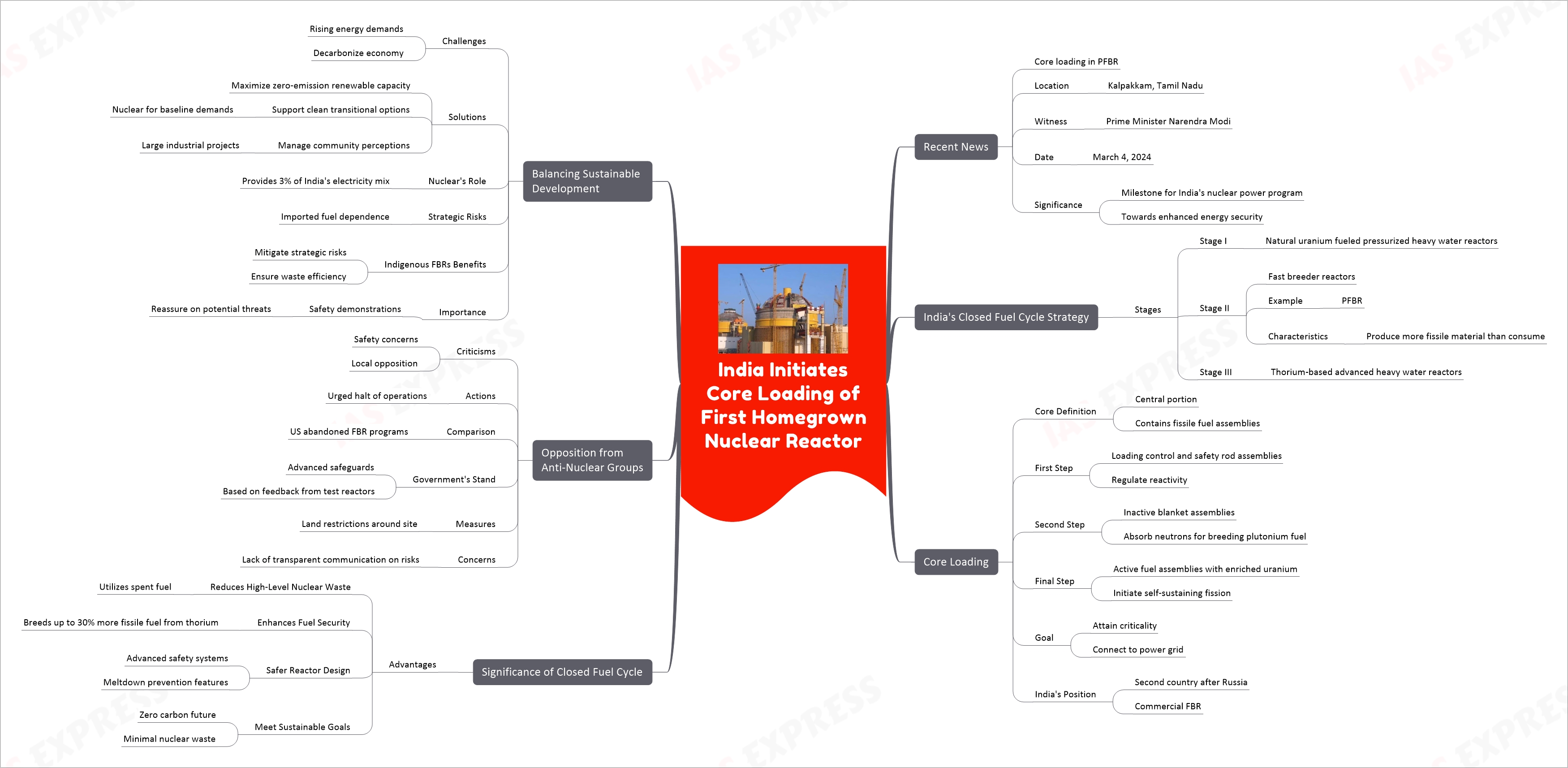
India Initiates Core Loading of First Homegrown Nuclear Reactor mind map

  Recent News
    Core loading in PFBR
    Location
      Kalpakkam, Tamil Nadu
    Witness
      Prime Minister Narendra Modi
    Date
      March 4, 2024
    Significance
      Milestone for India's nuclear power program
      Towards enhanced energy security
  India's Closed Fuel Cycle Strategy
    Stages
      Stage I
        Natural uranium fueled pressurized heavy water reactors
      Stage II
        Fast breeder reactors
        Example
          PFBR
        Characteristics
          Produce more fissile material than consume
      Stage III
        Thorium-based advanced heavy water reactors
  Core Loading
    Core Definition
      Central portion
      Contains fissile fuel assemblies
    First Step
      Loading control and safety rod assemblies
      Regulate reactivity
    Second Step
      Inactive blanket assemblies
      Absorb neutrons for breeding plutonium fuel
    Final Step
      Active fuel assemblies with enriched uranium
      Initiate self-sustaining fission
    Goal
      Attain criticality
      Connect to power grid
    India's Position
      Second country after Russia
      Commercial FBR
  Significance of Closed Fuel Cycle
    Advantages
      Reduces High-Level Nuclear Waste
        Utilizes spent fuel
      Enhances Fuel Security
        Breeds up to 30% more fissile fuel from thorium
      Safer Reactor Design
        Advanced safety systems
        Meltdown prevention features
      Meet Sustainable Goals
        Zero carbon future
        Minimal nuclear waste
  Opposition from Anti-Nuclear Groups
    Criticisms
      Safety concerns
      Local opposition
    Actions
      Urged halt of operations
    Comparison
      US abandoned FBR programs
    Government's Stand
      Advanced safeguards
      Based on feedback from test reactors
    Measures
      Land restrictions around site
    Concerns
      Lack of transparent communication on risks
  Balancing Sustainable Development
    Challenges
      Rising energy demands
      Decarbonize economy
    Solutions
      Maximize zero-emission renewable capacity
      Support clean transitional options
        Nuclear for baseline demands
      Manage community perceptions
        Large industrial projects
    Nuclear's Role
      Provides 3% of India's electricity mix
    Strategic Risks
      Imported fuel dependence
    Indigenous FBRs Benefits
      Mitigate strategic risks
      Ensure waste efficiency
    Importance
      Safety demonstrations
        Reassure on potential threats

India’s first indigenous Prototype Fast Breeder Reactor (PFBR) in Kalpakkam, Tamil Nadu, marks a significant advancement in the country’s nuclear energy capabilities. With Prime Minister Narendra Modi witnessing the core loading activities, this development is pivotal for India’s three-stage nuclear power program, aimed at enhancing energy security through a closed fuel cycle strategy. This strategy includes utilizing spent fuel to reduce waste, breeding more fissile material, and advancing towards a zero carbon future with minimal nuclear waste, thereby supporting sustainable energy goals. Despite facing opposition over safety concerns, the project underscores India’s commitment to balancing rising energy demands with the need to decarbonize, highlighting the strategic importance of indigenous nuclear technology in ensuring fuel security and environmental sustainability.

Related Posts
If you like this post, please share your feedback in the comments section below so that we will upload more posts like this.

Responses

🖍️ Highlight
HomeCoursesPlansAccount