Pigeonpea

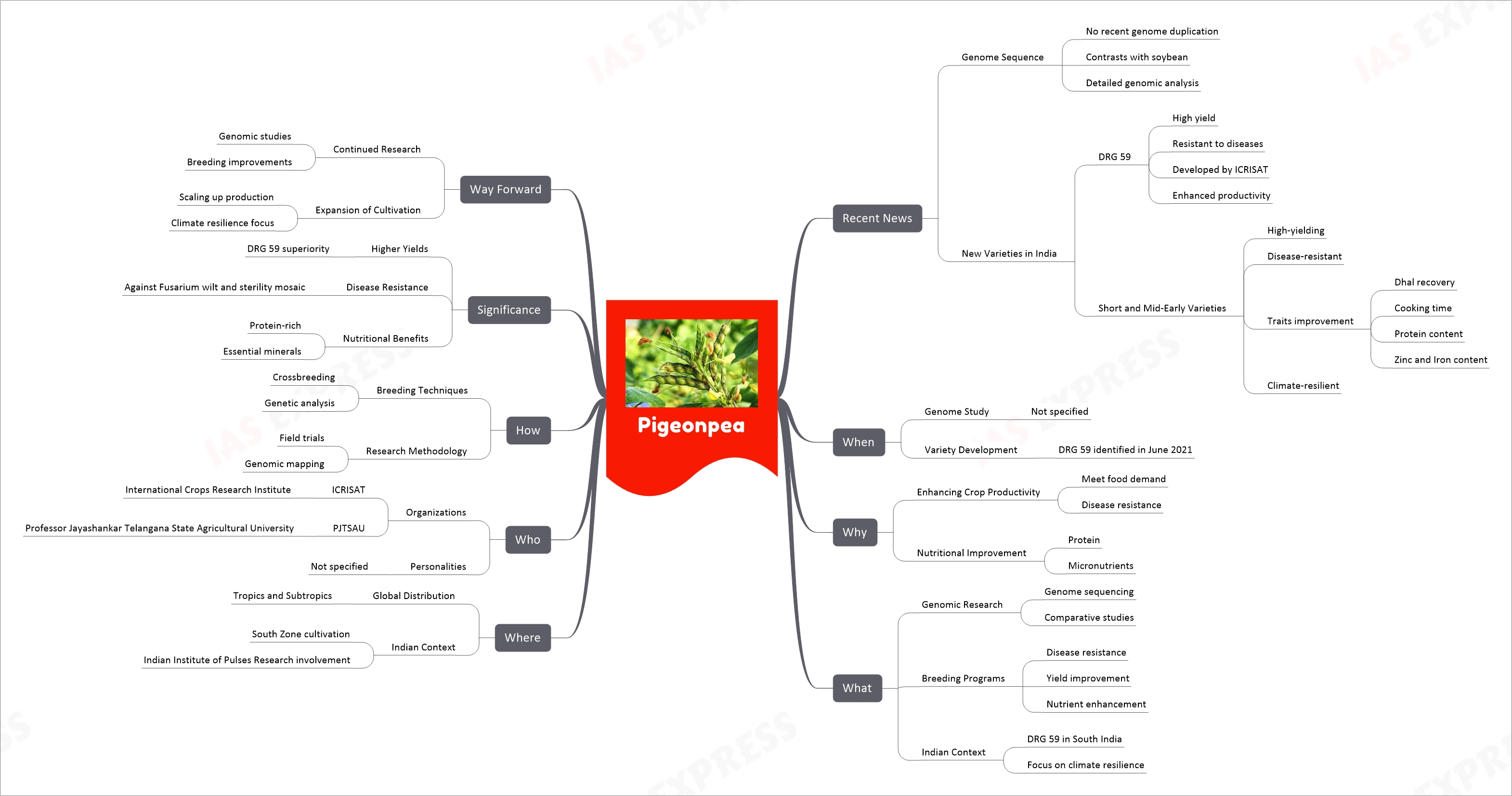
Pigeonpea mind map
  Recent News
    Genome Sequence
      No recent genome duplication
      Contrasts with soybean
      Detailed genomic analysis
    New Varieties in India
      DRG 59
        High yield
        Resistant to diseases
        Developed by ICRISAT
        Enhanced productivity
      Short and Mid-Early Varieties
        High-yielding
        Disease-resistant
        Traits improvement
          Dhal recovery
          Cooking time
          Protein content
          Zinc and Iron content
        Climate-resilient
  When
    Genome Study
      Not specified
    Variety Development
      DRG 59 identified in June 2021
  Why
    Enhancing Crop Productivity
      Meet food demand
      Disease resistance
    Nutritional Improvement
      Protein
      Micronutrients
  What
    Genomic Research
      Genome sequencing
      Comparative studies
    Breeding Programs
      Disease resistance
      Yield improvement
      Nutrient enhancement
    Indian Context
      DRG 59 in South India
      Focus on climate resilience
  Where
    Global Distribution
      Tropics and Subtropics
    Indian Context
      South Zone cultivation
      Indian Institute of Pulses Research involvement
  Who
    Organizations
      ICRISAT
        International Crops Research Institute
      PJTSAU
        Professor Jayashankar Telangana State Agricultural University
    Personalities
      Not specified
  How
    Breeding Techniques
      Crossbreeding
      Genetic analysis
    Research Methodology
      Field trials
      Genomic mapping
  Significance
    Higher Yields
      DRG 59 superiority
    Disease Resistance
      Against Fusarium wilt and sterility mosaic
    Nutritional Benefits
      Protein-rich
      Essential minerals
  Way Forward
    Continued Research
      Genomic studies
      Breeding improvements
    Expansion of Cultivation
      Scaling up production
      Climate resilience focus

Pigeonpea, also known as Cajanus cajan, is an important legume crop, particularly in tropical and subtropical regions. Originating in India and widely cultivated in Africa, pigeonpea is a nutritious and protein-rich food source. The crop is a perennial woody shrub but is mostly grown as an annual for its seeds. It is classified into varieties based on maturity and floral characteristics, with different types suited to varying climatic and soil conditions. Pigeonpea cultivation involves specific practices such as intercropping, appropriate seed rate and spacing, and tailored fertilizer application. Harvesting generally occurs from January to February, followed by specific threshing, drying, and storage techniques. Pigeonpea plays a significant role in subsistence agriculture, providing essential nutrition and economic benefits, especially for resource-poor farmers.

Related Posts
If you like this post, please share your feedback in the comments section below so that we will upload more posts like this.

Responses

🖍️ Highlight
HomeCoursesPlansAccount