Positronium

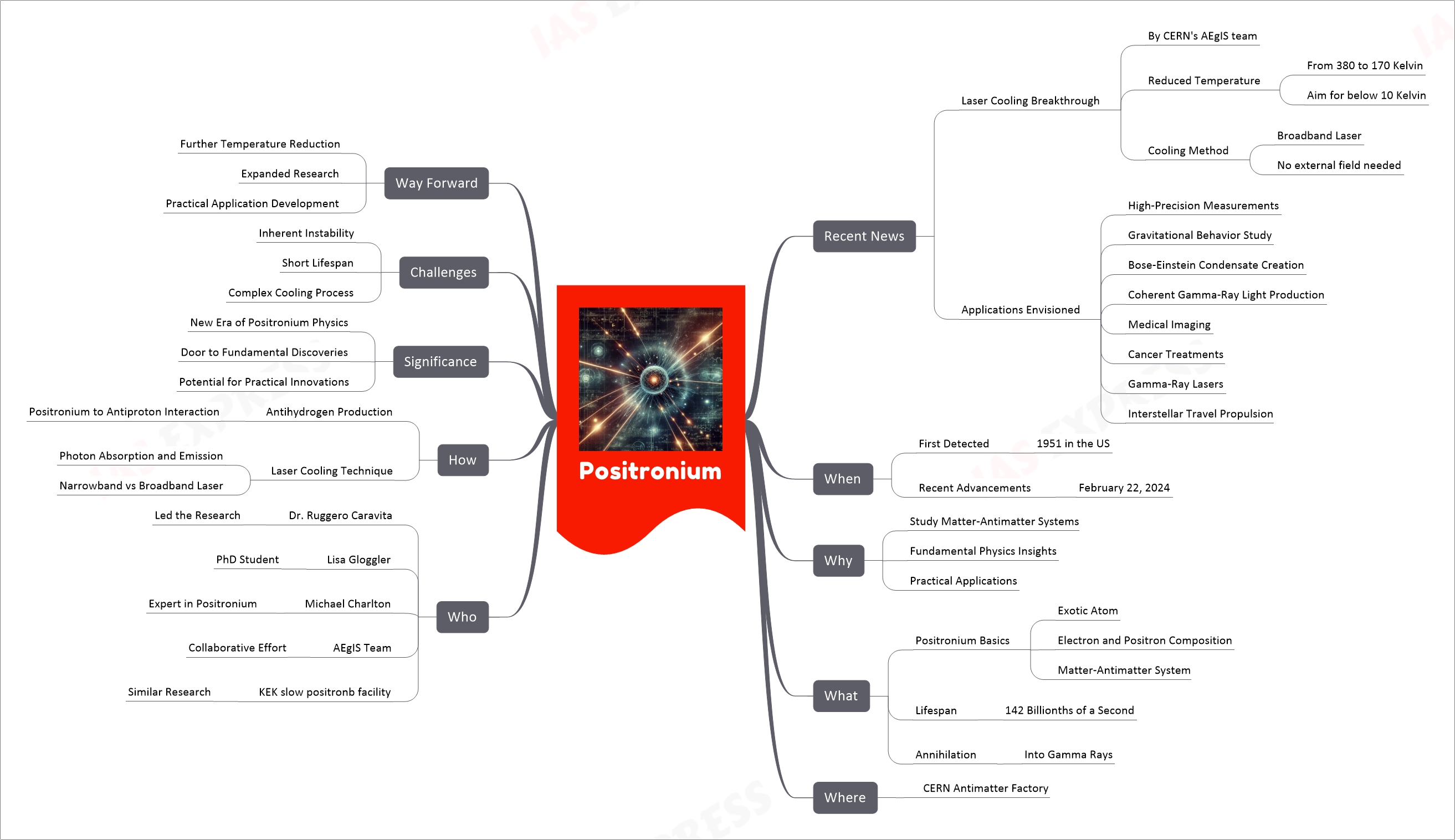
Positronium mind map
  Recent News
    Laser Cooling Breakthrough
      By CERN's AEgIS team
      Reduced Temperature
        From 380 to 170 Kelvin
        Aim for below 10 Kelvin
      Cooling Method
        Broadband Laser
        No external field needed
    Applications Envisioned
      High-Precision Measurements
      Gravitational Behavior Study
      Bose-Einstein Condensate Creation
      Coherent Gamma-Ray Light Production
      Medical Imaging
      Cancer Treatments
      Gamma-Ray Lasers
      Interstellar Travel Propulsion
  When
    First Detected
      1951 in the US
    Recent Advancements
      February 22, 2024
  Why
    Study Matter-Antimatter Systems
    Fundamental Physics Insights
    Practical Applications
  What
    Positronium Basics
      Exotic Atom
      Electron and Positron Composition
      Matter-Antimatter System
    Lifespan
      142 Billionths of a Second
    Annihilation
      Into Gamma Rays
  Where
    CERN Antimatter Factory
  Who
    Dr. Ruggero Caravita
      Led the Research
    Lisa Gloggler
      PhD Student
    Michael Charlton
      Expert in Positronium
    AEgIS Team
      Collaborative Effort
    KEK slow positronb facility
      Similar Research
  How
    Antihydrogen Production
      Positronium to Antiproton Interaction
    Laser Cooling Technique
      Photon Absorption and Emission
      Narrowband vs Broadband Laser
  Significance
    New Era of Positronium Physics
    Door to Fundamental Discoveries
    Potential for Practical Innovations
  Challenges
    Inherent Instability
    Short Lifespan
    Complex Cooling Process
  Way Forward
    Further Temperature Reduction
    Expanded Research
    Practical Application Development

Positronium is an exotic atom composed of an electron and its antimatter counterpart, the positron. Recently, significant progress has been made in its study, particularly in the field of laser cooling, led by teams at CERN’s AEgIS experiment and other global institutions. By cooling positronium atoms with laser light, researchers have significantly reduced their temperature, enabling more precise measurements and research. This breakthrough not only advances fundamental physics, understanding matter-antimatter interactions, but also opens possibilities for practical applications like medical imaging, cancer treatment, development of gamma-ray lasers, and even interstellar travel propulsion. Despite challenges like its inherent instability and short lifespan, positronium research stands at the brink of exciting new discoveries and applications.

Related Posts
If you like this post, please share your feedback in the comments section below so that we will upload more posts like this.

Responses

🖍️ Highlight
HomeCoursesPlansAccount