INSAT-3DS

INSAT-3DS mind map
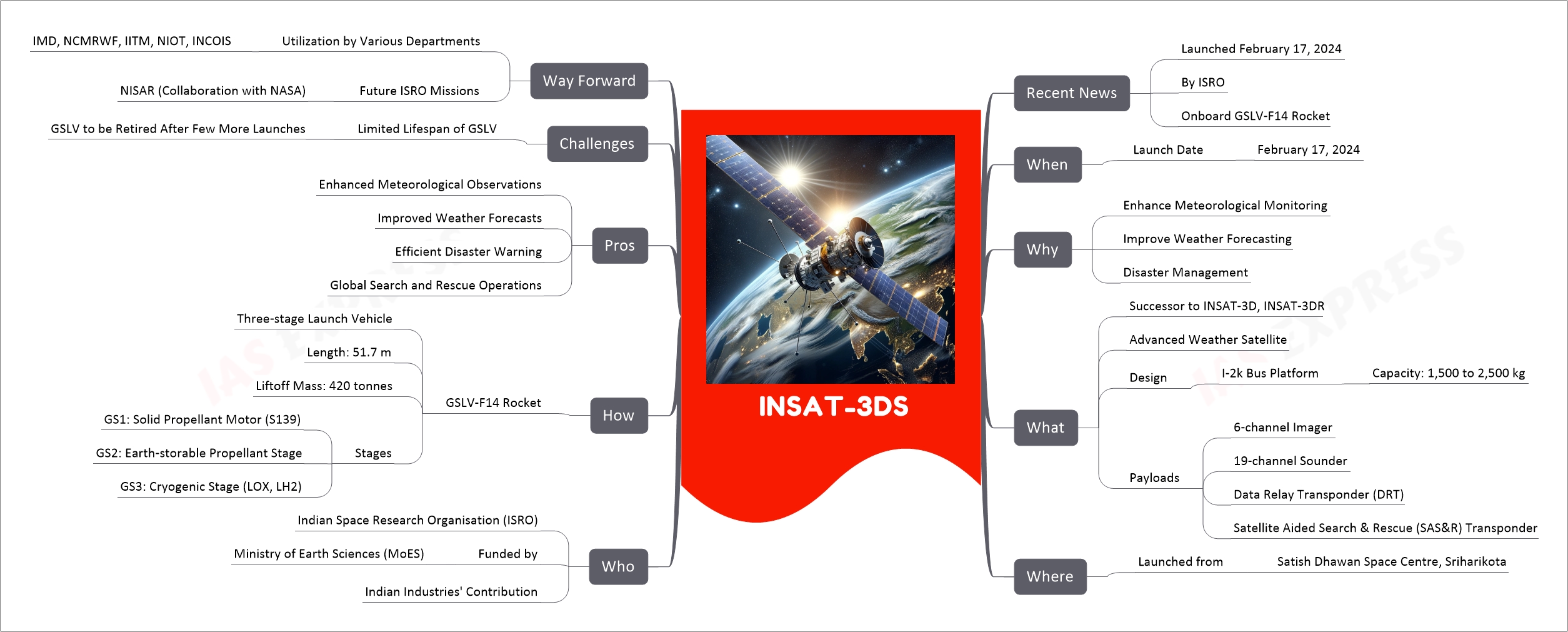
  Recent News
    Launched February 17, 2024
    By ISRO
    Onboard GSLV-F14 Rocket
  When
    Launch Date
      February 17, 2024
  Why
    Enhance Meteorological Monitoring
    Improve Weather Forecasting
    Disaster Management
  What
    Successor to INSAT-3D, INSAT-3DR
    Advanced Weather Satellite
    Design
      I-2k Bus Platform
        Capacity: 1,500 to 2,500 kg
    Payloads
      6-channel Imager
      19-channel Sounder
      Data Relay Transponder (DRT)
      Satellite Aided Search & Rescue (SAS&R) Transponder
  Where
    Launched from
      Satish Dhawan Space Centre, Sriharikota
  Who
    Indian Space Research Organisation (ISRO)
    Funded by
      Ministry of Earth Sciences (MoES)
    Indian Industries' Contribution
  How
    GSLV-F14 Rocket
      Three-stage Launch Vehicle
      Length: 51.7 m
      Liftoff Mass: 420 tonnes
      Stages
        GS1: Solid Propellant Motor (S139)
        GS2: Earth-storable Propellant Stage
        GS3: Cryogenic Stage (LOX, LH2)
  Pros
    Enhanced Meteorological Observations
    Improved Weather Forecasts
    Efficient Disaster Warning
    Global Search and Rescue Operations
  Challenges
    Limited Lifespan of GSLV
      GSLV to be Retired After Few More Launches
  Way Forward
    Utilization by Various Departments
      IMD, NCMRWF, IITM, NIOT, INCOIS
    Future ISRO Missions
      NISAR (Collaboration with NASA)

INSAT-3DS, launched by the Indian Space Research Organisation (ISRO) on February 17, 2024, aboard the GSLV-F14 rocket, marks a significant advancement in India’s meteorological monitoring and disaster management capabilities. This state-of-the-art satellite, a successor to INSAT-3D and INSAT-3DR, is designed to enhance weather forecasting and disaster warning efficiency. Built on the I-2k bus platform, INSAT-3DS is equipped with sophisticated meteorological instruments like a 6-channel Imager and a 19-channel Sounder, along with communication payloads for data relay and search & rescue operations. The mission, funded by the Ministry of Earth Sciences and supported by Indian industries, signifies a pivotal step in utilizing space technology for societal benefits.

Related Posts
If you like this post, please share your feedback in the comments section below so that we will upload more posts like this.

Responses

🖍️ Highlight
HomeCoursesPlansAccount