Species Threat Abatement and Restoration (STAR) Metric

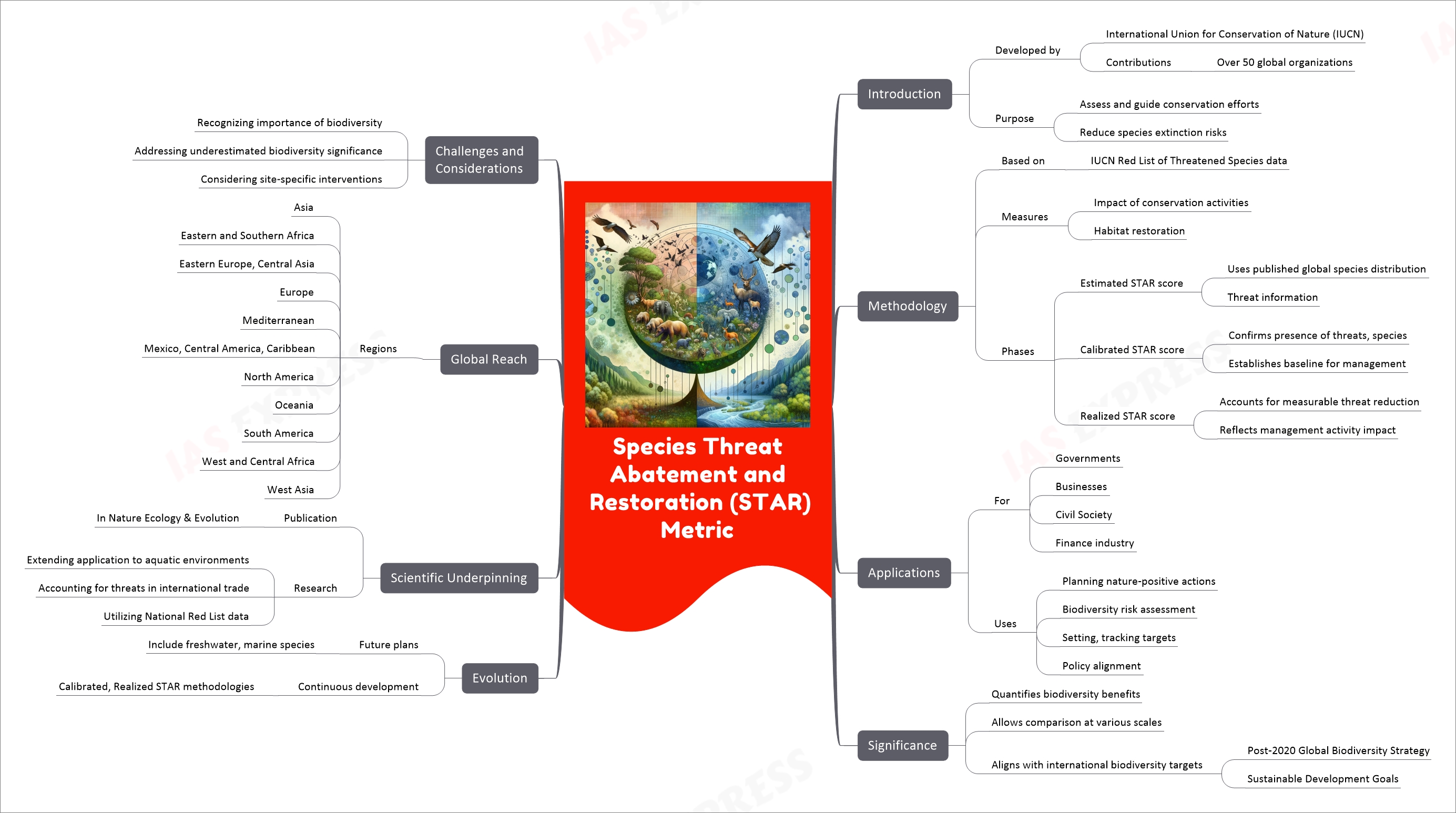
Species Threat Abatement and Restoration (STAR) Metric mind map

  Introduction
    Developed by
      International Union for Conservation of Nature (IUCN)
      Contributions
        Over 50 global organizations
    Purpose
      Assess and guide conservation efforts
      Reduce species extinction risks
  Methodology
    Based on
      IUCN Red List of Threatened Species data
    Measures
      Impact of conservation activities
      Habitat restoration
    Phases
      Estimated STAR score
        Uses published global species distribution
        Threat information
      Calibrated STAR score
        Confirms presence of threats, species
        Establishes baseline for management
      Realized STAR score
        Accounts for measurable threat reduction
        Reflects management activity impact
  Applications
    For
      Governments
      Businesses
      Civil Society
      Finance industry
    Uses
      Planning nature-positive actions
      Biodiversity risk assessment
      Setting, tracking targets
      Policy alignment
  Significance
    Quantifies biodiversity benefits
    Allows comparison at various scales
    Aligns with international biodiversity targets
      Post-2020 Global Biodiversity Strategy
      Sustainable Development Goals
  Evolution
    Future plans
      Include freshwater, marine species
    Continuous development
      Calibrated, Realized STAR methodologies
  Scientific Underpinning
    Publication
      In Nature Ecology & Evolution
    Research
      Extending application to aquatic environments
      Accounting for threats in international trade
      Utilizing National Red List data
  Global Reach
    Regions
      Asia
      Eastern and Southern Africa
      Eastern Europe, Central Asia
      Europe
      Mediterranean
      Mexico, Central America, Caribbean
      North America
      Oceania
      South America
      West and Central Africa
      West Asia
  Challenges and Considerations
    Recognizing importance of biodiversity
    Addressing underestimated biodiversity significance
    Considering site-specific interventions

The Species Threat Abatement and Restoration (STAR) metric, developed by the International Union for Conservation of Nature (IUCN) with contributions from over 50 global organizations, is a pioneering tool designed to assess and guide efforts in conserving biodiversity and reducing species extinction risks. Utilizing data from the IUCN Red List of Threatened Species, the STAR metric measures the impact of conservation activities and habitat restoration in specific areas. It operates in three phases: estimating, calibrating, and realizing STAR scores, which correspond to initial assessments, confirmation of threats and species, and the impact of management activities, respectively. This metric is crucial for governments, businesses, and other stakeholders in planning nature-positive actions, assessing biodiversity risks, and aligning with international biodiversity targets. With continuous development and future plans to include aquatic environments, the STAR metric represents a significant step forward in quantifying and comparing the benefits of different conservation actions on a global scale.

Related Posts
If you like this post, please share your feedback in the comments section below so that we will upload more posts like this.

Responses

🖍️ Highlight
HomeCoursesPlansAccount