[Newsbits] 12.02.2024: InfexnTM, PACE Satellite & More

newsbits mindmap notes
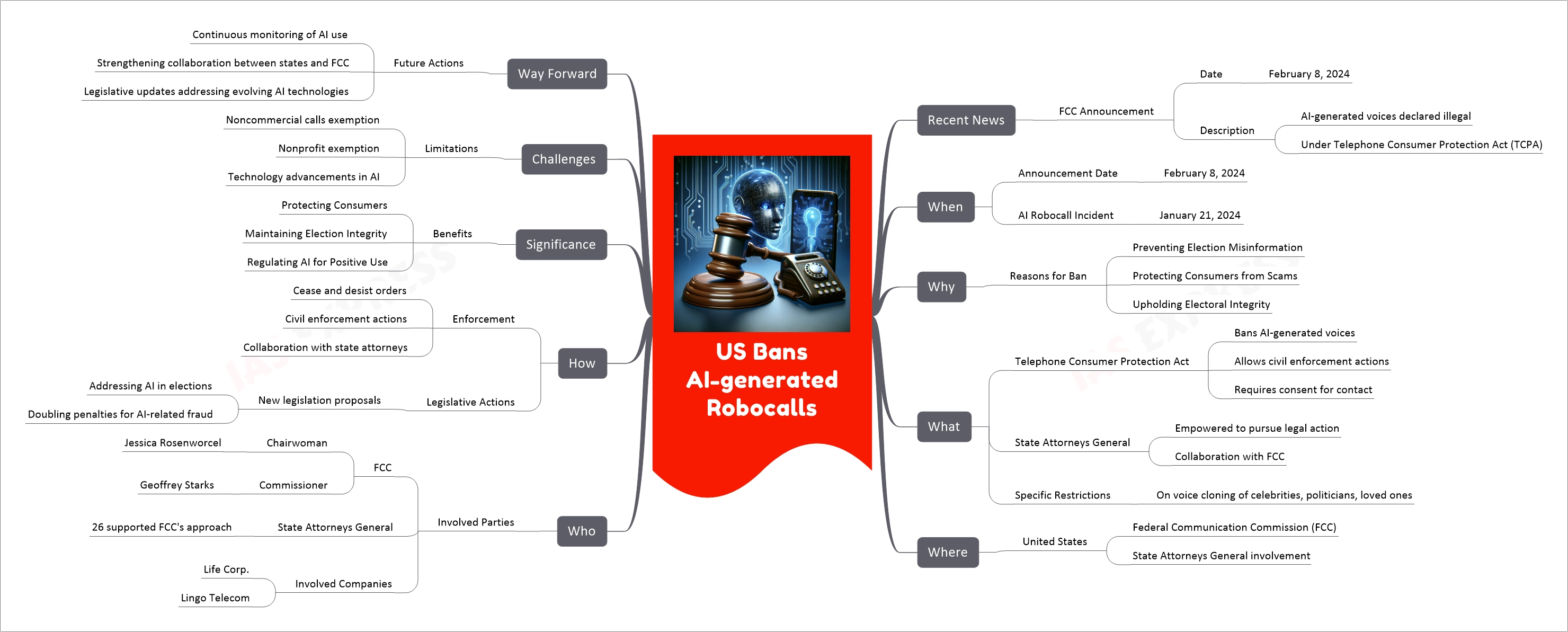
US Bans AI-generated Robocalls mind map
  Recent News
    FCC Announcement
      Date
        February 8, 2024
      Description
        AI-generated voices declared illegal
        Under Telephone Consumer Protection Act (TCPA)
  When
    Announcement Date
      February 8, 2024
    AI Robocall Incident
      January 21, 2024
  Why
    Reasons for Ban
      Preventing Election Misinformation
      Protecting Consumers from Scams
      Upholding Electoral Integrity
  What
    Telephone Consumer Protection Act
      Bans AI-generated voices
      Allows civil enforcement actions
      Requires consent for contact
    State Attorneys General
      Empowered to pursue legal action
      Collaboration with FCC
    Specific Restrictions
      On voice cloning of celebrities, politicians, loved ones
  Where
    United States
      Federal Communication Commission (FCC)
      State Attorneys General involvement
  Who
    Involved Parties
      FCC
        Chairwoman
          Jessica Rosenworcel
        Commissioner
          Geoffrey Starks
      State Attorneys General
        26 supported FCC's approach
      Involved Companies
        Life Corp.
        Lingo Telecom
  How
    Enforcement
      Cease and desist orders
      Civil enforcement actions
      Collaboration with state attorneys
    Legislative Actions
      New legislation proposals
        Addressing AI in elections
        Doubling penalties for AI-related fraud
  Significance
    Benefits
      Protecting Consumers
      Maintaining Election Integrity
      Regulating AI for Positive Use
  Challenges
    Limitations
      Noncommercial calls exemption
      Nonprofit exemption
      Technology advancements in AI
  Way Forward
    Future Actions
      Continuous monitoring of AI use
      Strengthening collaboration between states and FCC
      Legislative updates addressing evolving AI technologies

The US Federal Communications Commission (FCC) announced on February 8, 2024, a ban on AI-generated robocalls, particularly those using AI-generated voices. This decision falls under the Telephone Consumer Protection Act, aiming to protect consumers from scams and prevent election misinformation. The ban was prompted by incidents involving deepfake robocalls, including one mimicking President Joe Biden’s voice to spread false election information. The ruling enables state attorneys general to take legal action against such deceptive practices and highlights the growing need to regulate AI technology for its ethical and legal use, especially in the context of elections and consumer protection.
/ Indices/Reports, Species
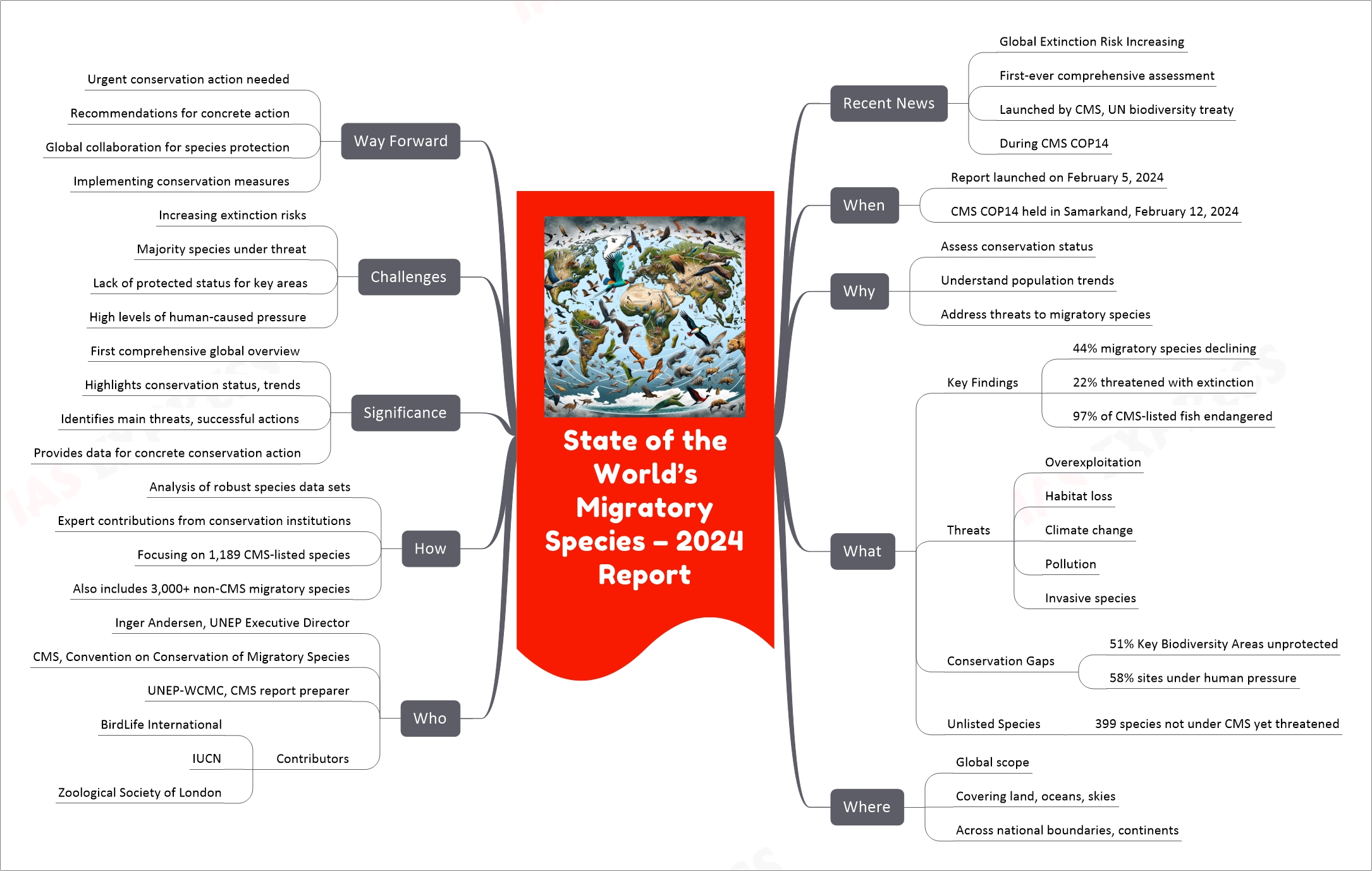
State of the World’s Migratory Species – 2024 Report mind map
  Recent News
    Global Extinction Risk Increasing
    First-ever comprehensive assessment
    Launched by CMS, UN biodiversity treaty
    During CMS COP14
  When
    Report launched on February 5, 2024
    CMS COP14 held in Samarkand, February 12, 2024
  Why
    Assess conservation status
    Understand population trends
    Address threats to migratory species
  What
    Key Findings
      44% migratory species declining
      22% threatened with extinction
      97% of CMS-listed fish endangered
    Threats
      Overexploitation
      Habitat loss
      Climate change
      Pollution
      Invasive species
    Conservation Gaps
      51% Key Biodiversity Areas unprotected
      58% sites under human pressure
    Unlisted Species
      399 species not under CMS yet threatened
  Where
    Global scope
    Covering land, oceans, skies
    Across national boundaries, continents
  Who
    Inger Andersen, UNEP Executive Director
    CMS, Convention on Conservation of Migratory Species
    UNEP-WCMC, CMS report preparer
    Contributors
      BirdLife International
      IUCN
      Zoological Society of London
  How
    Analysis of robust species data sets
    Expert contributions from conservation institutions
    Focusing on 1,189 CMS-listed species
    Also includes 3,000+ non-CMS migratory species
  Significance
    First comprehensive global overview
    Highlights conservation status, trends
    Identifies main threats, successful actions
    Provides data for concrete conservation action
  Challenges
    Increasing extinction risks
    Majority species under threat
    Lack of protected status for key areas
    High levels of human-caused pressure
  Way Forward
    Urgent conservation action needed
    Recommendations for concrete action
    Global collaboration for species protection
    Implementing conservation measures

The “State of the World’s Migratory Species – 2024 Report” presents a critical and comprehensive assessment of the conservation status and population trends of migratory species globally. Launched by the Convention on the Conservation of Migratory Species (CMS) under the UN, the report reveals alarming statistics: nearly half of the migratory species are in decline, with a significant number threatened with extinction. Key threats include overexploitation, habitat loss, climate change, pollution, and invasive species. The report highlights the urgent need for global conservation efforts, emphasizing the role of migratory species in maintaining ecosystem balance and advocating for the protection of key biodiversity areas.

/ Tourism Sector
Swadesh Darshan Scheme mind map
  Who
    Ministry of Tourism
    Government of India
    Implementing Agencies
      State Governments
      Union Territory Administrations
      Central Agencies
  When
    Launched in 2014-15
  Why
    Promote tourism in India
    Economic growth and job creation
    Synergy with other initiatives
      Swachh Bharat Abhiyan
      Skill India
      Make in India
  What
    Central Sector Scheme
    Theme-based tourist circuits
    Development of tourism infrastructure
    Circuits Identified
      Buddhist Circuit
      Coastal Circuit
      Desert Circuit
      Eco Circuit
      Heritage Circuit
      Himalayan Circuit
      Krishna Circuit
      North East Circuit
      Ramayana Circuit
      Rural Circuit
      Spiritual Circuit
      Sufi Circuit
      Tirthankar Circuit
      Tribal Circuit
      Wildlife Circuit
    Financial Assistance
      Central Financial Assistance (CFA)
      To State Governments and UTs
  Where
    Pan India
    31 States/UTs
    76 projects sanctioned
  How
    Submission of Detailed Project Reports (DPR)
    Adherence to scheme guidelines
    Utilization of released funds
  Significance
    Sustainable tourism development
    Responsible tourism destinations
    Private sector investment boost
    Public-Private Partnerships (PPP) promotion
  Challenges
    Overlap with other schemes
    Delays in execution
    Poor site identification
    Non-utilization of funds
  Way Forward
    Review and refine objectives
    Formulate long-term development plans
    Institutional mechanism for coordination
    Ensure sustainability of assets

The Swadesh Darshan Scheme is a central sector initiative by the Ministry of Tourism, aiming to develop various thematic tourist circuits across India. These circuits focus on different themes like heritage, culture, spirituality, and nature, reflecting the diverse attractions of the country. The scheme is notable for its comprehensive approach, involving state governments and UT administrations in creating infrastructure that enhances the tourism experience while promoting economic growth and job creation. It aligns with other major initiatives, emphasizing the integrated development of the tourism sector as a key economic driver.
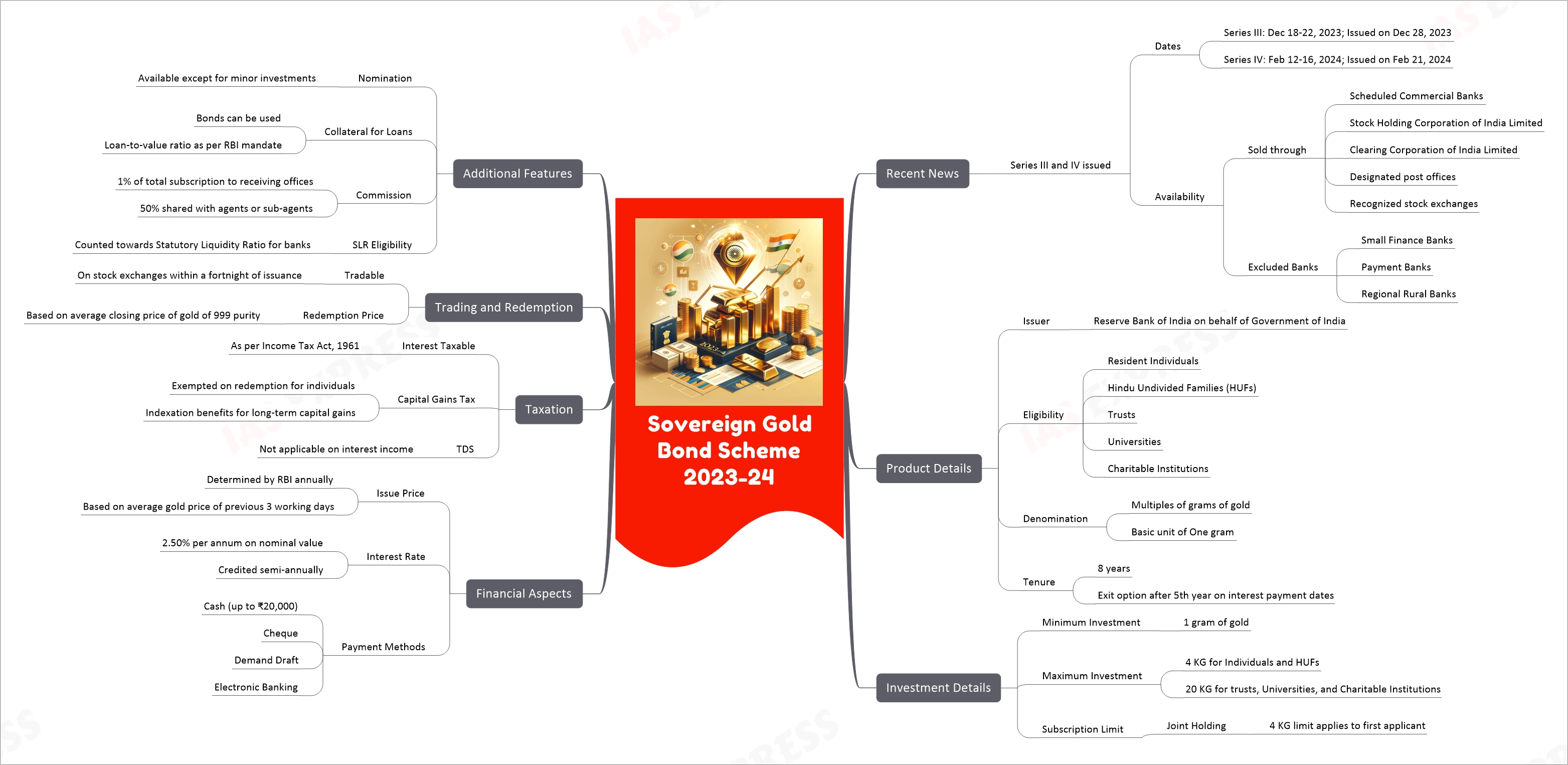
Sovereign Gold Bond Scheme 2023-24 mind map
  Recent News
    Series III and IV issued
      Dates
        Series III: Dec 18-22, 2023; Issued on Dec 28, 2023
        Series IV: Feb 12-16, 2024; Issued on Feb 21, 2024
      Availability
        Sold through
          Scheduled Commercial Banks
          Stock Holding Corporation of India Limited
          Clearing Corporation of India Limited
          Designated post offices
          Recognized stock exchanges
        Excluded Banks
          Small Finance Banks
          Payment Banks
          Regional Rural Banks
  Product Details
    Issuer
      Reserve Bank of India on behalf of Government of India
    Eligibility
      Resident Individuals
      Hindu Undivided Families (HUFs)
      Trusts
      Universities
      Charitable Institutions
    Denomination
      Multiples of grams of gold
      Basic unit of One gram
    Tenure
      8 years
      Exit option after 5th year on interest payment dates
  Investment Details
    Minimum Investment
      1 gram of gold
    Maximum Investment
      4 KG for Individuals and HUFs
      20 KG for trusts, Universities, and Charitable Institutions
    Subscription Limit
      Joint Holding
        4 KG limit applies to first applicant
  Financial Aspects
    Issue Price
      Determined by RBI annually
      Based on average gold price of previous 3 working days
    Interest Rate
      2.50% per annum on nominal value
      Credited semi-annually
    Payment Methods
      Cash (up to ₹20,000)
      Cheque
      Demand Draft
      Electronic Banking
  Taxation
    Interest Taxable
      As per Income Tax Act, 1961
    Capital Gains Tax
      Exempted on redemption for individuals
      Indexation benefits for long-term capital gains
    TDS
      Not applicable on interest income
  Trading and Redemption
    Tradable
      On stock exchanges within a fortnight of issuance
    Redemption Price
      Based on average closing price of gold of 999 purity
  Additional Features
    Nomination
      Available except for minor investments
    Collateral for Loans
      Bonds can be used
      Loan-to-value ratio as per RBI mandate
    Commission
      1% of total subscription to receiving offices
      50% shared with agents or sub-agents
    SLR Eligibility
      Counted towards Statutory Liquidity Ratio for banks

The Sovereign Gold Bond Scheme 2023-24, initiated by the Government of India and managed by the Reserve Bank of India, offers a method for individuals and entities to invest in gold without the need to hold physical gold. It provides a fixed interest rate and tax benefits on capital gains, making it an attractive option for long-term investment in gold. The scheme includes a series of bonds with various subscription and redemption features, aimed at different investor needs and preferences.
/ Road
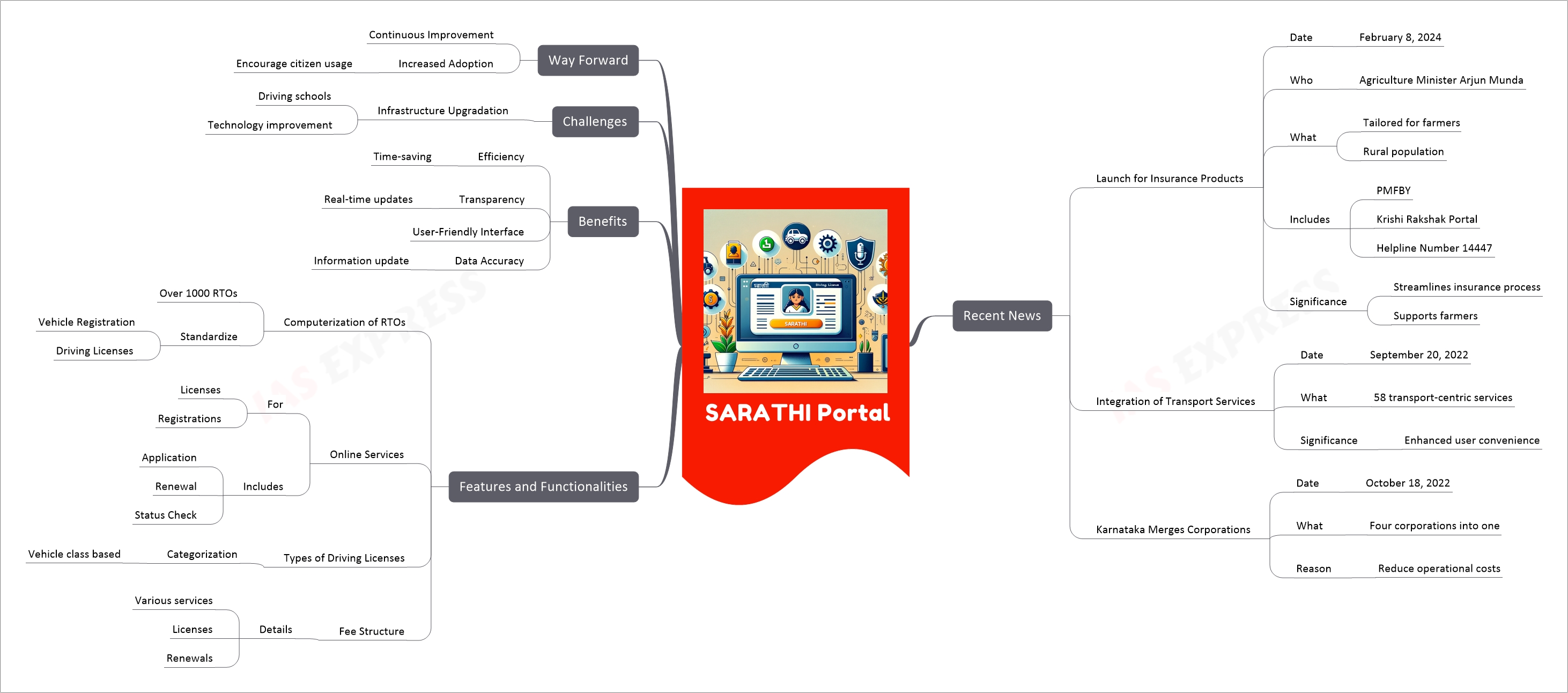
SARATHI Portal mind map
  Recent News
    Launch for Insurance Products
      Date
        February 8, 2024
      Who
        Agriculture Minister Arjun Munda
      What
        Tailored for farmers
        Rural population
      Includes
        PMFBY
        Krishi Rakshak Portal
        Helpline Number 14447
      Significance
        Streamlines insurance process
        Supports farmers
    Integration of Transport Services
      Date
        September 20, 2022
      What
        58 transport-centric services
      Significance
        Enhanced user convenience
    Karnataka Merges Corporations
      Date
        October 18, 2022
      What
        Four corporations into one
      Reason
        Reduce operational costs
  Features and Functionalities
    Computerization of RTOs
      Over 1000 RTOs
      Standardize
        Vehicle Registration
        Driving Licenses
    Online Services
      For
        Licenses
        Registrations
      Includes
        Application
        Renewal
        Status Check
    Types of Driving Licenses
      Categorization
        Vehicle class based
    Fee Structure
      Details
        Various services
        Licenses
        Renewals
  Benefits
    Efficiency
      Time-saving
    Transparency
      Real-time updates
    User-Friendly Interface
    Data Accuracy
      Information update
  Challenges
    Infrastructure Upgradation
      Driving schools
      Technology improvement
  Way Forward
    Continuous Improvement
    Increased Adoption
      Encourage citizen usage

The SARATHI portal is a digital initiative by the Indian government, primarily aimed at revolutionizing how vehicle-related services are managed. Recently, it has expanded to include insurance products tailored for farmers, integrating 58 transport services for user convenience. This portal simplifies processes like vehicle registration and driving license applications, renewals, and status checks. It brings benefits like increased efficiency, transparency, and data accuracy through a user-friendly interface. However, challenges such as the need for infrastructure and technology upgrades in driving schools persist. The way forward includes continuous improvement and encouraging wider adoption among citizens.
/ Species
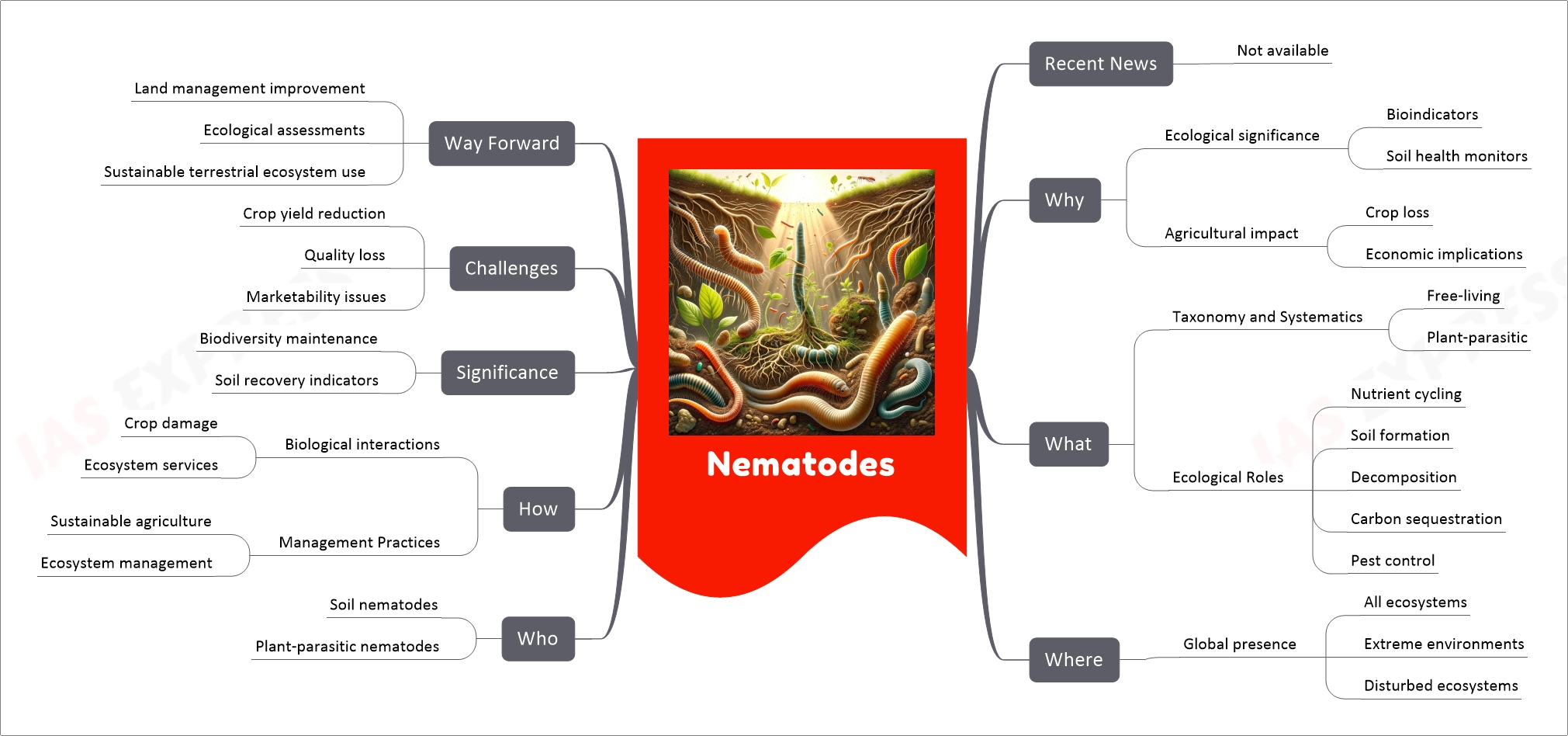
Nematodes mind map
  Recent News
    Not available
  Why
    Ecological significance
      Bioindicators
      Soil health monitors
    Agricultural impact
      Crop loss
      Economic implications
  What
    Taxonomy and Systematics
      Free-living
      Plant-parasitic
    Ecological Roles
      Nutrient cycling
      Soil formation
      Decomposition
      Carbon sequestration
      Pest control
  Where
    Global presence
      All ecosystems
      Extreme environments
      Disturbed ecosystems
  Who
    Soil nematodes
    Plant-parasitic nematodes
  How
    Biological interactions
      Crop damage
      Ecosystem services
    Management Practices
      Sustainable agriculture
      Ecosystem management
  Significance
    Biodiversity maintenance
    Soil recovery indicators
  Challenges
    Crop yield reduction
    Quality loss
    Marketability issues
  Way Forward
    Land management improvement
    Ecological assessments
    Sustainable terrestrial ecosystem use

Nematodes are a diverse group of organisms playing significant roles in ecology and agriculture. They are key bioindicators for monitoring soil health and environmental changes. In agriculture, while some nematodes are beneficial for soil processes like nutrient cycling and decomposition, plant-parasitic nematodes cause substantial crop losses, impacting the economy. Understanding their taxonomy, ecological roles, and management practices is essential for sustainable agriculture and ecosystem management. Their study is crucial for improved land management, ecological assessments, and sustainable use of terrestrial ecosystems.

/ Space
High-Altitude Pseudo Satellite Vehicle (HAPS) mind map
  Recent News
    BAE Systems launched PHASA-35
      Altitude over 66,000 ft
    Mira Aerospace tested ApusDuo
      Altitude 16,686 m
      Wingspan 15 m
      Payload 3.6 kg
  When
    Development Timeline
      2016
        UK MOD ordered Zephyr S UAVs
      2018
        Zephyr S set flight endurance record
      2019-2023
        Ongoing development and testing
  Why
    Purpose
      Services similar to satellites
      Benefits
        Rapid deployment
        Lower costs
        Operational flexibility
  What
    Capabilities
      Telecommunications
      Earth Observations
      GNSS
      Scientific applications
      Lower latency than satellites
    Technical Features
      Operate at altitudes 18-22 km
      Stratospheric conditions
        Low temperatures
        High solar, UV radiation
        Low atmospheric pressure
  Where
    Operating Zone
      Stratosphere
      Altitudes 59,000-72,000 ft
  Who
    Key Manufacturers
      Airbus
      BAE Systems
      AeroVironment, Inc.
      THALES
    Applications
      Military
      Security
      Civil missions
        Maritime surveillance
        Border patrol
  How
    Functioning
      Advanced battery and solar cell technologies
      Autonomous operation
      AI for data processing
  Significance
    Advantages
      Cost-effective
      Flexible
      Suitable for various applications
        Disaster management
        Surveillance
        Communication
  Challenges
    Limitations
      Weather hazards
      Technological challenges
        Battery efficiency
      Need for global regulations
      Meteorological data requirements
  Way Forward
    Future Prospects
      Battery technology advancements
      Remote sensor miniaturization
      Integration into global networks

High-Altitude Pseudo Satellite Vehicles (HAPS) are innovative unmanned aerial systems operating in the stratosphere, providing satellite-like services with added flexibility and lower costs. They hold immense potential for applications in telecommunications, surveillance, environmental monitoring, and disaster management. Despite facing challenges such as weather hazards and technological limitations, ongoing advancements in battery technology and AI integration suggest a promising future for HAPS in enhancing global communication and observation capabilities.
/ Diseases
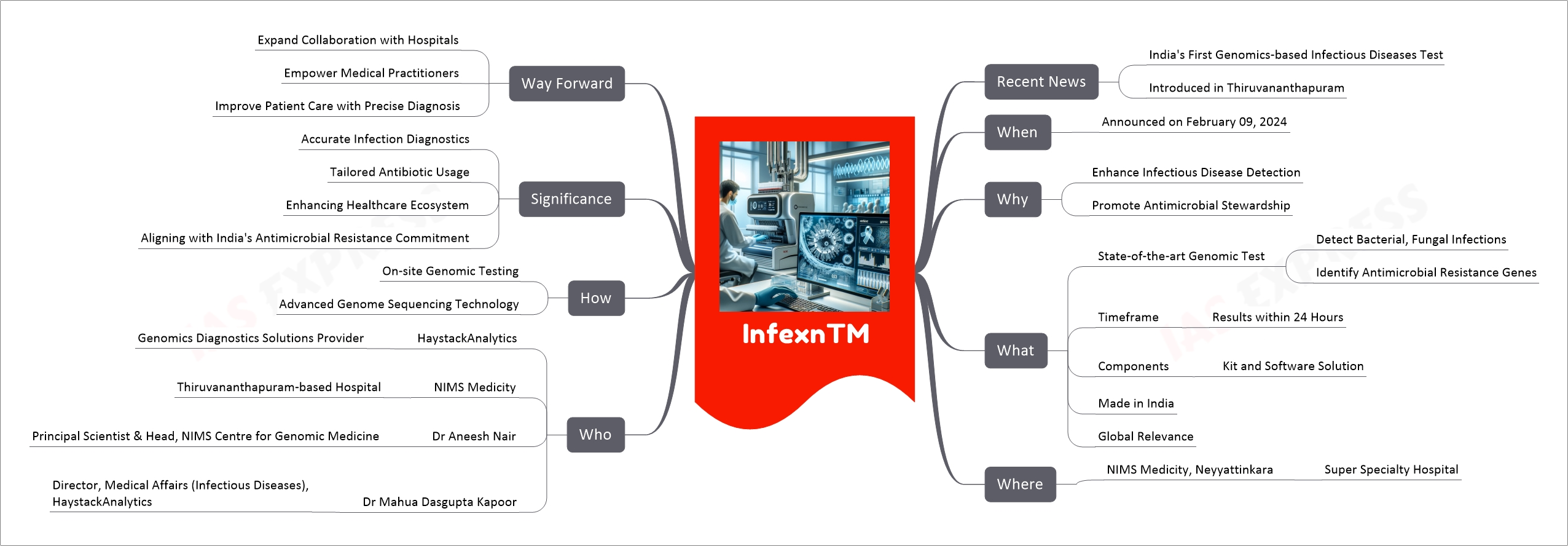
InfexnTM mind map
  Recent News
    India's First Genomics-based Infectious Diseases Test
    Introduced in Thiruvananthapuram
  When
    Announced on February 09, 2024
  Why
    Enhance Infectious Disease Detection
    Promote Antimicrobial Stewardship
  What
    State-of-the-art Genomic Test
      Detect Bacterial, Fungal Infections
      Identify Antimicrobial Resistance Genes
    Timeframe
      Results within 24 Hours
    Components
      Kit and Software Solution
    Made in India
    Global Relevance
  Where
    NIMS Medicity, Neyyattinkara
      Super Specialty Hospital
  Who
    HaystackAnalytics
      Genomics Diagnostics Solutions Provider
    NIMS Medicity
      Thiruvananthapuram-based Hospital
    Dr Aneesh Nair
      Principal Scientist & Head, NIMS Centre for Genomic Medicine
    Dr Mahua Dasgupta Kapoor
      Director, Medical Affairs (Infectious Diseases), HaystackAnalytics
  How
    On-site Genomic Testing
    Advanced Genome Sequencing Technology
  Significance
    Accurate Infection Diagnostics
    Tailored Antibiotic Usage
    Enhancing Healthcare Ecosystem
    Aligning with India's Antimicrobial Resistance Commitment
  Way Forward
    Expand Collaboration with Hospitals
    Empower Medical Practitioners
    Improve Patient Care with Precise Diagnosis

InfexnTM, introduced in Kerala’s capital, Thiruvananthapuram, is India’s first genomics-based infectious diseases test. Developed by HaystackAnalytics in collaboration with NIMS Medicity, this state-of-the-art test can detect bacterial and fungal infections, as well as antimicrobial resistance genes within 24 hours. This initiative promises to revolutionize the diagnosis and treatment of infectious diseases, aligning with India’s commitment to fight antimicrobial resistance. It symbolizes a significant advancement in the healthcare sector, enhancing patient care through precise diagnosis and tailored antibiotic usage.

/ Space
PACE Satellite mind map
  Recent News
    Launch Date
      February 8, 2024
    Launch Details
      SpaceX Falcon 9 Rocket
      Cape Canaveral Space Launch Complex 40
    Orbit Type
      Sun-Synchronous Orbit
    Launch Cost
      $80.4 million
  When
    Concept Inception
      Dates back over a decade
    Development Challenges
      Covid-19 Pandemic
      Budget Constraints
      Technical Issues
    Launch Countdown
      60-day Commissioning Period
  Why
    Mission Purpose
      Monitoring Earth's Oceans
      Atmospheric Study
    Climate Change
      Understanding Impacts
  What
    Instruments Onboard
      Hyperspectral Ocean Color Instrument
        UV, Visible, Near-Infrared Light Spectrum
        Detects 200 Colors
      Two Polarimeter Instruments
        Hyper-Angular Rainbow Polarimeter #2
        Spectro-Polarimeter for Planetary Exploration
    Data Utilization
      Phytoplankton Dynamics
      Aerosols and Cloud Properties
      Air Quality Assessment
  Where
    Operation Control
      NASA's Goddard Space Flight Center
    Spatial Coverage
      Global Observation
  Who
    Key Figures
      Mark Voyton
        PACE Project Manager
      Jeremy Werdell
        PACE Lead Scientist
    Collaborating Organizations
      NASA
      SpaceX
  How
    Mission Execution
      Daily Earth Scans
      Monthly Measurements
    Technology Utilization
      Advanced Spectrometry
      Polarimetry
  Significance
    Environmental Understanding
      Ocean Health
      Air Quality
      Atmospheric Effects
    Climate Change Insights
      Phytoplankton's Role
      Carbon Dioxide Exchange
  Challenges
    Technical Setbacks
      Instrument Failures
    Financial Challenges
      Budget Adjustments
    Pandemic-Related Delays
      Social Distancing Impacts
  Way Forward
    Data Analysis and Research
      Publish Scientific Data
    Long-Term Observation
      Ongoing Earth Monitoring

The PACE (Plankton, Aerosol, Cloud, ocean Ecosystem) satellite is a notable mission by NASA aimed at understanding and monitoring the Earth’s ocean and atmospheric conditions. Launched on February 8, 2024, aboard a SpaceX Falcon 9 rocket from Cape Canaveral Space Launch Complex 40, PACE marks a significant stride in climate research. The mission focuses on the intricate relationships between phytoplankton, aerosols, clouds, and other environmental elements.

PACE’s journey to launch was marked by various challenges, including technical issues and budget constraints exacerbated by the COVID-19 pandemic. Despite these hurdles, the mission, managed by NASA’s Goddard Space Flight Center, successfully advanced through rigorous testing and integration phases.

In orbit, PACE will observe the Earth’s atmosphere and ocean surface, enhancing our understanding of phytoplankton dynamics and their environmental interactions. This satellite is equipped with advanced instruments, including a hyperspectral ocean color instrument and two polarimeter instruments, Hyper-Angular Rainbow Polarimeter #2 and Spectro-polarimeter for Planetary Exploration. These instruments will provide detailed data on ocean ecology, atmospheric aerosols, cloud properties, and air quality at various scales.

PACE represents a continuation and advancement of over two decades of NASA’s satellite observations related to ocean biology, atmospheric aerosols, and climate studies. The mission aims to provide invaluable data for understanding and addressing climate change challenges.

Overall, PACE is a testament to the persistence and perseverance of the scientific community in advancing our knowledge of Earth’s complex systems, despite facing significant obstacles along the way.
/ Species
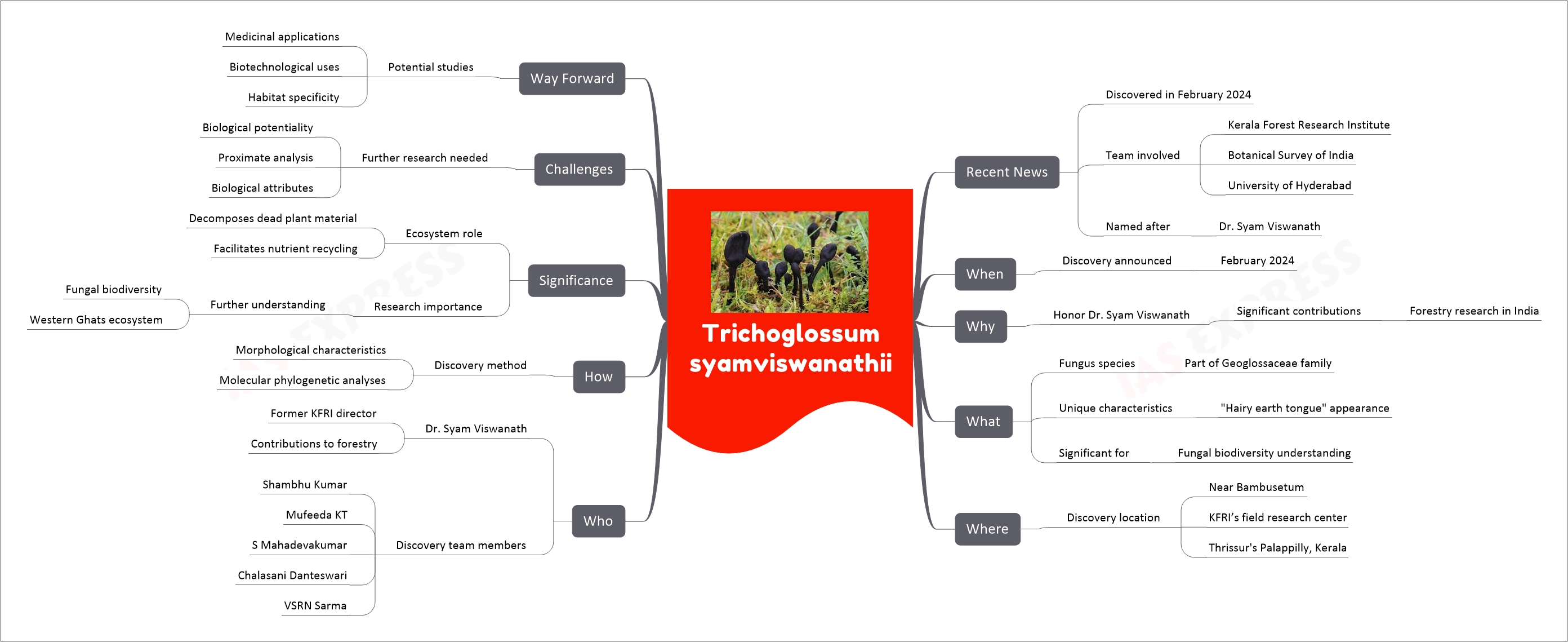
Trichoglossum syamviswanathii mind map
  Recent News
    Discovered in February 2024
    Team involved
      Kerala Forest Research Institute
      Botanical Survey of India
      University of Hyderabad
    Named after
      Dr. Syam Viswanath
  When
    Discovery announced
      February 2024
  Why
    Honor Dr. Syam Viswanath
      Significant contributions
        Forestry research in India
  What
    Fungus species
      Part of Geoglossaceae family
    Unique characteristics
      "Hairy earth tongue" appearance
    Significant for
      Fungal biodiversity understanding
  Where
    Discovery location
      Near Bambusetum
      KFRI’s field research center
      Thrissur's Palappilly, Kerala
  Who
    Dr. Syam Viswanath
      Former KFRI director
      Contributions to forestry
    Discovery team members
      Shambhu Kumar
      Mufeeda KT
      S Mahadevakumar
      Chalasani Danteswari
      VSRN Sarma
  How
    Discovery method
      Morphological characteristics
      Molecular phylogenetic analyses
  Significance
    Ecosystem role
      Decomposes dead plant material
      Facilitates nutrient recycling
    Research importance
      Further understanding
        Fungal biodiversity
        Western Ghats ecosystem
  Challenges
    Further research needed
      Biological potentiality
      Proximate analysis
      Biological attributes
  Way Forward
    Potential studies
      Medicinal applications
      Biotechnological uses
      Habitat specificity

Trichoglossum syamviswanathii is a newly discovered fungus species within the Geoglossaceae family, known for its distinctive “hairy earth tongue” appearance. Discovered in February 2024 near the Bambusetum at KFRI’s field research center in Kerala, the fungus was named in honor of Dr. Syam Viswanath, a notable forestry researcher and former director of KFRI. The discovery team included experts from KFRI, BSI, and the University of Hyderabad. This species is crucial for the decomposition of dead plant materials, playing a significant role in nutrient recycling within forest ecosystems. The discovery highlights the importance of ongoing research into the diverse flora and fauna of the Western Ghats and opens avenues for future studies on its potential medicinal or biotechnological applications.

If you like this post, please share your feedback in the comments section below so that we will upload more posts like this.

Responses

🖍️ Highlight
HomeCoursesPlansAccount