Trichoglossum syamviswanathii

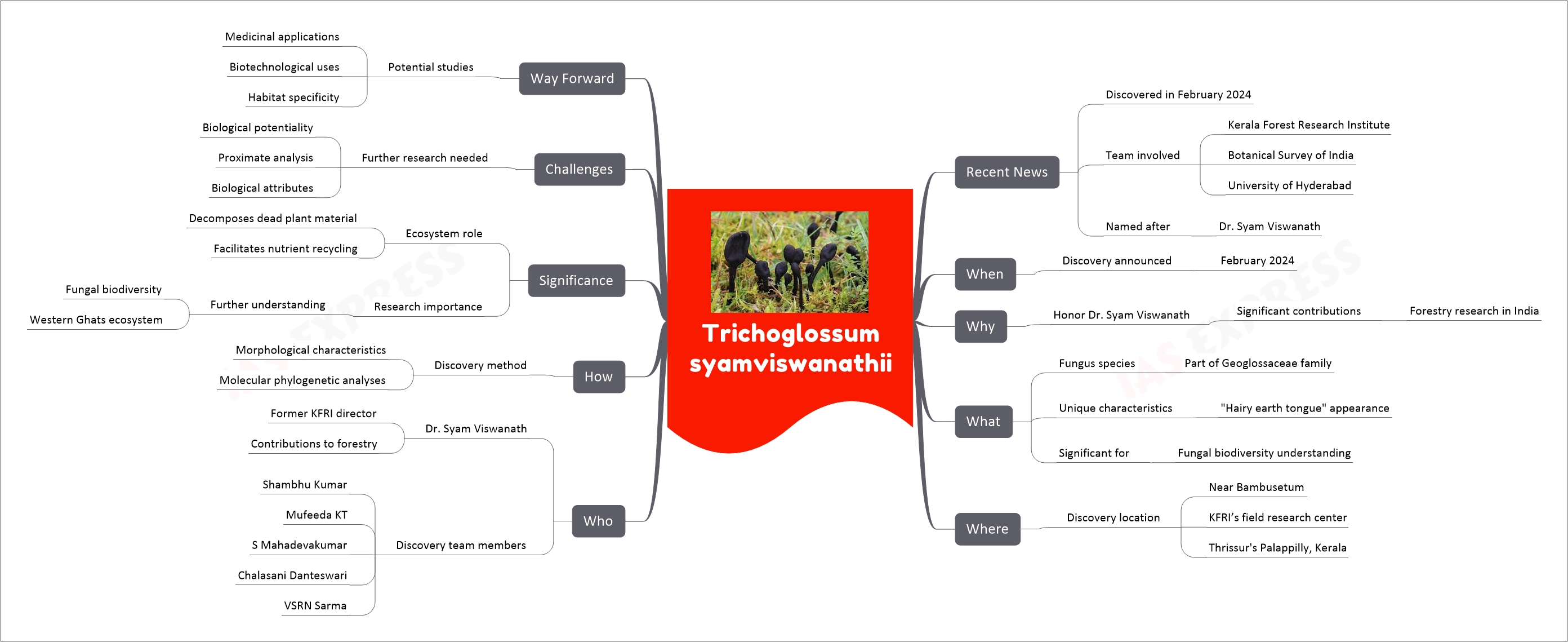
Trichoglossum syamviswanathii mind map

  Recent News
    Discovered in February 2024
    Team involved
      Kerala Forest Research Institute
      Botanical Survey of India
      University of Hyderabad
    Named after
      Dr. Syam Viswanath
  When
    Discovery announced
      February 2024
  Why
    Honor Dr. Syam Viswanath
      Significant contributions
        Forestry research in India
  What
    Fungus species
      Part of Geoglossaceae family
    Unique characteristics
      "Hairy earth tongue" appearance
    Significant for
      Fungal biodiversity understanding
  Where
    Discovery location
      Near Bambusetum
      KFRI’s field research center
      Thrissur's Palappilly, Kerala
  Who
    Dr. Syam Viswanath
      Former KFRI director
      Contributions to forestry
    Discovery team members
      Shambhu Kumar
      Mufeeda KT
      S Mahadevakumar
      Chalasani Danteswari
      VSRN Sarma
  How
    Discovery method
      Morphological characteristics
      Molecular phylogenetic analyses
  Significance
    Ecosystem role
      Decomposes dead plant material
      Facilitates nutrient recycling
    Research importance
      Further understanding
        Fungal biodiversity
        Western Ghats ecosystem
  Challenges
    Further research needed
      Biological potentiality
      Proximate analysis
      Biological attributes
  Way Forward
    Potential studies
      Medicinal applications
      Biotechnological uses
      Habitat specificity

Trichoglossum syamviswanathii is a newly discovered fungus species within the Geoglossaceae family, known for its distinctive “hairy earth tongue” appearance. Discovered in February 2024 near the Bambusetum at KFRI’s field research center in Kerala, the fungus was named in honor of Dr. Syam Viswanath, a notable forestry researcher and former director of KFRI. The discovery team included experts from KFRI, BSI, and the University of Hyderabad. This species is crucial for the decomposition of dead plant materials, playing a significant role in nutrient recycling within forest ecosystems. The discovery highlights the importance of ongoing research into the diverse flora and fauna of the Western Ghats and opens avenues for future studies on its potential medicinal or biotechnological applications.
Related Posts
If you like this post, please share your feedback in the comments section below so that we will upload more posts like this.

Responses

🖍️ Highlight
HomeCoursesPlansAccount