Candida Auris

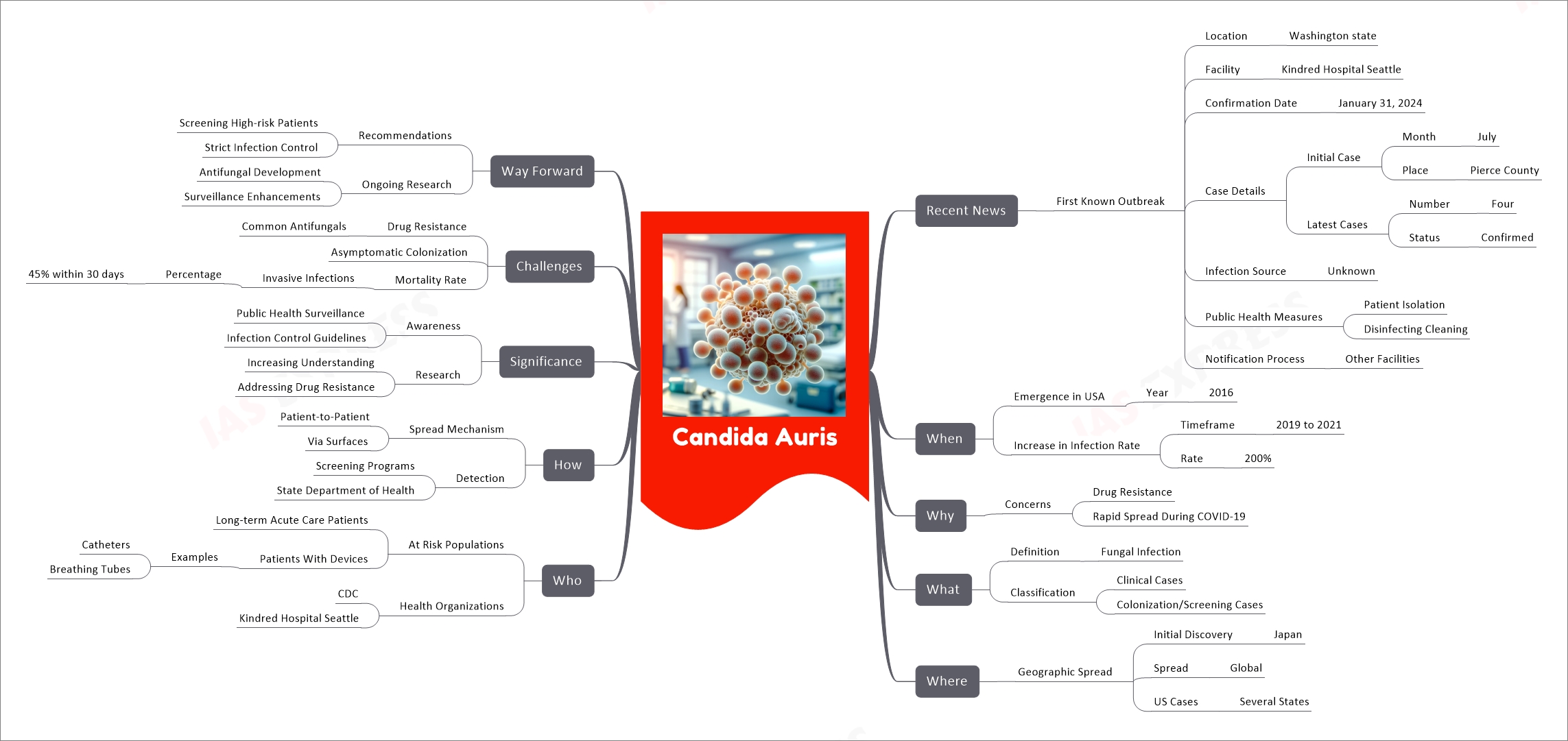
Candida Auris mind map
  Recent News
    First Known Outbreak
      Location
        Washington state
      Facility
        Kindred Hospital Seattle
      Confirmation Date
        January 31, 2024
      Case Details
        Initial Case
          Month
            July
          Place
            Pierce County
        Latest Cases
          Number
            Four
          Status
            Confirmed
      Infection Source
        Unknown
      Public Health Measures
        Patient Isolation
        Disinfecting Cleaning
      Notification Process
        Other Facilities
  When
    Emergence in USA
      Year
        2016
    Increase in Infection Rate
      Timeframe
        2019 to 2021
      Rate
        200%
  Why
    Concerns
      Drug Resistance
      Rapid Spread During COVID-19
  What
    Definition
      Fungal Infection
    Classification
      Clinical Cases
      Colonization/Screening Cases
  Where
    Geographic Spread
      Initial Discovery
        Japan
      Spread
        Global
      US Cases
        Several States
  Who
    At Risk Populations
      Long-term Acute Care Patients
      Patients With Devices
        Examples
          Catheters
          Breathing Tubes
    Health Organizations
      CDC
      Kindred Hospital Seattle
  How
    Spread Mechanism
      Patient-to-Patient
      Via Surfaces
    Detection
      Screening Programs
      State Department of Health
  Significance
    Awareness
      Public Health Surveillance
      Infection Control Guidelines
    Research
      Increasing Understanding
      Addressing Drug Resistance
  Challenges
    Drug Resistance
      Common Antifungals
    Asymptomatic Colonization
    Mortality Rate
      Invasive Infections
        Percentage
          45% within 30 days
  Way Forward
    Recommendations
      Screening High-risk Patients
      Strict Infection Control
    Ongoing Research
      Antifungal Development
      Surveillance Enhancements

Candida Auris is a significant public health concern due to its resistance to common antifungal medications and its ability to spread rapidly, especially in healthcare settings. It first emerged in the United States in 2016 and has since seen a significant increase in infection rates. The fungus can spread through patient-to-patient contact and contaminated surfaces. Particularly concerning is the fungus’s ability to colonize patients without causing symptoms, which can lead to invasive infections with a high mortality rate. Public health efforts focus on surveillance, strict infection control measures, and ongoing research to address drug resistance and improve detection methods.

Related Posts
If you like this post, please share your feedback in the comments section below so that we will upload more posts like this.

Responses

🖍️ Highlight
HomeCoursesPlansAccount