[Newsbits] 23.01.2024: Malathion Pesticide, Khanjar Exercise & more

newsbits mindmap notes

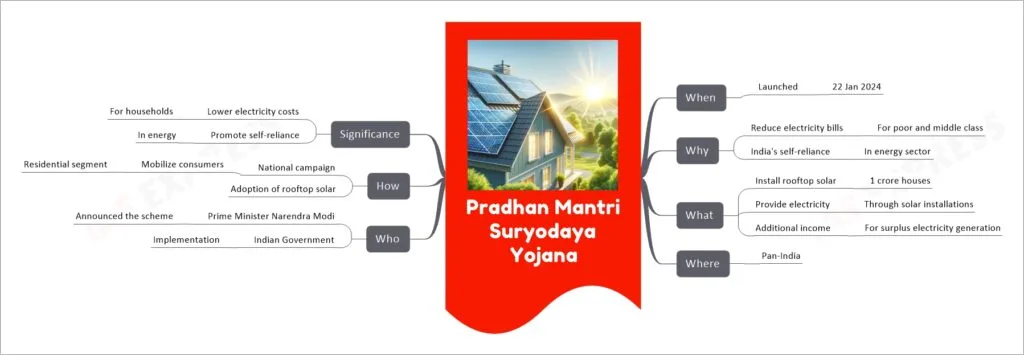
The Pradhan Mantri Suryodaya Yojana is a new initiative announced by Indian Prime Minister Narendra Modi, targeting the installation of rooftop solar panels on one crore houses. This scheme is designed to reduce electricity bills for the poor and middle class and promote India’s self-reliance in the energy sector. It also offers the potential for additional income through surplus electricity generation. The plan was launched on January 22, 2024, and involves a nationwide campaign to encourage the adoption of rooftop solar among residential consumers. The significant benefits of the scheme include lower electricity costs for households and the promotion of energy self-reliance.

Khanjar Exercise mind map
  Recent News:
    11th Edition:
      Commenced: 22nd January 2024
      Ends: 3rd February 2024
      Location: Bakloh, Himachal Pradesh
  When:
    Started: 22nd January 2024
    Ends: 3rd February 2024
  Why:
    Counter Terrorism
    Special Forces Operations
    Under UN Charter Chapter VII
  What
    India-Kyrgyzstan:
      Joint Exercise
      Annual Event
      Alternates Locations
    2024 Edition:
      Location: India
      Previous: Kyrgyzstan
  Where:
    Bakloh:
      Himachal Pradesh
      India
  Who:
    Indian Army:
      20 Personnel
      Parachute Regiment
    Kyrgyzstan:
      20 Personnel
      Scorpion Brigade
  How:
    Exchange:
      Experiences
      Best Practices
    Focus:
      Mountainous Terrain
      Built-up Areas
    Techniques:
      Special Forces Skills
      Advanced Insertion
      Extraction
  Significance:
    Strengthening Defence Ties
    Addressing Terrorism
    Showcasing Indigenous Equipment
    Bilateral Relations

The Khanjar exercise is the 11th edition of a joint special forces exercise between India and Kyrgyzstan. It commenced on 22nd January 2024 and is scheduled to conclude on 3rd February 2024. The exercise is taking place in Bakloh, Himachal Pradesh, India. This annual event alternates locations between the two countries. The exercise includes 20 personnel from the Indian Army’s Parachute Regiment and 20 from Kyrgyzstan’s Scorpion Brigade. Its aim is to share experiences and best practices in counter-terrorism and special forces operations, particularly in mountainous terrains and urban areas. The exercise is part of the cooperation under Chapter VII of the United Nations Charter and focuses on developing special forces skills and advanced techniques in insertion and extraction. It plays a significant role in strengthening defense ties, addressing international terrorism, showcasing state-of-the-art indigenous defense equipment, and boosting bilateral relations between India and Kyrgyzstan.
/ Afghanistan
Malathion Pesticide mind map
  Recent News
    India supports Afghanistan
      Date
        January 2024
      Details
        40,000 liters supplied
        Combats locust threat
        Through Chabahar port
      Delivered to
        Taliban-controlled Ministry
        Ministry of Agriculture, Irrigation, and Livestock
      FAO of UN
        Gratitude expressed
        Importance
          Effective in arid regions
          Minimal water usage
      Impact
        Prevents locust spread
        Protects Central Asian countries
          Tajikistan
          Uzbekistan
          Turkmenistan
  When
    January 2024
  Why
    Combat locust threat
  What
    40,000 liters Malathion
  Where
    Afghanistan
  Who
    India
    Taliban-controlled Afghanistan government
    FAO of UN
  How
    Via Chabahar port
    In two trucks
  Significance
    Effective in arid regions
    Minimizes water usage
    Prevents locust spread

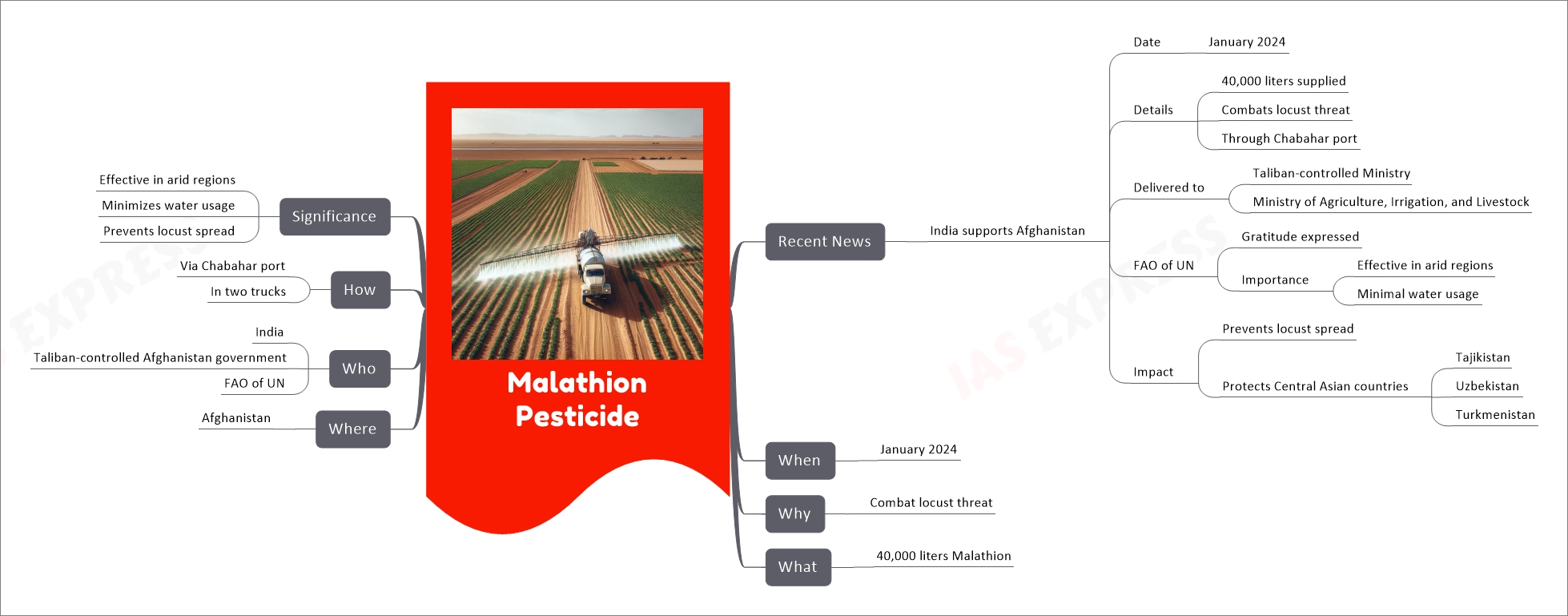
In summary, Malathion is a powerful pesticide that India recently supplied to Afghanistan to combat a severe locust threat. This aid not only addresses the immediate issue within Afghanistan but also plays a critical role in preventing the spread of locusts to neighboring Central Asian countries, thereby protecting regional food security and agricultural stability.

/ Canada

In January 2024, the Canadian government implemented a cap of approximately 360,000 on new international student visas for a two-year period to address challenges like housing shortages and to improve the overall quality of education and student support resources. This initiative includes changes to the Post-Graduation Work Permit Program and introduces new requirements like the attestation letter for study permit applications. The changes also affect open work permit eligibility for spouses of international students. These measures are part of Canada’s effort to ensure a balanced and sustainable approach to international education, focusing on both the well-being of students and the needs of the Canadian education system.
India Surpasses Hong Kong as 4th biggest stock market mind map
  Recent News:
    January 2024:
      India becomes world's:
        Fourth biggest stock market
  When:
    Achievement date:
      January 2024
  Why:
    Contributing factors:
      Strong growth prospects
      Policy reforms
      Investor confidence
  What
    Market capitalization:
      India:
        $4.33 trillion
      Hong Kong:
        $4.29 trillion
  Where:
    Global ranking:
      Top five stock markets:
        United States:
          $50.86 trillion
        China:
          $8.44 trillion
        Japan:
          $6.36 trillion
        India:
          $4.33 trillion
        Hong Kong:
          $4.29 trillion
  Who:
    Key performers:
      Sensex and Nifty indexes
      BSE MidCap and SmallCap
      Notable companies:
        Tata Motors
        Bajaj Auto
        NTPC
        L&T
        Coal India
  How:
    Investment trends:
      Overseas funds:
        $21 billion into Indian shares in 2023
      S&P BSE Sensex Index:
        Eighth consecutive year of gains
  Significance:
    Positive impact:
      Global investor attraction
      Domestic market growth
      Strong economic indicators
  Challenges:
    Comparisons:
      China and Hong Kong:
        Economic challenges
        Declining market trends
  Way Forward:
    Future prospects:
      Anticipated global rate cuts in 2024
      Upcoming budget announcement
      Central government elections

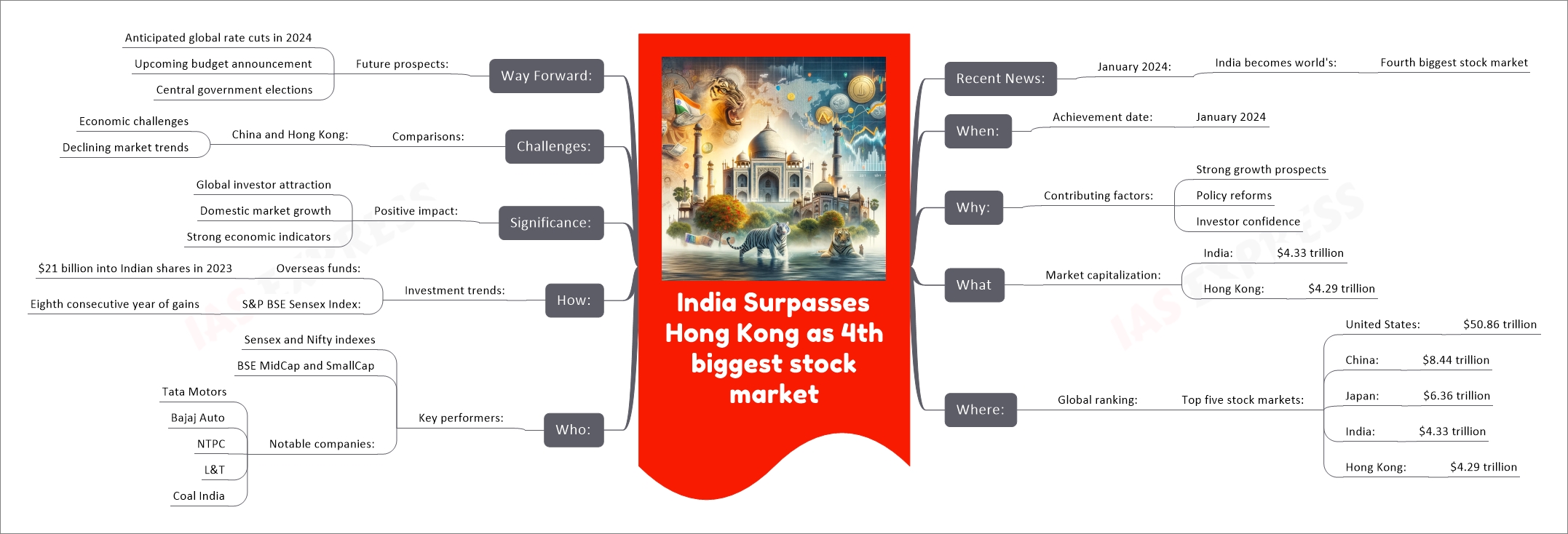
India’s recent milestone of surpassing Hong Kong to become the world’s fourth-largest stock market in January 2024 is significant. This achievement was driven by strong growth prospects, policy reforms, and high investor confidence. With a market capitalization of $4.33 trillion, India now ranks behind the United States, China, and Japan. Key performers in this growth include the Sensex and Nifty indexes, and companies like Tata Motors, Bajaj Auto, and NTPC. Overseas investment has played a major role, with more than $21 billion poured into Indian shares in 2023. This growth stands in contrast to the economic challenges faced by China and Hong Kong. Looking forward, India’s stock market remains optimistic with potential global rate cuts in 2024 and key political and economic events on the horizon.

Madiga Community mind map
  Recent News:
    January 2024:
      Committee Formation:
        Purpose: Address SC sub-categorization
        Goal: Equitable benefits distribution
        Context:
          Historical demand: Raised in 1994
          Legal possibilities: Explored in 2005
          National Commissions: Opposed amendment
          Constitutional Articles: 341, 342 allow sub-categorization
          Current Scenario: No substantive hearings on sub-classification
  When:
    Historical Demand: 1994
    Legal Exploration: 2005
    Modi's Commitment: 2013
    Recent Committee: January 2024
  Why:
    Equitable distribution:
      Within SC quota
      Among sub-castes
    Historical disparities:
      Between Madigas, Malas, Adi Andhras, Rellis
  What
    Madiga Dandora Movement:
      Founders: Manda Krishna Madiga, Dandu Veeraiah Madiga
      Aim: Categorization of SC reservation quota
      Activities: Dharnas, rallies, rail rokos
      Report by Justice Raju: 1997
      Recommended Classification:
        Group D: 1% Rellis
        Group C: 7% Madigas
        Group B: 6% Malas
        Group A: 1% Adi Andhra
  Where:
    Predominant States:
      Andhra Pradesh
      Telangana
      Karnataka
  Who:
    Madiga Community:
      Traditional Occupations:
        Tannery
        Leatherwork
        Handicrafts
        Agricultural laborers
        Village drummers
        Street sweepers
    Manda Krishna Madiga:
      Role: Activist, Politician
      Contribution: Founder of MRPS
  How:
    Political Involvement:
      Initial: Dalit Maha Sabha
      BSP Influence: In 1990s
      Modi's Promise: Amend Constitution
    Legal Efforts:
      Sub-classification:
        Referred to 7-Judge Bench
        No hearings since referral
  Significance:
    Fair distribution:
      Of reservations
      Of government benefits
  Challenges:
    Internal differentiation:
      Within SCs
      Among OBCs
    Reservation vs. Merit debate
  Way Forward:
    Need for:
      Workable solution
      Substantive hearings
      Constitutional clarity

The Madiga community, primarily found in the southern Indian states of Andhra Pradesh, Telangana, and Karnataka, is historically associated with occupations like tannery, leatherwork, and handicrafts. In recent news, a committee was formed in January 2024 to address the sub-categorization of Scheduled Castes (SCs) for equitable benefits distribution. This move follows historical demands dating back to 1994, seeking better representation and fair distribution of reservations and government benefits among various SC sub-castes. The Madiga community, through movements like the Madiga Dandora movement, has played a significant role in advocating for these changes. The community’s struggles and demands highlight the ongoing debates around caste-based reservations, internal differentiation within SCs, and the challenges in achieving equitable distribution of resources. The way forward includes finding a workable solution, conducting substantive hearings, and gaining constitutional clarity on these issues.

/ Diseases
Cameroon Malaria Vaccine Program mind map
  Recent News
    January 2024 Launch
  When
    Launched January 2024
  Why
    Combat Malaria
  What
    RTS,S Vaccine
    Developed by GSK
    Targets P. falciparum
    Four Doses
    From 5 Months Age
  Where
    Across Cameroon
  Who
    Cameroon Government
    Supported by
      WHO
      Gavi
      UNICEF
  How
    Free of Charge
    Integrated with Other Vaccinations
    20 African Countries Involved
  Significance
    First of Its Kind
    Reduces Severe Malaria Risk
    Alleviates Healthcare Burden
  Challenges
    Moderate Effectiveness
    Logistical Challenges
    Requires Multiple Doses
  Way Forward
    Broader African Rollout
    Introduction of Second Vaccine
      R21 by Oxford University

In January 2024, Cameroon launched the world’s first malaria vaccine program for children, marking a significant milestone in public health. The program utilizes the RTS,S vaccine, developed by GSK, to target the deadliest strain of malaria, P. falciparum. This vaccine, which requires four doses starting from around 5 months of age, will be offered free of charge and integrated with other routine child immunizations. While the vaccine’s effectiveness is moderate, it represents a critical step towards reducing the malaria burden in Africa, where the disease has a profound impact. Challenges such as logistical distribution and ensuring complete immunization remain, but the program’s launch is seen as a major achievement in the fight against malaria.

/ Awards & Honors
Karpoori Thakur mind map
  Recent News 
    Bharat Ratna Awarded
      Posthumously
      January 2024
      Honouring Contributions
  When
    Born 1924
    Chief Minister Tenure
      December 1970 to June 1971
      December 1977 to April 1979
    Passed Away February 17, 1988
  Why
    Champion for Marginalised
    Stalwart of Equality
    Significant Political Contributions
  What
    Prohibition of Alcohol
      Enforced 1970
    Education Initiatives
      Established Schools, Colleges
    Mandal Commission Recommendations
      Implemented Later
    Mungeri Lal Commission Report
      Reclassifying Backward Classes
      Implemented 1978
  Where
    Bihar, India
  Who
    Socialist Leader
      Non-Congress Chief Minister
    Education Minister
      Removed English Requirement
    Legacy
      Influence on Bihar Politics
  How
    Upliftment of Backward Classes
    Reforms in Education, Employment
  Significance
    Pioneering Social Reforms
    Foundation for Affirmative Action
    Influence on Regional Politics
  Way Forward
    Continued Inspiration
      For Social Justice
      Equity and Empowerment

Karpoori Thakur, a revered figure in Indian politics, is best known for his contributions towards the upliftment of backward classes and marginalized communities. Born into a marginal farmer’s family in 1924, Thakur rose to prominence as a socialist leader and served as the Chief Minister of Bihar. His tenure is notable for several key initiatives, including the total prohibition of alcohol and the establishment of educational institutions in underdeveloped regions. Thakur was instrumental in advocating for the rights of the Other Backward Classes (OBC), laying the groundwork for future affirmative action policies in India. His efforts led to the implementation of the Mandal Commission recommendations and the reclassification of backward classes. In January 2024, Thakur was posthumously honored with the Bharat Ratna, India’s highest civilian award, recognizing his enduring efforts for social justice and equality.

NATO Mega Ammunition Deal mind map
  Recent News
    January 2024
    Ukrainian Conflict
  When
    Deal Signed
      Date
        January 23, 2024
  Why
    Support Ukraine
      Against Russian Aggression
  What
    $1.2 Billion Deal
      220,000 Artillery Shells
      155mm Ammunition
    Delivery
      24 to 36 Months
      Possibly until 2027
  Where
    NATO Headquarters
      Brussels
    Ukraine
      Battlefield
  Who
    Involved Parties
      NATO
        North Atlantic Treaty Organization
      Ukraine
        Recipient
      Russia
        Aggressor
    Key Figures
      Jens Stoltenberg
        NATO Secretary General
      Volodymyr Zelenskyy
        Ukrainian President
  How
    Bulk Purchase
      Reduced Prices
    Collaboration
      Belgium, Lithuania, Spain
    Manufacturers
      Nexter (France)
      Junghans (Germany)
  Significance
    Support Ukraine's Defense
      Balance Power
    Replenish NATO Stockpiles
  Challenges
    Delivery Delays
      Long Production Time
    Immediate Need
      Ukraine's Urgency
  Way Forward
    Increase Ammunition Production
      NATO Factories
    Accelerate Supply
      To Ukraine

The NATO Mega Ammunition Deal, signed on January 23, 2024, involves a $1.2 billion agreement for the purchase of 220,000 rounds of 155mm artillery ammunition. This deal is a strategic move by NATO to support Ukraine in its ongoing conflict with Russia, aiming to replenish depleted stockpiles and bolster Ukraine’s defense capabilities. The contract indicates a delivery timeline of 24 to 36 months, potentially extending until 2027. Key players in this agreement include NATO, with Jens Stoltenberg as the Secretary-General, and Ukraine, led by President Volodymyr Zelenskyy. The deal highlights the challenges faced by Ukraine in terms of immediate ammunition needs and the anticipated delays in delivery, emphasizing the necessity for NATO to increase its ammunition production and expedite the supply process to Ukraine.
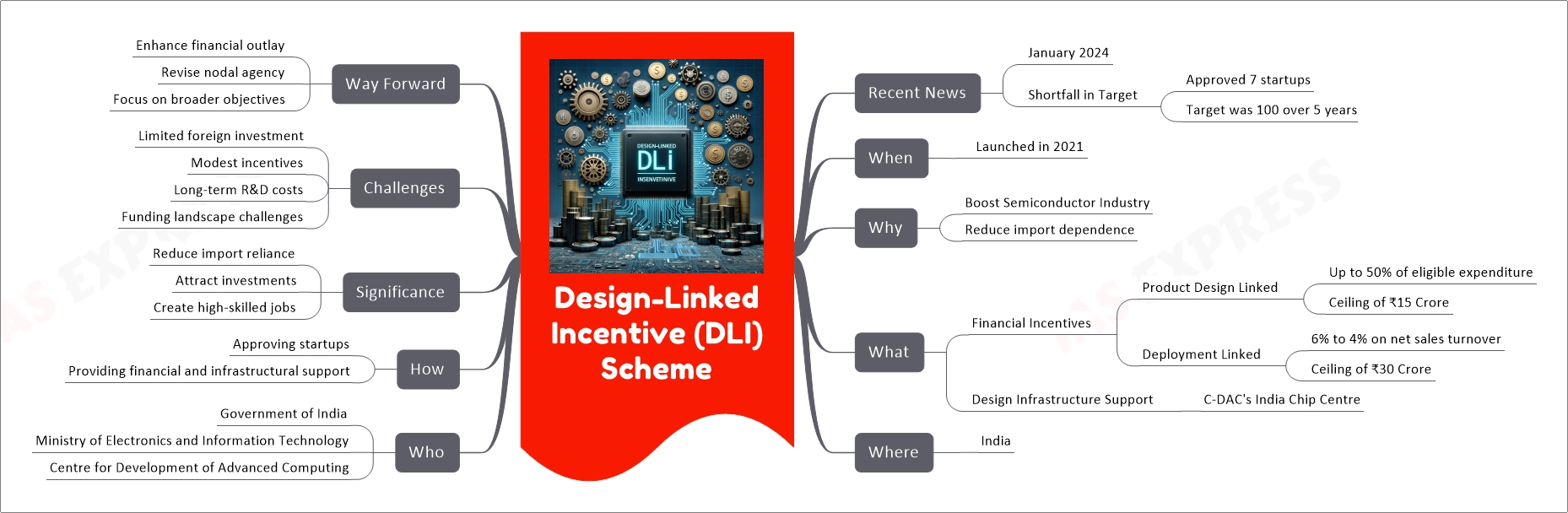
Design-Linked Incentive (DLI) Scheme mind map
  Recent News
    January 2024
    Shortfall in Target
      Approved 7 startups
      Target was 100 over 5 years
  When
    Launched in 2021
  Why
    Boost Semiconductor Industry
    Reduce import dependence
  What
    Financial Incentives
      Product Design Linked
        Up to 50% of eligible expenditure
        Ceiling of ₹15 Crore
      Deployment Linked
        6% to 4% on net sales turnover
        Ceiling of ₹30 Crore
    Design Infrastructure Support
      C-DAC's India Chip Centre
  Where
    India
  Who
    Government of India
    Ministry of Electronics and Information Technology
    Centre for Development of Advanced Computing
  How
    Approving startups
    Providing financial and infrastructural support
  Significance
    Reduce import reliance
    Attract investments
    Create high-skilled jobs
  Challenges
    Limited foreign investment
    Modest incentives
    Long-term R&D costs
    Funding landscape challenges
  Way Forward
    Enhance financial outlay
    Revise nodal agency
    Focus on broader objectives

The Design-Linked Incentive (DLI) scheme, initiated by the Indian government, is a strategic move to bolster the domestic semiconductor design industry. Its primary objectives include reducing dependence on semiconductor imports, especially from China, and fostering growth in this high-tech sector. Despite its promising goals, the scheme has experienced setbacks, notably in reaching its startup support targets. Key challenges involve limited foreign investment, modest financial incentives, and the substantial costs associated with long-term semiconductor research and development. A concerted effort to reevaluate and enhance the scheme’s financial and structural aspects could pave the way for India to emerge as a significant player in the global semiconductor industry.

If you like this post, please share your feedback in the comments section below so that we will upload more posts like this.

Responses

🖍️ Highlight
HomeCoursesPlansAccount