[Newsbits] 10.01.2024: Shark Meat Consumption in India, Fungi Bio-Pesticide, Work4Food & more

newsbits mindmap notes

/ Species
Shark Meat Consumption in India mind map
  Recent News
    Rising Popularity
      Among Middle-Class
      Among Foreign Tourists
      In Restaurants
    Study Highlights
      9.8% Annual Catch
      251.6 Tonnes Sold Annually
      292 Restaurants Listed
  When
    Centuries-Old Tradition
    Increased Since 1960s
    2024 Data
  Why
    Affordability
    Distinct Taste
    Traditional Cuisine
  What/Full Provisions
    Consumed Species
      Spadenose Shark
      Milk Shark
      Gray Sharpnose Shark
      Reticulate Whipray
    Legal Status
      Banned Live-Finning
      10 Species Protected
    Global Trade Value
      $4.1 Billion (2012-2019)
  Where
    Coastal Regions
    Highest in Goa
    Tamil Nadu
    Maharashtra
  Who
    Consumers
      Local Goans
      Foreign Tourists
    Researchers
    Restaurant Owners
  How
    Served in Dishes
      Ambotik
      Butter Garlic Shark
      Shark Fry
    Marketed
      Online Menus
  Pros
    Economic Importance
  Cons
    Threat to Species
      Overfishing
      Impact on Juveniles
    Health Risks
      Heavy Metals
      Toxic Metals
  Way Forward
    Sustainable Alternatives
    Consumer Awareness
    Increased Prices
    Bycatch Reduction
    Better Fisheries Management

Shark meat consumption in India has been a traditional practice for centuries, primarily among tribal and coastal communities. Recently, there has been a significant rise in its popularity, especially among middle-class consumers and foreign tourists, with approximately 251.6 tonnes of shark meat being sold annually in Indian restaurants. This increase poses a threat to shark species, many of which are already facing extinction due to overfishing. A notable shift has occurred since the 1960s, with an expansion in the variety of sharks consumed, including endangered species. The consumption is highest in states like Goa, Tamil Nadu, and Maharashtra. The rise in shark meat demand has led to concerns regarding sustainability and the impact on marine ecosystems, prompting suggestions for increased consumer awareness, sustainable alternatives, and better fisheries management.

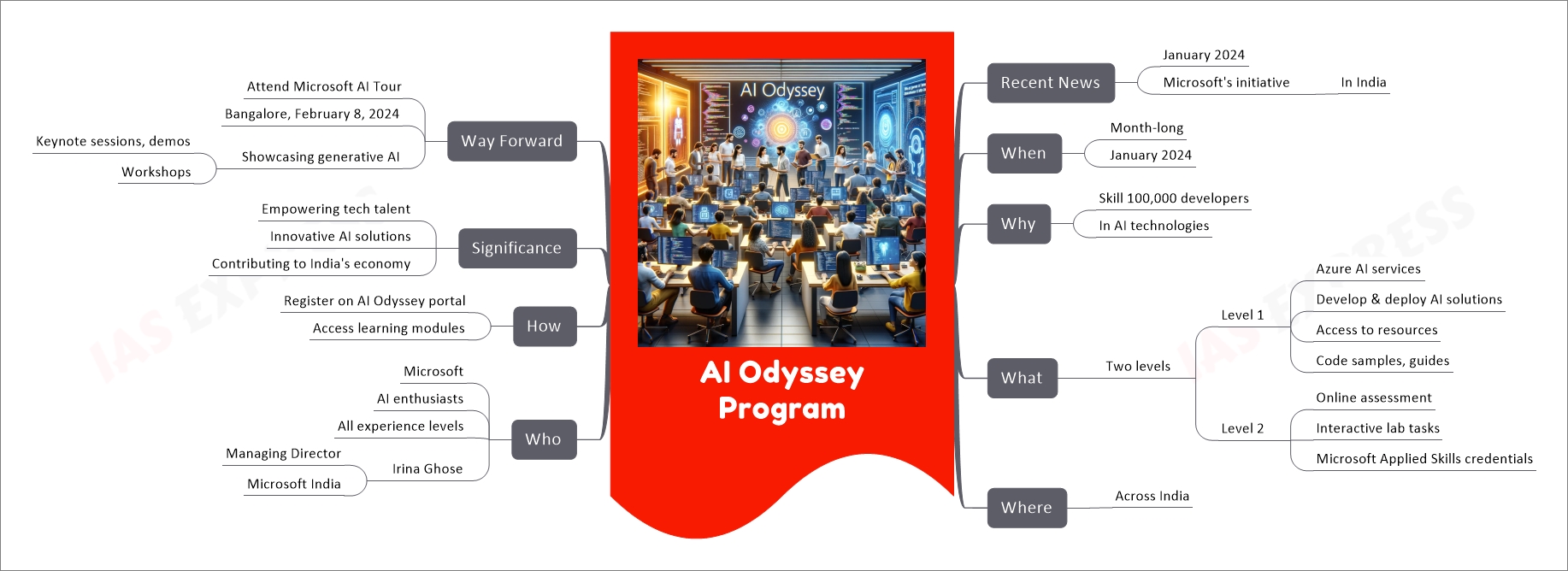
AI Odyssey Program mind map
  Recent News
    January 2024
    Microsoft's initiative
      In India
  When
    Month-long
    January 2024
  Why
    Skill 100,000 developers
    In AI technologies
  What
    Two levels
      Level 1
        Azure AI services
        Develop & deploy AI solutions
        Access to resources
        Code samples, guides
      Level 2
        Online assessment
        Interactive lab tasks
        Microsoft Applied Skills credentials
  Where
    Across India
  Who
    Microsoft
    AI enthusiasts
    All experience levels
    Irina Ghose
      Managing Director
      Microsoft India
  How
    Register on AI Odyssey portal
    Access learning modules
  Significance
    Empowering tech talent
    Innovative AI solutions
    Contributing to India's economy
  Way Forward
    Attend Microsoft AI Tour
    Bangalore, February 8, 2024
    Showcasing generative AI
      Keynote sessions, demos
      Workshops

The AI Odyssey program, launched by Microsoft in January 2024, aims to skill 100,000 developers in India in the latest AI technologies and tools. This month-long program is accessible to all AI enthusiasts, regardless of their background or experience. It is structured into two levels: the first focuses on using Azure AI services to develop and deploy AI solutions, providing participants with resources, code samples, and guides. The second level involves an online assessment with interactive lab tasks, leading to Microsoft Applied Skills credentials. Successful participants also have the opportunity to attend the Microsoft AI Tour in Bangalore. This initiative by Microsoft, under the guidance of Irina Ghose, Managing Director of Microsoft India, is significant in empowering India’s tech talent and contributing to the country’s economy through innovative AI solutions.

/ Labour Rights
Work4Food mind map
  Developed by
    IIT Delhi
  Recent News
    January 2024
    Announced development
  Why
    Fair compensation
    Minimize platform costs
    Enhance customer satisfaction
  What
    Guarantees minimum wage
      Government-mandated
    Minimizes travel
      Reduces air pollution
    Income Guarantees
      Fair, consistent income
    Addresses gig work issues
  Where
    India
  Who
    Food delivery agents
    IIT Delhi researchers
      Prof. Abhijnan Chakraborty
    Fairwork India
      Global initiative
  How
    Ensuring local minimum wages
    Onboarding flexibility
    Novel solution approach
  Significance
    Fair labor standards
    Reduced vehicular emissions
  Challenges
    Implementation barriers
      Gig nature
      Operational constraints
    Delivery fee limits
  Way Forward
    Broader adoption
    Addressing operational hurdles

“Work4Food” is an innovative program developed by researchers at IIT Delhi, launched in January 2024. It’s designed to ensure fair compensation for food delivery agents in India. The initiative guarantees that these workers receive a minimum wage as mandated by the government, addressing a major issue in the gig economy where workers often don’t earn enough after accounting for expenses like fuel. Work4Food also aims to minimize travel for delivery agents, thereby reducing air pollution. A critical component of this program is the income guarantee, allowing delivery agents to earn a fair and consistent income. This approach not only benefits the workers but also addresses operational challenges faced by food delivery platforms. While the program promises to enhance labor standards and reduce environmental impact, it also faces implementation barriers due to the nature of gig work and operational constraints in the industry.

Micro and nanoplastics, defined as tiny plastic particles less than 5mm and 1μm respectively, have become a significant concern for environmental and human health. Recent studies, including those conducted in 2024, reveal the alarming presence of these particles in everyday items such as bottled water, with reports indicating up to 240,000 nanoparticles per litre. Found in various locations like beaches and food products, these particles are a global issue. Key organizations like the Columbia Climate School are involved in researching their impact. The detection methods include novel microscopy techniques and data-driven algorithms. Micro and nanoplastics pose serious health risks including carcinogenic properties, genotoxicity, and metabolic disruption, and they also have detrimental effects on ecosystems, such as disruption and the emergence of antimicrobial resistance. The way forward involves increased awareness, more research to address knowledge gaps, and thorough impact assessments.

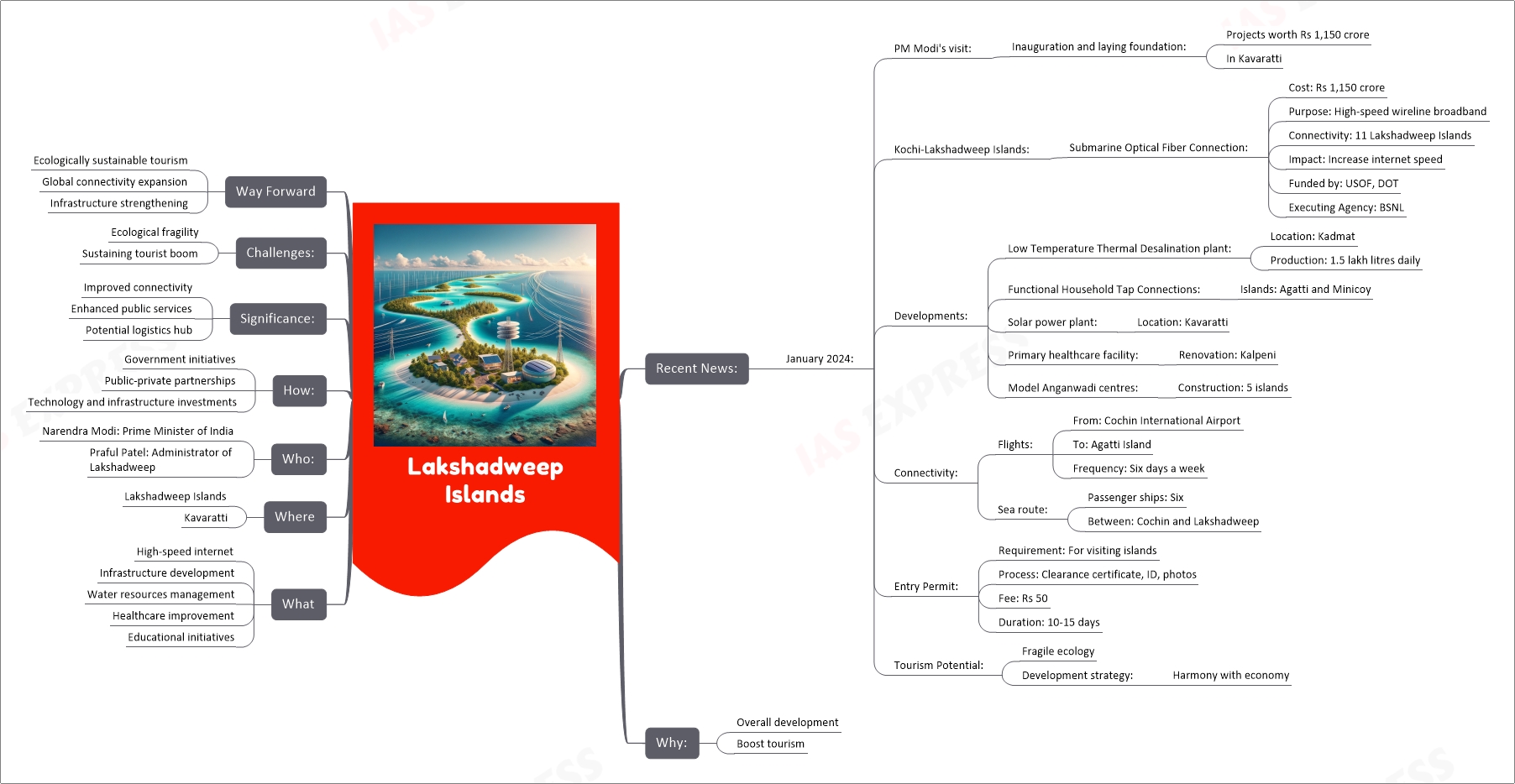
Lakshadweep Islands mind map
  Recent News:
    January 2024:
      PM Modi's visit:
        Inauguration and laying foundation:
          Projects worth Rs 1,150 crore
          In Kavaratti
      Kochi-Lakshadweep Islands:
        Submarine Optical Fiber Connection:
          Cost: Rs 1,150 crore
          Purpose: High-speed wireline broadband
          Connectivity: 11 Lakshadweep Islands
          Impact: Increase internet speed
          Funded by: USOF, DOT
          Executing Agency: BSNL
      Developments:
        Low Temperature Thermal Desalination plant:
          Location: Kadmat
          Production: 1.5 lakh litres daily
        Functional Household Tap Connections:
          Islands: Agatti and Minicoy
        Solar power plant:
          Location: Kavaratti
        Primary healthcare facility:
          Renovation: Kalpeni
        Model Anganwadi centres:
          Construction: 5 islands
      Connectivity:
        Flights:
          From: Cochin International Airport
          To: Agatti Island
          Frequency: Six days a week
        Sea route:
          Passenger ships: Six
          Between: Cochin and Lakshadweep
      Entry Permit:
        Requirement: For visiting islands
        Process: Clearance certificate, ID, photos
        Fee: Rs 50
        Duration: 10-15 days
      Tourism Potential:
        Fragile ecology
        Development strategy:
          Harmony with economy
  Why:
    Overall development
    Boost tourism
  What
    High-speed internet
    Infrastructure development
    Water resources management
    Healthcare improvement
    Educational initiatives
  Where
    Lakshadweep Islands
    Kavaratti
  Who:
    Narendra Modi: Prime Minister of India
    Praful Patel: Administrator of Lakshadweep
  How:
    Government initiatives
    Public-private partnerships
    Technology and infrastructure investments
  Significance:
    Improved connectivity
    Enhanced public services
    Potential logistics hub
  Challenges:
    Ecological fragility
    Sustaining tourist boom
  Way Forward
    Ecologically sustainable tourism
    Global connectivity expansion
    Infrastructure strengthening

In January 2024, the Lakshadweep Islands witnessed significant developments led by Indian Prime Minister Narendra Modi, focusing on overall development and boosting tourism. Key initiatives included inaugurating projects worth Rs 1,150 crore in Kavaratti and establishing the Kochi-Lakshadweep Islands Submarine Optical Fiber Connection for high-speed internet. The project aims to connect 11 Lakshadweep Islands, improving internet speed and enhancing public services like healthcare, education, and digital banking. Additionally, infrastructural developments such as a desalination plant, tap connections, a solar power plant, and healthcare facilities were initiated. The focus remains on balancing ecological sustainability with economic growth in this fragile archipelago.

Fungi Bio-Pesticide mind map
  Recent News
    Scientists develop bio-pesticide
      Target
        Eucalyptus snout beetle
      Location
        Colombia
      Fungi Types
        Beauveria pseudobassiana
        Metarhizium brunneum
      Use
        Control beetle
        Protect Eucalyptus plantations
      Research
        Characterized for insecticidal activity
        UV-B radiation tolerance
      Future Plans
        Trials in Eucalyptus forests
  When
    Discovery
      Not specified
  Why
    Pest Control
      Protect crops
      Environmentally friendly
  What
    Types of Bio-Pesticides
      Biofungicides
      Bioherbicides
      Bioinsecticides
      Other Biopesticides
    Indian Context
      Market Segmentation
        Crop Type
          Cash Crops
          Horticultural Crops
          Row Crops
      Key Players
        Andermatt Group AG
        Central Biotech Pvt. Ltd.
        Coromandel International Ltd.
        Others
  Where
    Use Regions
      Colombia
      Potential global use
  Who
    Researchers
      University of Eastern Finland
    Insects Affected
      Eucalyptus snout beetle
  How
    Fungus Pathogenicity
      Collect from naturally infected beetles
      Adapt to environmental conditions
    Production
      Mass culture
      Stabilization
      Formulation
  Significance
    Environmental Safety
      Less harmful than synthetic pesticides
    Targeted Effects
      Specific to certain pests
    Resistance Reduction
      Reduces pesticide resistance
    Residue
      Less residue than synthetics
  Challenges
    Photodecomposition
      Susceptible to UV light, radiation
    Specificity
      Targets only certain species
    Cost
      Some types expensive
    Storage
      Shorter lifespan
      Specialized storage required
  Way Forward
    Continued Research
      Explore broader applications
    Funding
      For further trials
    Global Implementation
      Expand to other affected regions

Fungi bio-pesticide refers to a type of environmentally friendly pest control that uses fungi to target specific pests, such as the Eucalyptus snout beetle. This form of bio-pesticide, developed through research efforts like those by the University of Eastern Finland, offers an alternative to traditional chemical pesticides. It’s characterized by its adaptability to environmental conditions, targeted pest control, and lesser environmental impact. In India, the bio-pesticide market includes various forms, segmented by crop type and is supported by companies like Andermatt Group AG and Coromandel International Ltd. The main advantages of fungi bio-pesticides include their environmental safety, specific targeting of pests, reduced resistance, and minimal residue. However, challenges include their vulnerability to photodecomposition, limited pest targeting, higher costs, and specialized storage requirements. The future of fungi bio-pesticides lies in ongoing research, securing funding for further trials, and expanding their use globally.
If you like this post, please share your feedback in the comments section below so that we will upload more posts like this.

Responses

🖍️ Highlight
HomeCoursesPlansAccount